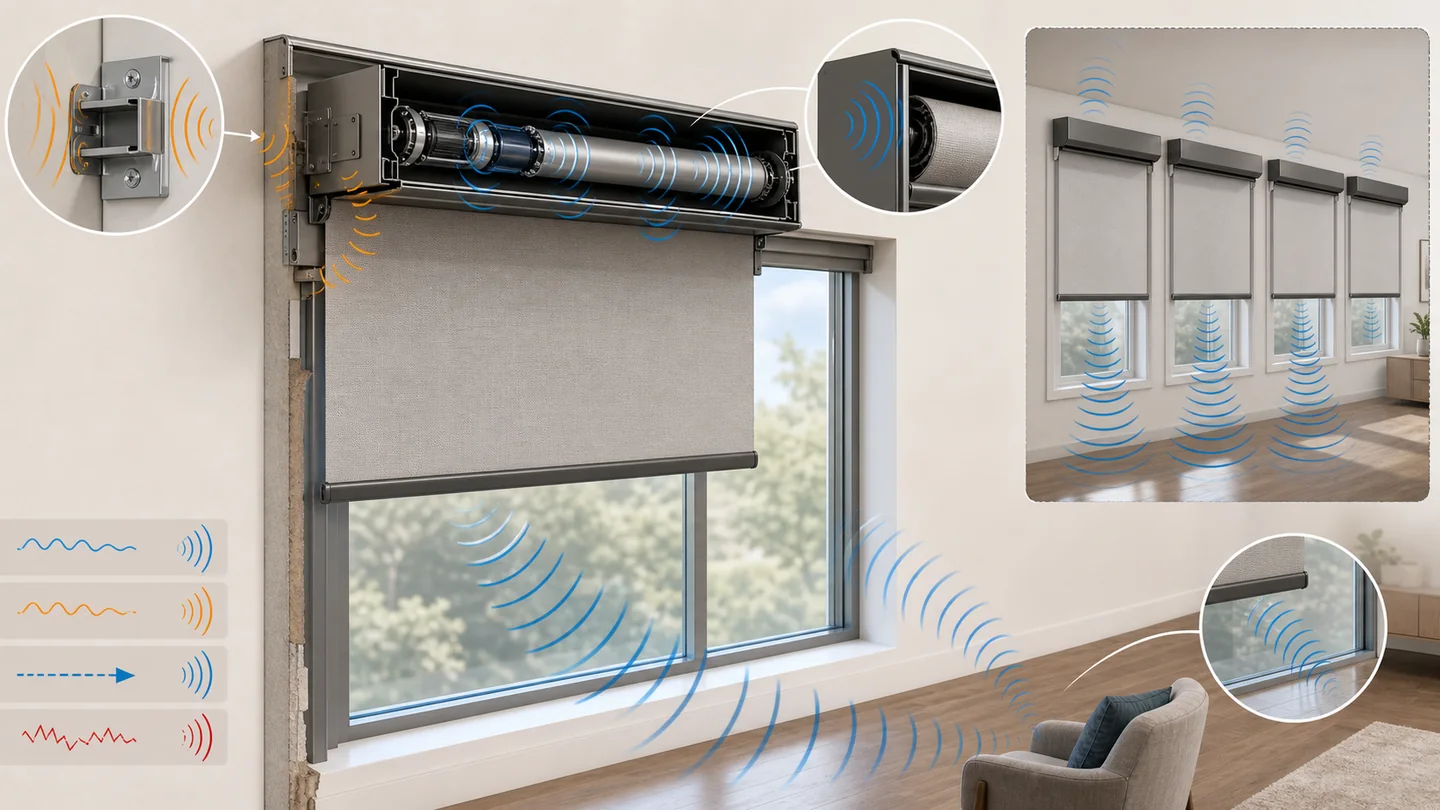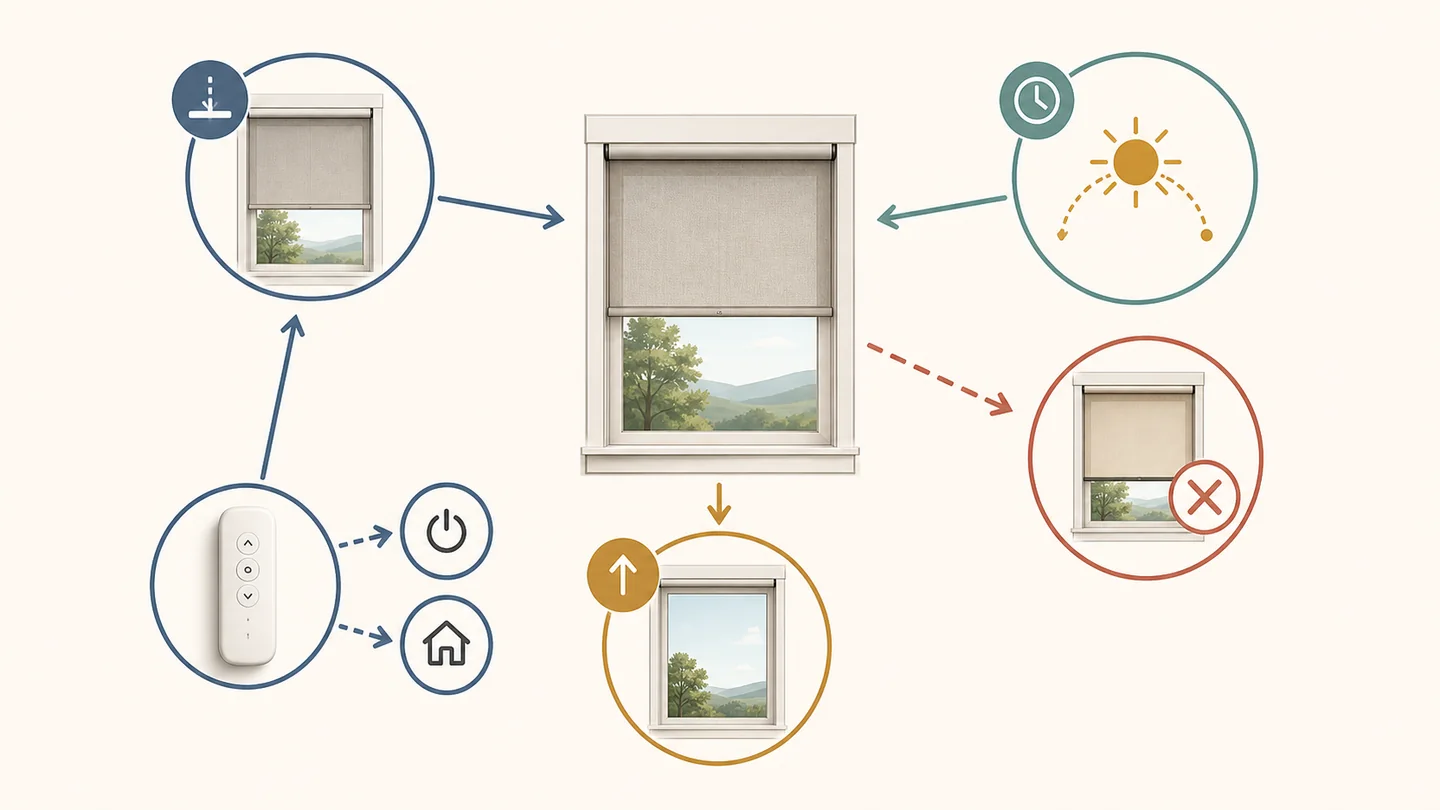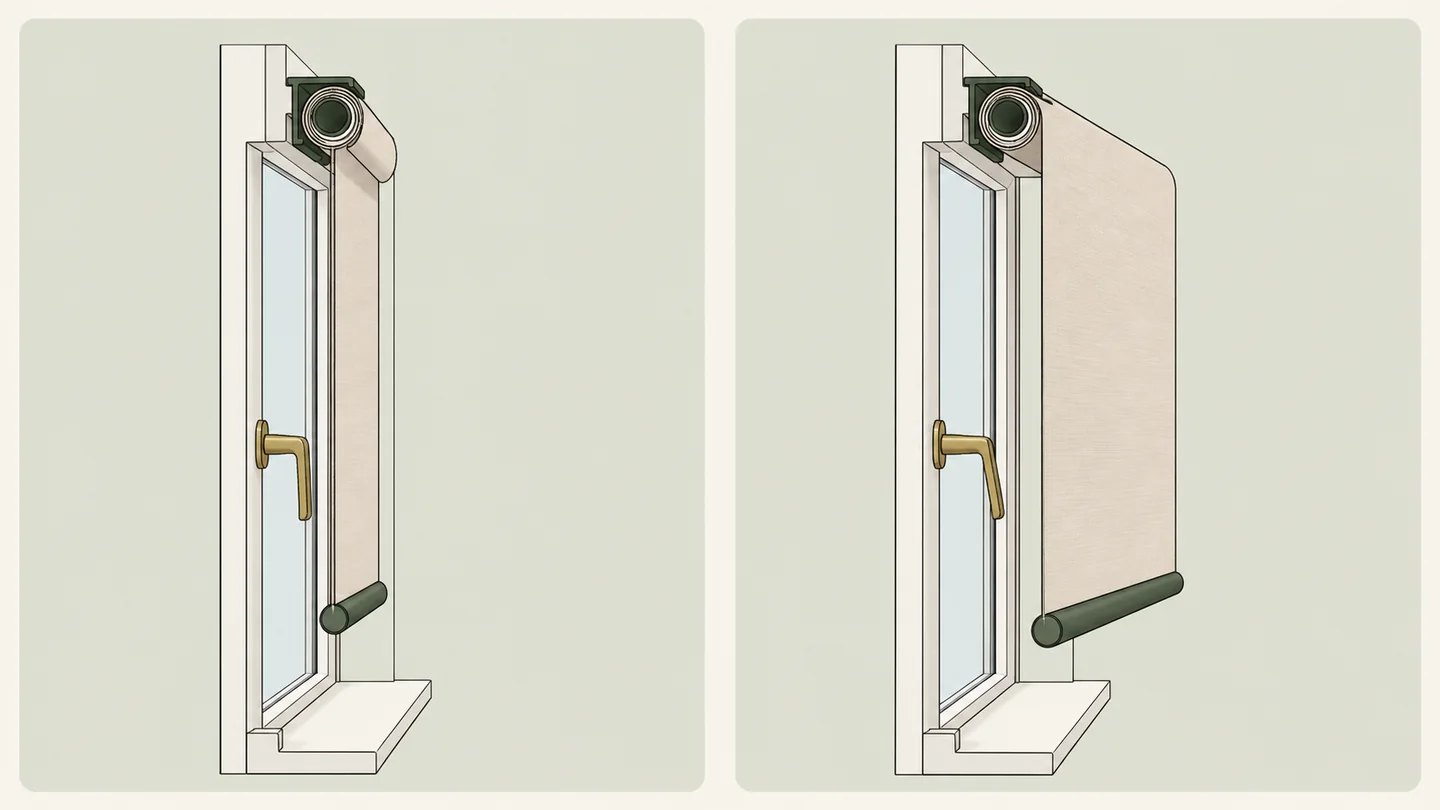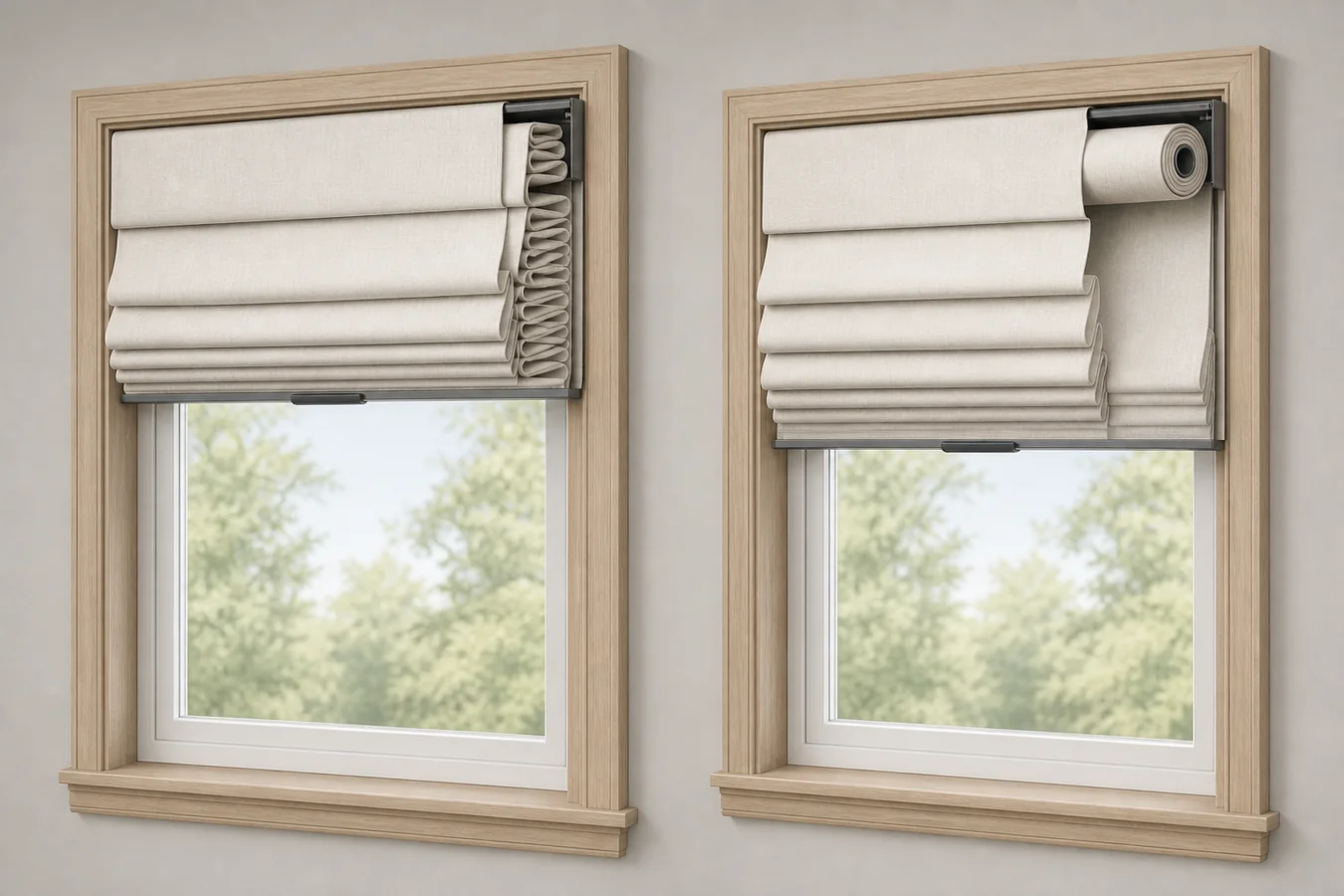
Cordless tells you what is absent at your hand. It does not tell you what happens behind the fabric. Two shades can show the same soft Roman folds in a product photo while using a different path to raise them.
Before comparing color or price, ask the exact product to reveal three things: where the fabric goes, which rail your hand moves, and which fold-and-function table controls its size and raised stack. A folding Roman gathers the face into folds. A roller-backed Roman can feed fabric onto a concealed roller while retaining a pleated Roman appearance. “Cordless” alone does not distinguish them.
First make sure a reachable manual shade fits the room and daily use. The room-by-room smart shade planner owns that earlier decision. This page begins after a cordless Roman shade is a serious candidate.
Watch where the fabric disappears
Ignore the beauty shot for one minute. Find an uninterrupted operating video or image sequence that begins with the shade fully lowered and ends with it raised. Watch the face instead of the hand. Does the fabric form successive folds that travel upward, or does it disappear into a headrail?
That is not a theoretical distinction. One current Airtex/West Elm product sheet describes a named cordless Roman shade whose fabric rolls on a concealed roller while the seamless front forms Roman pleats. That construction may be entirely suitable. The problem is comparing it with a folding Roman as if the shared style label proves the same mechanism, stack and service path.
Use one reveal card for each exact collection, SKU or custom line:
| Evidence to capture | What the exact listing or guide must reveal | If it is missing |
|---|---|---|
| One complete operating sequence | Whether the fabric folds into a stack, feeds onto a roller or follows another documented path | Do not infer the mechanism from a lowered front photo |
| Hand, handle and moving rail | The part you push or pull, plus whether the shade is bottom-up or top-down/bottom-up | Leave reach and operation unresolved |
| Side or rear construction | Roller, rings, battens, lift path, rear fabric and anything requiring access | Do not approve serviceability from the front view |
| Exact function name | Cordless bottom-up, cordless TDBU, magnetic positioning or another named function | Do not borrow a function from a nearby product tile |
| Fold/function size, depth and stack table | The row for this fold, liner, control and opening size | Do not use a category-wide dimension |
| Product identity and current document | Collection, configuration, guide revision and seller responsible for unanswered fields | Keep the candidate on hold |
Unknown is not a fifth style to average into a comparison. It is a stop: the seller has not yet shown what is being ordered.
Cordless does not name the moving rail
A basic cordless bottom-up shade is commonly moved at the lower rail or handle. Hunter Douglas, for example, describes its named LiteRise system as raising with an upward hand movement and lowering by pulling down. That describes LiteRise; it is not proof that every cordless Roman uses the same hardware or force.
Top-down/bottom-up changes the question because the upper boundary can move as well. A current LEVOLOR Roman and Natural Shade technical guide lists cordless bottom-up and cordless TDBU as separate operating combinations. Record the exact rail or handle used for each movement. If the buying decision is really about where privacy begins while daylight enters above, set that line first with the top-down/bottom-up shade planner.
Some products use magnets to hold or position fabric, but “magnetic” can describe more than one job. Route that claim to the magnetic Roman shade mechanism guide rather than treating it as a standard cordless function.
Now rehearse the ordinary hand path. Can the shortest regular user reach the handle without pulling the fabric, leaning over furniture or lifting one side first? A cordless label removes a hanging operating cord; it does not make a high or obstructed rail reachable.
The fold can change the available size
Fold is not only an appearance choice. It can change the amount and stiffness of fabric the lift must manage, so the available width may change with both fold and function.
The current LEVOLOR guide makes the dependency concrete. Within that named guide, cordless bottom-up starts at 18 inches; its listed maximum width is 96 inches for flat shades and 84 inches for soft shades. Cordless TDBU is listed from 27.5 to 60 inches. The stated maximum length for those cordless rows is 78 inches. These are LEVOLOR guide values, not universal Roman-shade limits. Their value here is to show why the exact fold/function row must survive into the quote.
Attach the opening to a stable source record with the Smart Shade Measurement and Compatibility Checker. Keep finished width and height, inside depth, obstructions, handle reach and the intended mount on the same opening ID. Then ask the seller to return the eligible fold and function for that record; do not trim or round the opening to rescue a preferred product.
The raised stack must belong to this build
The lowered shade proves coverage. The raised shade decides how much glass remains and where the fabric lives. A generic “Roman shades have a larger stack” warning is not precise enough to order from.
Ask for the raised-stack value or range for the exact width, height, fold, liner and cordless function. The LEVOLOR guide publishes separate approximate-stack tables by shade details and also states product-specific minimum and flush-mount depths. That is the correct shape of evidence, but its numbers stay with the named line. A retailer’s general depth filter cannot replace the selected build’s row.
A liner can change more than opacity. If room darkening is the real constraint, resolve the liner, seams and edge paths with the blackout Roman shade guide before accepting a stack value. If the product needs to sit beyond the opening, the outside-mount Roman shade decision owns the extra coverage and projection geometry.
Put one dimensioned raised view beside the lowered view in the quote. If the seller changes the fold, liner, function or size, the old stack evidence expires with that build.
Look behind the face before you trust the front
A Roman front can hide the part that matters for repair. Request a rear or side image with the shade partly raised. For a folding build, it should show how the folds are formed and guided. For a roller-backed build, it should show the roller relationship and the fabric route. The purpose is not to rank one construction as inherently better; it is to identify what can be cleaned, adjusted, removed or serviced without guessing.
Add the exact manual or service document to the product record. Mark which component the homeowner may access, which action belongs to the seller or installer, and what happens if the shade lifts unevenly or no longer holds position. A lifetime or warranty label without a mechanism identity does not answer those questions.
Cordless is still an important safety direction. For rooms used by young children, the CPSC’s Go Cordless guidance treats a cordless covering as the safest available choice. That narrow guidance supports choosing a cordless category; it does not approve every hidden component or finished installation. Use the cordless blind child-safety audit for the complete product, room and reach-zone review.
Send one revealed build to the quote
The quote should name one collection, one function, one fold, one liner and one size. Attach the full operating sequence, moving-rail view, rear/side image, exact size row, raised-stack evidence, mount-depth requirement and current manual. Ask the seller to correct the record whenever a substitution changes any of them.
Return one result:
- Approve documented folding cordless when the fabric visibly folds, the moving rail and rear lift path are identified, and the exact fold/function dimensions close the opening.
- Approve documented roller-backed Roman when the concealed roller is disclosed, the Roman face is still the intended look, and its exact depth, stack and service path are acceptable.
- Route the TDBU or magnetic branch when a second moving boundary or a magnetic claim changes the operating decision.
- Choose another lift when the manual reach or repetition is a poor match. A Roman format can remain while the control changes; the motorized Roman shade guide owns that finished-system review.
- Hold for build evidence when the listing cannot show the fabric path, exact function or current configuration table.
Only then compare fabric, color, delivery and price. The cordless label gets a candidate into the room; the revealed build is what earns a place on the order.