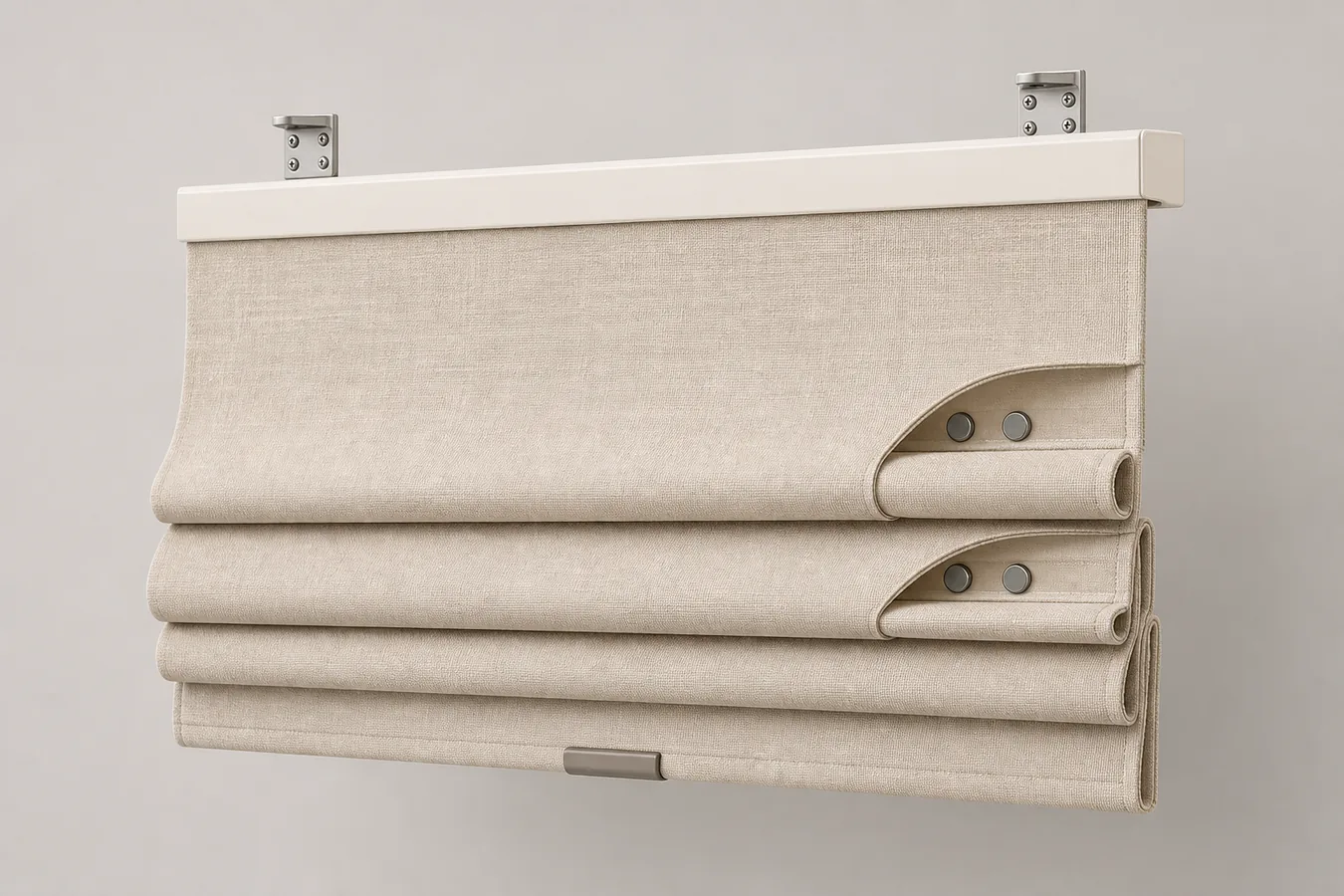
A magnetic Roman shade can use magnets for more than one job. In one product, concealed magnets catch the fabric folds as the shade is raised while ordinary brackets hold the headrail. Another product may use hook-and-loop adhesive at the top and magnets to keep hand-lifted folds in position. A shade sold for a steel door may use magnets as the mount itself.
Those products do not share the same installation, movement, reach, finished width or service path. The word magnetic does not identify which one is in the listing.
Before ordering, locate the magnets, identify what carries the shade’s weight, map the useful stopping positions, confirm that the bottom edge remains reachable, and put the finished dimensions, fabric, rear construction, care and service contact on the same product record. If the seller cannot close those fields, the color swatch is not ready to become an order.
Start by locating the magnets
Begin with a plain question: what do the magnets attach to? Do not accept “cordless magnetic lift” as the entire answer.
One current Blinds Chalet product record says its concealed magnets sit in alternating fabric folds and hold those folds together as the shade is lifted. The same page says its headrail is not magnetic and installs with standard brackets and screws. That is a magnetic lift on a conventional mounted headrail.
Chicology describes another magnetic-lift pattern with magnets in the bottom bar and within the shade, creating a series of positions as the lower part is raised. The exact manual still matters because the listing name does not tell you the bracket count, required depth, handle arrangement or available sizes.
A GoDear instruction record shows a materially different top connection: hook-and-loop tape with an adhesive side, a waiting period before the shade is loaded, and an optional rod. The shade is still adjusted by lifting near its lower edge. A steel-door magnetic shade is a third branch; there, the substrate and door movement can govern the mount.
If avoiding holes is the real requirement, take the exact attachment into the no-drill fit decision. If the shade will move with a door, add handle, lock, trim, wall and hold-down clearance from the French-door movement guide before considering fabric.
Make one mechanism record before you compare fabric
Save the exact listing URL or quote, not just a screenshot. Then complete this record from the current product page and its named installation or use manual:
- Product identity: manufacturer or fabricator, collection, SKU or order code, document date, and the exact manual that applies.
- Magnet job: the magnets hold adjacent folds, connect a bottom rail to sewn-in positions, retain a rod or panel, attach the top to a steel surface, or perform another documented job.
- Weight path: standard brackets and screws, adhesive plus hook-and-loop tape, a rod, a documented steel-door magnetic mount, or another named attachment. Record the supported surface and whether it is an inside, outside or door application.
- Movement map: how the shade is raised and released, every useful magnetic stop, the position that provides ordinary daylight, and the fully raised stack.
- Reach and fit: bottom-edge height in those states, ordered and finished width and height, any factory deduction, mounting depth or projection, trim/handle clearance, and required overlap.
- Completed fabric: exact fiber or material, lining, light-control and privacy language, front and rear views, internal cords or bands, handle, hold-down option when applicable, and the permitted care method.
- Service identity: warranty or service contact, model-specific replacement route, and what happens if a magnet, handle, top attachment, fold or fabric panel fails.
The acceptable result is one exact shade whose mechanism and finished configuration can be replayed from this record. “Magnetic Roman shade, beige, 35 inches” is not a completed product identity.
Magnetic stops are useful only at reachable heights
A conventional continuous cordless mechanism may let the bottom rail stop across a broad range. A magnetic Roman design can instead gather at discrete points where its magnet sets meet. That can make the operation simple, but it changes how you should test the window.
Mark the height of the bottom edge when the shade is fully lowered, at the daylight position you expect to use most, and fully raised. Someone must be able to grasp the intended handle or lower fold without pulling one corner, climbing on furniture or reaching across a counter. A stop that looks attractive in a product image may leave too much glass covered—or put the next reachable fold above the daily user’s comfortable reach.
Also ask how a wide shade is meant to be handled. One central grip and a two-handle wide configuration are not interchangeable operating assumptions. The exact manual should resolve that point. If the window is high, frequently adjusted or blocked by furniture, compare the manual reach burden with a documented motorized Roman configuration rather than assuming magnets solve access.
The top attachment carries the shade’s real load
Do not use the magnets’ lifting job as evidence about the mount. On the Blinds Chalet example, ordinary brackets and screws carry the nonmagnetic headrail. The product page supplies its own mounting-depth limits. Those figures belong to that product, not to a generic magnetic-shade size chart.
The GoDear instruction PDF instead tells the user to clean and dry the surface, apply the adhesive side of its hook-and-loop tape, and wait 24 hours before completing the connection. That is an exact product instruction, not proof that adhesive is suitable for every painted wall, trim finish, temperature, humidity or shade weight. Ask the seller to name the supported surface and the remedy if the attachment releases.
For a steel-door product, verify the actual door skin is magnetic where the hardware will sit; do not infer it from the door’s appearance. Then replay the door’s full swing. The shade, bottom edge, hold-downs, folds, handle, lock, wall and neighboring leaf must remain clear in both lowered and gathered states.
The attachment branch should be settled before you use “no drill” as a benefit. A no-hole product that lacks a supported surface or practical movement envelope has not passed the fit decision.
Nominal width is not the covered width
Ready-made sizes can hide deductions in plain sight. One current Home Depot Chicology Runway listing is named as a 35-inch-wide shade but gives an actual shade width of 34.5 inches and describes a standard half-inch deduction. That fact is useful for that SKU. It is not a deduction rule for another collection.
Put both numbers on the order record: the size printed in the selector and the finished product width. For an inside mount, compare the finished headrail and fabric with the opening at the actual mount plane and with any depth requirement. For an outside mount, specify the finished coverage you need across the glass and trim, not merely the nominal package size.
Then evaluate the lowered perimeter. A magnetic lift does not remove side light, create privacy beyond the fabric, or guarantee that the bottom edge lands where the sill, handle or trim requires. The light-control claim, mount, finished width and room sightline have to describe the same configuration.
Fabric and rear construction finish the mechanism
“Magnetic” is not an opacity class. The named Home Depot Runway example is a light-filtering polyester product. GoDear currently sells magnetic Roman products with different material and light-control claims. Neither record proves how an unverified listing will behave by day or at night.
Request the exact fabric and lining specification plus a lowered front view, a lowered rear view, and the raised folds. If the listing uses words such as linen, blackout, thermal or privacy, keep each claim attached to that fabric and completed shade. The linen Roman guide explains why a material-style name is not the same as a fiber specification.
The rear view also answers a different question. A cordless operating method means the user does not pull an operating cord; it should not be used as a shortcut for every internal detail. Review the completed shade, labeling, rear cords or bands, and room reach under the cordless child-safety guide. The US Consumer Product Safety Commission currently directs consumers toward cordless window coverings where young children are present and warns about accessible cords. That guidance does not certify the product in a marketplace photo.
Care belongs in the order because the lift depends on aligned fabric folds. One product record permits dusting or low-suction vacuuming and limited spot cleaning; another fabric or attachment can have a different rule. Do not introduce water, heat, steam or saturated cleaning unless the exact care record permits it.
Service the exact shade, not the category name
Save the manual and product identity after installation. If one side stops catching, the folds become uneven, the top attachment releases or the handle fails, the useful service request names the model, width, mount, magnet job, failed state and accessible markings. A photo of a loose magnet without that identity is not a repair plan.
Ask whether the maker supplies a model-specific part, services the complete shade or requires replacement. Do not sew in a stronger magnet, add an unapproved adhesive, expose rear components or transfer hardware from another product merely because both are sold as magnetic Romans.
The order is coherent when one sentence remains true: this exact product attaches to this exact surface, stops at usable heights, stays within reach, covers the required opening, delivers the selected fabric state, has an acceptable rear construction, and has a current service owner.
That sentence can approve a magnetic-lift Roman on standard brackets, an adhesive-top product on a supported surface, or a steel-door shade with a documented movement envelope. It can also send the shopper to a standard cordless Roman or a motorized Roman. If the sentence cannot be completed, return HOLD and compare the unresolved requirement in the motorized shade-type planner instead of buying from the category name.