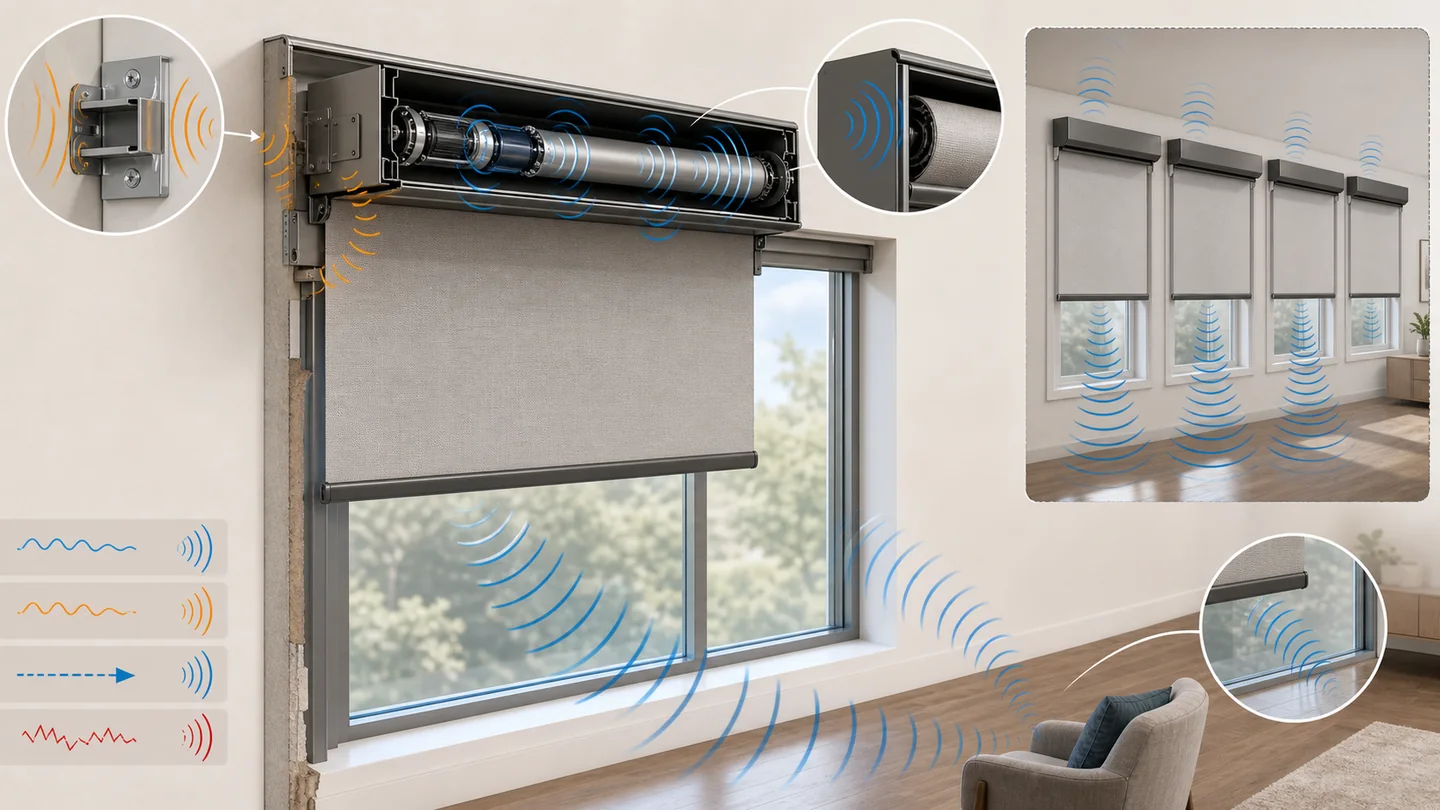
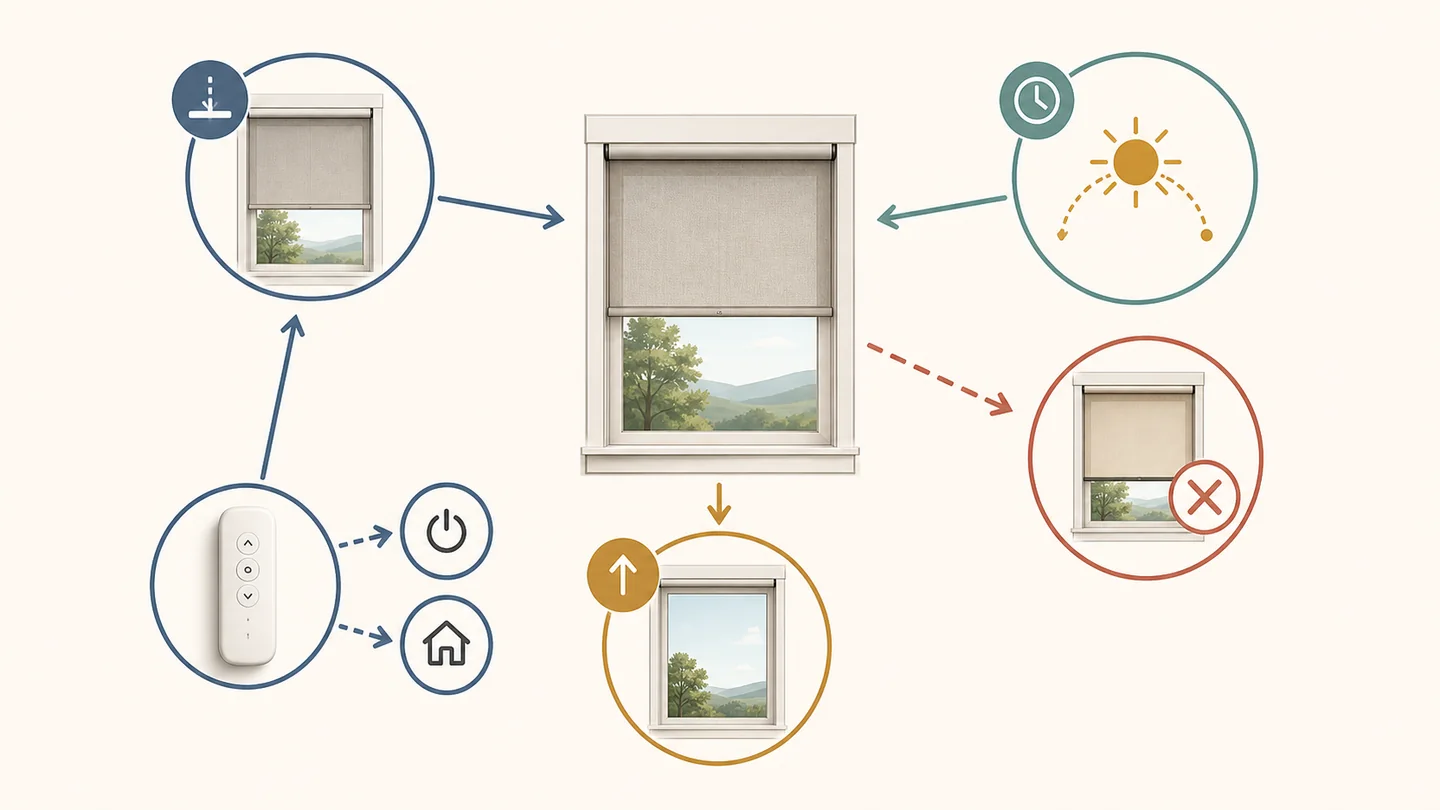
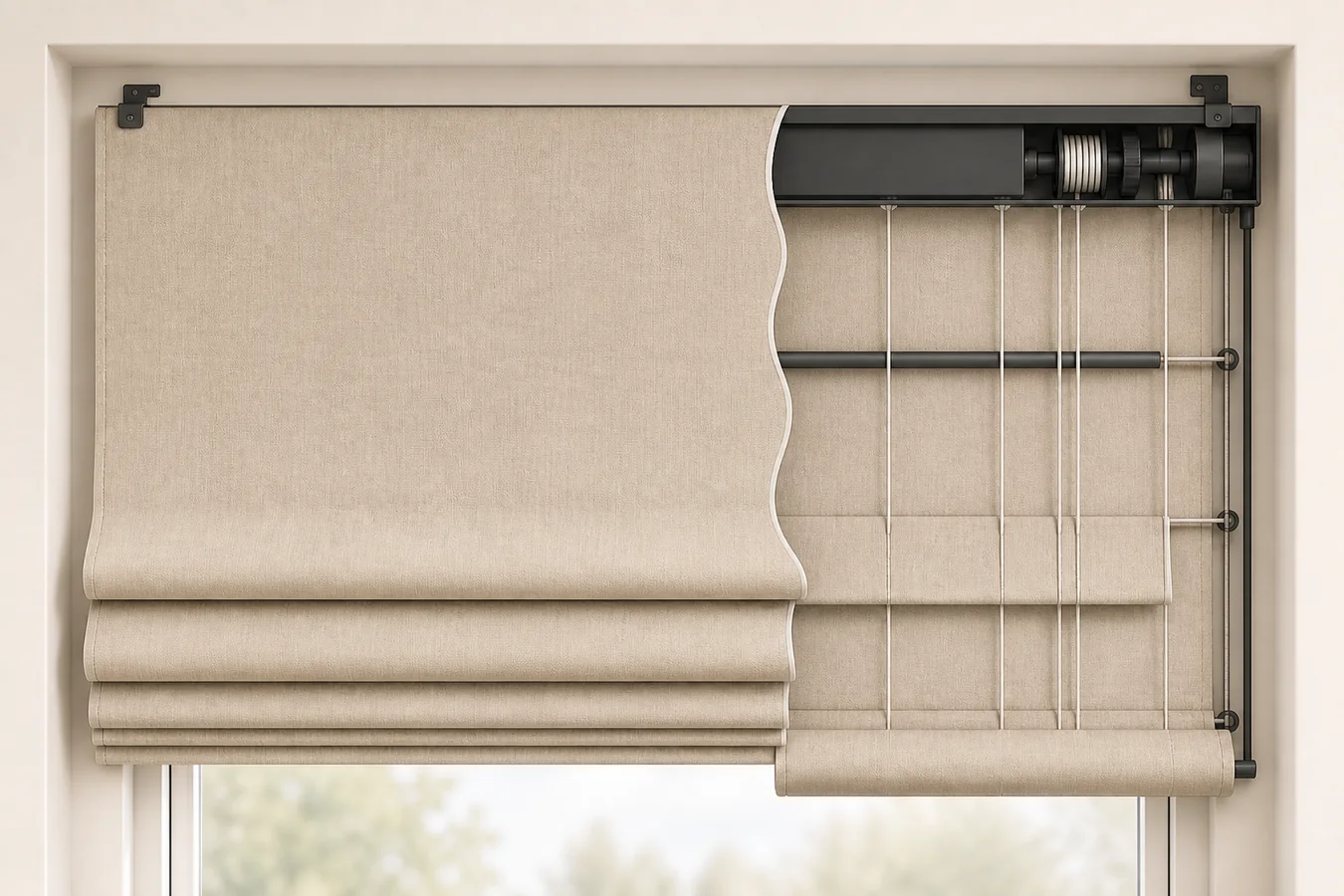
A reverse roll does one physical thing: it moves the shade fabric from the window side of the roller tube to the room side. That extra clearance can keep the cloth away from a crank, handle or projecting trim. The same move also brings the fabric and bottom bar farther into the room and can open a more direct sightline at the edges.
Reverse roll is not the premium answer, and standard roll is not automatically safer. Draw both paths on the exact window, then check whether the selected product, enclosure and control are actually offered in that orientation. If the quote cannot return a finished side section, the direction is still a guess.
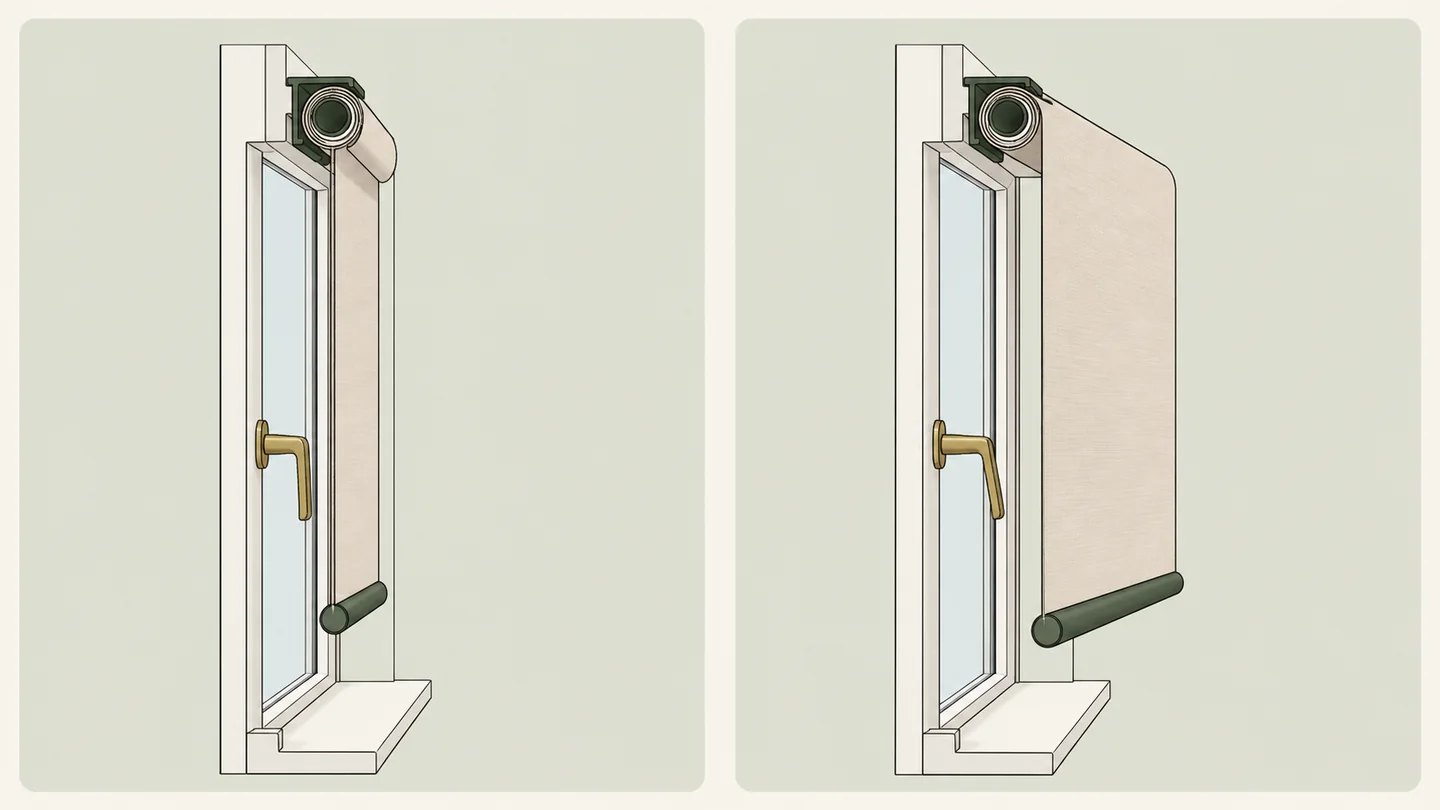
The two panels keep the window and tube in the same place. Only the fabric path moves; that is enough to change both obstruction clearance and the finished edge relationship.
Put both fabric paths on one side view
The names are easy once the window is drawn. Texton’s current open-roll product record shows standard roll bringing the fabric off the back of the tube, closer to the window. Reverse roll brings it over the front, farther from the window. Treat those definitions as two candidate lines, not two complete products.
Start with the Smart Shade Measurement and Compatibility Checker to preserve the opening, mount plane, depth and obstructions. On a simple side section, add the finished tube or enclosure and the fields below.
| Section field | Standard-roll line | Reverse-roll line | Evidence the quote must return |
|---|---|---|---|
| Fabric exit | From the window side of the tube | From the room side of the tube | Exact product section, not a generic roller sketch |
| Nearest obstruction | Distance to the glass, lock, handle, crank and trim | The same distances after the fabric moves forward | Narrowest clearance through full travel |
| Bottom bar | Its complete path from raised to fully lowered | Its complete path on the forward fabric plane | Actual bar profile and projection, not fabric alone |
| Finished edges | Left and right cloth edges at the window-side plane | Left and right cloth edges viewed from the room-side plane | Ordered width, actual fabric width and both edge locations |
| Top treatment | Exposed roll, fascia, cassette or pocket around the standard path | The exact same option checked for reverse eligibility | Current combination record for product, control and revision |
| Service side | Drive, idle end, charger, button, wire and removal route | The same items in the ordered reverse orientation | Delivered end orientation and service access |
Do not draw one path from a brochure and invent the other by mirroring it. Tube diameter, bracket location, fabric thickness, control head and enclosure can change the finished section. “Reverse available” is only useful when it belongs to the exact configuration being quoted.
Roll direction is downstream of the shade architecture. If the opening is still being compared across roller, cellular, Roman or zebra systems, settle that larger choice in the motorized shade-type comparison before optimizing which side of one roller tube releases the cloth.
Reverse roll earns its place at one collision
Name the obstruction before selecting the direction. “There is a handle” is not enough. Mark how far the handle, crank, lock or trim projects from the glass or jamb, where it sits across the width, and which part of the shade would meet it.
A crank near the lower corner may clear the cloth but hit a wide bottom bar. A folding handle can occupy one plane while stored and another while the window operates. Raised trim may miss the fabric in the middle yet touch it near one edge. The critical result is the smallest clearance during the positions you will actually use, not the cleanest front-view photograph.
Use a straightedge, cardboard strip or removable line to represent each proposed fabric plane without attaching anything to the shade. Follow the line from the tube to the sill, then repeat with the bottom-bar depth included. If the standard line crosses the obstruction and the reverse line clears it throughout the required travel, reverse roll has a specific job.
If the obstacle is part of an operating casement, the broader casement-window treatment guide owns the sash, screen, lock and ventilation cycle. Roll direction can clear one handle while the treatment still blocks another required motion.
The cleared handle can reopen the edge
Moving fabric forward changes the viewing geometry even when the cloth width stays the same. From an angle, the direct line between the fabric edge and the jamb can become wider because the two planes are farther apart. Whether that matters depends on the opening, mount, observer position and room task.
Mark the sightline that would expose the failure: a bed looking toward a bright jamb, a screen catching a narrow beam, or a person outside seeing past an edge. Draw it to the standard fabric line, then to the reverse line. Do not replace that observation with a universal claim that one direction is “blackout” or “private.”
The Texton record describes its standard path as the closer-coverage option and reverse as the obstruction-clearing option. That is a useful configuration clue, not an installed darkness measurement. A forward fabric plane may be acceptable in a daylight room and unacceptable at a bedroom edge. A wider outside overlap, a compatible side system or another mount can change the outcome more than the label on the roll.
Fabric transmission remains a separate question. If the center of the shade is the uncertainty, use the light-filtering roller shade guide to test the exact fabric and color. Roll direction cannot turn a translucent material opaque.
The top treatment may veto the direction
A top treatment is not decoration placed after the roll decision. It establishes where the tube sits, where the cloth exits and which surfaces remain open for travel and service.
The current Texton card says reverse roll is unavailable with its cassettes and a named traditional valance. The current Norman Soluna Roller Shade Guide 2026 excludes reverse roll from its curved fascia, square fascia, LightGuard 360, cassette system and a named smart-motor charging-wand configuration. Those restrictions belong to those documents. They prove why the quote needs an exact combination; they do not create a universal list of forbidden covers.
Ask for one option record containing the product family, fabric, control, tube or enclosure, roll direction and revision date. If the supplier changes from exposed roll to fascia or cassette, reopen the side section. The tube may move, the fabric exit may change and the service route may require a different direction.
The cassette roller shade guide takes over when housing height, depth, release motion and service access are the main decision. This page only decides whether the required fabric path survives that exact enclosure.
Motorized and dual shades arrive with an orientation
Do not assume a completed motorized shade can be flipped because the fabric looks symmetrical. The current LEVOLOR roller and screen automation instructions distinguish standard, reverse and dual orientations and include direction-specific motor and limit handling within the named system. That makes roll direction part of the delivered configuration.
Hardware can make the distinction visible even on manual shades. The March 2025 SelectBlinds traditional vinyl roller instructions place the compressible pin on different ends for standard and reverse exposed rolls in that product family and give product-specific bracket orientation. Another shade may use different hardware. Follow the exact current instructions rather than transferring the example.
A dual roller adds two fabric paths, not one preference copied twice. Texton’s named double-shade record assigns the front fabric to reverse roll and the back fabric to standard roll so the panels can pass. Other systems may package the rollers differently. The dual shade guide owns depth, layer order, gaps, controls and service for the complete pair.
Before approving a motorized or dual quote, require the drawing to identify drive side, idle side, charge or wire route, buttons, bottom bars, both travel planes and the removal path. A direction that clears the handle but traps the charging connector has not solved the opening.
If neither line works, move upstream
Standard and reverse roll are not the only admissible outcomes. A binary answer is wrong when both paths fail different requirements.
| What the section shows | Order result |
|---|---|
| Standard roll clears every moving part and preserves the required edge result | Keep standard roll. Do not add projection without a job. |
| Standard hits a documented obstruction; reverse clears it; edge and option checks pass | Approve reverse roll for that exact configuration. |
| Standard hits while reverse projects too far or opens an unacceptable sightline | Change the mount plane, overlap or top treatment and redraw. |
| Neither path is supported with the required control or enclosure | Choose another exact roller system or shade architecture. |
| A dimension, option rule or service route is missing | Hold the order until the current owner supplies it. |
If the mount plane is still negotiable, the inside-versus-outside mount guide owns that earlier choice. For an outside mount, the outside-mount roller shade guide separates hardware width from finished cloth coverage. Moving the whole assembly can be cleaner than forcing the fabric over an obstruction.
Do not rescue a failed section with an undocumented bracket flip, hand reroll or field change. That can alter drive orientation, tracking, limits, warranty and service even if the cloth appears to descend from the desired side afterward.
Make the quote return the finished section
Send the supplier the measured opening and one marked side view. Ask the returned quote to identify the exact manufacturer, collection and revision; mount and tube plane; standard or reverse fabric exit; finished fabric edges; bottom-bar path; obstruction clearance; fascia, cassette, pocket or side-system eligibility; drive and idle ends; charging or wiring access; removal direction; and the document that governs installation.
Read the answer as a section, not as a preference field. The fabric must clear the obstruction through every required position. The edge relationship must still satisfy the room. The selected enclosure and control must explicitly allow the direction. A reachable installer must be able to follow the named instructions and service the completed unit.
When those facts return on one drawing, standard or reverse becomes an orderable configuration. Until then, “waterfall look,” “better coverage” and “clears handles” are only fragments of the decision.