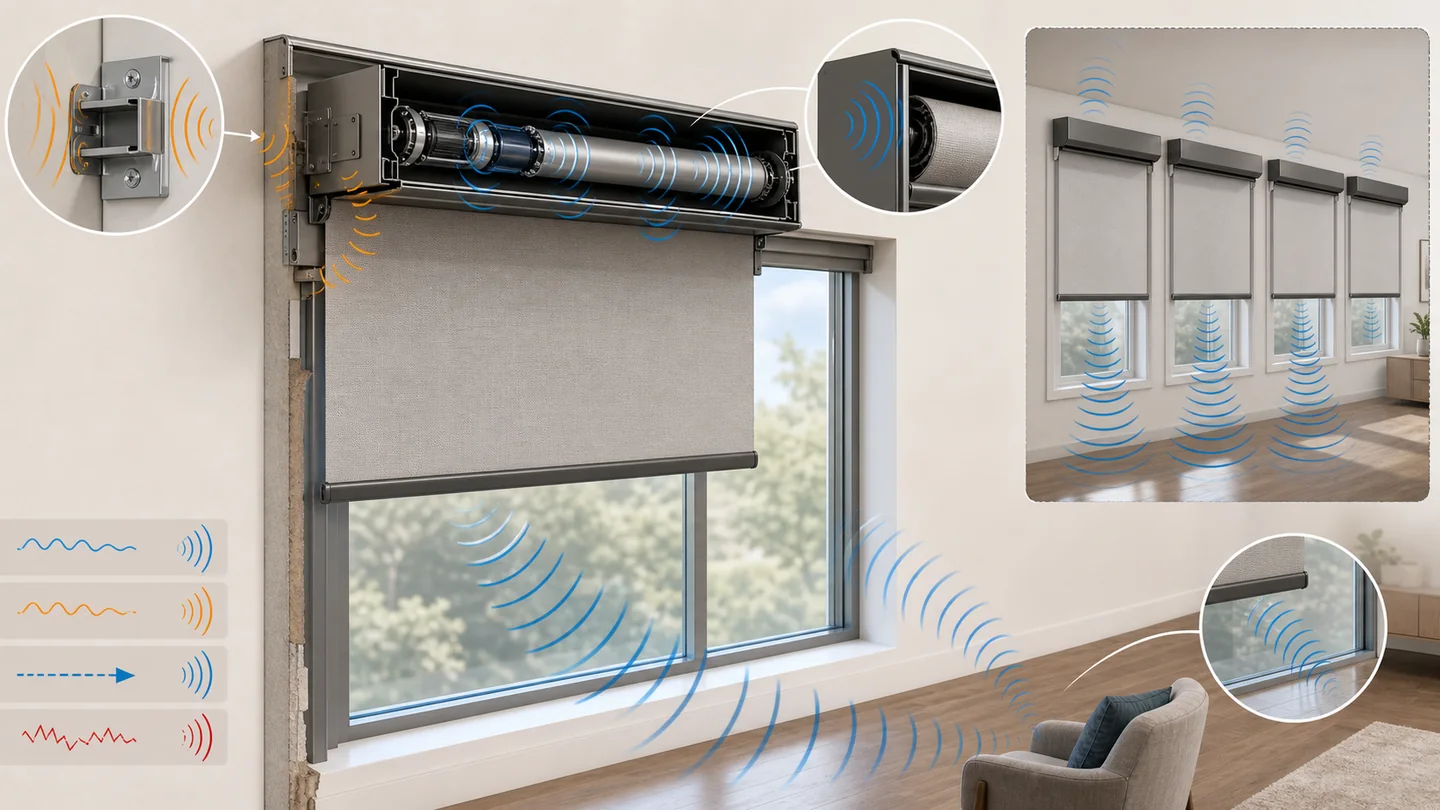
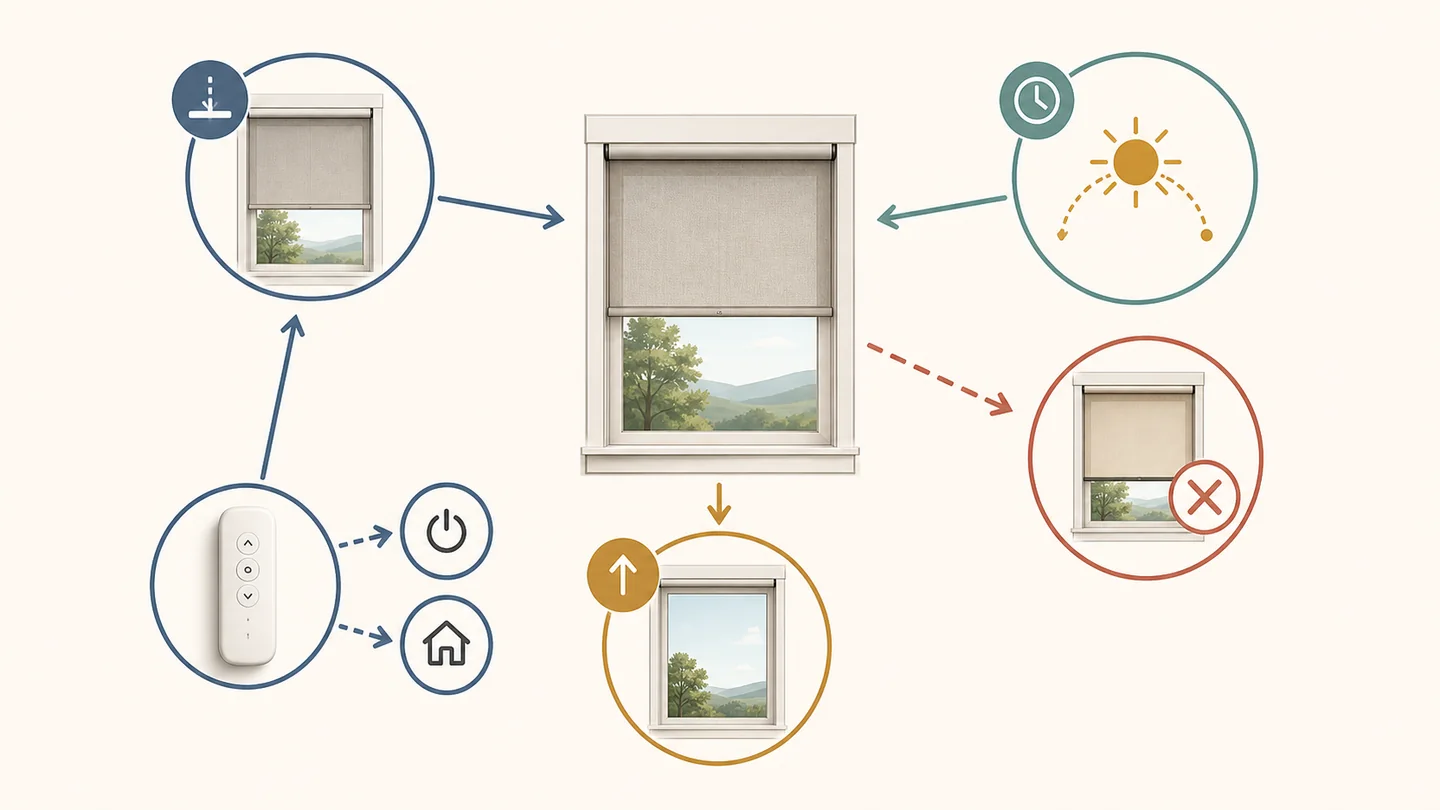
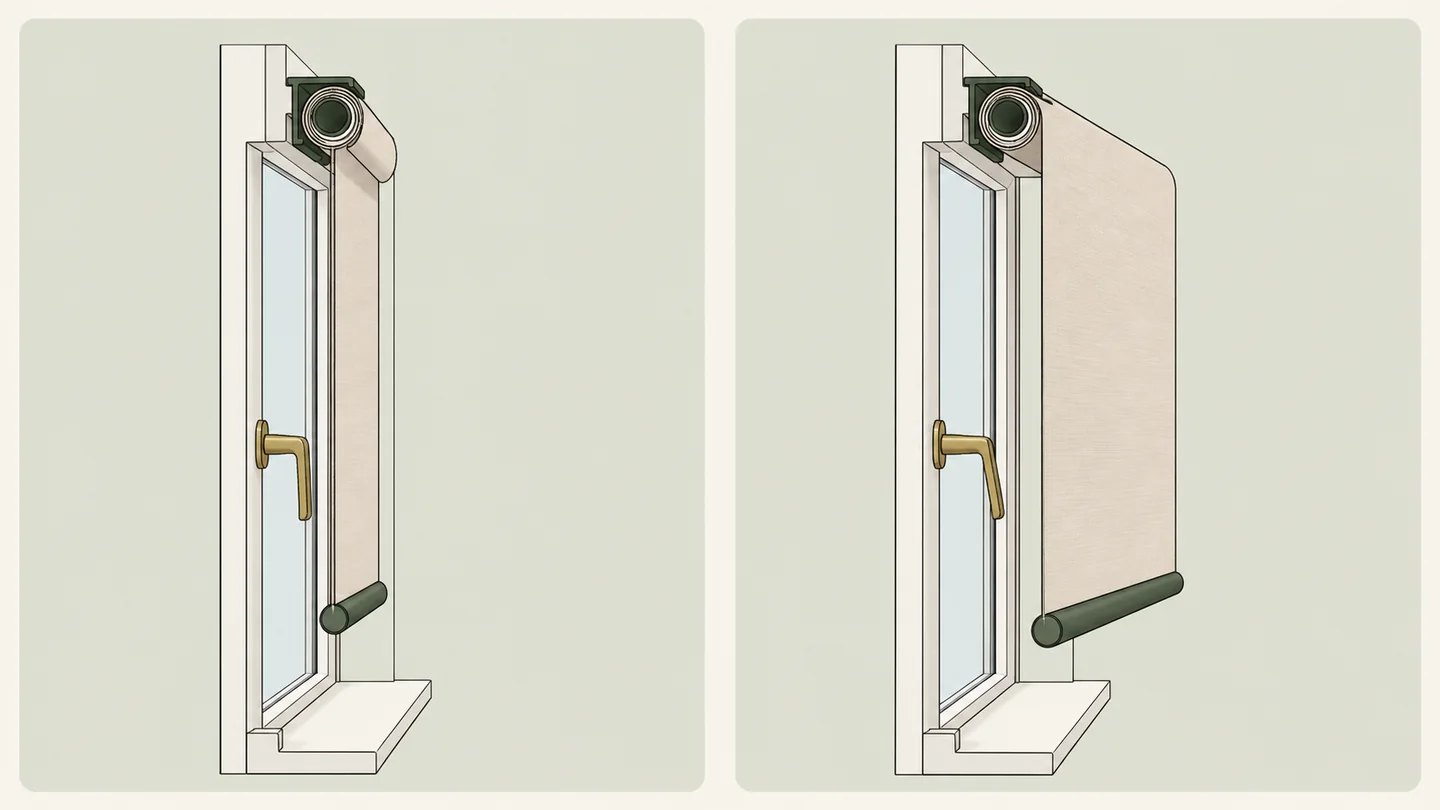
A search for Roman shade parts can lead to two purchases that should never share a shopping basket. One is a replacement for a finished shade whose maker, order and operating system already determine what fits. The other is hardware for fabricating a new Roman shade, where the headrail, control, lift components, panel attachments and safety devices must work as one documented system.
If a completed shade needs service, begin with its order or permanent label and ask the current owner to identify the supported service unit. If a new shade is being made, begin with one complete fabrication system and design the panel around that contract. A loose piece is useful only after one of those records owns every interface it touches.
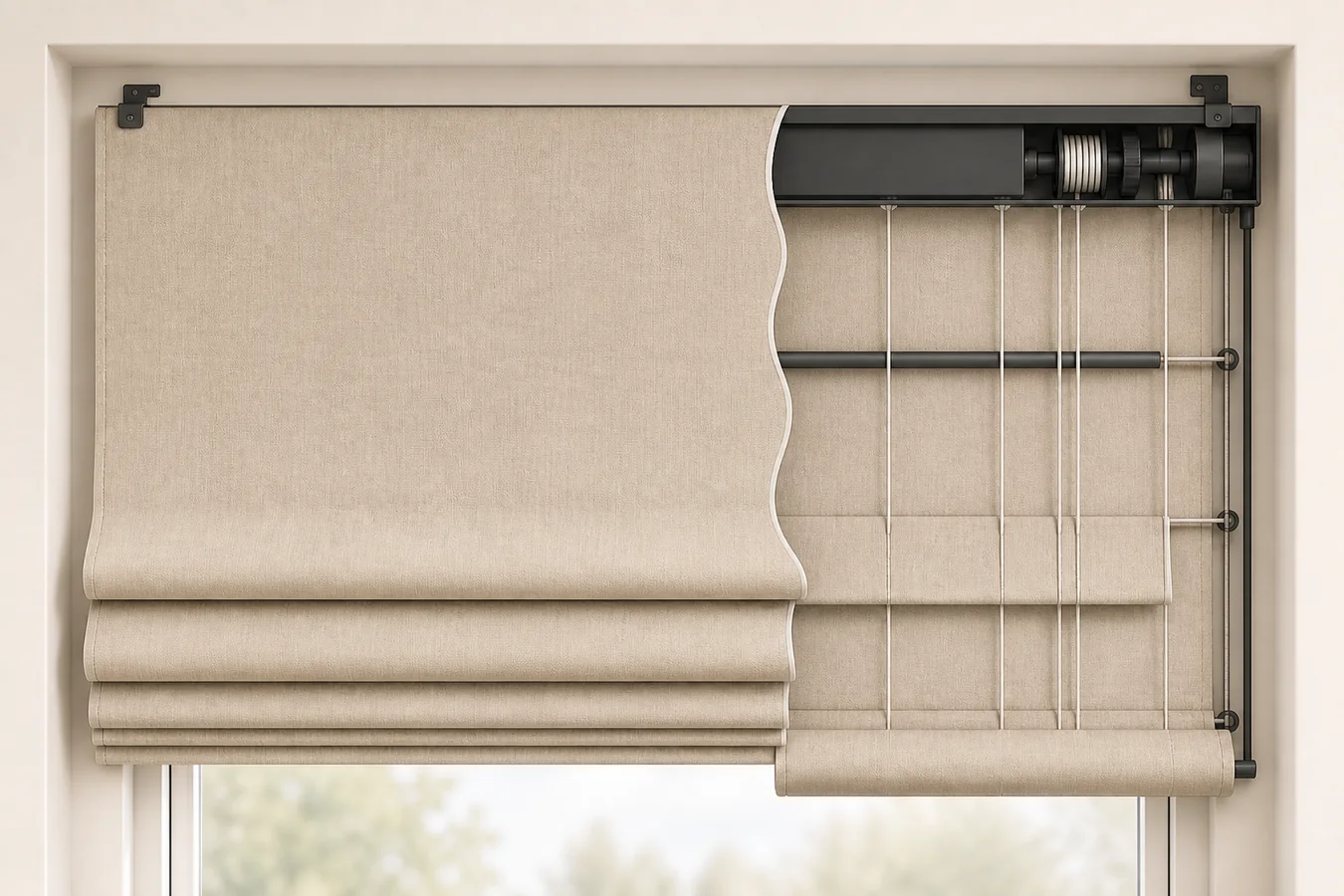
The cutaway shows connected zones in a completed shade. It is for orientation, not a repair procedure or a promise that one maker’s components fit another system.
The same search hides two shopping trips
“Roman shade hardware” sounds like one product category. Current results actually combine replacement forms, individual brackets and connectors, maker supplies, manual headrails and motorized systems. Classify the job before naming a part.
| Your starting point | Record that controls the decision | A defensible result | Shortcut to reject |
|---|---|---|---|
| A finished manufacturer or fabricator shade | Maker, product/order identity, date and current parts or service record | One exact component, a supported assembly, maker service or complete-shade replacement | Matching a listing from shape or approximate size |
| A new fabric shade project | One named headrail/control/lift system plus its fabrication instructions and limits | A complete matched system and panel made to that contract | Combining loose parts from several kits into an undocumented mechanism |
This split also keeps the page separate from the motorized Roman-shade purchase decision. The motorized Roman shades guide owns fabric, fold, stack, motor, power and completed configuration. This page begins only after the job is clearly replacement or fabrication.
A finished shade starts with its identity
Do not begin by typing the loose piece’s color into a marketplace. Record the manufacturer or fabricator, product family, order number, order date, finished width and height, control type and every readable marking. Photograph the shade lowered, raised and from the back without pulling on cords or opening the headrail.
Bali’s current replacement-parts process asks for the original order number, shade size and purchase date. If the paperwork is gone, it directs the customer to the identification label on the blind or shade. That is a maker-specific process, but its logic is broadly useful: the product record comes before the part photo.
The US CPSC’s current window-covering business guidance also makes the finished product itself identifiable. Within the rule’s scope, a permanent marking includes the manufacturer or importer, manufacture month and year, stock/custom designation and order information for a custom covering. Those fields can separate two generations that look alike.
An exact code still needs its exact scope. The current Springs Window Fashions Roman parts form assigns specific numbers to items such as installation brackets, a cord cleat, shims and joiner balls. For the joiner balls, the form asks for the color name and number of the product originally ordered. The useful lesson is not that those parts fit every Roman shade; it is that even a small visible item can remain order-specific.
If the missing object is a mounting bracket, keep this page at the product-identity layer and move the interface work to the blinds mounting brackets guide. The headrail profile, handed role and mount direction—not the word Roman—own that match.
A new fabrication starts with the headrail system
A fabrication project reverses the evidence path. There is no old order to recover, so the system must be chosen before the panel is treated as finished. The fabric weight, shade dimensions, fold construction, control, lift spacing, bottom weight, mounting method and service access all have to remain inside one supplier’s documented envelope.
Forest’s current Roman collection illustrates why “Roman shade kit” is too broad. It presents Endeavor, BCS, RBS, motorized RBS and RBS XL as distinct systems with different control and capacity positions. That does not make Forest the only valid source; it demonstrates that a responsible supplier gives the operating architecture a name.
The company’s RBS installation and specification record then treats the assembled rail, mounting brackets, child-safety device and optional counterweight as one installation set. Its specification names a headrail, control unit, cord-roll support, stop ring, tilt rod and endless chain within that RBS record. Those names are not a universal recipe. They show the level of system ownership a new fabrication needs.
Before buying, require one document set to define the headrail model, control unit, supported width and load, number and spacing of lift points, approved panel attachments, bottom treatment, mount hardware, safety device, assembly responsibility and service route. If those facts come from unrelated listings, there is no single owner for the completed mechanism.
Read the shade in five connected zones
Common part names vary by maker. A stable zone description helps support locate the issue without pretending to identify the exact component.
| Zone | What may be visible | Evidence worth capturing | What the zone does not prove |
|---|---|---|---|
| Mount | Wall/ceiling brackets, clips, shims, fasteners | Headrail profile, bracket markings, mount plane, left/right role and current manual | That a similar clip has the same lock, load or projection |
| Headrail and control | Enclosed rail, manual control, motor, drive or supports | System/model label, control type, end views, code and service document | That one clutch, motor or internal unit is separately replaceable |
| Lift connection | Lift lines, shrouds, rolls, stops, guides or rings | Number and spacing of lift points, rear construction, last normal movement and any safe visible discontinuity | That generic cord or a knot restores a compliant lift system |
| Panel structure | Fabric, liner, rings/guides, ribs or battens, folds | Fabricator identity, construction drawing, attachment spacing, broken versus missing item | That a new rod or ring preserves fold geometry and load distribution |
| Bottom | Hem, bottom rod/weight, end pieces and lower attachments | Finished width, level state, original section shape and the system’s part name | That a heavier or longer loose bar is an improvement |
Use the zone only to phrase the request: “the affected area is inside the headrail,” or “one rear lift connection is visibly different.” Do not turn it into a diagnosis. A shade that rises unevenly can involve more than the first visible line, and an altered panel can change the load carried by the headrail.
Let the supported service unit set the basket
The cheapest visible component is not automatically the smallest safe repair. Let the maker, fabricator or current system supplier define what it supports as a unit.
One loose part is defensible when the current record names that part for the exact product/system, its revision and dimensions match, every paired interface is documented, and the work does not disturb unsupported control or safety hardware. A mounting clip, cap or system-coded connector can sometimes meet that standard.
A supported assembly is the better answer when the supplier services several coupled items together. The unit might be a bracket kit, control assembly, matched headrail or another named group. Do not break it apart merely because one marketplace lists an internal piece.
Manufacturer or fabricator service owns the outcome when the affected item sits inside an enclosed headrail, changes lift spacing, requires resetting a control, alters the fabric construction or cannot be identified from the outside. Complete-shade replacement becomes reasonable when no current owner supports the old system, required safety hardware cannot be restored through an approved path, or the proposed assembly would combine undocumented generations.
Cord hardware changes the decision
Lift lines, cord shrouds, stops, connectors and tension devices are not neutral trim. The CPSC guidance above includes requirements for accessible operating cords and inner cords, including shrouds and stop/connector provisions where applicable. A generic string, a relocated ring or a removed restraint can therefore change more than motion.
For a consumer-facing boundary, CPSC’s cord-safety guidance places cordless coverings at the safest end of the choice for homes that young children use. It also explains that measures for existing corded products reduce rather than eliminate the hazard. If a cord, rear inner line, continuous loop, shroud, stop, connector or tension device is missing, loose, damaged or newly accessible, stop the parts comparison and use the maker’s current safety/service route. Do not improvise a knot, loop length, routing or restraint from a generic diagram.
“Cordless” does not make internal lift components universal, and motorization does not erase the need for a safe completed panel. If a whole-shade replacement changes the control choice, return to the Smart Motorized Blinds Planner and rebuild the complete decision rather than attaching a new control to an unidentified Roman mechanism.
Make the supplier own one precise outcome
A useful request is a compact evidence packet, not a guessed part name. Put the maker/fabricator, order or model, date, finished size and control in the first block. Add front, back, headrail-end, permanent-label and affected-zone photos. State whether the job is finished-shade replacement or new fabrication, and whether any cord or safety device is affected.
Then ask the current owner to return one of these outcomes in writing:
- Exact loose part. The part code and supported product/system revisions are explicit.
- Supported assembly. The current owner names the complete coupled unit or headrail that replaces the affected zone.
- Manufacturer or fabricator service. The shade stays intact until the responsible party inspects it.
- Complete replacement shade. The earlier system is unsupported or cannot be restored through a documented path.
- Hold. Product identity, system scope or safety evidence is incomplete, so no component is ordered yet.
For a new fabrication, require the same owner to name the complete system, limits, panel-attachment contract, safety hardware and finished-build responsibility. A list of individually purchasable Roman shade parts is not that answer.
One piece is the right purchase only when a current record makes it part of the same shade. Otherwise the honest unit may be a matched assembly, a complete operating system, professional service or the finished shade itself.