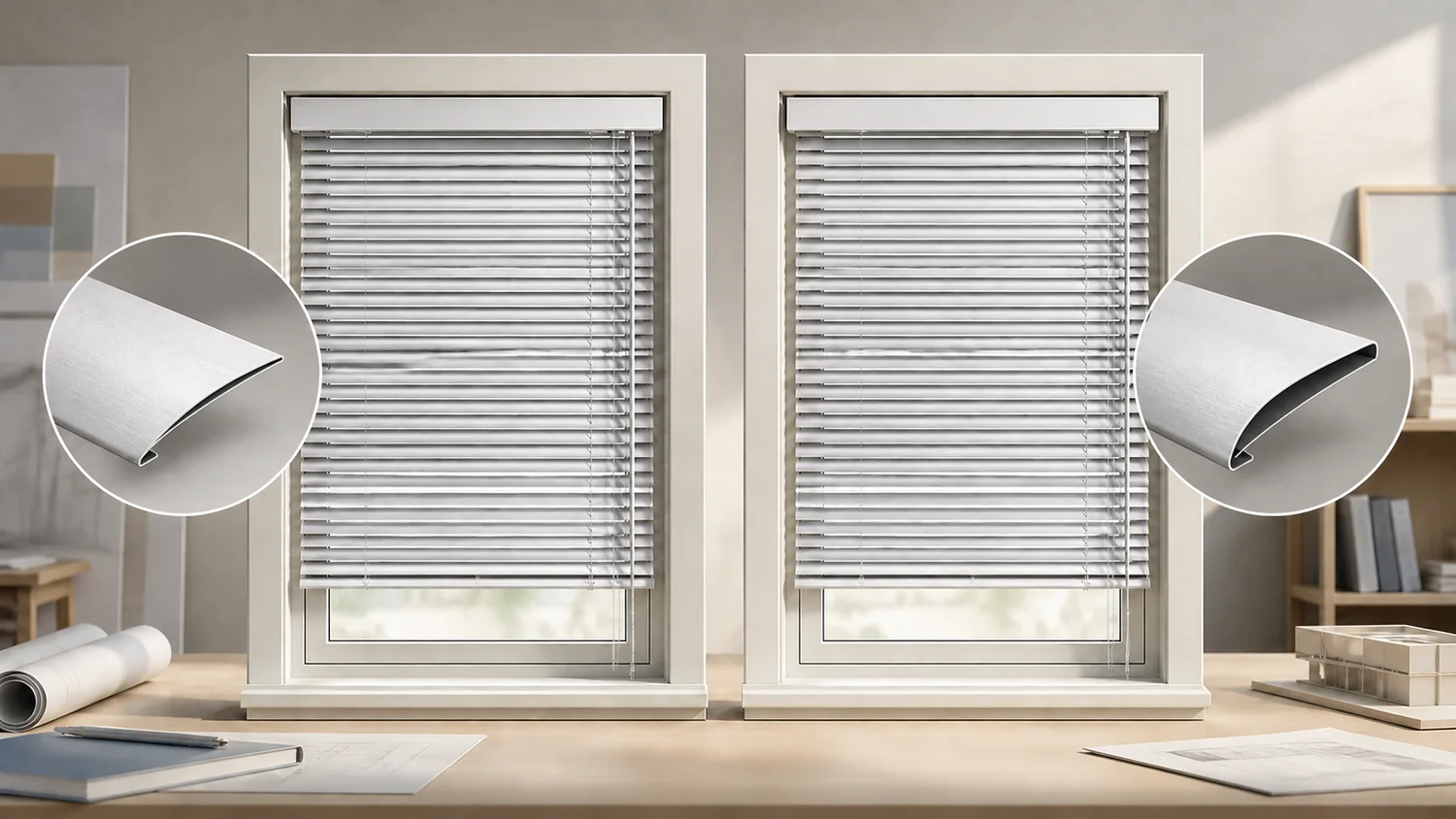
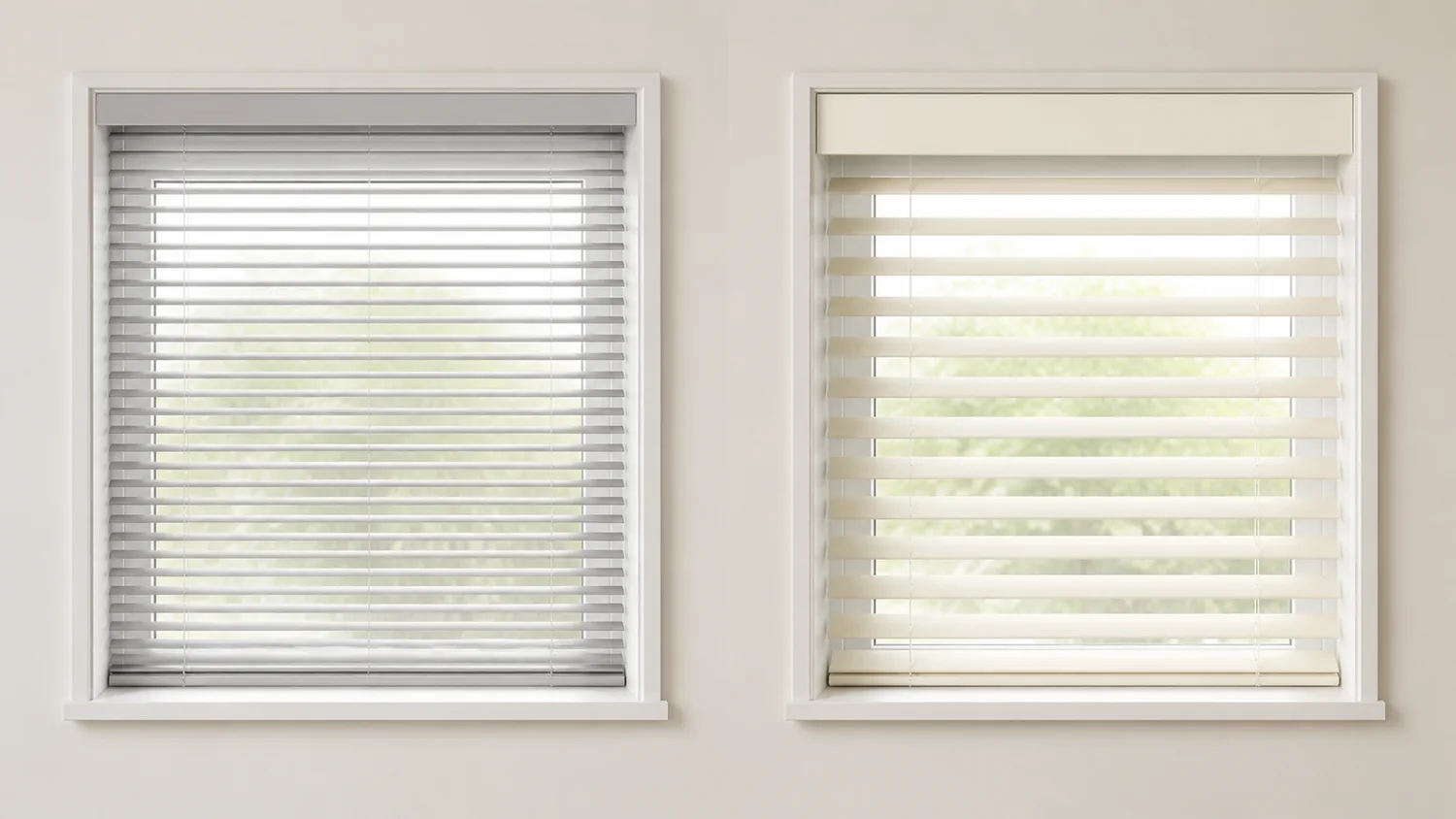
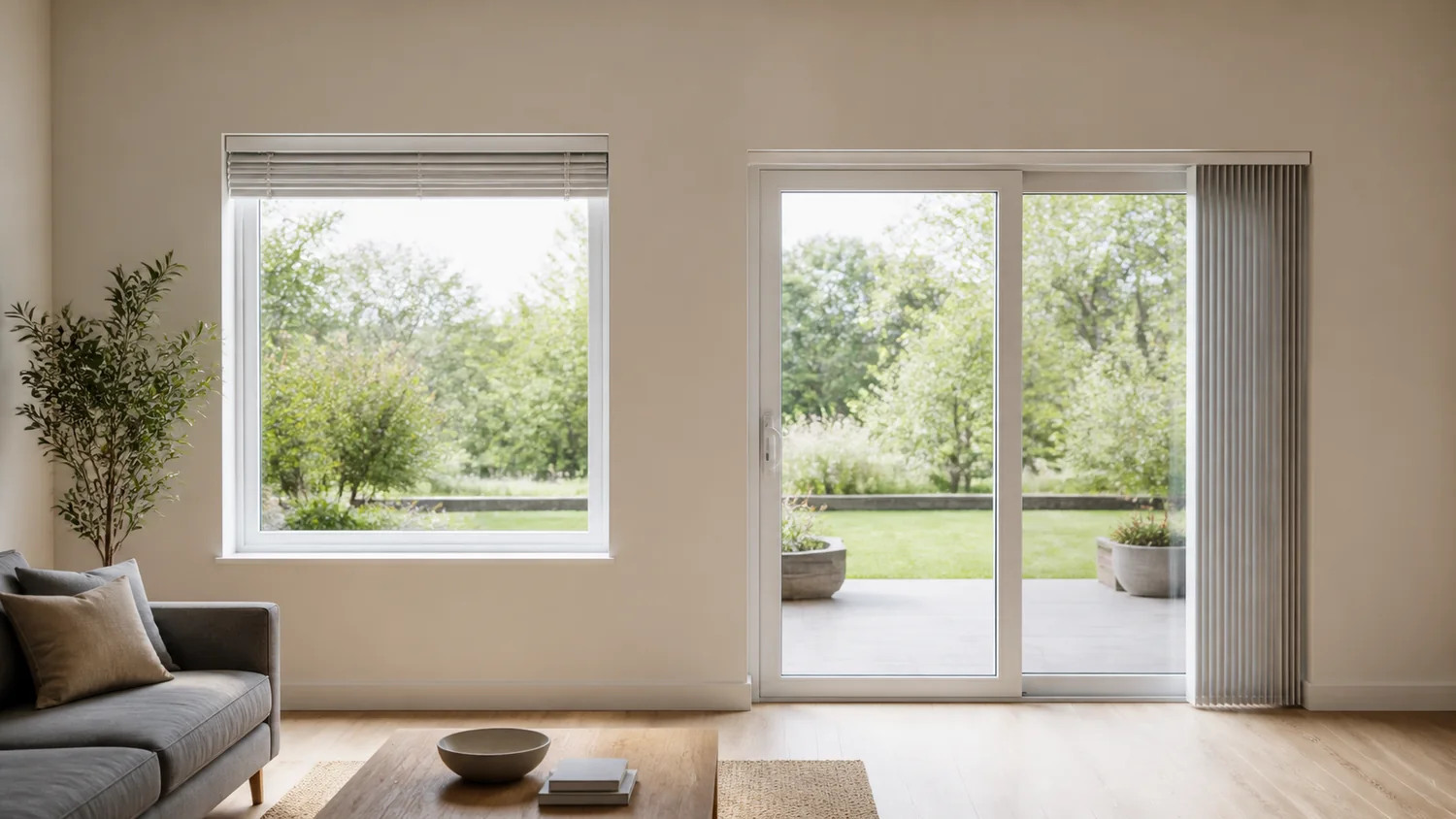
Comparing solar shades with roller shades as if they were automatically different mechanisms hides the useful choice. In much of the current residential market, a solar or screen fabric hangs from roller hardware. “Roller shade” can then describe a broader product form that accepts solar screen, light-filtering, room-darkening or opaque fabrics, depending on the seller and collection.
If both quotes use the same roller platform, hold that platform still and compare the two exact fabrics. Choose the solar-screen candidate when its exact weave, color and finished coverage pass the required view and sun-control scene. Choose the other roller fabric when its exact opacity and room result better fit privacy or darkness. Use two layers when the day and night jobs conflict. Hold the order when either quote supplies only a category label.
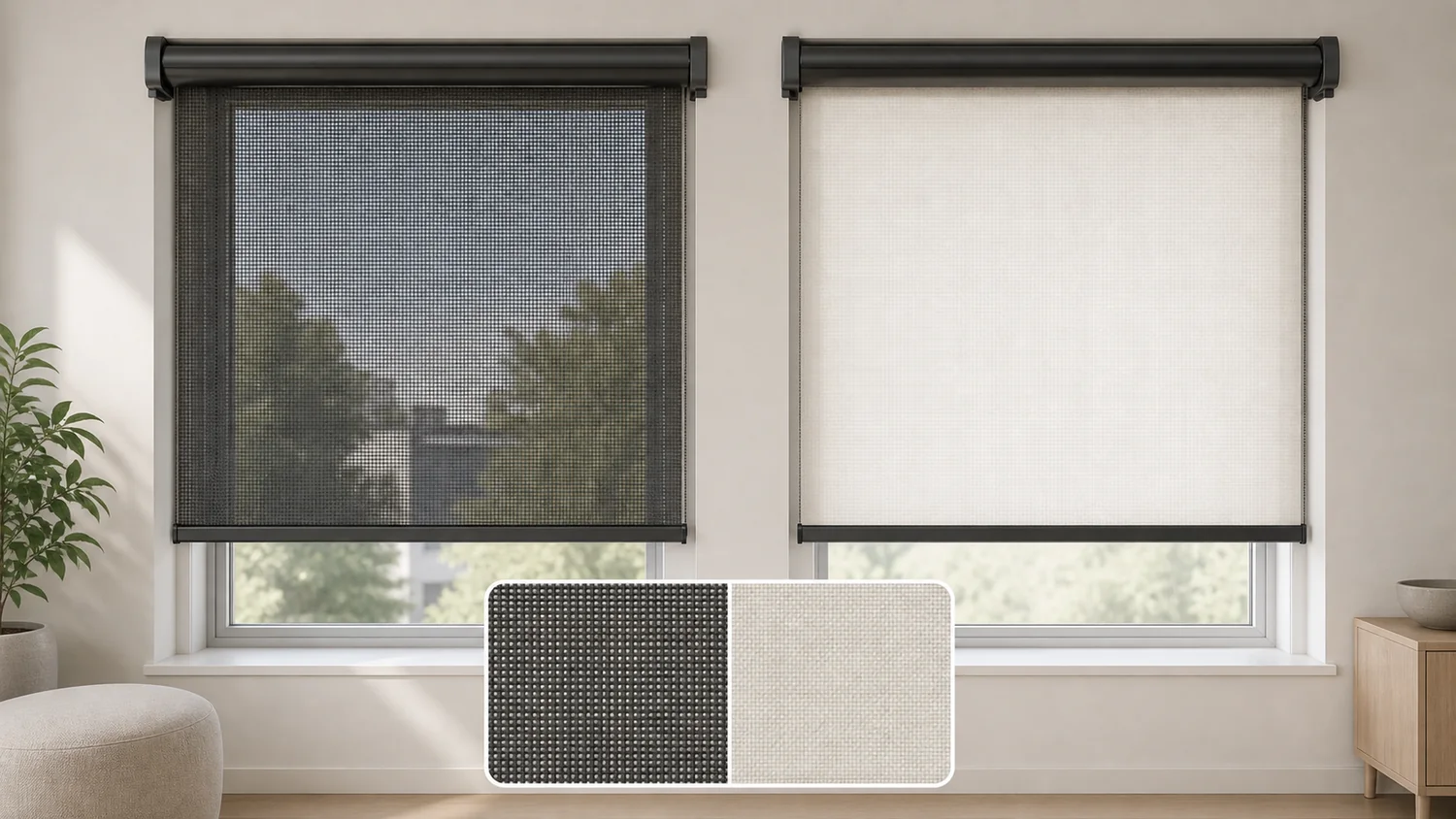
The hardware is intentionally matched. The illustration isolates the fabric question; it does not predict privacy, glare, heat or energy performance.
Start with the family tree, not the labels
There is no single naming system that every seller uses. A useful current example is Hunter Douglas: its Designer Screen/Solar page sits inside a roller-shade path, while its wider shade navigation also presents solar and roller collections as shopper-facing choices. That is evidence of one seller’s current taxonomy, not an industry-wide rule.
The practical question is therefore not “Which category wins?” Ask instead: are these two quotes built on the same roller architecture, and which exact material is attached to each one? A “solar shade” quote may specify an open screen fabric. A “roller shade” quote may name a denser decorative fabric—or it may be too vague to compare at all.
Keep this choice narrower than the site pillar on smart blinds versus motorized shades. Smart features and motorization describe control layers. They do not identify the fabric that manages the window.
Freeze what both shades share
Before comparing fabric claims, copy the common platform into a short header on both records: window ID, raw opening, inside or outside mount, tube and bracket family, cassette or fascia, roll direction, hem bar, ordered width, finished fabric width, control, power and warranty/service owner.
Every field does not have to match. It does have to be visible. A changed cassette can alter recess depth. A different roll direction can move the material farther from the glass. A motor option can change tube size or service access. Different fabric deductions can move the edge of coverage. If those fields drift, compare two finished shades rather than crediting the result to “solar versus roller.”
Start both candidates from the same raw opening in the Smart Shade Measurement and Compatibility Checker. Keep factory deductions product-specific; do not carry a fabric width or side gap from one collection into another.
Build two fabric passports
Do not combine both candidates in a generic pros-and-cons box. Give each material its own source trail and its own room observation.
Passport A: the solar-screen candidate
- Identity: manufacturer, collection, style or weave, color, sample code and source date.
- Material label: stated openness or other screen description, copied exactly and kept with the collection.
- Published evidence: any solar transmission, reflection, absorption, visible-light or UV field, plus the document and test/glazing basis that defines it.
- Window observation: outward view, troublesome sun or glare scene, interior appearance and after-dark visibility from the relevant exterior position.
- Finished build: mount, fabric width, side gaps, roll direction, seam or split, control and power.
- Unresolved field: any privacy, darkness, heat or energy claim that the exact record and room observation do not support.
Passport B: the other roller-fabric candidate
- Identity: manufacturer, collection, fabric, color, backing or liner, sample code and source date.
- Material label: sheer, light filtering, room darkening, opaque or blackout wording in that collection—not a cross-brand scale.
- Published evidence: exact transmission or rating information if offered; otherwise write “not disclosed” rather than inventing equivalence.
- Window observation: daylight diffusion, lost or retained view, glare at the occupied position, night visibility and the required darkness scene.
- Finished build: the same mount and coverage fields used for Passport A, plus any product-specific deduction or hardware change.
- Unresolved field: any result implied only by the category tile, fabric color or sales adjective.
A passport is complete enough to choose only when the fabric can be traced to the sample, data and finished order. “Five-percent solar” versus “room-darkening roller” is not complete: neither phrase identifies the exact color, evidence basis, night condition or perimeter.
A percentage needs a subject and a test basis
Current Phifer SheerWeave records show what useful component evidence looks like: a named fabric family can carry stated openness and solar-optical values, with tables that vary by style and color. Those values belong to that component record. They are not default properties of every shade sold under the word solar. Compare the current SheerWeave 1000 record with the separate 4000-series style and color records.
Likewise, two fabrics with the same nominal openness should not be treated as twins. Yarn, weave, color and the way a manufacturer defines or approximates openness can differ. Use the percentage to locate the exact sample and source table; do not turn it into a universal privacy, glare or cooling score.
| Claim on the quote | Record that makes it usable | If the record is missing |
|---|---|---|
| Openness | Exact fabric style, color and current component document | Compare samples, but leave the percentage unverified |
| UV, solar or visible-light percentage | Exact measured field, test basis and named component | Do not transfer a family or category number |
| Energy performance | Matching finished-product rating identity and stated glazing/deployment scope | Do not award an energy winner |
| Privacy or darkness | Exact sample in the actual day/night scene plus finished perimeter | Do not infer the result from openness or opacity wording |
| Better heat control | Comparable exact evidence for both candidates and the same window system | Leave the heat comparison unresolved |
Berkeley Lab’s residential-window-attachment work and AERC’s label framework treat an attachment as part of a defined system, with rating scope and operating conditions that matter. An exact AERC identity can support a controlled comparison within that scope. It does not promise the same bill savings in every home, and it cannot be assigned to a look-alike fabric.
One fabric may not own both day and night
The solar-screen route is strongest when preserving some daytime view matters and the exact fabric passes the troublesome sun scene. That does not settle night privacy. A lit interior changes the viewing condition, so observe the actual sample from the relevant exterior position after dark. The motorized solar-shade guide owns the deeper openness, color and critical-sun trial.
A denser roller fabric can be the better candidate when view is expendable and diffusion, privacy or darkness has priority. Yet “light filtering” still needs an exact sample and night observation, while “room darkening” or “blackout” fabric does not erase uncovered perimeter light. Use the light-filtering roller guide for the fabric behavior and the light-filtering-versus-room-darkening guide when the opacity state itself is undecided.
If the room needs a view-oriented solar fabric by day and stronger privacy or darkness at night, stop asking one material to compromise between both jobs. A dual-shade or another intentional second layer can give each state its own fabric, provided the headrail depth, controls and service path fit. The dual-shade guide owns that two-roll decision.
The finished unit can change the fabric decision
A handheld sample proves only the material in your hand. The installed result also contains the distance from glass, side deductions, possible light gaps, overlap, roll direction, bottom bar, cassette and any seam or split. These fields can change both the visible edge and where direct sun passes.
Ask the seller to return the finished fabric width—not only the ordered shade width—for each candidate. Require a section drawing when the recess, handle or trim is tight. If control and power are included, name the exact motor generation, charger or wire path, local control and removal method. A fabric win is not useful if the completed shade cannot fit, cover the needed edge or be serviced.
Do not import an insulation conclusion from a cellular comparison. Roller and cellular shades have different constructions; the roller-shades-versus-cellular-shades guide owns that category crossover. P110 keeps both candidates in the roller family so the fabric decision stays visible.
Close on the fabric, the second layer or a hold
Return one of four outcomes for this window:
- Solar-screen fabric. The exact identity and source record are current, the real-window sample passes the daytime view/sun task, the night requirement is acceptable or separately covered, and the finished roller configuration fits.
- Other roller fabric. The exact identity and opacity record are current, the sample passes the required privacy/darkness/light scene, the lost view is acceptable, and the finished configuration fits.
- Two-layer path. Neither fabric can meet the necessary day and night states alone, but two independently controlled materials fit the available depth and service envelope.
- Hold. A fabric identity, evidence basis, room observation or finished-coverage field is missing, or the two quotes quietly use different hardware.
The seller should be able to place both passports beside the window record without translating marketing language: exact fabric and color, current source document, stated openness or opacity, any claimed optical/rating basis, finished fabric width and gaps, mount and roll, control and power, service owner and installed total.
Solar shades versus roller shades becomes a useful comparison only after the shared mechanism stops doing the fabric’s work. Hold the roller platform still, make each material carry its own evidence, and choose the completed window state—not the shorter label.