An “8-gauge upgrade” sounds precise. It is not precise enough to buy until the seller writes the actual slat thickness for the exact blind on your quote. One current product page demonstrates why: its description pairs 8 gauge with 0.008 inch, while a specification line on the same page prints 0.0068 inch. The page may contain a simple error, but a buyer should not guess which field will govern the order.
Ask for two written configurations. Keep the product, one-inch slat width, finish, headrail, controls, ordered size, warranty and quote date the same. Then compare the confirmed decimal and price. Prefer 8 gauge only if it is the thicker defined slat, the rest of the blind is genuinely comparable, and you can name the contact or handling that makes the premium useful.
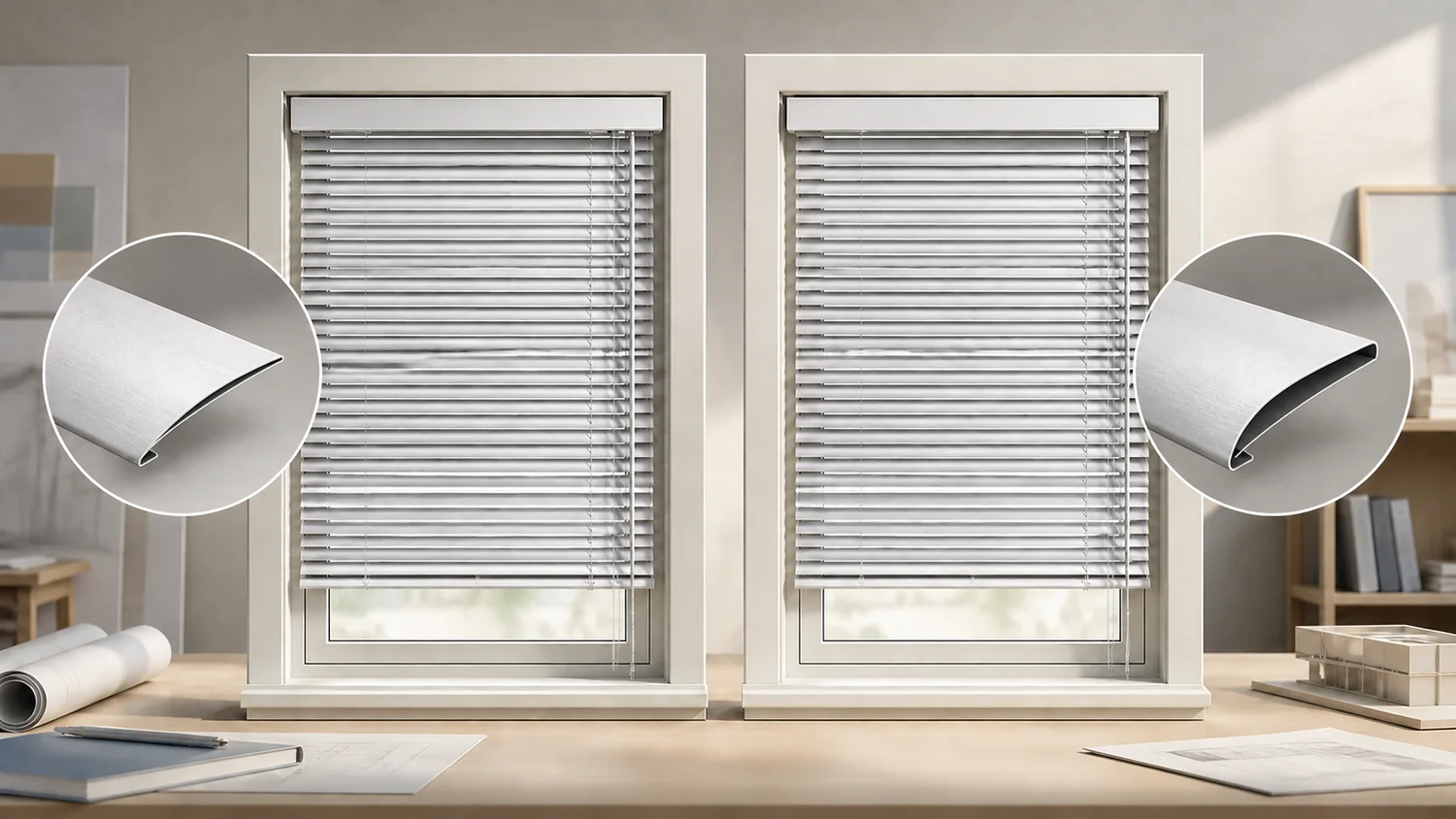
The paired blinds keep the visible configuration the same. The edge insets illustrate a thickness question only; they do not predict denting, lifespan or performance at a particular window.
A gauge label is not yet a measurement
In LEVOLOR’s metal-blind technical guide, gauge is the thickness of the aluminum slat, and the guide calls its 6-gauge slat thinner and less durable than its 8- or 9-gauge slats. That definition is useful within the guide, but the document says it was effective in April 2007. It cannot establish current availability, price or the meaning used by every seller.
Current product records do confirm that the choice still exists. Fabtex’s aluminum-blind brochure offers 6- or 8-gauge slats on a named one-inch system, alongside the same brochure’s headrail, control and size details. Blindsgalore currently offers both gauges on one Luxera product and recommends 8 gauge for high-traffic settings, homes with children and homes with pets. Treat that last statement as seller guidance, not as an independent durability test.
The useful translation is therefore not “8 is always better.” It is: what decimal thickness will be supplied under this product code and quote revision? AwardBlinds’ current American one-inch product page uses 0.006 inch and 0.008 inch in its descriptive copy. Because the same page also contains the conflicting 0.0068-inch line for 8 gauge, put the decimal in the written order rather than relying on a selector label.
Put the whole upgrade on one strip
Copy both offers into one comparison strip. “Same” means the seller has confirmed that the field does not change; it does not mean the second configurator screen happens to look similar.
| Field | 6-gauge quote | 8-gauge quote | What the row decides |
|---|---|---|---|
| Product identity | Maker, collection, product code and revision | Must match | Whether this is one product comparison |
| Slat specification | One-inch width and seller’s decimal | One-inch width and seller’s decimal | Whether the thickness change is defined |
| Alloy and temper | Copy wording or “not disclosed” | Copy wording or “not disclosed” | Whether another slat property changed |
| Finish and color | Exact finish and color code | Must match or name the substitution | Whether appearance or availability moved |
| Headrail and controls | Headrail, lift and tilt | Must match or name the difference | Whether operation moved with gauge |
| Opening and order | Window ID, mount and ordered size | The same window record | Whether price is based on the same blind |
| Warranty and service | Exact coverage and replacement unit | Exact coverage and replacement unit | Whether ownership risk changed |
| Delivered price | Total and quote date | Total, delta and quote date | What the defined upgrade costs |
Three results are possible. Comparable means both rows identify the same product and finished configuration, with a larger confirmed decimal in the 8-gauge row. The premium now buys a defined thickness change. Configuration changed means the 8-gauge option also switches the collection, slat width, color, headrail, controls, size limit or warranty. The offer may still be good, but the price difference no longer belongs to gauge alone. Undefined gauge means the seller will not state the decimal or the written materials conflict. Ask for a corrected specification rather than paying to settle the terminology yourself.
Start both rows with the same raw opening and mount record from the Smart Shade Measurement and Compatibility Checker. Do not copy a factory deduction from another product. Gauge does not repair an incorrect order width, inadequate recess or control that cannot be reached.
Buy thickness for a contact you can name
A thicker confirmed slat is easiest to justify when the blind has a specific, recurring contact risk. “Busy room” is not specific. A cat passing behind the lower slats, a chair back touching the window, a child brushing one reachable section or a staff member adjusting the blind several times a day describes the exposure much better.
That description still does not predict service life. Slat alloy and temper, curvature, span, ladders, bottom rail, finished width and the way a person contacts the blind can all matter. Neither a product-page adjective nor a hand-bent store sample controls those variables. This comparison cannot tell you how many dents an extra 0.002 inch prevents or how many years it adds.
Use the named contact to ask a narrower question: does the manufacturer offer the thicker slat in the exact required configuration, and is a damaged slat replaceable under the seller’s service path? If yes, the premium can be a reasonable risk preference. If the window is rarely touched and both gauges pass the required configuration, color and service gates, the thinner defined option can remain a rational purchase.
Cleaning is a separate branch. A thicker slat does not reduce the number of slats or establish which cleaner the finish accepts. If kitchen residue, dust or frequent wiping is the real concern, move that work to the easy-to-clean blind comparison and retain the exact care instructions for the chosen finish.
Gauge can drag a different blind into the quote
Gauge is sometimes a free choice within one line, and sometimes a boundary between lines. AwardBlinds’ current aluminum category includes products advertised as 6 gauge only, 8 gauge only, or available in both. Its individual product page also changes selectable colors, headrail and control options around the gauge selector. That is evidence about the offer’s configuration, not evidence that every aluminum blind behaves the same way.
Watch for five kinds of drift. Product drift puts a different collection or product code on the 8-gauge quote. Geometry drift changes slat width, headrail, minimum depth, finished width or raised stack. If slat width changes, use the 2-inch versus 2.5-inch blind comparison for that geometry instead of crediting the result to gauge. Control drift changes lift, tilt, wand side or cordless availability. Appearance drift removes the required color or finish. Commercial drift changes freight, lead time, warranty owner or replacement terms with the line.
Cloth tapes deserve their own row if either quote includes them. They change the visible ladder treatment and may create a different cleaning or replacement burden; the blinds-with-cloth-tape guide owns that decision. Do not hide the change inside the gauge premium.
If several fields move, keep the two offers but rename the decision. It is no longer “6 gauge versus 8 gauge.” It is “finished blind A versus finished blind B.” The vinyl-versus-aluminum guide uses that discipline for material labels: identify the complete candidate before assigning an outcome to one component.
Send the seller five lines, then decide
Send this request with the window ID and current quote attached:
Please return two quotes for the same maker, collection, one-inch slat, finish, headrail, controls, mount and ordered size.
State the actual slat thickness in decimal inches for the 6-gauge and 8-gauge versions.
Identify any change in alloy/temper, color availability, size limit, control, lead time or warranty.
Show the delivered price difference and quote revision date.
Confirm which product specification will govern the supplied blind if the website fields disagree.
The reply should fit the comparison strip without interpretation. If it produces two matched rows and a larger confirmed decimal for 8 gauge, decide whether the named contact risk is worth the delivered premium. If it produces a different finished blind, compare that whole configuration. If it leaves the decimal unresolved, the upgrade is not yet defined.
This is a narrower choice than smart blinds versus motorized shades. That broader comparison remains the site pillar for format and automation decisions. Here, the useful finish line is simpler: a thickness you can quote, a configuration you can hold still and a price attached to the exact change.