A west-facing window tells you roughly when trouble may arrive, not which blind will solve it. The same low afternoon sun can wash out a laptop screen, strike a reading chair, heat a dark floor, expose the room from outside, or miss the occupied area entirely. A list that starts with “solar,” “cellular,” or “blackout” skips the part that determines what the covering must actually do.
Before comparing products, watch one clear afternoon. Record when direct sun reaches the glass, the first room surface it touches, the farthest target it reaches, and when it leaves. Then give one outcome—glare control, limiting solar gain, preserving the view, privacy, or darkness—first claim on the window. The useful blind is the smallest exact configuration that interrupts that observed path without permanently sacrificing the room after the beam has gone.
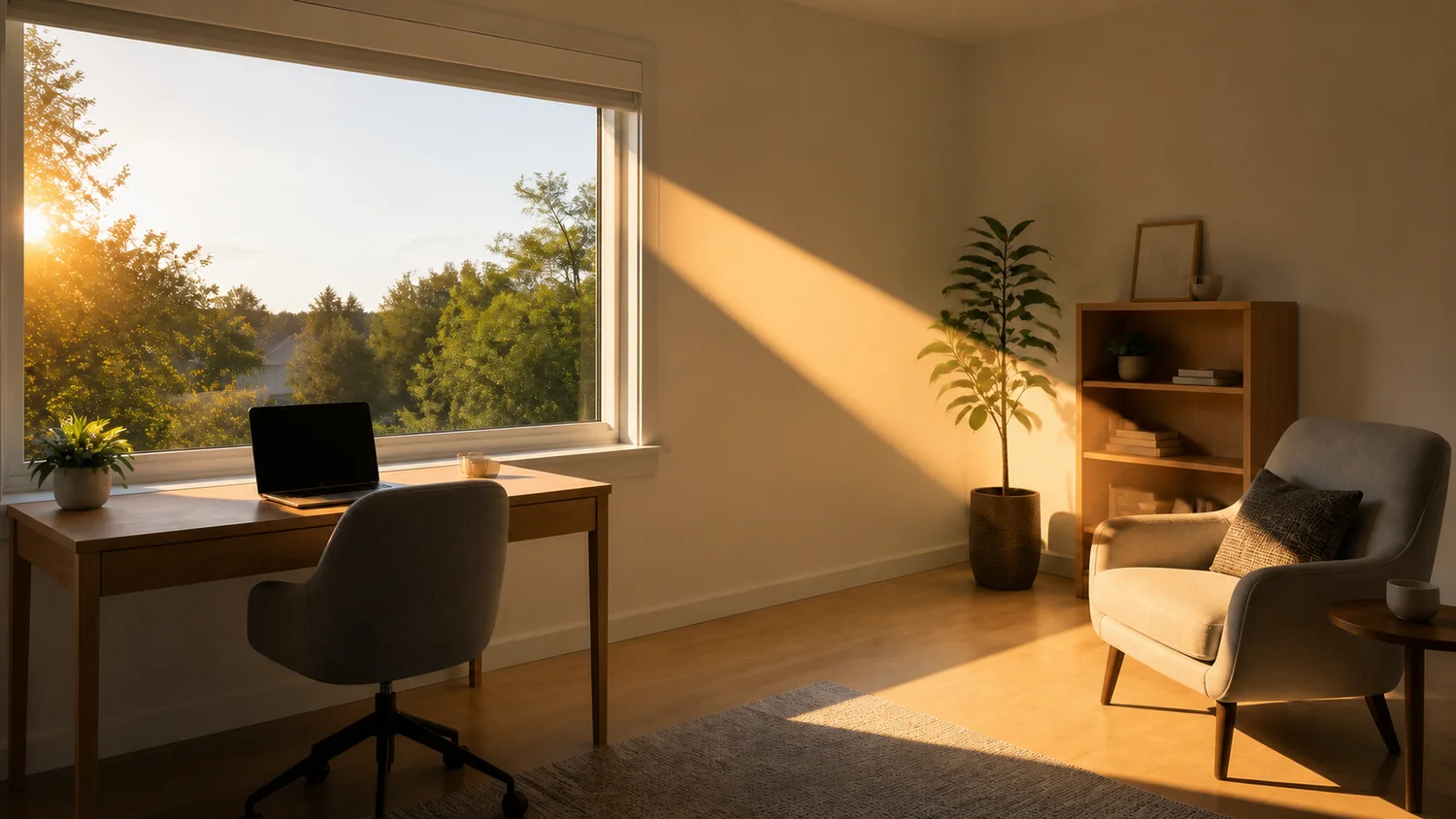
The visible beam is conceptual, but the decision is real: record which surface the afternoon sun reaches before choosing what the window covering must protect. The image does not predict temperature, fading, UV exposure, energy savings, or the performance of a particular product.
West is a clock, not a product category
The Department of Energy’s Building Science Education resource notes that heat and glare are harder to control at east- and west-facing windows. That makes orientation a useful warning: a west-facing opening deserves an afternoon observation. It does not make every west window equivalent.
A neighboring building, balcony, tree, deep reveal, roof line, insect screen, existing film, and the window’s position within the wall can change when direct sun reaches the glass. Latitude and season move the path too. A window described as west-facing on a plan may receive a short stripe in winter, a long late-day beam in summer, or no direct sun at the occupied surface during the period you care about.
Start with a window ID and the date. Confirm that the sun actually reaches this glass rather than assuming from the compass point. If your problem is reflected sky brightness without a visible beam, write that down: diffuse brightness and direct low-angle sun are different conditions. If the sun disappears behind a building before it reaches the desk or sofa, the obstruction is part of the solution record.
This distinction prevents an expensive mistake: buying a dark or permanently closed treatment to fix a one-hour event, then losing the view and daylight for the other twenty-three hours. The alternative is not automatically automation. It is first to learn when the window needs protection and when it does not.
Mark the two edges of the afternoon sun
Watch the opening on a representative clear day for the season that creates the problem. You are looking for two edges: the moment direct sun becomes consequential and the moment it stops. Between them, mark the first room target and the deepest target. A phone photo with the window ID and time is more useful than the label “hot west room.”
| Checkpoint | What to record at this window | What it changes in the decision |
|---|---|---|
| Before direct sun | Existing daylight, view, privacy, screen readability, and whether the covering is normally open | Defines what must be preserved before the event |
| Sun arrival | Time, date, weather, exterior obstruction, and the first bright edge on the glass or room | Defines when control needs to begin |
| First room target | Screen, eyes, seat, floor, artwork, plant, or another named surface | Identifies the first job the treatment must perform |
| Deepest reach | Farthest direct-sun line and the time it occurs | Tests whether partial coverage or slat tilt is enough |
| Sun departure | Time the beam clears the important target and the glass | Defines when view and daylight can return |
| Seasonal exception | A second observation in the other important season, or “not yet observed” | Prevents one-day timing from becoming a year-round promise |
Do not turn the trace into a temperature or fading forecast. A visual path cannot tell you the glass’s solar heat gain coefficient, a material’s spectral properties, or the future condition of furnishings. DOE fenestration purchasing guidance treats solar heat gain coefficient and visible transmittance as different properties. Berkeley Lab’s window-attachment program likewise evaluates attachment systems with glazing and operation as inputs. The trace locates the problem; exact product evidence must define the proposed response.
If you plan an inside mount, carry the same opening ID into the Smart Shade Measurement and Compatibility Checker. Width, depth, obstructions, hardware clearance, and finished gaps remain separate from the sun-path decision. A correct treatment category in an opening that cannot accept its hardware is still a failed order.
Give one room target first claim on the window
Several outcomes can matter, but one must control the first comparison. Otherwise every seller can describe a different feature as “best” and all of them can appear correct.
If direct sun lands on a display or in the viewer’s eyes, glare at that named position and time has first claim. An adjustable blind, a suitably documented solar or diffusing shade, or a movable exterior solution may be candidates. The office-blinds guide owns the broader work-scene decision; here, the question is limited to the traced west-window event.
If the concern is solar heat entering the room, do not substitute a dark fabric or a low openness number for evidence. Interior light control and stopping solar energy before it enters through the glass are not the same task. Ask what performance data applies to the exact attachment, glazing, mount, color, and operating condition. If the decision depends on rated thermal behavior, move that comparison to the energy-efficient-blinds guide.
If view preservation controls, write the view that must remain usable and when. A more open solar fabric may preserve more connection to the exterior, but openness factor is not the same as visible transmittance, and neither number alone proves glare control at your seat. Lutron’s April 2015 solar-screen technical paper is useful for that definition and also says nominal openness may be an approximation; current exact-fabric documentation must govern the order.
If privacy controls near sunset, observe from the relevant outside approach with indoor lights in their normal state. Slat direction can change the sightline but is not a universal privacy guarantee; the blinds-up-or-down-for-privacy guide owns that outside-view test. If darkness controls for sleep or projection, separate that requirement from daytime glare. The light-filtering-versus-room-darkening guide owns the fabric-state comparison and finished edge leakage.
Giving one job first claim does not erase the others. It establishes the order: solve the non-negotiable room target, then reject candidates that unacceptably damage the remaining view, privacy, darkness, daylight, fit, operation, or service requirements.
Decide whether to intercept the sun before or after the glass
Placement comes before a category winner. The same DOE guidance distinguishes exterior devices such as screens from interior blinds and shades. That boundary matters because direct solar energy has already passed through the glass before an interior attachment manages the resulting light and heat exchange.
An exterior assessment belongs in the branch when limiting solar gain before the glass is the controlling job. The candidate might be an exterior screen, awning, shutter, overhang, or another code- and building-compatible solution. This article does not design that system. Wind exposure, egress, façade rules, fastening, weather durability, maintenance access, and local authority can make an exterior route infeasible even when its position is attractive in principle.
An interior adjustable treatment is often the practical branch when the first job is to redirect a low beam, protect a screen position for part of the afternoon, or restore view later. Horizontal slats can redirect light only within the geometry of the finished blind and the viewer’s sightline. A roller or solar shade changes the covered portion as it moves. Neither behavior should be inferred from a category name; ask for the exact control range, fabric or slat identity, mount, side gaps, bottom position, and any required intermediate stop.
An interior opaque or insulating treatment belongs in the branch when darkness, privacy, or documented insulating performance takes priority over the view during closure. Cellular construction, side tracks, opaque fabric, or layering may address different parts of that requirement. Do not add their benefits together without evidence for the exact configuration.
Layering is justified only when two jobs cannot be acceptably combined. Lutron’s current west-room example assigns different layers to summer glare, winter insulation, and privacy. It is a manufacturer example, not a universal prescription, but it illustrates a sound question: does each layer have a distinct job and a time when it opens? If two products merely repeat the same vague “sun protection” claim, the second layer has not earned its cost or complexity.
Reopen the room after the beam has gone
The departure edge is part of the purchase decision. If the room regains a useful view at 6:20 p.m., a treatment that stays closed until bedtime has solved the event while creating a new loss. Write the reopen condition in plain language: “Raise when direct sun clears the laptop,” “return slats to view position when the beam leaves the chair,” or “keep closed after sunset for street privacy.”
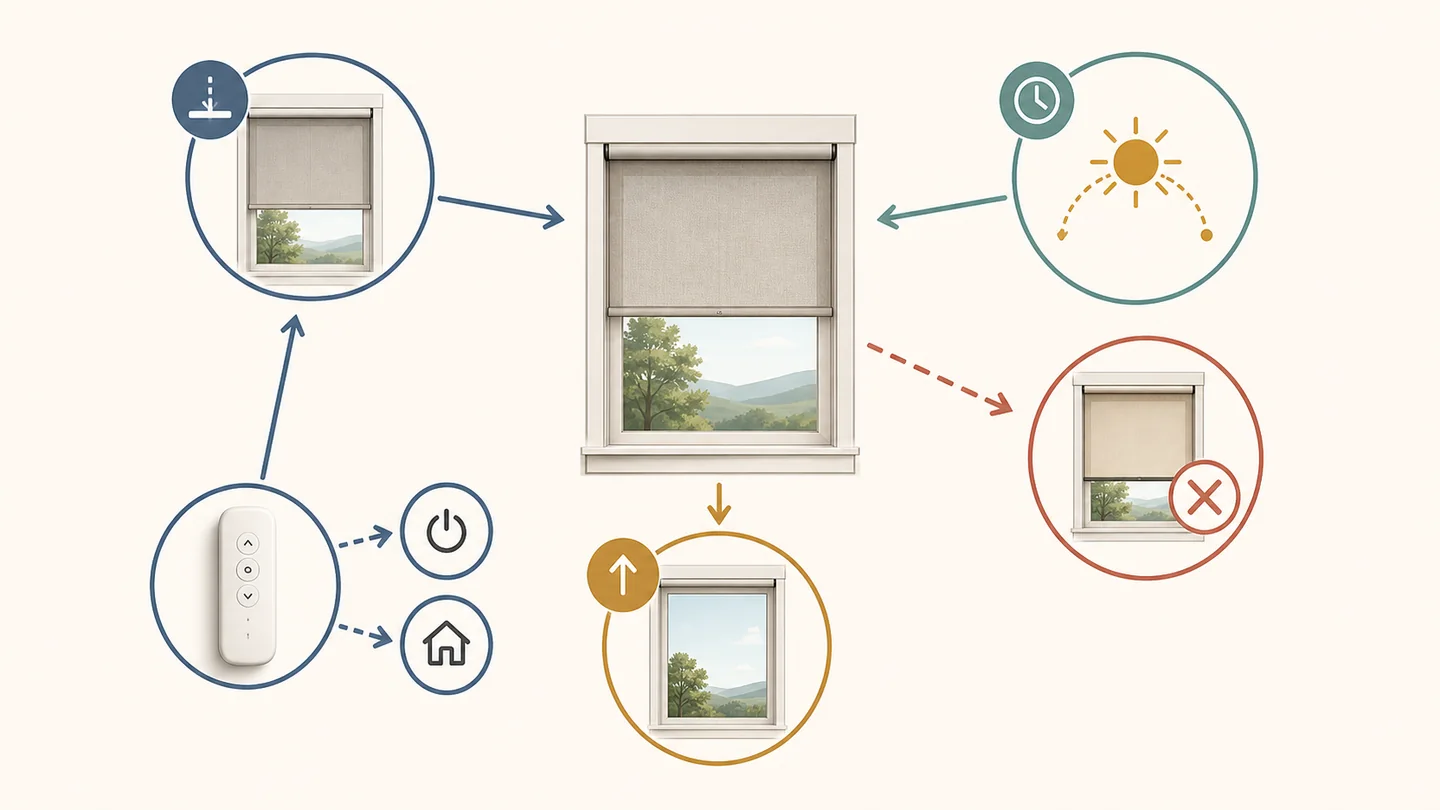
Manual operation is sufficient when someone is present, the control is reachable, and the routine is likely to happen. Motorization becomes relevant when the event recurs while the room is empty, the opening is inaccessible, several treatments must move together, or the required position is easy to miss. A DOE-recognized window-attachment program has included scheduled shade operation at south- and west-facing windows, which shows that timing can be part of an attachment strategy. It does not establish savings or the right schedule for this house.
For motorized solar shades, record the exact fabric and the positions needed during the observed event before programming a schedule. “Close at 3 p.m.” is fragile if seasonal sun arrival moves, daylight saving time changes the household routine, or a tree shades the glass in summer but not winter. A useful schedule ties the position to the room target and includes a seasonal review date.
Automation should also fail sensibly. Decide what happens after a power, hub, sensor, or network interruption; whether a local control remains available; and whether the treatment can still meet privacy or darkness needs. The sun trace tells the system what outcome matters. It does not excuse an inaccessible manual path or an unverified motor limit.
Make the quote reproduce one afternoon
The order is ready only when a seller can map the traced event to one exact finished configuration. Attach the window ID, dated photos, sun-arrival and departure times, first and deepest targets, controlling job, exterior obstruction, known glazing information, mount preference, finished coverage, view/privacy/darkness limits, and intended reopen condition.
Ask the quote to name the maker, collection, exact slat or fabric code and color, performance basis if one is claimed, mount, finished width and height, side and bottom coverage, control type and side, motor/power path if applicable, programmed or manual positions, warranty owner, service unit, and drawing revision. If a seller recommends solar fabric, ask for the exact fabric’s data rather than accepting openness alone. If a seller recommends a cellular or opaque product, require the claimed thermal or darkness result to identify its test scope and finished configuration.
Three endings are legitimate. Proceed when the exact product intercepts the observed path, satisfies the first-priority job, preserves the required after-sun state, fits the opening, and has an acceptable service path. Compare two complete configurations when interior and exterior placement, or a single treatment and a layered treatment, remain credible. Hold when the sun path, glazing, finished gaps, fabric/slat identity, performance basis, control position, exterior authority, or service responsibility is still missing.
Keep the broader room plan connected to the smart-shades-by-room guide, but do not let a whole-room label overwrite this window record. The finished quote should reproduce one real afternoon: what the sun hit, where the treatment intercepted it, when the room reopened, and exactly which product is responsible. That is a stronger buying specification than “best blinds for west-facing windows.”