Choose a motorized solar shade by testing the exact fabric at the window’s critical sun time—not by selecting an openness percentage from a generic chart. Openness, color and weave work together. The mount and finished gaps then change coverage. Motorization is useful when it moves that approved fabric to the right position for the recurring sun event.
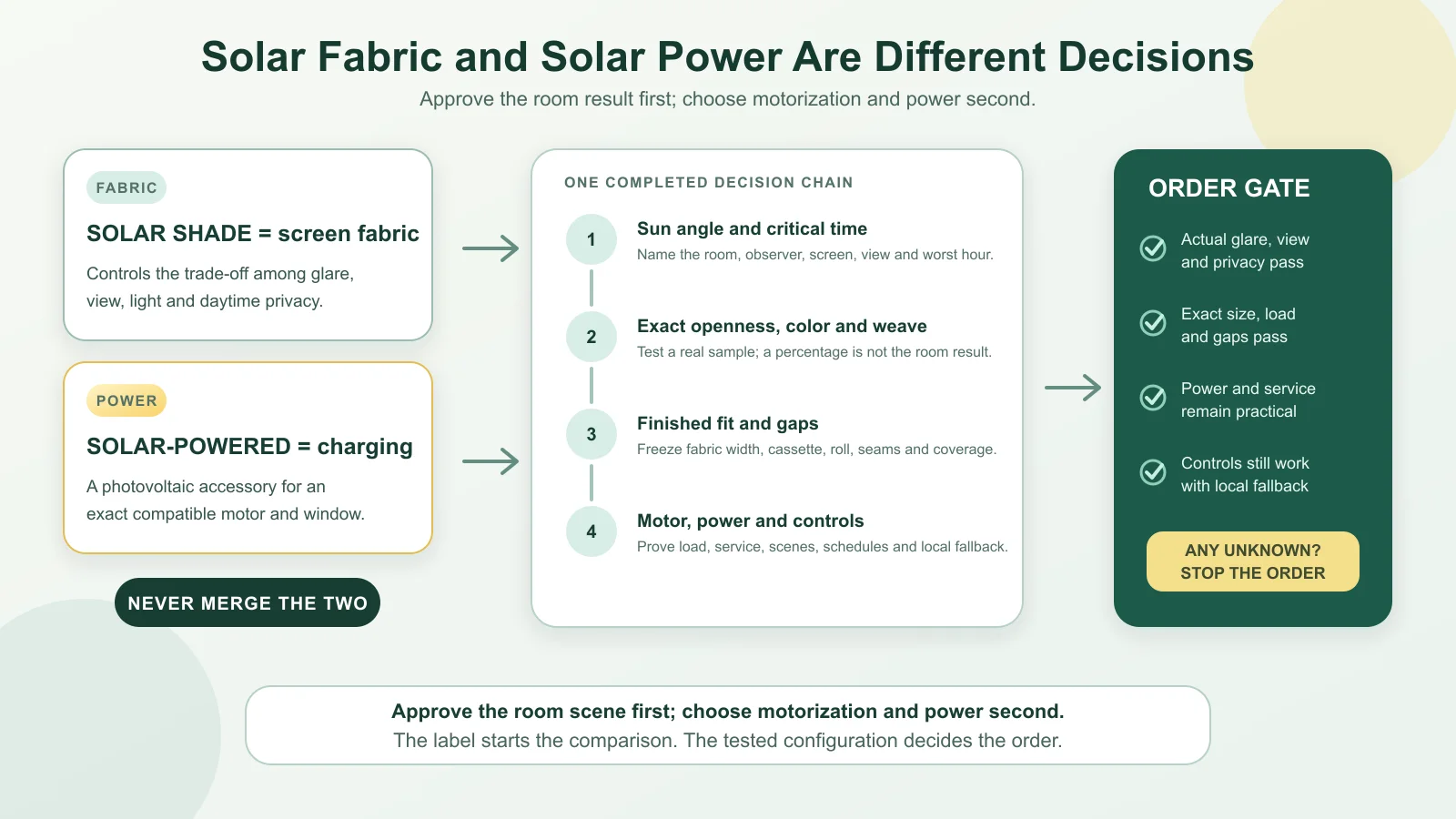
Also separate two meanings that search results often mix: a solar shade is a screen-like fabric designed to manage sunlight, glare and view; a solar-powered shade uses a photovoltaic accessory to charge a compatible motor system. One does not imply the other. If the screen-like fabric is still only one candidate, compare its construction with cellular, Roman, zebra, and ordinary roller paths in the motorized shade type guide.
Solar fabric and solar charging are two different decisions
The fabric decision asks what passes through the weave and what remains visible. The power decision asks how the motor receives energy and how it is serviced. A solar-screen fabric can use battery, rechargeable, plug-in or wired power. A compatible solar charger may power another fabric type.
Keep two separate quote fields: exact fabric and exact motor-power system. Do not allow “solar” to answer both.
Find the one sun event the shade must solve
Record the window orientation and the time when the room fails. Is low western sun reflecting on a screen? Is direct brightness uncomfortable at a desk? Is furniture exposure the concern? Is the task preserving a daytime view while reducing glare, or managing heat gain with less emphasis on view?
Photograph the window from the occupied position during that event. Note weather, time, observer/screen location and the minimum shade position that would block the problematic sun. A broad statement such as “south-facing room” is weaker than a repeatable critical-time scene.
Openness gives a sample a name, not a verdict
Openness describes the open area of a screen weave. Lower and higher values generally change the balance among transmitted light, glare reduction and view, but the percentage is not a cross-brand performance score. Yarn, weave and color can make two fabrics with the same listed openness look and behave differently.
Hunter Douglas’s current solar-shade guide explains the weave/openness tradeoff, color effects, day/night privacy reversal and edge gaps within its product context. Use those variables to structure a sample trial rather than treating one value as universally best. Review the current solar-fabric variables.
Color and weave can change the same percentage
A lighter fabric can reflect more light into the room and may look different against the window; a darker fabric can preserve a clearer outward view in some conditions while changing interior brightness. These are not promises for every material. Compare exact physical samples at the actual window.
Do not choose from a small swatch under showroom lighting alone. Hold the sample in the same plane and direction proposed for the finished shade, while viewing it from the real desk/seat. If available, use manufacturer data for that exact fabric as supporting evidence—but let the room trial decide whether the visual task is met.
| Observation | What to record | What can pass | What cannot be inferred |
|---|---|---|---|
| Normal daylight | Outward view, room brightness, fabric appearance and preferred shade position | The ordinary occupied scene is comfortable and useful | Critical glare or night privacy |
| Critical sun event | Glare source, screen/eye position, required coverage and retained view | Exact fabric and position solve the documented event | Whole-home cooling or energy savings |
| After dark | Exterior observer, interior lighting, silhouettes and side gaps | The actual privacy requirement from that viewpoint | Other observers, lighting or fabric colors |
Night reverses the privacy test
During daylight, a brighter exterior can make some solar fabrics feel private from inside. After dark, a lit interior against a dark exterior reverses the condition. Open weaves can reveal people and objects.
Graber’s current solar-shade guide connects openness with light, glare and view and distinguishes solar fabrics from more private roller fabrics; it also discusses a second layer for different room states. Treat those as product-selection directions, not universal night-privacy guarantees. Review the current solar-shade boundaries.
If after-dark privacy matters, test it from the actual exterior viewpoint. A separate privacy layer or different shade may be required.
Darkness usually means another layer or another shade
Solar fabric is primarily a sunlight/glare/view tool. Even a tight or room-darkening screen should not be assumed to create blackout. Material transmission and perimeter gaps remain.
Hunter Douglas’s current Designer Solar product page shows named solar and dual-layer options, illustrating that glare/view and stronger privacy/darkness can be separate layers. Check the exact named options if relevant. If darkness is the primary task, compare the solar candidate with an opaque roller, cellular or purpose-built layered path rather than forcing one fabric to do incompatible jobs.
Finished coverage can undo the sample
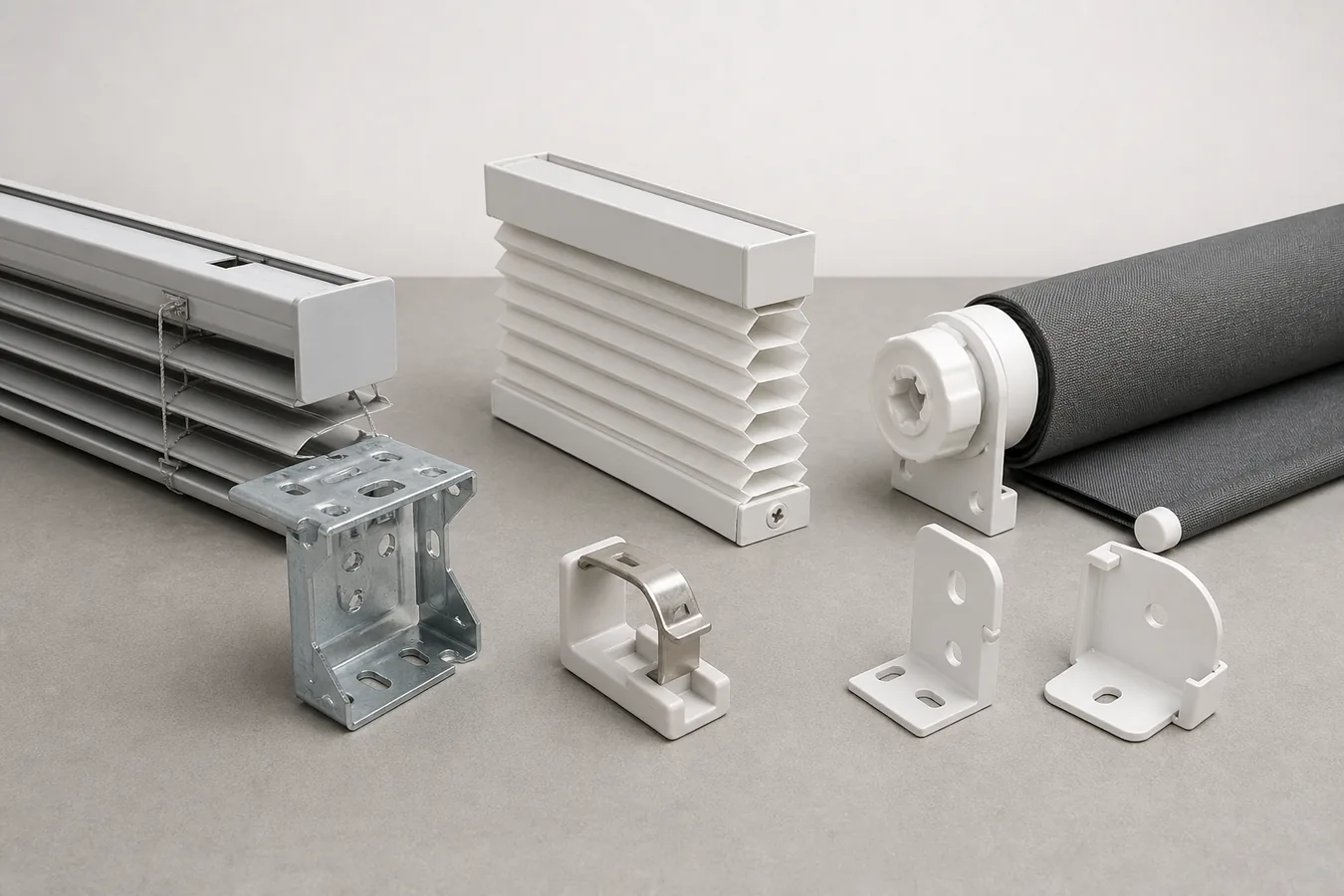
A fabric sample covers the area in your hand. The installed shade includes side deductions, cassette or fascia, roll direction, bottom rail and possibly seams or inter-panel gaps. Those light paths can sit exactly where the critical sun enters.
Record the opening with the measurement checker. Compare the intended plane in the inside-versus-outside mount guide. Then require ordered width, finished fabric width, side gaps, overlap, cassette projection and roll direction for the exact motorized build.
Large glass turns fabric choice into a split decision
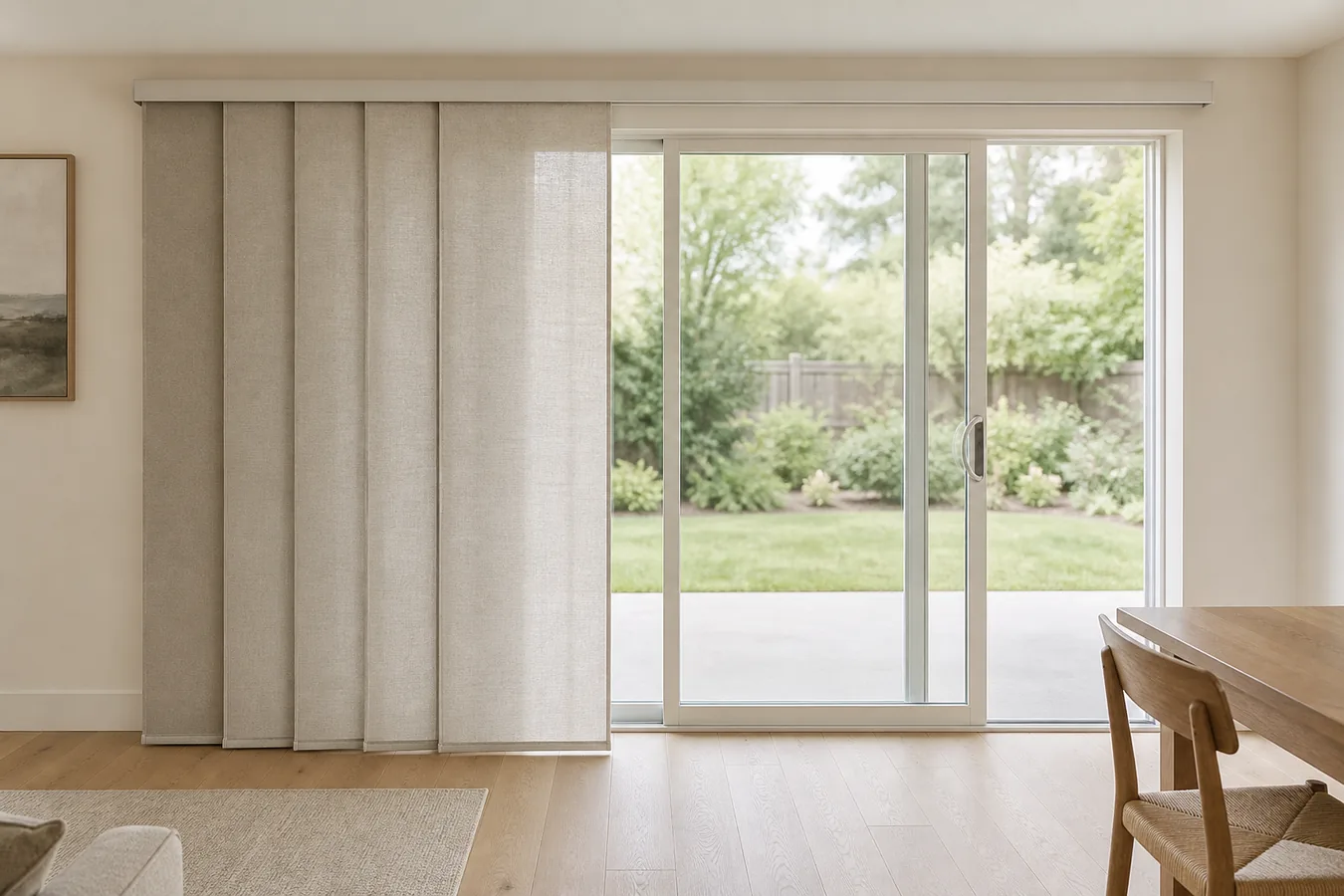
A wide or tall opening may exceed one finished unit, require a seam, or need several motors. A single approved sample does not decide where panel gaps cross the view or sun path. Divide the opening around structural support, user tasks and acceptable gap locations.
Use the large-opening planning guide to place splits and service identities. Then return to the solar sample trial for each distinct exposure. Adjacent shades may need separate groups if the critical event reaches them at different times.
Motorization should follow the sun event
Motorization adds more than a remote when the approved fabric must move repeatedly as the critical sun event arrives and passes. Save positions by room result—normal daylight, glare control, privacy layer—not by an unexplained app percentage.
Schedules can support a predictable exposure, but users need local open/stop/close control and a simple override. The schedule should close only the affected zone and only as much as the sample trial proved necessary. Automation does not create a better fabric or a better mount.
Hunter Douglas’s energy-efficiency overview discusses scheduling coverings for solar heat management and distinguishes roller/solar shades from more insulating cellular designs. Use that distinction to avoid claiming that a solar screen is an insulating cellular shade. See the current category boundary.
A solar charger is an exact power accessory
A photovoltaic panel is not part of the fabric definition. It must be compatible with the exact motor, battery and control generation, and its placement/orientation rules must work at the actual window.
Levolor’s current roller/solar/banded technical guide includes a named photovoltaic accessory with orientation limits in its specified InMotion scope. That is evidence of an exact-system option, not a cross-brand solar-power rule. Verify the current accessory scope if quoted.
Otherwise compare the exact battery, rechargeable, plug-in or wired choices. Hunter Douglas currently lists rechargeable and hardwired capability within PowerView, but exact product availability and service remain configuration-specific. Confirm power for the named shade system.
Approve one representative window at three times
Where practical, mock up or install one representative shade before repeating the order. Observe normal daylight, the critical sun event and after-dark privacy. Use the exact fabric, color, mount, roll direction and finished coverage proposed for the rest.
Then test the local control, saved glare position, schedule timing, group behavior and offline fallback. Record only what this window proves. It does not establish universal heat reduction, UV protection, energy savings, battery life or long-term reliability.
Order the fabric scene, fit and power separately
| Decision | Record | Acceptance |
|---|---|---|
| Fabric scene | Exact collection, openness, color, weave and three observation cards | Critical glare/view and night privacy are directly observed |
| Finished fit | Mount, fabric width, side/inter-panel gaps, cassette, roll, seams and splits | Coverage matches the approved sample scene |
| Motor control | Exact motor, saved positions, schedule, groups and local fallback | Movement follows the real sun event without over-closing the room |
| Power | Battery/rechargeable/plug-in/wired path or exact compatible solar accessory | Power and service are proven independently of the fabric name |
DOE notes that window-attachment heat effects depend on climate and heating/cooling tradeoffs, and exterior attachments can behave differently from interior shades. Do not convert an interior fabric decision into a whole-home savings promise or exterior-system instruction. Review the DOE scope if heat performance is central. Where young children may be present, CPSC recommends appropriate cordless coverings. See the current CPSC guidance.
Choose the solar fabric at the window’s worst sun hour, not from an openness chart alone. Once the sample passes glare, view, and night-privacy checks, motorization can earn its place by moving that exact fabric when the sun event returns.