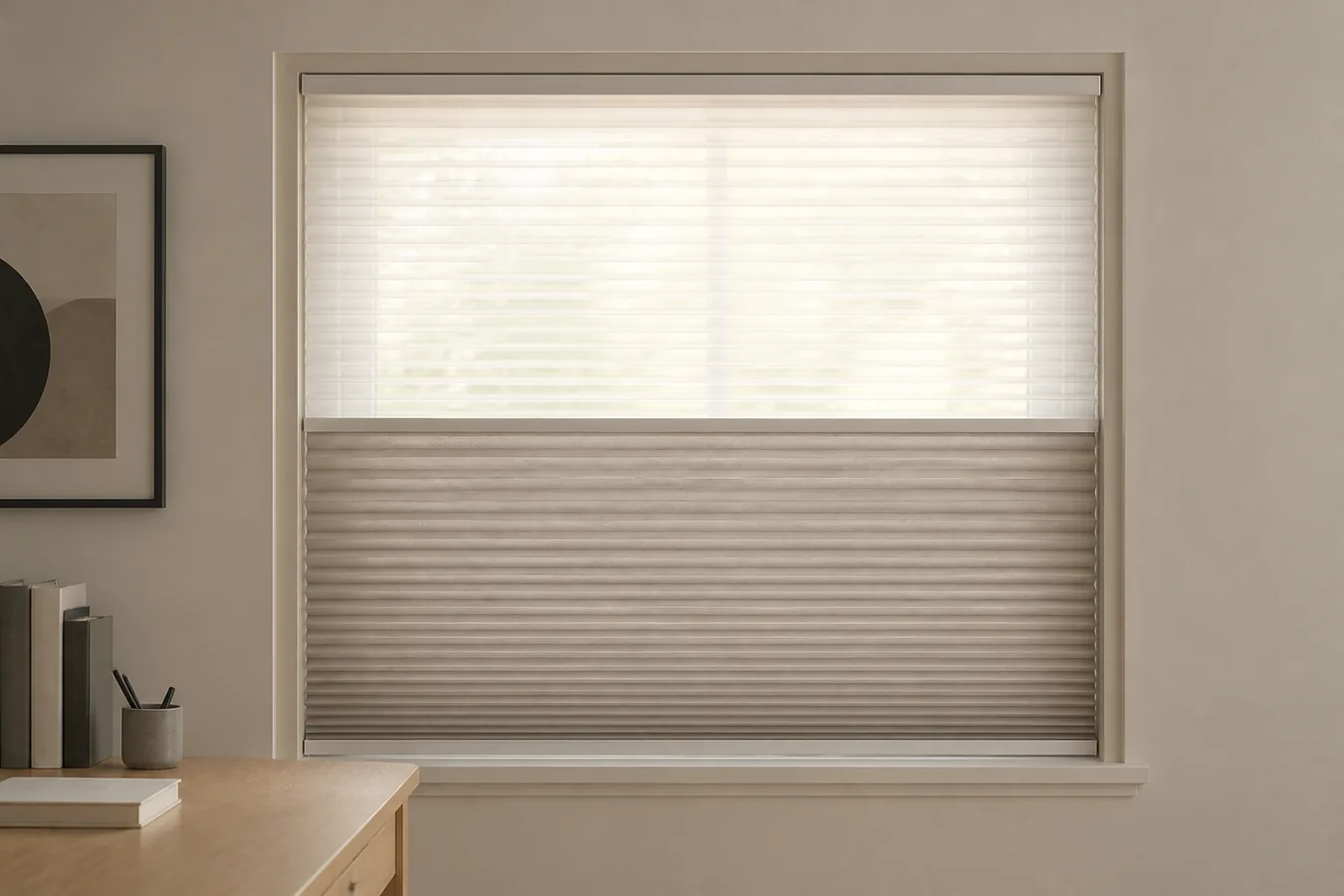
Two fabrics do not make a useful day-and-night cellular shade by themselves. The useful part is knowing which fabric is above the middle rail, which is below it, and which rail you move to change the window.
For a common vertical arrangement, keep the bottom rail lowered while the middle rail changes the share of light-filtering and more opaque fabric over the glass. Move the bottom rail when you want open glass. That distinction is the fastest way to tell whether a quote describes a complete shade or only repeats a “2-in-1” feature name.
Read the shade from headrail to sill
Begin with the physical assembly. Do not let “day fabric” and “night fabric” float around as marketing labels; attach both to a position and a rail. Record the opening, mount plane, recess depth and obstructions in the Smart Shade Measurement and Compatibility Checker first, then ask the seller to complete this chain for the exact product and control.
| Part in the exact shade | What the seller should identify | What remains unresolved if it is missing |
|---|---|---|
| Headrail | Finished height/depth, mount hardware and the panel attached below it | Fit, projection and the starting point of the upper panel |
| Upper fabric panel | Exact fabric, color, opacity description and permitted position | Which material can cover the upper part of the window |
| Middle rail | Finished rail, travel range and the control that moves it | How the shade changes from one fabric to the other |
| Lower fabric panel | Exact second fabric, color, opacity description and permitted position | Which material can cover the lower part of the window |
| Bottom rail | Travel range, fully raised position and resulting stack | Whether the shade can uncover the glass and how much remains at the top |
This is a real documented architecture, not a diagram invented for comparison. LEVOLOR’s current motorized cellular installation guide labels a Day/Night shade with a headrail, two fabric panels, a middle rail and a bottom rail. Its drawing is evidence for that named system, not permission to transfer its dimensions or controls to another shade.
If the seller cannot label all five parts, the product name has not yet told you enough to order.
The middle rail swaps which fabric owns the glass
Now freeze the bottom rail in its fully lowered position. In a common vertical configuration with a sheer or light-filtering upper panel and a more opaque lower panel, the middle rail has three useful positions:
- Move the middle rail near the bottom and the upper panel extends over most of the covered opening. The lower panel compresses near the bottom rail.
- Move the middle rail near the top and the lower panel extends over most of the covered opening. The upper panel compresses below the headrail.
- Stop between those ends and both fabrics share the window, divided by the middle rail.
The middle rail is therefore a fabric selector and divider. With the bottom rail still at the sill, it does not create a large area of open glass; it redistributes two panels inside the same covered span.
That gives the article’s “day” and “night” states a precise meaning. They are not times on a clock and they are not proof of a measured darkness level. They are two fabric-dominant configurations that still depend on the exact opacity, finished side gaps and room conditions. Use the light-filtering versus room-darkening guide to specify the fabric job without turning either label into a guarantee.
The transition position matters too. Put the middle rail where it would actually sit when you want daylight above a desk, privacy across a lower sightline or a visual division at the sash. If that rail lands in an awkward sightline, two good fabrics can still make a poor configuration.
The bottom rail is the route back to open glass
Keeping both motions separate prevents a common disappointment: approving two covered states but never checking the fully raised shade.
In the same common vertical architecture, the bottom rail defines the lower edge of the whole assembly. Raising it gathers the cellular panels and middle rail toward the headrail, exposing glass below. The resulting top package includes fabric and hardware; it cannot be predicted from a fabric swatch or from the word “cellular.” Ask for the finished raised position at your ordered height.
Control sequence can matter. LEVOLOR’s January 2025 Premier Cellular reference guide describes an exposed middle rail for its cordless Day/Night application and gives a specific sequence for operating the middle and bottom rails. It also notes that rails may drift slightly. Treat those points as instructions for that named application. Your product may map the two motions to different hand positions, wands, buttons or remote channels.
Replay the movement at the real window. Can the user reach the middle rail when it is high? Can the shade be fully raised without moving furniture? Does the stack cover a critical view or latch? If the opening is tall or the selected control is motorized, move to the motorized cellular shades guide only after this two-panel shade itself has passed.
The panel order can reverse
“Sheer on top, opaque on the bottom” is common enough to feel like a definition. It is not one.
In LEVOLOR’s current reference guide, several named vertical Day/Night controls require the top panel to be sheer and allow the bottom panel to be semi-opaque or opaque. The same guide reverses that fabric-placement rule for its skylight Day/Night configuration: the bottom panel must be sheer, while the top may be semi-opaque or opaque.
The point is not that every skylight shade follows LEVOLOR’s rule. The point is that orientation belongs to the exact configuration. A seller should return both fabric names attached to “upper panel” and “lower panel,” not merely list two swatches.
This also changes what each middle-rail direction produces. If the panel order reverses, a memorized instruction such as “move the middle rail up for privacy” can reverse with it. Describe the result by fabric position—“the greige opaque panel covers the opening”—rather than by an unqualified direction.
Cell construction is a separate choice. If the quote changes from one cell construction to another while it changes the panel order, resolve that in the single-cell versus double-cell cellular shades comparison and then return to one fixed Day/Night configuration. Otherwise two variables move at once.
Similar names can hide different mechanisms
A two-fabric promise can be delivered by more than one kind of shade. Choose the mechanism before comparing options.
| If the required result is… | Mechanism to examine | Do not assume… |
|---|---|---|
| One cellular assembly that changes which of two fabrics covers the window | Day/Night cellular with a documented middle rail and bottom rail | That either panel can occupy either position |
| One fabric that can lower from the top to preserve a selected view or privacy line | Top-down/bottom-up cellular | That it includes a second fabric |
| Two separately rolling sheets with independent coverage | Dual roller shade | That it shares the compact headrail, stack or motion of a cellular shade |
If the real goal is to lower the top edge of one fabric, use the top-down bottom-up shades guide to draw the observer and privacy line. If the goal is two independently controlled roller layers, use the dual shades guide and account for its two-roll headrail and service envelope.
Brand features need the same architecture check. Hunter Douglas describes Duolite as combining two fabrics, but the enhancement appears across more than one shade architecture; its Duette cellular page confirms a cellular option without making another line’s rail behavior transferable. Ask for the assembly drawing that belongs to the exact product behind the feature name.
Make the control prove both motions
“Cordless available” or “works with a remote” is not yet a control plan. A Day/Night configuration needs a reliable command for the middle rail and another for the bottom rail. The returned record should show both.
| Field to return for the configured shade | An answer that closes the field | Hold when… |
|---|---|---|
| Middle-rail control | Exact grip, wand direction, button or motor channel | Only the general control family is named |
| Bottom-rail control | Exact grip, wand direction, button or motor channel | Open-glass motion is not demonstrated |
| Fabric placement | Upper and lower fabric names tied to physical panels | Two fabrics are listed without positions |
| Travel and stop positions | Both rails shown at their useful endpoints and transition | A staged image replaces the operating record |
| Finished fit and stack | Headrail/middle-rail dimensions and fully raised position for the ordered size | A stock photo or another size is substituted |
| Size and option eligibility | Current exact row passes for width, height, fabrics and selected control | Product-page availability is treated as configured approval |
Current LEVOLOR records route Day/Night size standards through the selected control and fabric conditions. That is enough to prove the table can change; it is not a universal size chart. Recheck the current row after choosing cordless, wand or motorized operation and after assigning the two fabrics.
Do the same for the finished light result. A room-darkening lower panel does not close the light channels around an ordinary shade. If edge leakage is a decisive problem, treat blackout shade side tracks as a separate closure system and confirm that it is actually offered with the chosen Day/Night product. Never add tracks by analogy.
Put the whole order in one sentence
Before paying, ask the seller to return a sentence in this form:
Please return one sentence for my named opening and ordered size. State the exact product/version; the upper fabric and opacity description from headrail to middle rail; the lower fabric and opacity description from middle rail to bottom rail; the control for each moving rail; the fully raised position; and whether this fabric-and-control configuration passes the current size and option table.
Then make the decision from the sentence, not the feature badge. If the panel order, either rail motion, the raised position or selected-control eligibility is absent, hold the order. If the completed sequence cannot create the states you need, return to the roller, cellular, Roman and zebra shade comparison and choose a different mechanism.
When every field is explicit, the middle rail earns its place: one shade can change fabric without requiring two independent rolls, and the bottom rail can still return the window to open glass.