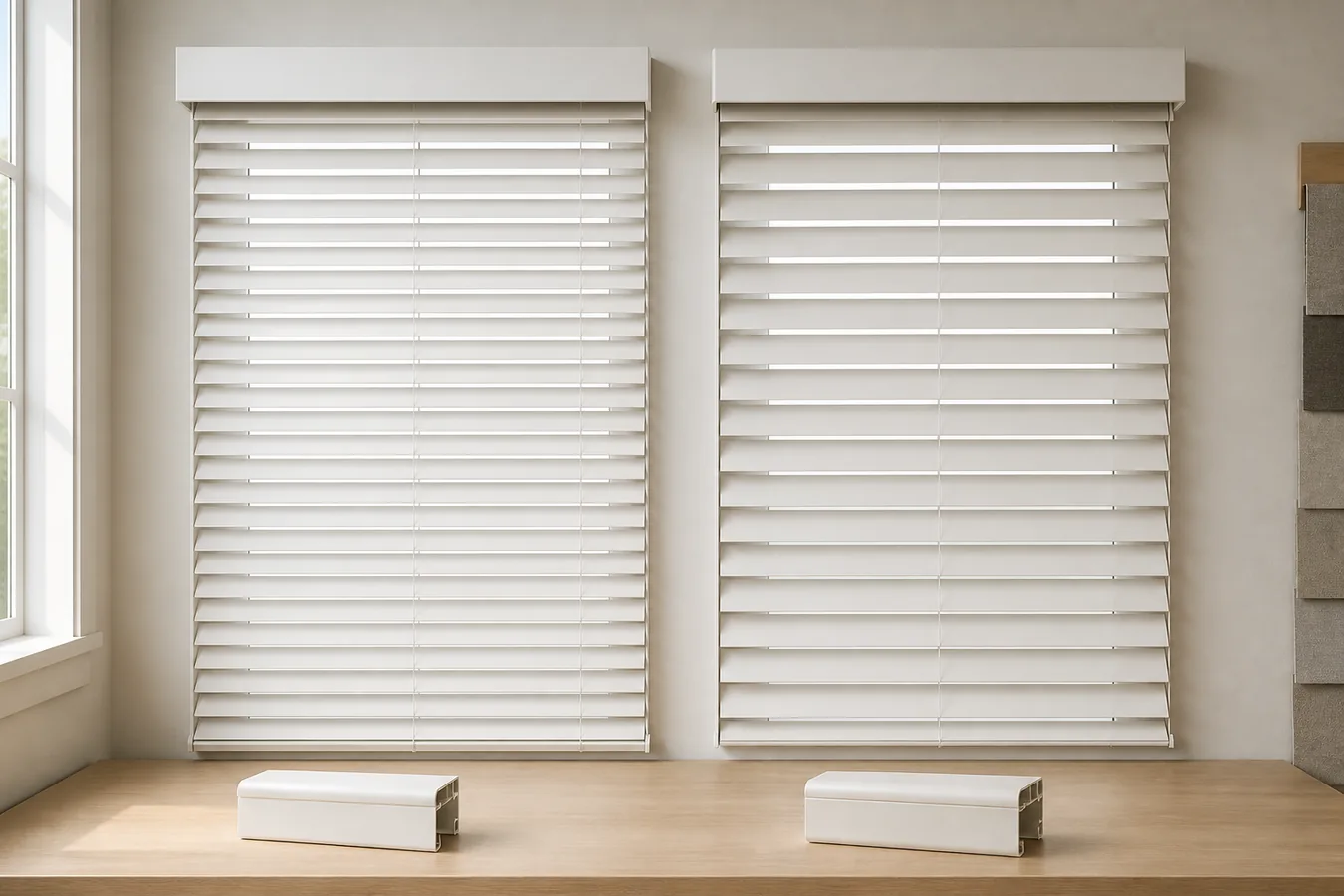
Half an inch sounds like a style choice when you hold two blind slats in a showroom. At the window, however, you are not buying a loose slat. You are buying a complete blind whose headrail, valance, mounting depth, ladders, raised package and available controls may belong to that slat-size configuration.
The safest comparison keeps the opening, product family, material, color, mount and control the same. Ask the seller to return one complete 2-inch row and one complete 2.5-inch row. Eliminate either row that fails the opening or a required operating state. Only then should the look of the slats break the tie.
Make slat size the only moving part
Start with one measured opening, not two attractive samples. If you have not recorded the recess, trim and obstructions yet, put them in the Smart Shade Measurement and Compatibility Checker first. Decide inside versus outside mount before comparing slat sizes; otherwise mount and slat size change at the same time and the result proves very little.
Slat size is also downstream of the product-format decision. If the room could use a fabric shade instead of tilting slats, settle smart blinds versus motorized shades before building these two rows.
Give both candidate rows the same starting specification:
| Keep identical | 2-inch configuration | 2.5-inch configuration |
|---|---|---|
| Opening ID and finished width × height | Exact same opening | Exact same opening |
| Product family, material and color | Exact same selection | Exact same selection |
| Mount and valance style | Exact same selection | Exact same selection |
| Control and operating side | Exact same preference | Exact same preference |
| Headrail and valance section | Seller returns actual dimensions | Seller returns actual dimensions |
| Minimum flush depth | Seller states it or marks NOT STATED | Seller states it or marks NOT STATED |
| Brackets, spacers and projection | Exact included/required parts | Exact included/required parts |
| Ladder count and positions | Full-width drawing or sample | Full-width drawing or sample |
| Fully raised height | Finished dimension | Finished dimension |
| Selected control eligibility | PASS, FAIL or exact restriction | PASS, FAIL or exact restriction |
| Configured size/area limit | Exact row passes or fails | Exact row passes or fails |
This is not a formality. Current manufacturer records show why the nominal slat label cannot stand in for the finished blind. LEVOLOR’s current Wood and Faux Wood technical guide lists separate configuration details and option/limit rows across 2-inch and 2.5-inch products. The exact entries belong only to that guide, but the lesson transfers: rerun the entire row when the slat size changes.
If the material label is still unsettled, stop here and resolve it with the composite-versus-faux-wood guide. Slat size cannot compensate for an unverified substrate, weight, care or warranty record.
A tilted sample is only one view
Showroom panels are usually lowered and tilted to an appealing angle. That is one useful view, but it is also the easiest state for both options to look acceptable. Compare the same two configurations in four states, at the scale of the real opening.
- Lowered and open: look from the chair, doorway or counter that matters. Do not assume that the wider slat produces a better view; ask for the actual full-height sample or rendering.
- Tilted for the room’s normal daytime use: check the whole face, not one slat. The number of horizontal courses and visible ladder routes can change the rhythm.
- Fully closed in both tilt directions the product permits: inspect the edge overlap, ladder routes and the view from inside and outside. A material sample cannot demonstrate the completed closure.
- Fully raised: record the top package and exposed glass. Fewer nominal slats do not prove a shorter raised package because tapes, overlaps, bottom rail and operating hardware still belong to the exact system.
Use the same camera position, light and tilt setting for both samples. If a seller supplies only a close-up of the slats, it has not shown the window-scale decision. A current product page such as Hunter Douglas Parkland confirms that both nominal sizes can exist in one modern family; it does not make the finished geometry of another family interchangeable.
The visual choice is legitimate. It just belongs after both blinds have been shown doing the same jobs.
The side section can veto 2.5 inches
Now turn the comparison ninety degrees. A front elevation can make the two blinds look nearly identical while their headrail or valance occupies a different depth.
Ask for one side section of each complete configuration. It should label the window frame, glass, headrail, valance, bracket, spacer if required, slat path and the most projecting part of the hardware. For an inside mount, add the recess depth and the supplier’s stated minimum for the desired finished condition. “Fits inside” and “sits flush” are different approvals.
For an outside mount, add the trim face and the wall plane. A deeper headrail may still fit, yet project farther than expected or need a different block arrangement to clear raised casing. Do not improvise a spacer from another product’s instructions.
The February 2025 LEVOLOR Premier Wood reference guide is a useful product-specific example: its documentation treats spacer blocks differently for named 2-inch and 2.5-inch configurations. That does not create a universal spacer rule. It proves that the side section must come from the exact row you intend to buy.
Use the side section as a veto, not as a reason to rationalize a preferred look. If one row cannot meet the required mount condition, clears the trim only with unapproved parts, or hides a required depth, that row is not ready for this opening.
Width and control rewrite the option table
A slat-size choice can survive the fit drawing and still fail at checkout. Rebuild the option table with the actual width, height, material and control selected—especially for cordless or motorized operation.
In LEVOLOR’s current technical guide, maximum motorized area varies across named real-wood/faux-wood and 2-inch/2.5-inch combinations. Those figures are not a formula for other blinds. They demonstrate that “this product is motorized” is incomplete evidence; the configured row must pass.
| Return this field for both rows | Acceptable answer | Reject or hold when |
|---|---|---|
| Exact width and height | Both sit inside the current row’s limits | Seller cites only a category-wide range |
| Selected control | Available for this slat, material and size | Control appears on the product page but not the configured row |
| Operating side and access | Usable after installation | Reset, charging or manual access is hidden |
| Multiple-blind arrangement | Headrails, gaps and controls are drawn | A wide opening is split without finished gap positions |
| Required safety route | Exact approved configuration is named | A corded alternative is silently substituted |
If the control choice is still open, make that decision with the cordless and motorized blinds child-safety guide before accepting a slat-size row. The goal is not to force motorization. It is to prevent an appealing 2.5-inch sample from being paired with a control the full-size blind cannot use.
Count ladders with the slats
Once both rows pass fit and operation, compare the complete face. Wider slats generally mean fewer slat courses across the same nominal height, but the exact visual result also includes overlaps, ladder routes, bottom rail and full-width proportions. Request a front view at the ordered width rather than extrapolating from a narrow sample rack.
Mark the ladder positions on both views. In current technical records, ladder count and spacing can depend on product and finished width. That makes the question more useful than “Are 2.5-inch blinds more modern?” A ladder route that disappears on a small sample may sit directly in a prominent sightline on a wide window.
For adjacent blinds, compare the group as installed. Headrail divisions, center gaps, control ends and ladder routes can create a stronger pattern than the difference between individual slats. If what you really want is the broad, framed appearance of a shutter, compare the complete installed states in the shutters-versus-blinds guide rather than asking a blind slat to imitate another product category.
At this point, preference gets a proper vote. View both passing rows at the real width, fully closed and at the usual tilt. Choose the one whose entire face suits the room—not the loose sample that looked best in your hand.
Let one failed state decide
Read the two rows from constraints to preference:
- If only one configuration passes the mount, selected control, configured size and all four window states, choose that one.
- If both pass, compare the real full-window face and headrail projection. Pick 2 inches or 2.5 inches deliberately; neither is a universal upgrade.
- If a required field is missing, do not fill it with another brand’s number. Ask the seller to complete the row or remove that candidate.
Send one concise request with the opening:
Please return the 2-inch and 2.5-inch versions of this exact product, material, color, mount, valance and control. For each, show the headrail/valance side section, minimum flush depth, brackets or spacers, ladder positions, fully raised height, control eligibility, configured size/area result, and full-window views lowered-open, tilted, closed and fully raised.
The half-inch difference matters only after it survives the whole blind. That is the comparison worth ordering from.