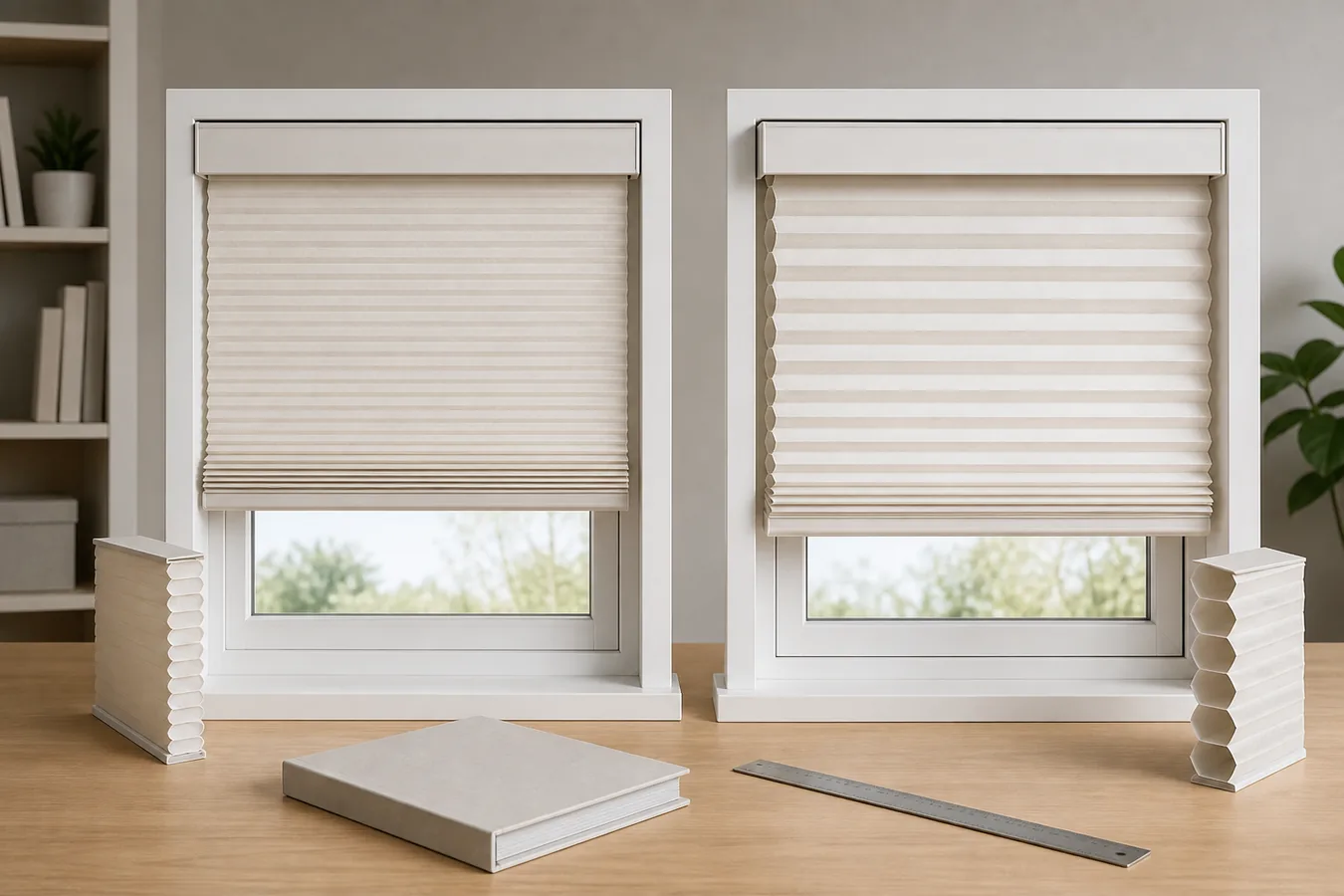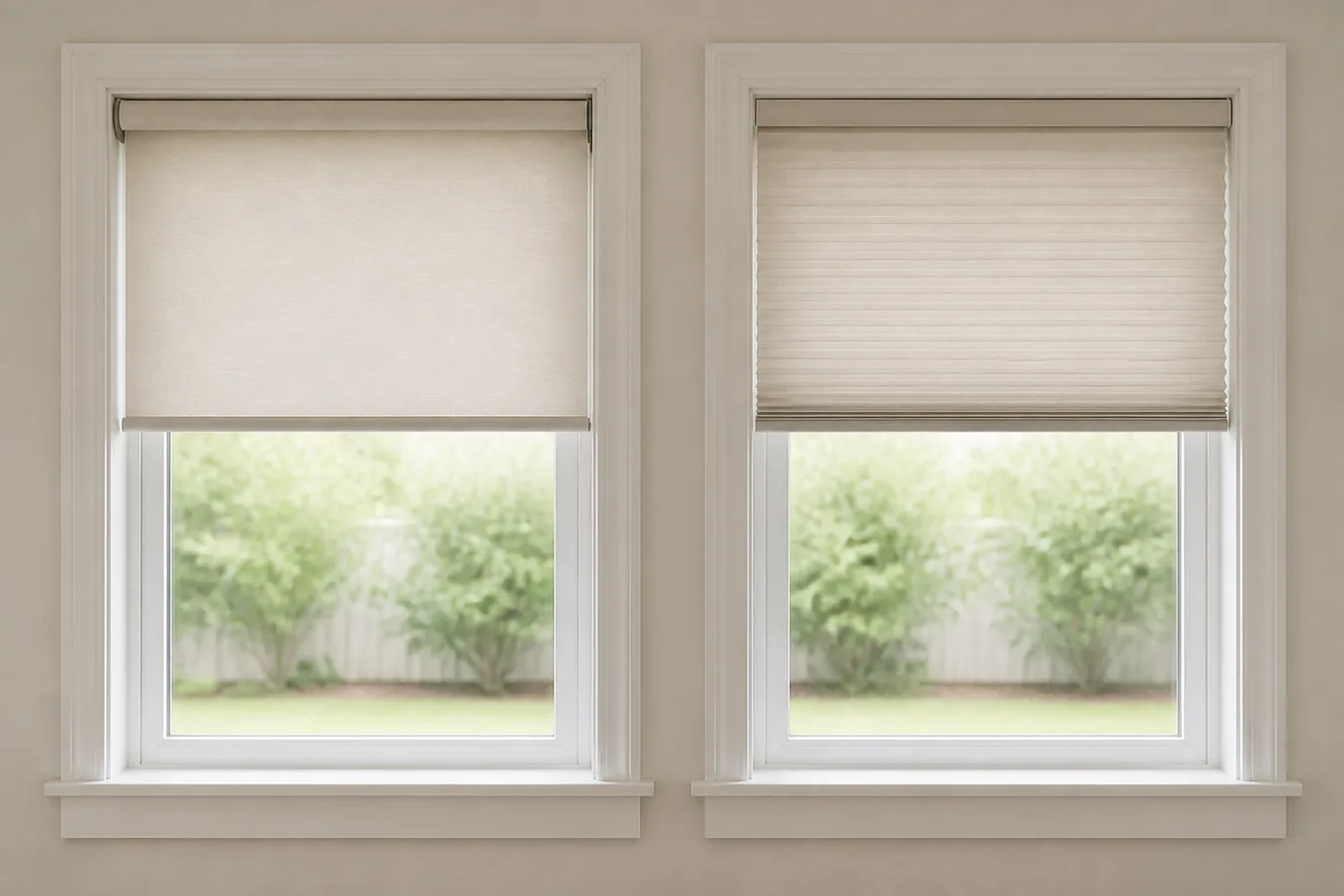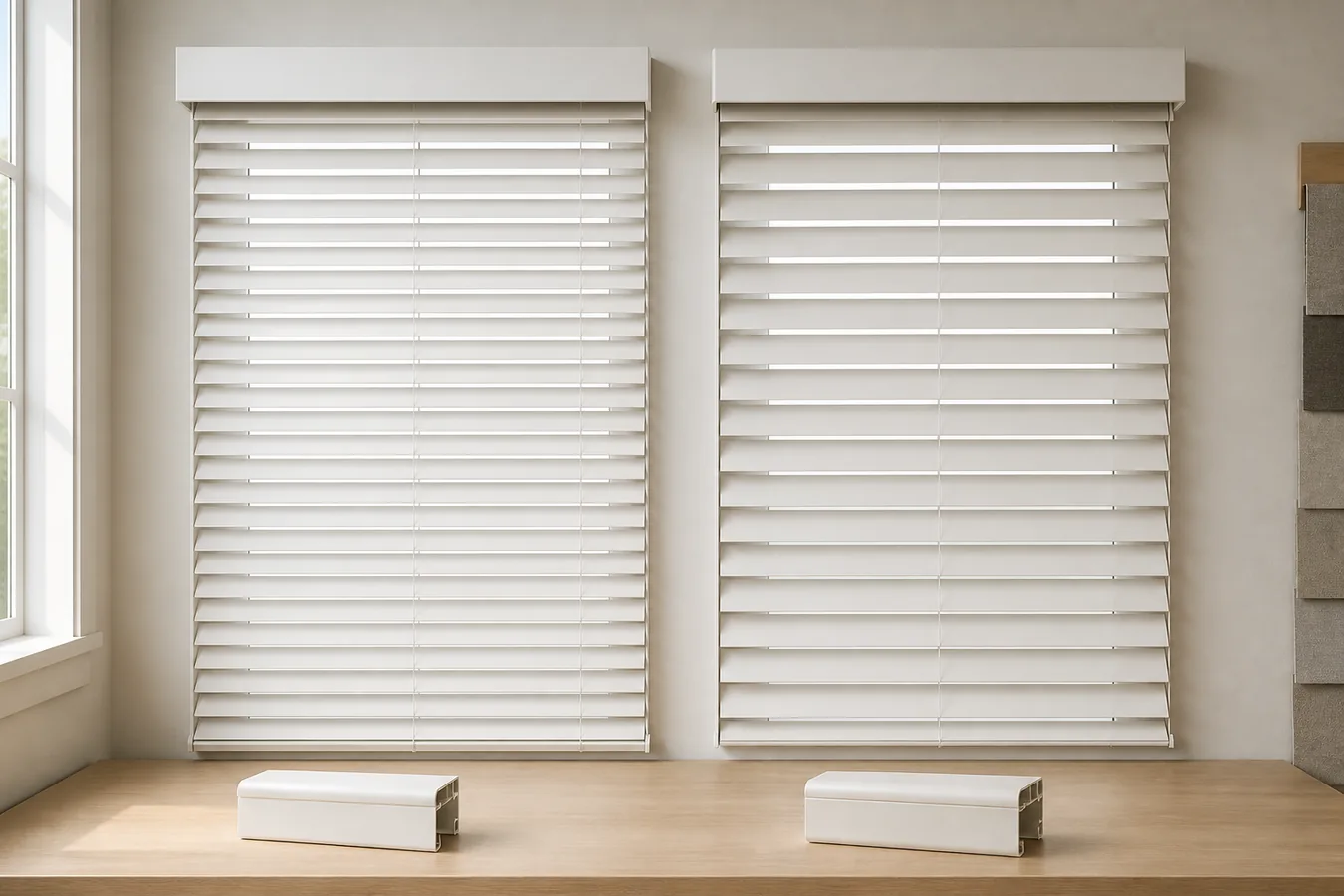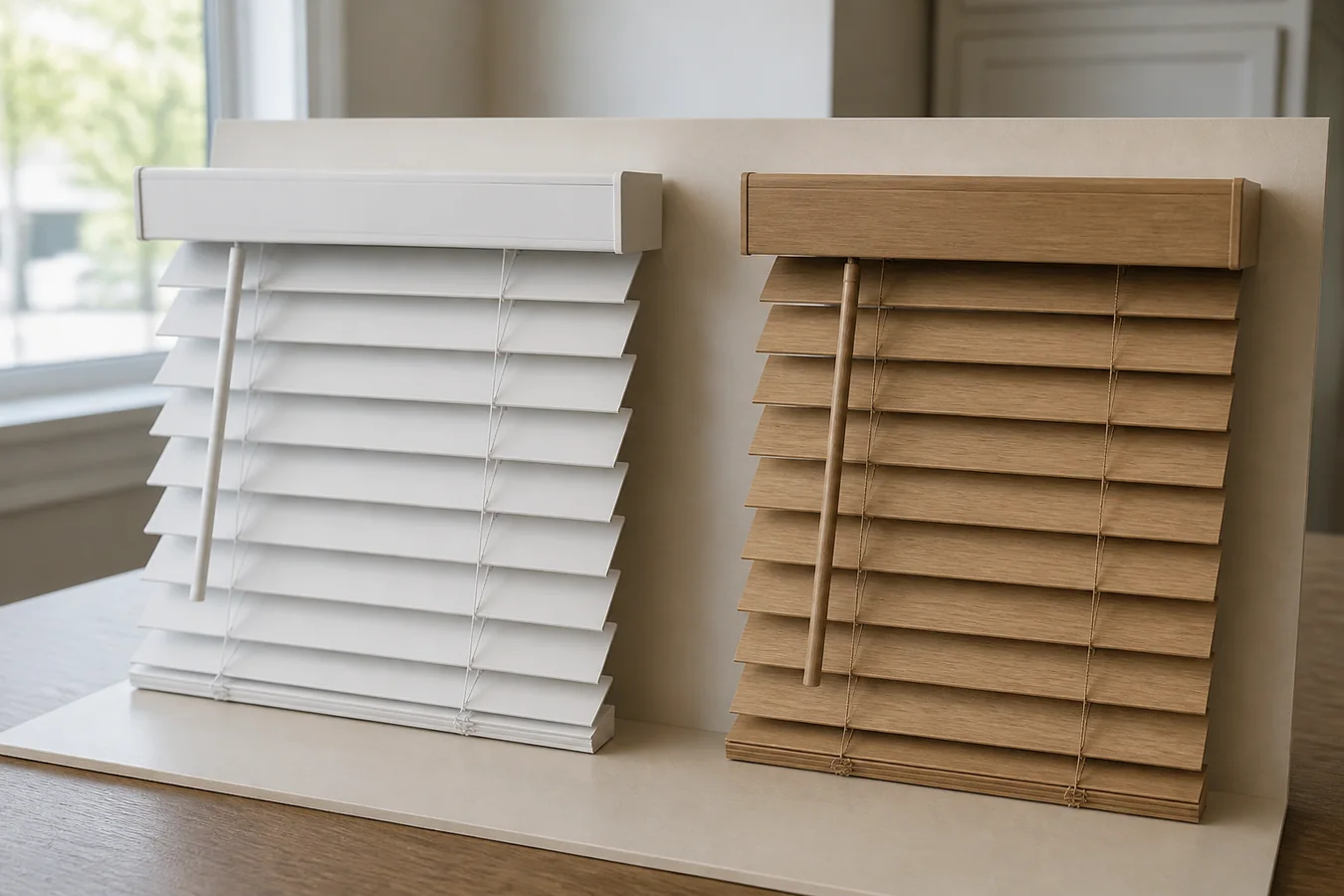
“Composite” and “faux wood” sound like two materials waiting for a winner. In the market, they are often overlapping product labels. A seller may use faux wood for a synthetic slat family and composite for one formulation within it; another may divide the terms differently.
Do not choose the label. Ask what the exact slat is made of, how the finished blind is reinforced and operated, and which limits and care rules apply to that product. If those fields are blank, a confident moisture, durability or weight comparison is only a story.
Build two product records before comparing
| Field | Product A | Product B | Why it can change the choice |
|---|---|---|---|
| Exact product and slat composition | Name, code and manufacturer wording | Name, code and manufacturer wording | Prevents an overlapping category label from standing in for a material. |
| Slat size and reinforcement | Named option and construction | Named option and construction | Affects appearance, weight and available finished sizes; exact limits remain product-specific. |
| Finished size, weight and lift | Quoted width/height, lift, tilt and any split | Quoted width/height, lift, tilt and any split | The useful comparison is the complete blind on this opening. |
| Moisture and care instructions | Permitted room/use and exact cleaning rule | Permitted room/use and exact cleaning rule | “Moisture resistant” does not define submersion, condensation, steam or cleaning chemistry. |
| Warranty exclusions | Current named-product terms | Current named-product terms | Shows whether the intended exposure and dimensions remain covered. |
Complete every cell from a current product guide, written quote or manufacturer response. A product guide such as Bali’s current wood and faux-wood guide can show how one manufacturer defines its families and options. It does not define every composite or faux-wood blind.
Translate composition into the decision you actually face
A material description matters because it can change weight, stiffness, surface behavior and permitted care. Those effects are not safe to rank from the category word alone. Ask the seller to connect each claim to the named slat and finished size.
For a wide window, request the supported width, any required multiple blinds on one headrail, intermediate supports and finished weight for the quoted dimensions. If slat bow or closure matters, ask for the manufacturer’s allowable span and an image of the named product at a comparable width. Do not transfer a maximum width from another collection, slat size or lift system.
For a bathroom or other damp room, replace “waterproof” with the actual exposure: occasional humidity, recurring condensation, splash, or direct water. Then compare the manufacturer’s placement and cleaning instructions. A suitable synthetic slat does not make the headrail, ladder cords, tapes, finish or fasteners immune to every exposure.
For a dusty, greasy or frequently handled room, ask what can touch the surface and how the slats are supported during cleaning. An easy-wipe claim is useful only when the exact finish and permitted cleaner are named.
Color samples need the same identity discipline. White, stained and painted finishes can reveal surface texture and edge treatment differently under side light. Request the actual finish on the actual slat material, then view it vertically at the window. A digital swatch or a wood-look name cannot prove sheen, printed grain, color match between rails and slats, or how replacement parts will look later.
Compare the complete blind on the same opening
Use one measured opening for both quotes. Give each seller the same mount, width, height, depth, trim, handles, desired slat size, tilt direction, lift type and privacy state. Record those inputs in the Smart Shade Measurement and Compatibility Checker.
Now compare the parts you will operate: headrail projection, stacked or raised position, tilt control, bottom rail, cords or wands, split configuration and service access. The completed lift can reverse a material preference. A heavier-looking slat may be acceptable on a modest opening with a supported control, while the same family may require a different layout on a wide one.
Operate the sample blind or showroom display at a comparable height if one is available, but do not report that experience as proof of the custom order. Use it to form questions: how much effort does the quoted lift require, do the slats close consistently in both directions, and is the control reachable behind furniture? The written product limits and final configuration still decide.
If children are present, apply the current safety requirements to the finished operating system, not just to the slat. The cordless and motorized child-safety guide explains that boundary. “Cordless lift” should not distract from other accessible parts or from the changing room layout.
Reject any advantage that cannot name its product
Statements such as “composite is lighter,” “faux wood is more durable” or “one handles humidity better” may be true for a particular pair. They are not a sound conclusion until both products are identified and the relevant spec or instruction is attached.
This is also why a generic price comparison is weak. Compare two completed quotes with the same opening, slat size, finish level, valance, controls, freight, installation scope and warranty basis. A lower base price for an incomplete configuration is not the cheaper finished blind.
Warranty language can expose the meaningful difference. Search for exclusions tied to width, moisture, warping, color change, commercial use or installation. Record what the document actually covers and for how long; do not convert a longer headline term into a promise that every failure mode is included.
Write the winning specification as one sentence
Your decision should be specific enough to survive a changed product label: “Choose Product B in the quoted two-on-one-headrail configuration because its documented size limit, permitted damp-room care and cordless tilt/lift fit this opening; Product A remains unknown on width and warranty exposure.”
If you cannot write that sentence without using only “composite” and “faux wood,” the comparison is not finished. Return to the broader smart blinds versus motorized shades decision path for terminology, or use the blinds-versus-shades guide if the slatted format itself is still undecided. The winner here is the product record that closes the real opening with the fewest critical blanks.