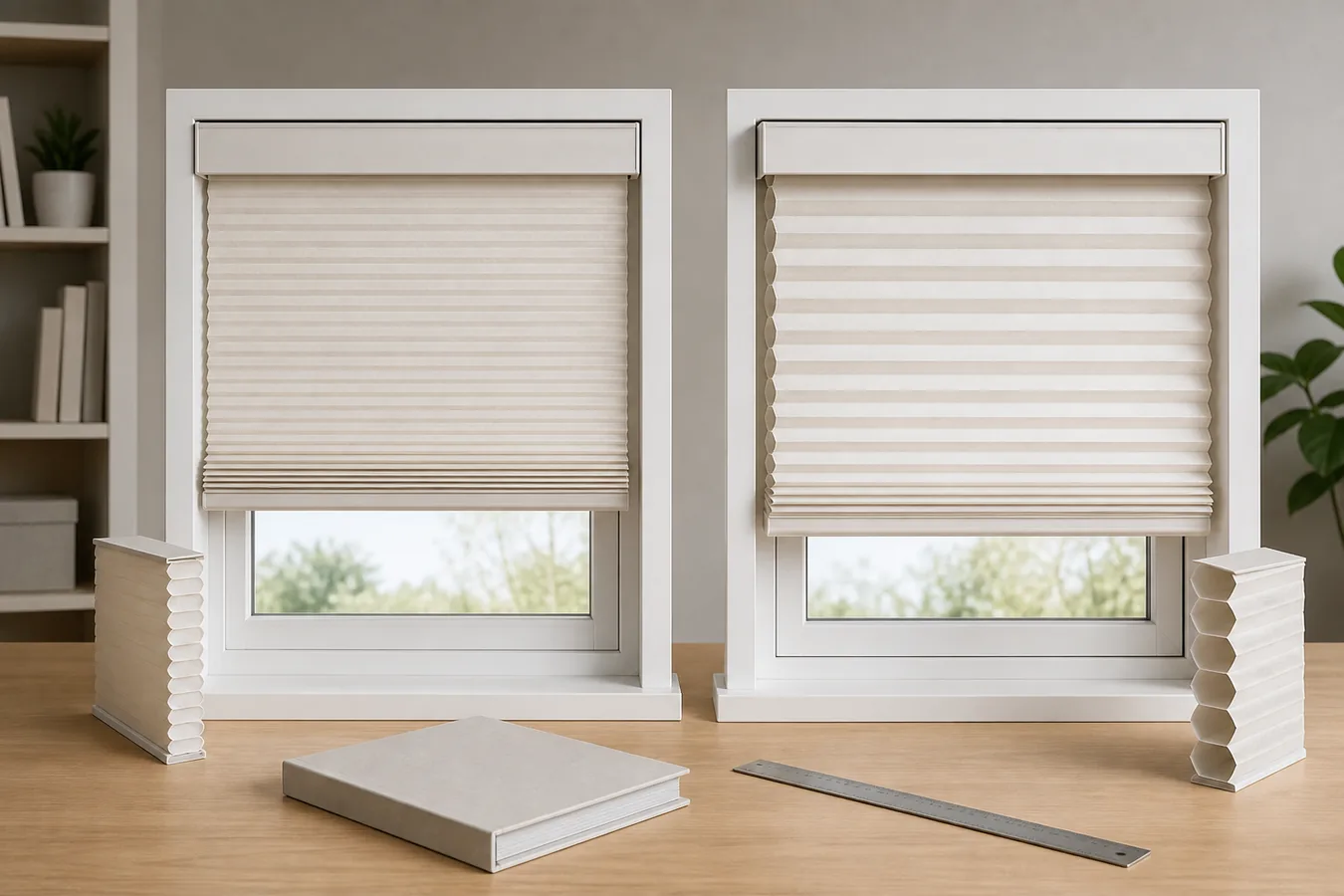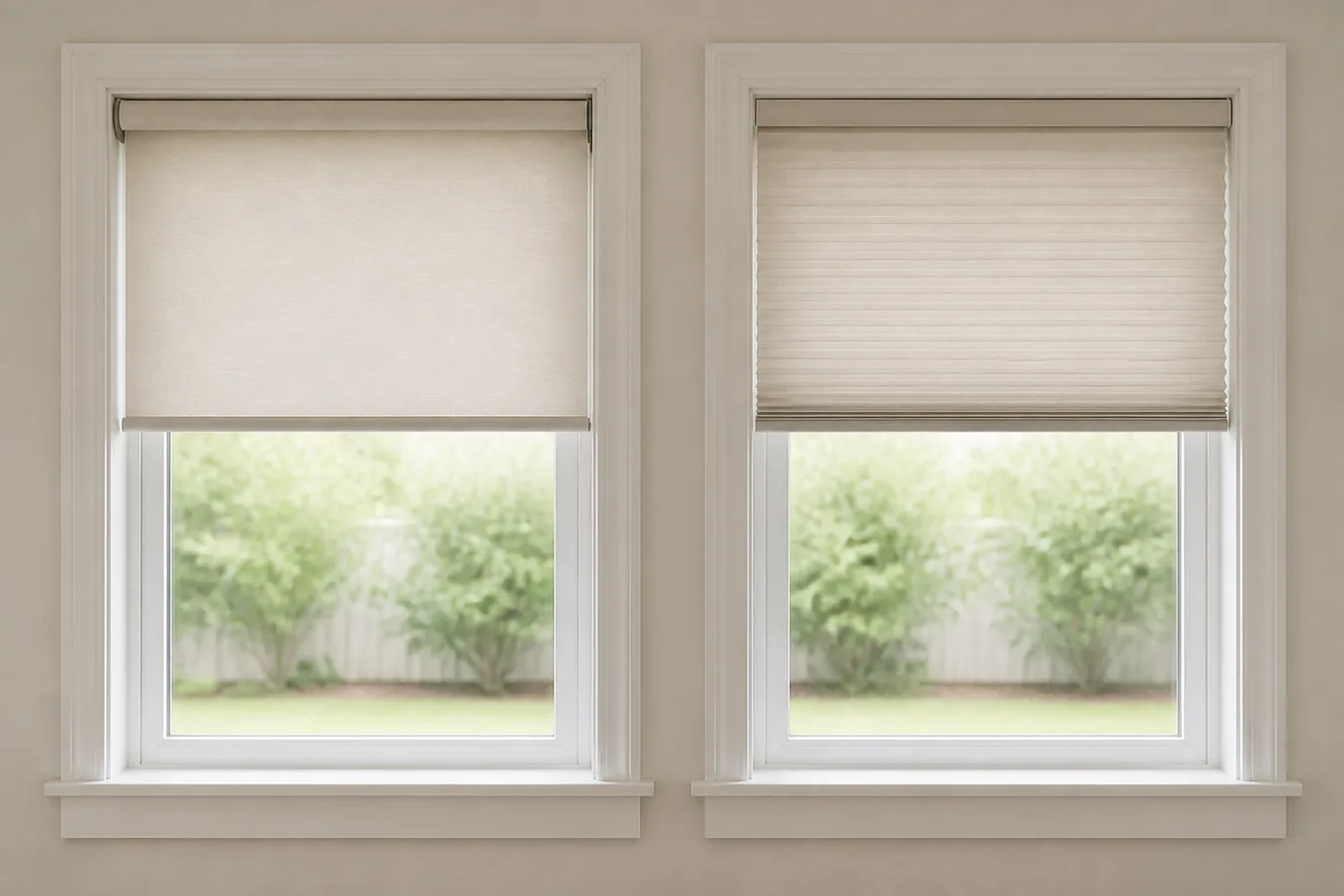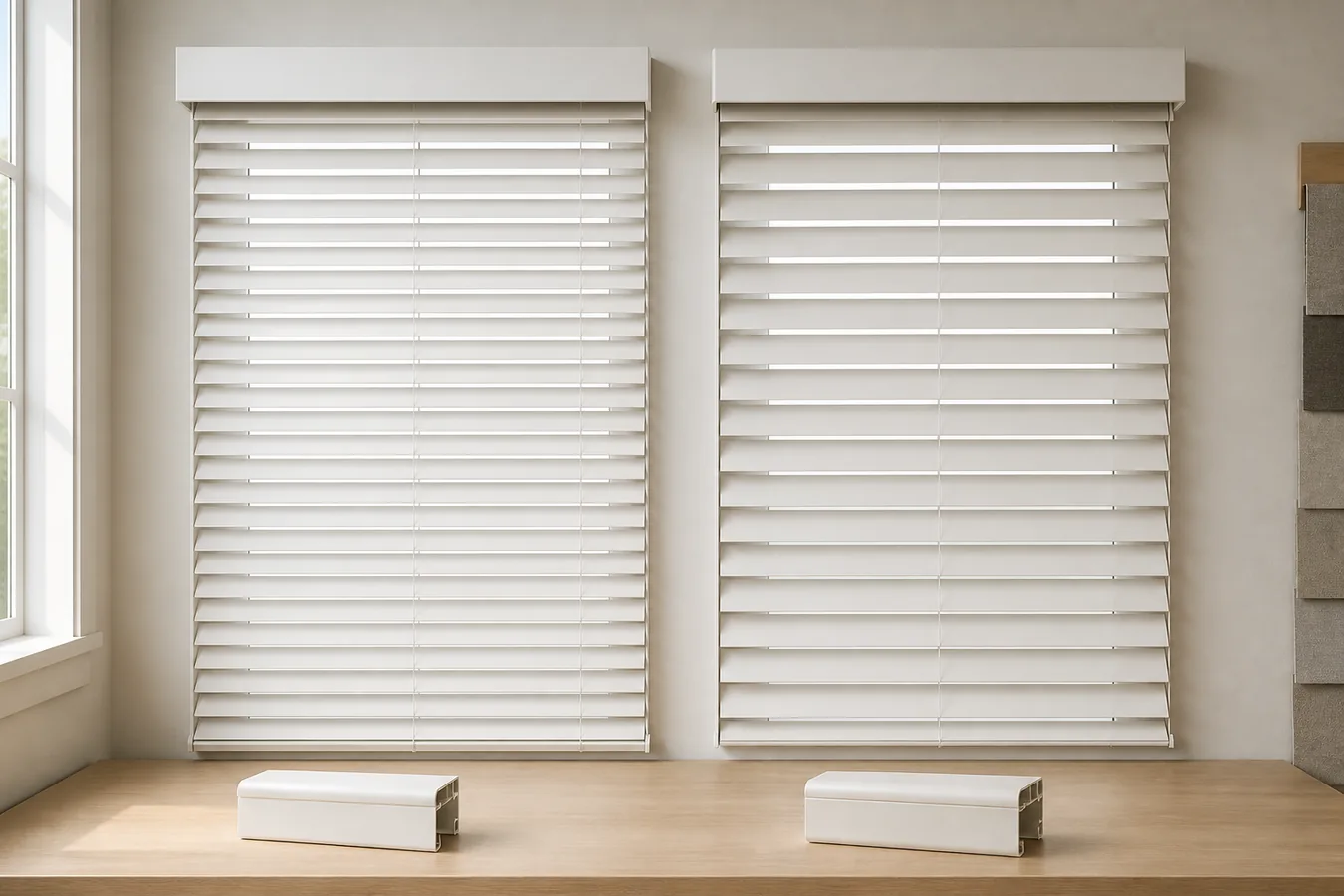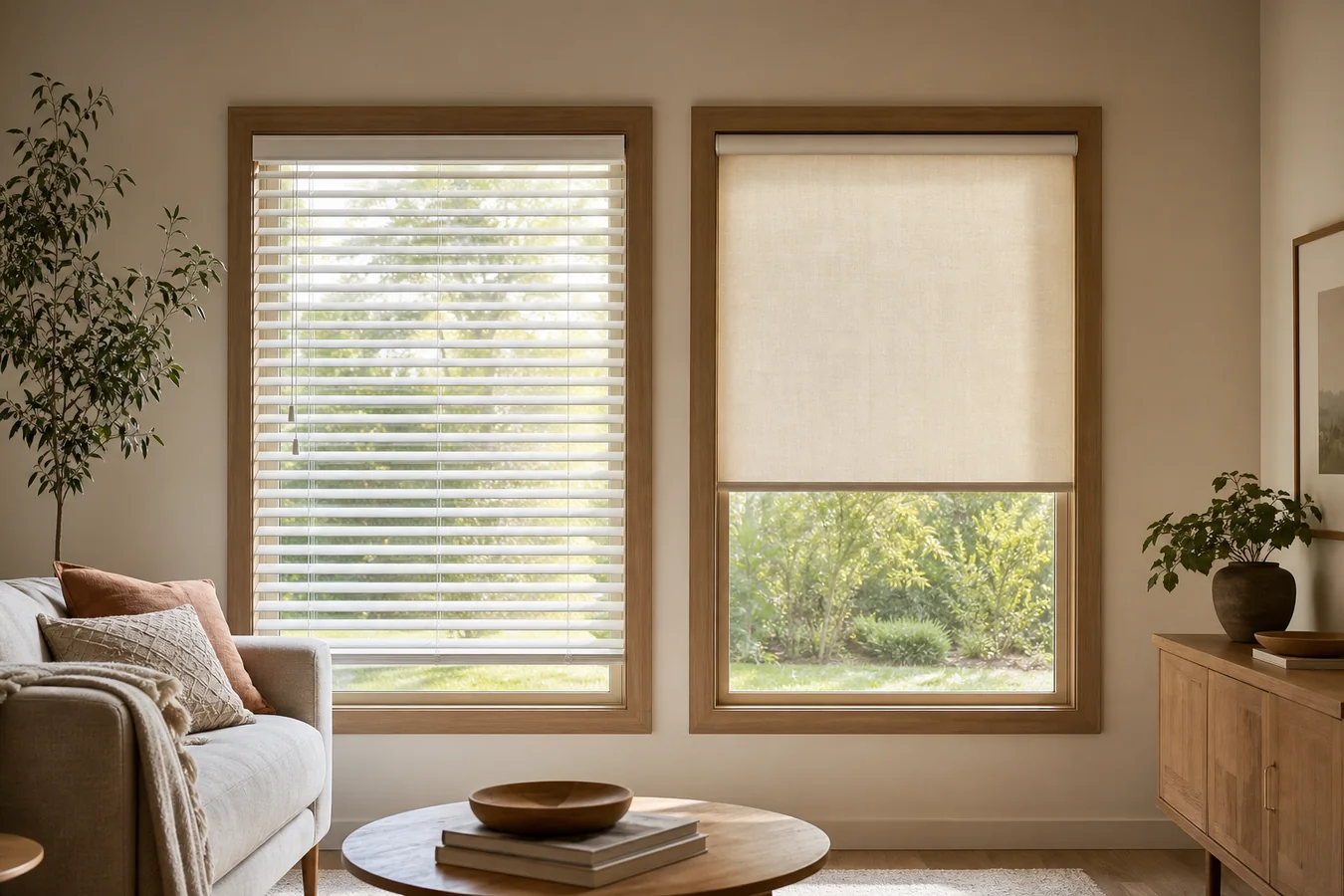
Choose blinds when you need to redirect light without uncovering the window. Choose shades when you want a continuous surface to diffuse or block light, or when a cellular construction’s insulating air pockets matter.
That answer is a starting point, not a purchase verdict. Ask what the window must do while it is still covered. The answer separates a real functional difference from labels such as “stylish,” “blackout,” “smart,” or “easy to clean.”
The difference that matters is mechanical
Conventional blinds use horizontal or vertical slats that can rotate. Conventional shades move a continuous piece—or connected pleats—of flexible material across the opening. Both can raise, lower, be cordless, or be motorized. The extra state that blinds add is slat angle; the extra work that shades give to the material is diffusion, opacity, texture, or cellular structure.
That distinction is more useful than the product name. Some products sold as “shadings” add fabric vanes, alternating sheer and opaque bands, or two layers. If it can create states beyond a normal slatted blind or a simple fabric panel, compare its actual construction in the motorized shade-type guide instead of forcing it into this binary choice.
Retailers do not always use blind and shade consistently, especially across regions. Read the construction line and operating description. A listing title is not enough to prove whether you are buying slats, one fabric plane, a hybrid shading, or a motor accessory.
Build the three states before comparing products
Describe the window in three moments: fully open, managed daylight, and closed at night. The middle state usually decides the format. It reveals whether you need to aim light between slats or keep the glass covered behind a chosen material.
| Required result | Slatted blind path | Continuous shade path | What still needs exact evidence |
|---|---|---|---|
| Clear view when fully open | Entire blind raises and slats stack at the headrail. | Shade rolls or stacks at the headrail. | Raised stack, clear opening and interference with trim or hardware. |
| Reduce direct glare but keep some view | Rotate slats to redirect the bright angle while the blind stays down. | Raise the bottom edge past the glare line, or choose a screen/light-filtering material that changes the view. | Sun angle, observer position, fabric sample and finished gaps. |
| Daylight with the glass continuously covered | Slats remain tilted; light and sightlines pass between them. | Material can diffuse daylight over the covered area. | Exact opacity, color and view-through. |
| Night privacy | Closed slats may interrupt sightlines, but angle and gaps still matter. | Opaque material can cover the center; sheer or screen material can expose the room when it is brighter inside. | Outside observation, side gaps and bottom/top coverage. |
| Sleep-critical darkness | Slat joints and perimeter gaps can leak light. | An opaque or blackout material is the stronger starting point. | Fabric identity, mount, deductions, edge channels or overlap, and hardware. |
| Added window insulation | Not established by the word blind. | Cellular shades deserve a product-specific comparison because their cells trap air. | Current rating, exact cell/fabric/control configuration and fit. |
| Frequent fingerprints, cooking film or dust | A compatible hard surface may wipe clean, but every slat is another surface. | A flat roller may have fewer exposed surfaces; fabric care and stain removal vary. | Material-specific care and humidity instructions. |
| Cordless or motorized operation | Available on some blind configurations. | Available on some shade configurations. | Completed product, accessible cords, motor, power, local control and service access. |
Do not award a row to a category unless the row matters at this window. A bedroom that never needs a partly filtered view should not be decided by slat adjustability. An office with moving glare should not be decided by the softer appearance of a fabric panel.
Blinds win when light needs a direction
Slats do more than make the opening lighter or darker. Their angle changes the path of direct light and the line of sight. That can be valuable at a desk, a street-facing window, or a room where the view should remain available without exposing the entire pane.
The benefit has limits. A tilted slat blocks one sightline better than another; an observer above, below, or close to the window may see something different. Closed slats also leave joints and perimeter gaps. Treat “precise light control” as the ability to tune an angle—not as a promise of blackout or complete privacy.
Horizontal and vertical blinds behave differently, and slat material changes weight, cleaning and humidity suitability. If directional control is the deciding requirement, shortlist the correct orientation first, then compare the exact slat material, headrail, stack, lift and completed gap pattern.
Shades win when the surface must do the work
A continuous material plane can soften a bright window without drawing horizontal lines across it, or it can carry an opaque layer across the center of the opening. The exact fabric matters more than the broad word shade: sheer, solar, light-filtering, room-darkening and blackout materials do different jobs.
If insulation leads the decision, narrow the word shade further. The US Department of Energy explains that cellular shades form air pockets within the cells and between the shade and window; its evidence supports a cellular-shade research path, not a claim that every shade saves energy or that a particular home will achieve a guaranteed result. Compare current ratings and complete configurations for the exact product.
A standard bottom-up shade is not the only operating pattern. A top-down bottom-up shade can cover the lower sightline while opening the top of the window. That may solve a privacy/daylight conflict that a simple roller cannot, but availability, cords, motorization and hardware envelope remain configuration-specific.
Four shortcuts that choose the wrong category
“Shades are private; blinds are not”
Privacy changes with material, slat angle, gaps, lighting and observer position. Hunter Douglas’ solar-shade guide notes that a screen fabric can provide useful daytime view-through yet reverse at night when the interior is brighter. A daytime showroom view therefore cannot prove night privacy. If a screen or light-filtering material is still attractive, use the four-moment fabric test before treating it as private.
“Shades are blackout”
Blackout describes an exact material or product option, not the whole category and not necessarily the installed room. Light can still appear along the sides, above the headrail or below the bottom bar. Blinds have their own joint and edge paths. For darkness, compare the completed coverage plan rather than the center material alone.
“One category is easier to clean”
A wipeable slat can tolerate a cleaning method that a delicate fabric cannot, yet dozens of slat surfaces collect dust. A flat shade may reduce exposed edges, but a stain or absorbed odor can be harder to remove. Kitchens and bathrooms make the shortcut worse: humidity suitability follows the exact material, coating, hardware and care instructions, not the noun on the category page.
Write the likely soil next to the window—dust, fingerprints, cooking film, splash or pet contact—then read the current care instructions for the exact sample. Reject any candidate whose required cleaning method conflicts with the room.
“Cordless, motorized, smart, or cheaper settles it”
Cord safety applies to both blinds and shades. The US Consumer Product Safety Commission advises cordless window coverings where young children are present and says cordless coverings eliminate the accessible operating-cord hazard. Inspect the completed product; a motorized lift label is not permission to ignore other accessible cords.
Motorized and smart describe operation and control, not whether the covering uses slats or a continuous material. Keep that terminology decision in the smart blinds versus motorized shades guide, then verify the exact motor, power and controller after the physical format works.
Price also refuses a category shortcut. Basic and custom products exist on both sides, and material, finished size, lift, motorization and installation can dominate the quote. Compare two complete configurations that meet the same three window states; an average “blinds are cheaper” or “shades cost more” claim does not close a real order.
Let the room overturn the first answer
In a home office, follow the glare. If the bright angle moves and a useful view should remain, adjustable slats may earn their extra cleaning. If the screen needs a calm, uniformly diffused background, a tested solar or light-filtering shade may work better—provided night privacy is handled separately.
In a bedroom, start from the closed state. An opaque shade with a deliberate gap plan is often the stronger research path for darkness. If the room also needs finely directed daytime light, a blind plus a separate opaque layer may be more honest than asking one covering to do incompatible jobs.
At a kitchen or bathroom window, do not let softness versus hardness decide. Locate splash, steam, grease and the normal cleaning reach. A material whose care instructions match those conditions can beat the category that looked easier in a generic chart.
At a street-facing living-room window, map the observer height. Slats may preserve a controlled view at one angle; a light-filtering fabric may obscure detail across the center; a solar fabric may fail after dark. The winner is the configuration that satisfies both the daytime sightline and the lit-night view from outside.
Freeze the format, then solve fit and control
Once one physical format leads, stop comparing generic categories. Record the opening, intended mount plane, available depth, trim, handles, locks, raised stack and required coverage in the Smart Shade Measurement and Compatibility Checker. Use the inside-versus-outside mount comparison when recess depth and edge overlap pull in opposite directions.
Then request one complete candidate: exact material, color, finished dimensions, expected gaps, lift or motor, power path, local control, service access, care instructions, warranty and return terms. If one of those fields changes the three states, reopen the format choice before ordering.
Your final note should be specific: “This window needs [directed / diffused / blocked] light while [partly / fully] covered, [day / night] privacy, and a surface that tolerates [actual room condition]. I am starting with [slatted blinds / continuous shades], pending [exact fabric, fit and control evidence].” That sentence is more useful than a universal winner.