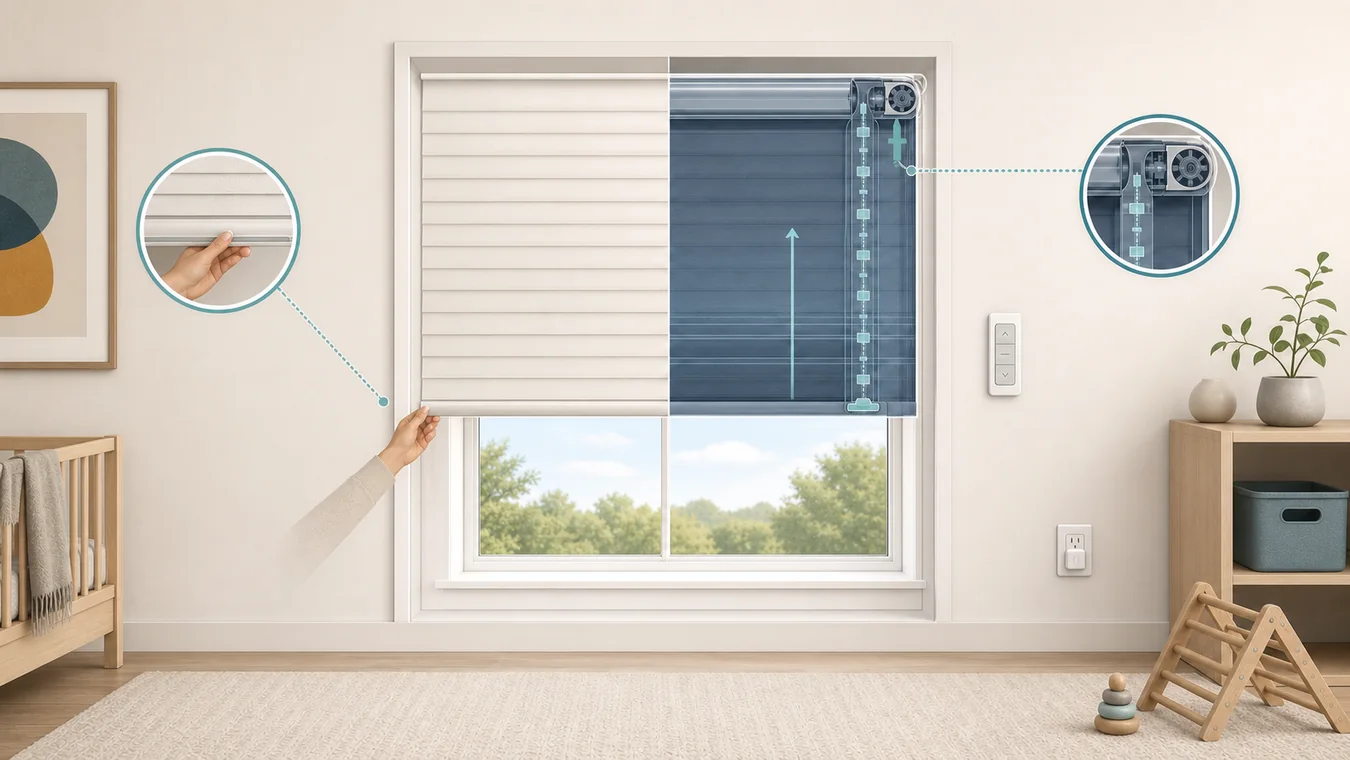
A cordless blind removes the operating cord from the way you raise, lower, or tilt the covering. It does not give you enough information to approve every part of the finished product—or the room around it.
For a home where children live or visit, close four separate questions: how the covering operates, what the maker documents about inner cords, what a child can reach around the window, and whether the chosen manual or motorized control can be used and serviced without putting climbable furniture there.
A cordless label answers one question
The U.S. Consumer Product Safety Commission says cordless window coverings are the safest option when young children are present. That makes cordless the right starting direction. The word still needs a precise meaning.
In the CPSC’s current Window Coverings 15(j) FAQ, a cordless operating system is one without an operating cord; the definition includes motorized operating systems. The same FAQ addresses inner cords separately. A finished covering may use cords inside its construction, but the applicable requirements concern whether those cords are inaccessible or too short to form a hazardous loop under the referenced test procedures.
That is why the useful shopping question is not simply, “Does the listing say cordless?” It is, “What exact finished product does that word describe, and what evidence travels with it?”
Audit four zones before you shortlist the blind
| Zone | Question to close | Evidence worth keeping | Decision if it is missing |
|---|---|---|---|
| Operating control | Does the exact configuration avoid a dangling operating cord, and how is it raised, lowered, and tilted? | Exact control name and product/configuration page; a quote that names manual cordless, motorized, short static cord, or inaccessible control accurately | Do not infer from a category tile or photo; ask the seller to identify the finished control |
| Inside the covering | What does the maker document about inner cords on this exact finished product? | Current product documentation, applicable compliance statement, or the exact product’s Best for Kids label/listing if claimed | Do not pull, open, or dismantle the covering to invent a home test; stop pending evidence |
| Room reach | Can a child reach the window, this covering, a second layer, or any cord by using a crib, bed, toy, shelf, or other climbable object? | A room photo or plan showing a clear window zone and every covering layer | Move furnishings and toys away, preferably to another wall; re-check whenever the room changes |
| Daily use and service | Can an adult operate and maintain it from a sensible position without placing climbable access by the window? | Manual reach and control path, or exact local control, power, charging, reset, and service plan for a motorized unit | Change the control or service plan before the product enters the shortlist |
A product reaches the shortlist only when all four rows describe the same product in the same room. A strong answer in one row cannot substitute for an unknown in another.
Read the finished product, not the front-of-box word
Start with identity. Record the manufacturer or fabricator, exact model or collection, chosen control, and whether the product is sold as stock or made as a custom order. Keep the configuration page or quote; a screenshot of a generic “cordless available” badge is not the same evidence.
The current CPSC 15(j) business guidance separates its scope. For stock coverings, the operating-cord path must be cordless, short—eight inches or less—or inaccessible. For both stock and custom coverings, the guidance addresses inner cords and a permanent finished-product marking. The CPSC FAQ says that marking identifies the manufacturer, importer, or fabricator; month and year of manufacture; and stock or custom designation, with order information for custom products.
This distinction matters to shoppers because it prevents a broad rule claim from being pasted onto the wrong product. You do not need to interpret a laboratory test. You need the seller or maker to bind the applicable evidence to the exact finished configuration. Follow the product instructions to locate a marking; do not dismantle a headrail, roller, or shade to look for one.
The Window Covering Safety Council’s Best for Kids program offers another product-specific signal. It is an industry program that uses designated third-party laboratories and limits eligibility according to its no-cord and inner-cord criteria. If a seller claims the certification, verify the label or listing for the exact product rather than assuming an entire brand or product family qualifies.
None of these records makes “child-safe” an absolute product promise. They replace a vague marketing word with evidence about one finished covering.
Give the window an empty reach zone
A current product does not neutralize the room around it. CPSC guidance says to move cribs, beds, furniture, and toys away from windows and window-covering cords, preferably to another wall. Apply that direction to rooms where a child lives and to rooms a visiting child can enter.
Look at the window from floor level and include everything that changes reach: a storage cube that can be climbed, a chair that moves, a toy chest, the edge of a bed, and the cord on a separate curtain or secondary shade. A motorized primary shade does not make a reachable cord on another layer disappear.
Do this room pass before finalizing the covering, then revisit it when furniture moves or the child’s reach changes. The site’s room-by-room smart-shade planner can hold the other room constraints—privacy, moisture, glare, darkness, door movement, and service access—after this safety boundary is set.
Manual cordless and motorized solve different access problems
Both paths can remove a dangling operating cord, but they create different daily jobs. Choose the one that works from the floor in the real room; do not plan to keep a chair or step stool beside the window just to operate the covering.
| Decision | Manual cordless | Motorized without an operating cord |
|---|---|---|
| Everyday movement | Bottom rail, handle, or wand must be comfortably reachable through the full useful travel | Wall control, remote, button, or documented automation can move the covering without reaching the rail |
| Exact configuration | Confirm the quoted lift and tilt method; wide, tall, heavy, or specialty sizes may change what is offered | Confirm the motor is part of a complete covering or explicitly compatible with the exact mechanism and size |
| Local operation | The physical control is local by design, but balance and reach still need to suit the user | Ask what works without an app, internet connection, bridge, or cloud service |
| Power and upkeep | No motor battery or wiring, but the mechanism still has use and care instructions | Record battery type, charge location, cable route, reset/control access, and the plan for a power or motor fault |
| Best fit | A regularly reached window where the rail or wand remains easy to use from the floor | A high, obstructed, grouped, or accessibility-sensitive window when the exact system makes operation and service practical |
Motorized is not a synonym for smart, and a retrofit motor is not automatically a complete window covering. Use the smart-blinds versus motorized-shades guide if quotes mix a full shade, a motorized control option, and a retrofit device. The inner-cord and product-identity questions still belong to the completed configuration you will install.
Treat an older blind as an identity problem first
An installed blind of unknown age and construction should not inherit the claims made for a new cordless product. CPSC notes that most window blinds sold before November 2000 have inner cords that a child can pull into a loop and says consumers should replace those blinds.
If the product date or identity is unknown, look for the permanent marking in the maker’s prescribed location and contact the manufacturer when possible. Visible wear, broken parts, a missing control, or an exposed cord is not a cue to improvise a repair that changes the mechanism.
When immediate replacement is not possible, use the steps on the CPSC’s current Window Covering Cords page for the exact cord type. CPSC is explicit that these steps reduce the hazard; they do not eliminate it. That keeps a temporary measure from quietly becoming a permanent approval.
Keep one product-and-room record
Before ordering, keep one note or marked photo with the exact product and control; manufacturer/fabricator and manufacture-date evidence; stock or custom designation; inner-cord documentation or exact certification claim; the clear room zone and every covering layer; and the manual reach or motor power, local-control, and service path.
Once the product passes those gates, record opening dimensions, mount plane, handles, locks, depth, and obstructions in the Smart Shade Measurement and Compatibility Checker. Measurement should refine a viable safety configuration, not rescue one whose identity or cord evidence is still unknown.
If every field belongs to the same finished covering and room, you can move on to material, light control, appearance, and price. If the inner-cord evidence or exact identity is missing, leave the decision open instead of approving the word cordless by itself.