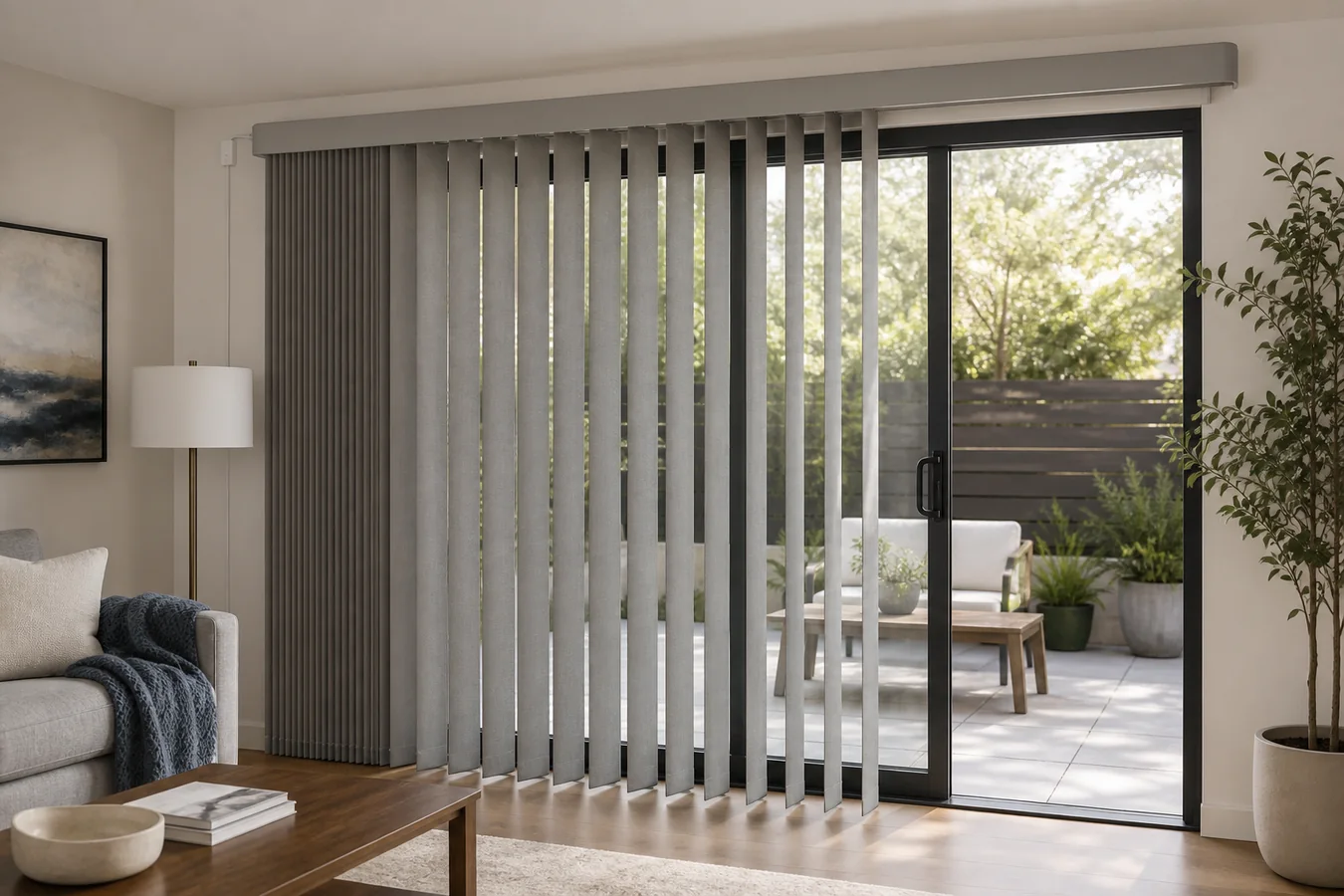
Before comparing fabric, send four commands to the motorized vertical blind you are considering: rotate the vanes open, rotate them closed, traverse the carriers to the stack, and bring them back across the opening. If the quote, remote or demonstration cannot distinguish those outcomes, the automation is not specified yet.
Motorized vertical blinds need two motions: vane rotation controls light and privacy, while track traversal creates the clear opening. A system that automates only one may still suit a fixed wide window, but it can fail the main job on a sliding door.
Audit the two motions command by command
| Requested result | Physical motion | Evidence to request | Failure that matters |
|---|---|---|---|
| Soften daylight | Rotate vanes to a repeatable angle. | Exact remote/app command and whether position feedback or favorite positions exist. | “Open” only traverses the blind and exposes the whole door. |
| Close for privacy | Rotate vanes to the specified closed orientation. | Completed overlap and both end positions on the actual track. | Vanes stop at an angle or the command name does not match the physical state. |
| Use the door | Traverse carriers to the chosen stack side or split. | Fully stacked width, leading carrier position and clear walking width. | The system rotates but does not move off the active door panel. |
| Restore coverage | Traverse across the track, then rotate as needed. | One-button scene or explicit command sequence, limits and obstruction behavior. | The carriers return but leave an unplanned gap or wrong vane orientation. |
Some current named systems explicitly describe both actions. Motionblinds, for example, says its vertical system can rotate slats and slide them open, while its page also describes a manual override. That is evidence for the named Motionblinds system only. Graywind and Yoolax list their own controls and options. None of those pages grants the same feature set to a different motor, track or selected configuration.
Draw the stack beside the walking lane
On a sliding door, the useful output is not “fully open.” It is the clear passage left after the carriers, vanes, end hardware and any valance occupy their final position. Put the active door panel, handle, lock and normal walking lane on the measurement drawing. Then choose left stack, right stack, split draw or another supported arrangement from that geometry.
A stack on the wrong side can force people through the hanging vanes even when the track technically opened. A split stack can preserve symmetry yet place material at both edges. A one-way stack may protect the traffic lane but cover more fixed glass. Ask for a front elevation of the fully traversed blind rather than estimating stack from a showroom sample.
Replay partial access too. A person carrying a tray, a child opening only one door panel or a pet using the doorway may not wait for a long full-track cycle. Mark the minimum useful opening and ask whether the system can stop there reliably without leaving vanes in the traffic path. If a favorite position is proposed, confirm whether it stores both traverse position and vane angle or only one of them.
Use the Smart Shade Measurement and Compatibility Checker to record the opening, mount surface, handles and obstructions. If the target is a patio door, the broader sliding-door fit, stack and power guide helps compare a vertical track with other covering families.
Make the controller speak physical language
“Open” is ambiguous on a vertical blind. It might mean rotate to admit light, traverse to clear the opening or run a combined scene. Write the physical result beside every remote button, app command and voice phrase. Do the same for “close,” favorite positions and grouped scenes.
If two motors or channels are required, learn whether the everyday controller exposes both without an awkward sequence. Confirm what happens when a group contains windows with different stack directions. Ask whether limits are stored in the motor, track controller, remote or cloud account, and what must be re-paired after service. These are exact-system questions, not generic smart-blind features.
Voice control deserves the same discipline. “Open the patio blind” is only useful when every person in the home knows the resulting physical state. A scene named “daylight” can rotate vanes while keeping the doorway covered; a scene named “door” can traverse to the safe stack and leave the vanes in the manufacturer-supported orientation. Document the desired results before naming the scene.
The public motorized shade-type guide helps decide whether a vertical system is the right physical family. It does not certify the selected motor, controller or ecosystem; put those model numbers on the quote.
Plan the unpowered state before it happens
Power source changes the service plan. For a rechargeable system, record the charge port, cable route, access position and what happens if the blind stops across the active door. For a plug-in system, record the outlet, cable path and safe disconnection method. Hardwired work belongs to qualified professionals and the applicable local requirements.
Do not assume a motorized vertical blind can be pushed, pulled or rotated by hand. Some named systems advertise a manual override; others may require a particular release or may prohibit physical movement. The exact manual controls the answer. If fallback matters, have the seller demonstrate or document it before the order. The separate guide on manual use of motorized blinds explains why a safe fallback is model-specific.
Service access belongs on the drawing as well. Show how a technician reaches the motor, controller, track cover and power connection with the room furnished. A ceiling-recessed or tightly valanced track may look finished while making a simple reset or carrier repair unnecessarily disruptive.
Approve an annotated track, not a feature list
The final quote should name the track, carrier and vane configuration; finished track width; stack direction and fully stacked width; vane rotation range or supported positions; traverse and rotate commands; controller and required hub; power source; manual fallback; limit-setting method; service access; and current installation instructions.
Ask the seller to annotate the fully covered, daylight-tilted, privacy-closed and doorway-open states on one drawing. A feature list can say “smart,” “voice” and “remote” while leaving the useful doorway unresolved. The drawing makes the two motions answer to the room.