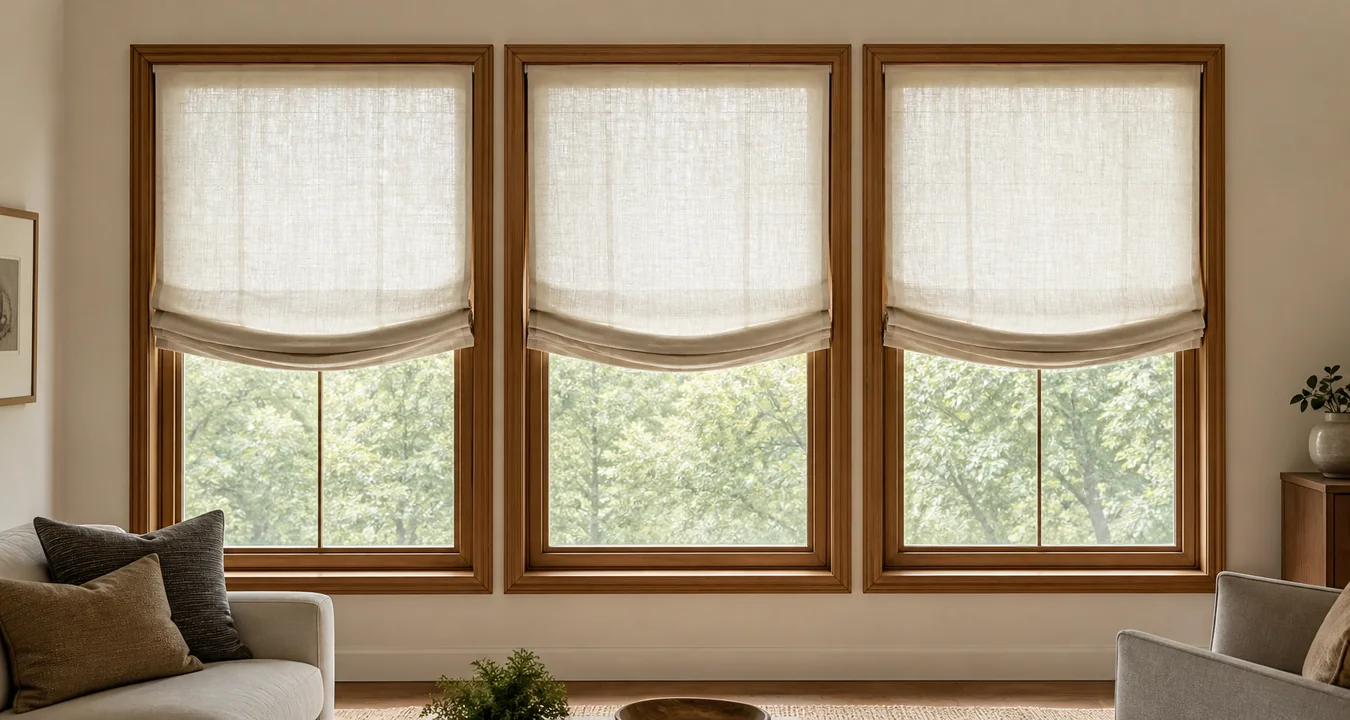
A relaxed Roman shade is supposed to curve. Its lower center falls into a soft swoop instead of tracing the sill like a straightedge. That slight irregularity can look generous on one focal window—and distract on a bank of three windows where every casing creates a hard reference line.
The useful question is not “Do I like relaxed Roman shades in this photograph?” It is: Will I accept the exact shade fully lowered, at the height I use most, and fully raised—then accept the small differences between every shade in the set? If strict alignment or frequent hands-off operation matters more than the soft fold, choose a flatter Roman construction or another shade family.
If the style question is still open, the shade-family comparison separates Roman, roller, cellular and zebra systems by what the room needs. This page begins after relaxed Roman is on the shortlist.
The bottom edge is allowed to disagree with the trim
Hunter Douglas describes relaxed Roman shades as soft Roman shades with a swoop-like fold at the bottom hem, and distinguishes them from a slouch style with a scalloped hem. Graber likewise lists relaxed as one variation within its tailored Roman shade family. Those definitions are useful orientation, not a cross-brand construction standard.
Ask the fabricator to name and draw the exact style. “Relaxed,” “soft,” “European,” “tulip,” “slouch” and “hobbled” can point to visibly different bottoms and fold patterns. Record where lift points sit, whether the face is seamless, how much the center is intended to fall below the sides, and what the bottom looks like when the shade is stopped halfway. Do not let a shared adjective stand in for the drawing.
Decide whether the room can absorb variation
Use the room, not the trend, to set the tolerance.
| Window situation | What the curve must prove | Practical direction |
|---|---|---|
| One focal window, occasional adjustment | It looks intentional lowered and partly raised; the stack does not hide too much glass. | Relaxed Roman can remain on the shortlist. |
| Adjacent windows with strong trim lines | The set looks coherent even when the centers do not land on an identical line. | Request a matched-set mockup; choose a flatter style if exact repetition is essential. |
| Several movements on a typical day | It reaches the common stopping height without frequent hand-shaping. | Operate the exact configuration; consider a more structured Roman if needed. |
| Night privacy or room darkening | The exact face fabric and lining meet the privacy goal without changing the curve beyond your tolerance. | Review the finished combination, not an unlined swatch. |
| Shallow opening or nearby hardware | Headrail, fabric projection, curve and raised stack fit the real envelope. | Resolve mount geometry before choosing the style. |
| Young children live in or visit the room | The completed control and inner-cord configuration has exact evidence and remains usable. | Follow current safety guidance; style never proves safety. |
The result does not need to be perfectly symmetrical. It needs to look deliberately soft rather than accidentally mismatched in the room where it will live.
Ask for three views of the exact configuration
A product photo usually shows the state that flatters the fabric. Your order has to work in the states you actually use.
- Fully lowered: Is the center swoop deliberate? Are the left and right returns convincing against the trim? Does a pattern look centered when the bottom is curved?
- At the ordinary stopping height: Does the shade form a graceful fold, or does it need repeated hand-shaping? If several windows stop at the same height, do their curves still read as one set?
- Fully raised: How much glass does the stack cover? Does the relaxed fold compress into a shape you still like? Can the window, latch and screen operate?
Blinds.com’s current Roman fold-style guide describes its relaxed fold as a soft curved style and cautions that it is not ideal for frequent raising and lowering because it can require more shaping. Treat that as seller-specific guidance, then ask the fabricator of your exact shade what normal operation and reshaping should look like.
If motorization is part of the order, the motorized Roman shade guide goes deeper into fold, stack, motor and finished-configuration evidence. A motor can move fabric; it does not prove the fabric will settle into the curve you expect.
Neighboring windows turn softness into a pattern
A single relaxed Roman shade is read as an object. Three adjacent shades are read as a rhythm. The casing tops, sill heights, muntins and the exposed daylight band all create lines that make small curve differences easier to see.
Photograph the entire window wall straight on. Mark which openings are truly the same width and drop, which trim lines differ, and which shade will sit beside a door, corner or cabinet. Then choose one of three honest outcomes:
- Natural variation is welcome. Small differences make the set feel textile-rich rather than manufactured.
- Variation is welcome only within a boundary. The fabricator must state how the set will be matched and what finished variation is considered normal.
- A repeated straight line is the design. Choose a flat or more structured Roman style rather than asking a relaxed shade to stop looking relaxed.
Do not promise yourself that installation will correct a curve you have not accepted. Level headrails and accurate measurements matter, but the intended fabric drape is still part of the finished look. Record each opening, trim edge, mount plane and obstruction in the Smart Shade Measurement Checker; use the fabricator’s own measuring rules for the order.
Fabric and lining rewrite the swoop
The relaxed curve is made by a complete textile assembly, not a color swatch. Hunter Douglas notes that lightweight fabrics that drape readily usually suit the style. The Shade Store’s current fabric guidance for Roman shades similarly points relaxed styles toward light or medium-weight, pliable fabrics. Neither source creates a universal weight limit or promises how another workroom’s construction will hang.
Bind these fields together on the quote:
- exact face fabric, color and pattern direction;
- exact privacy, blackout or interlining option;
- any seams, battens, ribs or reinforcement;
- finished width and drop;
- relaxed-style construction and lift-point layout;
- control type and headrail;
- one window versus a matched set.
Lining can add body and change opacity. The Shade Store’s current Roman shade overview lists lining and interlining choices for named styles, while its relaxed configurator shows that choices are attached to an exact product. That proves the variable matters; it does not prove that “blackout lining” preserves the same curve across every fabricator.
For a room-darkening project, inspect the exact lined sample after dark and separate light through the fabric from light around the edges. The blackout Roman shade guide covers liner, seams, fabrication points and perimeter gaps without treating a soft fold as a darkness guarantee.
Patterns deserve their own proof. A broad motif can look balanced while the shade is lowered and shift visually when the center swoops or the shade stacks. Ask for the pattern repeat, the proposed cut position and a front-view rendering at the finished width. On adjacent windows, state whether the pattern must align across the set or merely be centered on each shade.
Daily movement changes the decision
Relaxed Roman shades can be functional, but some current sellers place them toward the decorative end of their Roman range. The Shade Store’s relaxed shade configurator describes the style as more demanding to operate daily. Blinds.com makes a similar caution for its relaxed fold.
Translate “high maintenance” into your own room rather than treating it as a verdict. A shade lowered at night and raised in the morning has a different job from a shade that chases glare above a desk all day. A guest-room shade can tolerate a quick hand adjustment that would irritate someone operating a whole wall of windows.
During a demonstration, use the actual control to stop at the height you expect to use. Repeat the movement several times only to observe how that displayed configuration settles; do not treat a showroom cycle as a durability test. Ask whether hand-shaping is normal, where hands may touch the fabric, what care method is allowed, and whether a service visit can preserve a matched set if one shade later needs work.
If frequent movement, a compact raised stack and a straighter bottom matter more than the textile curve, compare the completed alternative in the Roman-versus-roller guide. The decision may change without declaring one format universally better.
Keep the lift attached to the style name
Do not approve the fabric, fold and control as three independent options. A seller may offer continuous loop on one relaxed construction while reserving cordless or motorized control for other Roman styles. The Shade Store’s current Roman overview is one example of style-specific control eligibility; another fabricator can have a different range.
The quote should return one line such as:
Relaxed Roman / exact fabric and lining / exact finished size / exact headrail / exact cordless, loop or motorized control / left or right control position / expected lowered curve and raised stack.
If young children are present, current CPSC guidance recommends cordless window coverings. “Cordless” is a completed-product question, not a styling claim. Use the cordless and child-safety guide to review operating cords, inner cords, labels and the room around the window; do not improvise a compliance test by pulling apart a display shade.
Make the quote prove one window set
Send the supplier one record for the whole group:
Windows: opening IDs, finished widths and drops, inside/outside mount, trim and sill reference lines.
Style: fabricator’s exact relaxed-fold name and drawing.
Textile: face fabric, color, pattern placement, lining/interlining and seams.
Three states: accepted fully lowered curve, ordinary stopping-height curve and fully raised stack for every shade.
Controls: exact lift or motor configuration, local operation, power/service path and child-safety evidence where relevant.
Variation: written expectation for how a matched set may differ and what remedy applies if one shade falls outside it.
Care: normal reshaping, approved cleaning and how one shade can be serviced without losing the set.
Choose relaxed Roman shades when the soft curve is part of the room’s design, the exact material assembly produces a result you accept, and ordinary operation does not turn the look into a chore. Choose a flatter Roman, a roller or a decorative relaxed shade paired with a separate functional layer when straight repetition, frequent movement or stricter light control owns the decision.
If the quote shows only one perfect photograph and cannot bind that photograph to your fabric, lining, control and window set, the configuration is not ready to order.