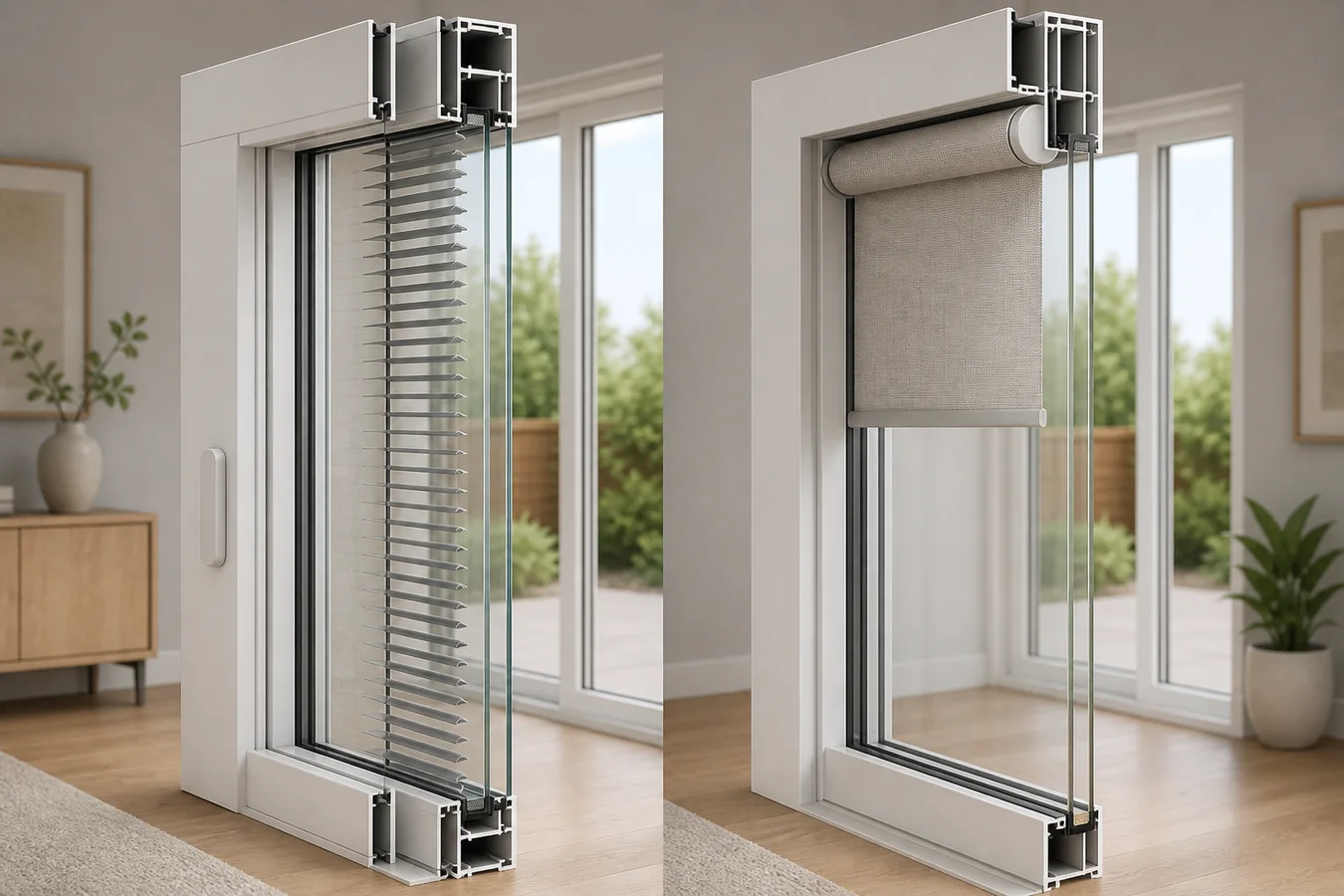
A patio door with built-in blinds is not just a door plus a tidy window treatment. The blind, glass and service path may become one purchase. That can be an excellent trade when the door already needs replacement—but an expensive way to solve a shade problem when the existing door is sound.
Start with three questions: Does the door itself need replacing? Does the exact blind tilt, raise and lower in every panel where you need it? If the blind fails, what physical unit is serviced or replaced, and who pays for labor? Do not order from the phrase “built-in blinds” until the quote answers all three.
Start with the replacement event, not the blind
Write the project in one sentence before looking at products:
- “The patio door is failing and will be replaced; I need privacy and light control in the new unit.”
- “The door works; I only need a covering that does not swing or bang.”
- “The door glass or insert can be changed without replacing the full frame, and the manufacturer supports that route.”
Those are different purchases. If a new door is already justified, factory-integrated blinds deserve a place on the shortlist. If the existing door is sound, compare the cost and future service boundary of a supported insert or add-on with an independent shade before letting the blind trigger a full-door replacement.
| Architecture | What you buy now | Evidence needed before choosing | Main reason to reject it |
|---|---|---|---|
| Factory blinds between glass | A new patio-door panel or door configuration with the blind built into its glazing system | Exact door/size eligibility, blind operation, glass specification, service part and warranty | The door does not otherwise need replacement, or the service/glass terms are unacceptable. |
| Accessible between-glass system | A named door or panel system whose internal treatment can be reached as documented | Exact product family, access method, allowed owner actions and replacement parts | “Accessible” was inferred from another product line rather than documented. |
| Supported enclosed add-on or replacement insert | A compatible enclosure over existing doorglass or a supported glass insert | Written fit, size, door-type and clearance compatibility | It is being treated as a universal retrofit for any sliding patio door. |
| Separate room-side covering | A shade or blind mounted independently of the door glass | Mount surface, handle/trim clearance, stack, passage, controls and service access | The covering interferes with door travel, passage or daily use. |
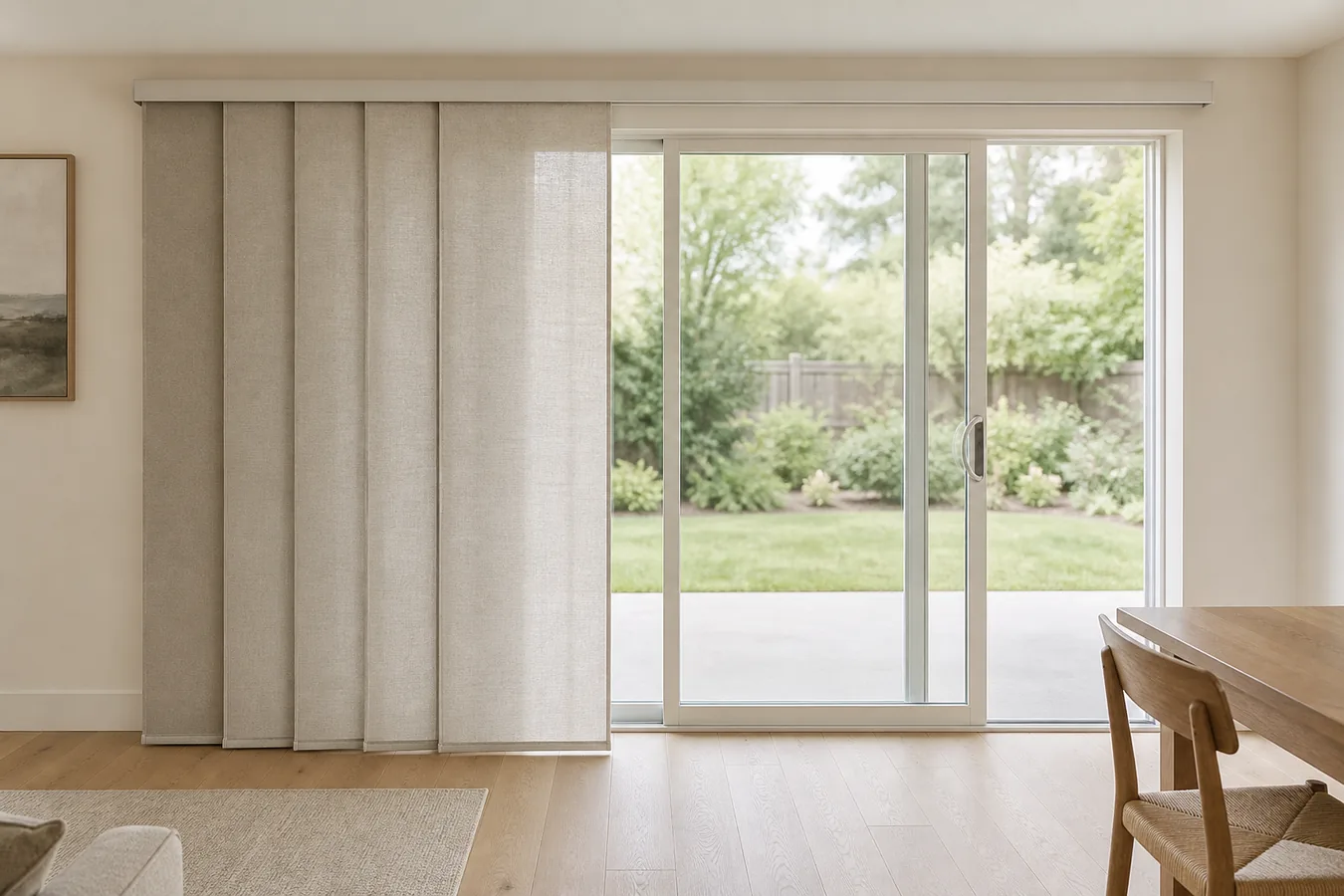
The independent-covering route has its own geometry. Use the large-opening and sliding-door shade guide to compare vertical, panel-track, roller and other families without folding that separate task into this door-unit decision.
An add-on also needs a narrow definition. ODL’s current Add-On Blinds enclose a blind over supported existing doorglass with an added pane of tempered glass. That proves the architecture exists; it does not prove the product fits every sliding patio door. Make the seller identify the exact compatible door glass and finished clearances.
Ask what the operator can actually do
“Internal” and “between the glass” describe location, not the complete control function. Put the quoted operation in verbs:
- tilts open and closed;
- raises and lowers;
- does both;
- works on the active panel, fixed panel or both;
- leaves the view fully open to a stated position;
- places every operator within comfortable reach.
ODL describes a named Raise/Lower/Tilt operator for listed sliding, French and swinging-door contexts. Pella’s current owner manual separately describes raise-and-lower Slimshade blinds and tilt-only blinds in named between-glass systems. The lesson is not that one is better. It is that “built-in” does not promise the same motion on every product.
Ask for a demonstration or current operation document for the exact door. Move each control from fully raised to fully lowered and through the tilt range. On a slider, identify which glass panel moves, which remains fixed and whether both contain blinds. On a hinged pair, check that the operator remains reachable and that handles, locks and the other leaf do not obscure it.
Record color and size availability at the same time. Andersen’s current blinds-between-the-glass page lists the option only on named patio-door families and shows that finish choices vary by family. Pella’s current 250 Series design manual marks blinds-between-the-glass for select sizes. A brochure photo is not an option confirmation for your width, handing, panel arrangement and finish.
Make the glass specification follow the blind
Do not compare the performance label of a base patio door with the appearance of a blind option. Ask for the exact glass configuration that ships when the blind is added.
At minimum, the quote should return:
- number of panes and insulating-glass construction;
- Low-E coating option;
- gas fill or air-filled status;
- U-factor and solar heat gain coefficient for the exact door configuration, or the exact label/document that supplies them;
- tempered-glass and other required safety-glazing details;
- size, altitude or regional restrictions;
- whether the blind changes any glass option you assumed was included.
The differences are real even among current first-party examples. Pella’s 250 Series Classic sliding-door design manual lists its Low-E glass with blinds-between-the-glass as a dual-pane, air-filled option for that named configuration. ODL’s Blinds + Glass FAQ says its capillary-tube design precludes gas fill. Neither statement can be transferred to every patio door with built-in blinds.
This does not mean an integrated blind is inherently inefficient. It means the words “Low-E,” “insulated,” “argon,” “ENERGY STAR” and “built-in” cannot be mixed into a made-up package. Compare the exact label and option sheet against the separate-covering proposal, and keep the door’s structural and installation decisions with the qualified door professional.
If you are preserving the door and mounting a separate shade, record the opening, trim, handle and obstructions in the Smart Shade Measurement Checker. The checker organizes shade-fit evidence; it does not replace a patio-door rough-opening measurement or a manufacturer’s installation requirements.
Rehearse one night and one open-door trip
Integrated blinds protect the slats from ordinary room contact and remove a hanging treatment from the passage. Those are useful advantages. They do not prove blackout, every privacy angle or a completely unobstructed view.
Run two short rehearsals on the exact display, sample or documented configuration.
At night: turn on the room lights, close and tilt the blind to the intended privacy position, then view it from outside at standing and seated sightlines. Look at slat overlap, edges, the head and sill, and any fixed panel that lacks a blind. If a display is unavailable, ask the seller for current photos of the exact slat color and door configuration under comparable lighting; mark the result unverified until you can test it.
Slat direction affects the sightline, but there is no universal direction that wins every floor height and viewing angle. The blinds privacy direction guide explains how to observe the real outside view instead of trusting a diagram.
During an ordinary door trip: raise the blind fully, open the active panel, pass through with what you normally carry and close it again. Confirm the operator does not require awkward reaching and the blind stays in its documented state. Then compare the separate-covering proposal in its fully open position. A roller cassette, vertical stack or drapery return may occupy room-side space; the integrated blind may leave more of that space clear, but the door panel, screen, handle and frame still set the passage.
The test should also preserve the view you care about. Ask how much blind or hardware remains visible when fully raised and whether a tilt-only option ever clears the glass. “Protected between panes” is not the same as “disappears from view.”
Name the part you would replace
The most important service question is physical: if the blind stops moving after installation, what would the technician replace? Possible answers include a blind control, an insulated-glass unit, a door panel, a supported insert or a serviceable component in a named accessible system. Do not guess from the marketing term.
Pella’s current owner manual includes an opening procedure for a hinged interior glass panel on named Designer Series products. That is evidence for that documented system, not proof that every between-glass blind can be reached. A sealed insulated-glass product may have a different service remedy.
Read the written warranty in separate columns:
| Field | What to copy into the quote record |
|---|---|
| Covered object | Blind mechanism, external control, insulated-glass seal, glass unit, panel or full door |
| Coverage period | Exact term for each object, not the longest headline on the door |
| Remedy | Repair, replacement part, glass/panel replacement or refund at the warrantor’s option |
| Labor | Included, excluded, capped or not stated |
| Eligibility | Original purchaser, registration, transfer, installation and maintenance conditions |
| Exclusions | Breakage, condensation, misuse, improper installation, environmental limits or other written exclusions |
| Service route | Manufacturer, dealer, installer or retailer; required proof of purchase and product label |
Current written terms show why this separation matters. Andersen’s warranty for named patio doors with shades or blinds in insulated glass covers the blind/shade system for ten years, but one stated replacement-product remedy excludes labor. ProVia’s current warranty card gives internal blinds on named patio-door lines their own term. ODL lists different warranties for Blinds + Glass and Add-On Blinds. These are examples of structure, not a ranking: obtain the warranty version attached to your exact order and ask the installer what its labor agreement adds.
A clean glass surface is not the same as a zero-maintenance ownership path. Keep the product label, order configuration, glass code, installer contact and warranty together. Photograph the operators and the full door when operation is normal, so a later service request can identify what changed.
Send back one page, not five vague questions
Before approving the order, make the seller or installer return this record:
Project: door replacement is already required / existing door remains / supported insert or add-on is proposed.
Door: exact series, material, size, handing, active/fixed panels and screen.
Blind: panel location, color, tilt function, raise/lower function, operator location and fully raised position.
Glass: exact pane construction, Low-E option, gas or air fill, performance label and restrictions.
Use: night sightline accepted, operator reachable, clear view accepted and passage rehearsed.
Service: failed-blind service unit, available parts, service contact and expected access method.
Warranty: blind, glass, seal, panel and labor terms with the written document attached.
Choose factory-integrated blinds when the door replacement already makes sense and that completed record is acceptable. Choose a supported add-on or insert only when compatibility is documented. Keep the covering separate when you want independent style, blackout, replacement or service flexibility—and then finish the inside-versus-outside mount decision on the real frame.
If the seller cannot identify the exact blind motion, glass package or replacement unit, the right answer is not “probably fine.” Hold the order until the door, blind and future service path describe the same product.