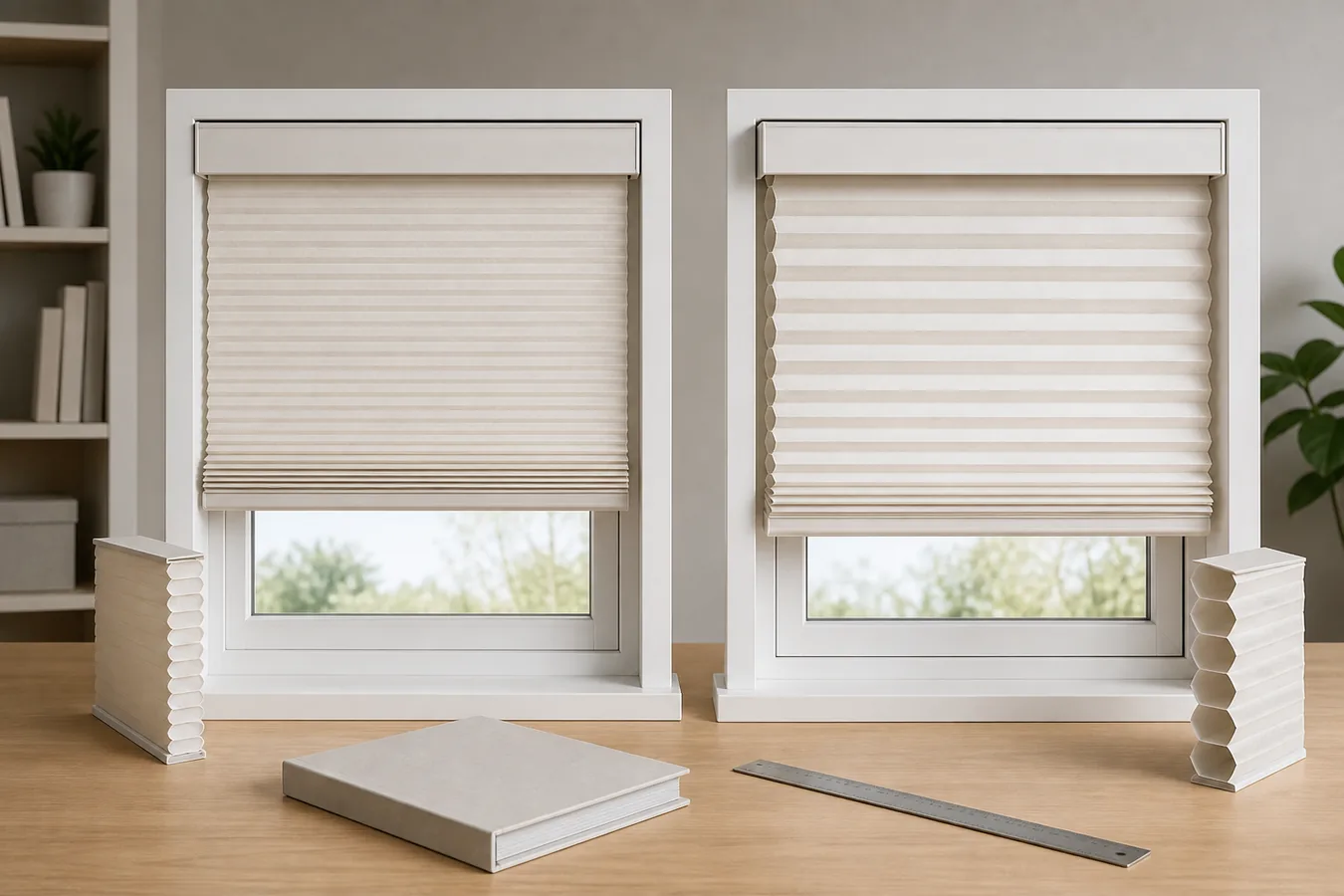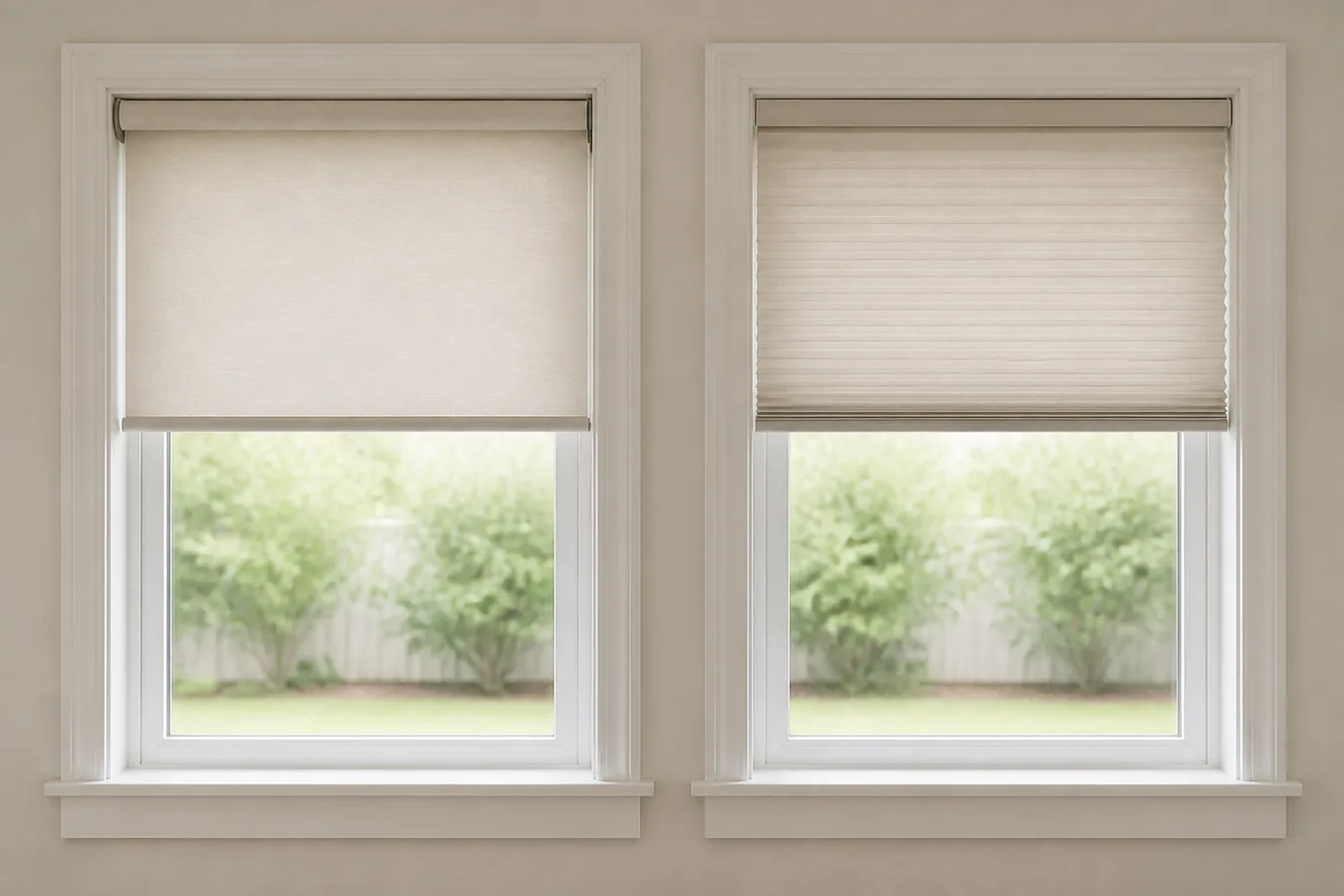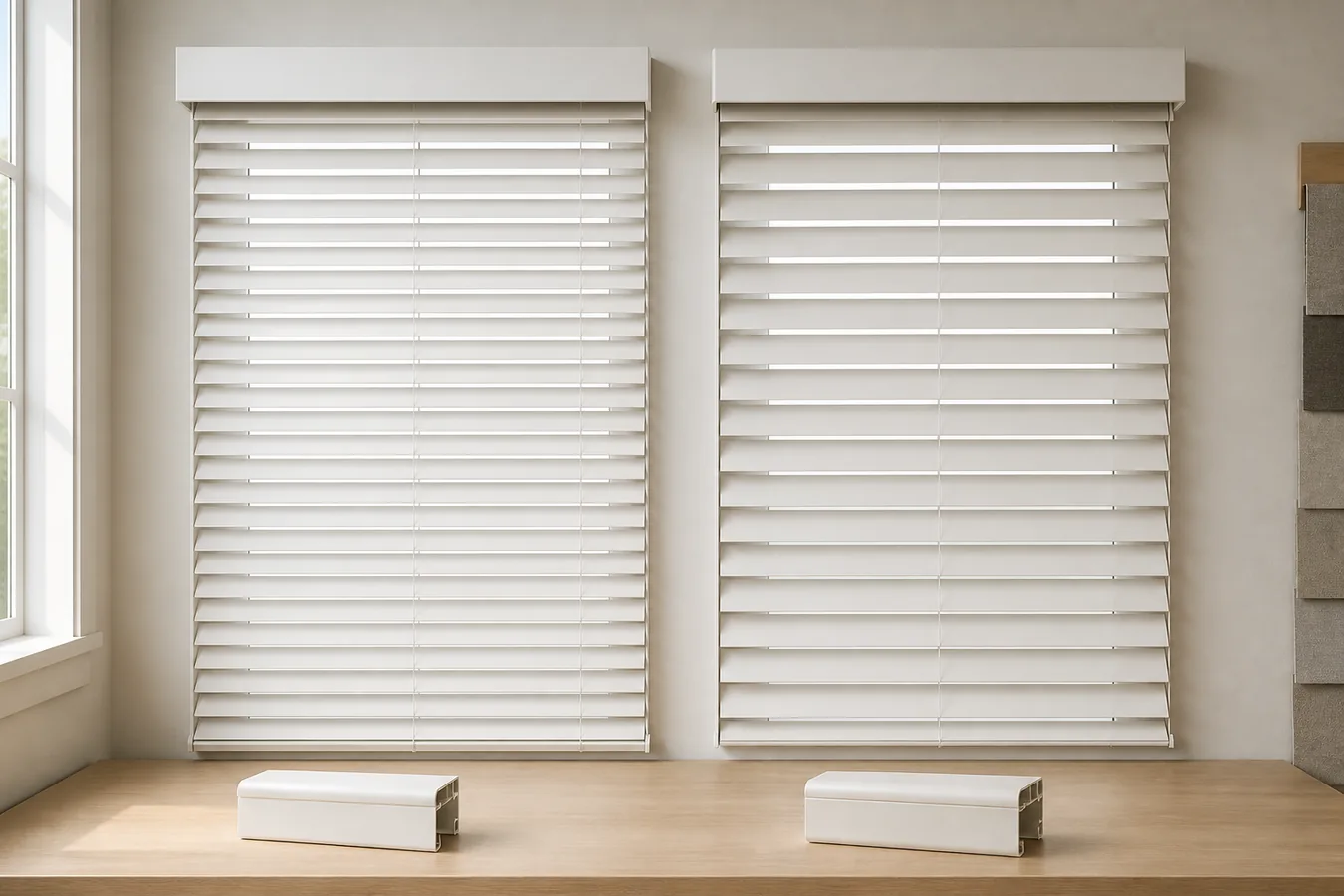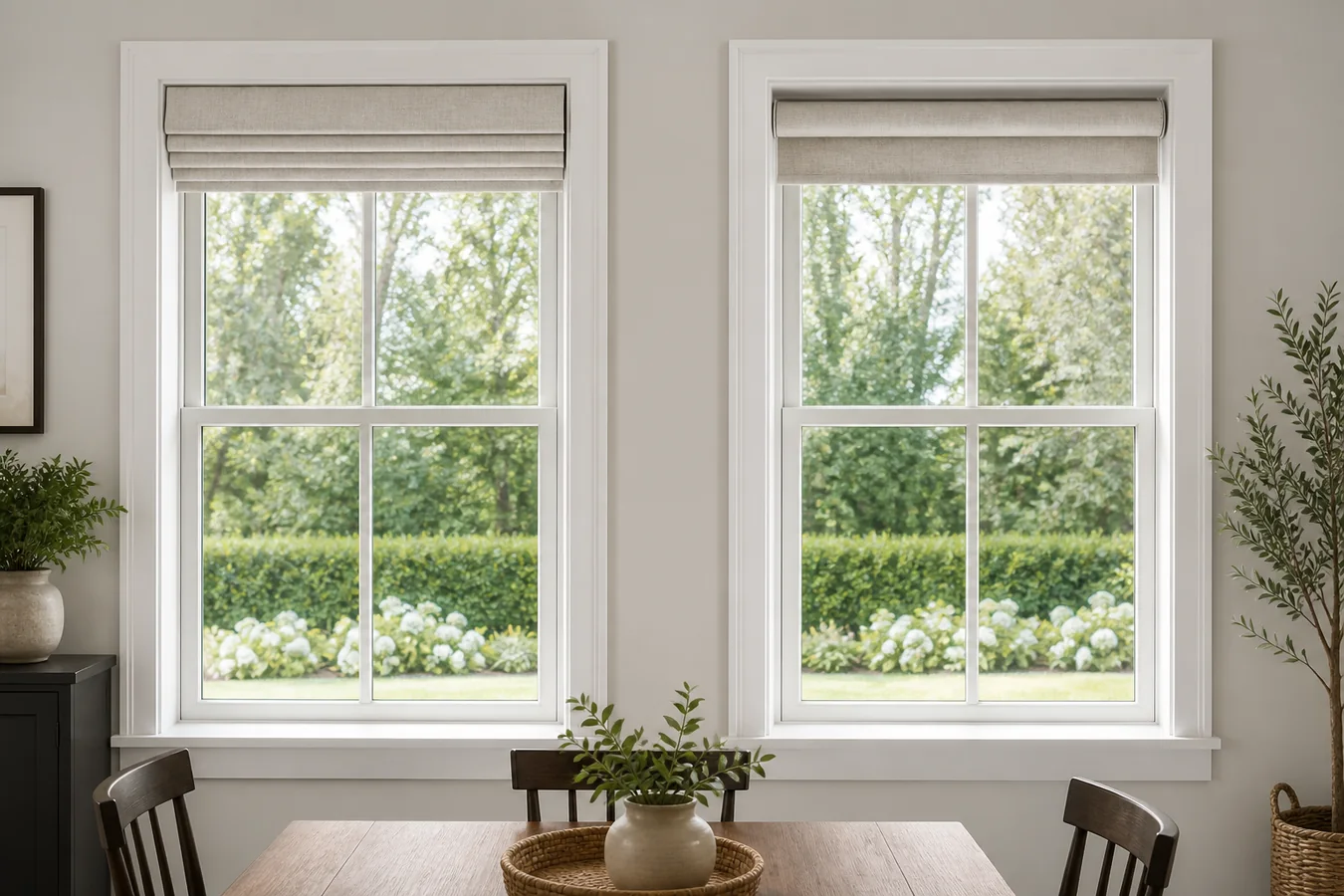
Most Roman-shade and roller-shade comparisons begin with both products lowered. Begin with both fully raised. The remaining folds, tube, cassette, headrail and clear glass can change the decision before color enters it.
Start with Roman shades when the fabric face and fold should remain a visible furnishing; start with roller shades when a compact tube-based form and quieter visual background matter more. Then make the exact products prove their raised size, lowered coverage, backlit behavior, controls and care.
Mark the glass you refuse to lose
Photograph the bare window straight on. Draw a horizontal line at the lowest acceptable position for a fully raised shade. This may protect a view, daylight, a short sash, a plant shelf or access to a lock. Give the same line to both sellers.
Ask each seller to place the quoted product above that line on a same-scale elevation. The Roman drawing must include the actual fold construction, face fabric, liner, headrail and accumulated raised package. The roller drawing must include the roll, tube or cassette, bottom bar and chosen roll direction. Do not accept a category estimate.
| Evidence | Roman proposal | Roller proposal | Decision |
|---|---|---|---|
| Fully raised bottom position | Quoted fold stack and hardware | Quoted roll/cassette and bottom bar | Reject any proposal below the protected-glass line unless the lost view is acceptable. |
| Projection and depth | Folds, headrail and any front projection | Tube/cassette, brackets and roll direction | Check handles, trim, curtains, inward movement and service access. |
| Return from raised | Folds lower evenly in the named construction | Material tracks and bottom bar returns as specified | Require the supported control and adjustment procedure for the exact system. |
This trial does not guarantee that roller shades always stack smaller. Tube size, shade dimensions, material thickness, cassette and hardware all matter. Roman construction also varies. Hunter Douglas’s Roman style guide demonstrates that traditional folded and more modern rolling constructions can live under the broad Roman-shade conversation. Name the actual style.
Lower both shades with light behind them
Roman shades display fabric across a broad face, with seams, folds and a liner when specified. Roller shades present a flatter moving sheet around a tube. That visual distinction is real, but privacy and darkness still belong to the completed configuration.
Place the exact sample against the window during the difficult light condition. Repeat after dark with the room lights on and observe from outside. For the Roman quote, record face fabric, liner, fabrication points and fold style. For the roller quote, record fabric, opacity, material width versus ordered width, roll direction and bottom bar. For both, request finished side, top and bottom gaps.
A Roman liner can change opacity, drape, thickness and raised behavior. A roller blackout fabric can still leave perimeter light. The guide to blackout Roman liners, seams and edge gaps handles the Roman path; the light-filtering roller shade guide shows why a roller swatch needs daylight, dusk and lights-on observations.
Watch the whole trip, not just the endpoints
A shade moves every day. A traditional Roman construction forms and releases folds as it travels. A roller shade winds and unwinds around its tube. Ask how the named system should look halfway down, how it is adjusted if movement becomes uneven and which parts the owner may safely touch.
Pattern can make this decisive. A Roman design may celebrate the textile when lowered but interrupt a large motif as the folds gather. A roller can present a flatter graphic face while down, yet the material and pattern disappear around the tube as it rises. Request a full-width sample or rendering when pattern placement matters; a small swatch cannot prove the finished composition.
Side hems, battens, seams and bottom treatments can also change what the Roman face does in motion. Roller material may curl, telescope or need product-specific alignment procedures if the installation or fabric combination is outside its supported conditions. Do not predict either fault from the category. Ask what the manufacturer considers normal, what adjustment is permitted and what the warranty excludes for the exact size.
Depth, controls and service finish the choice
Inside mount can emphasize the window architecture, but the exact product needs sufficient depth and can leave product-specific edge gaps. Outside mount can add coverage or place hardware above the opening, but it needs a suitable mounting surface and must clear trim and adjacent elements. Record all dimensions and obstructions in the Smart Shade Measurement and Compatibility Checker, then follow the chosen manufacturer’s ordering rules.
Neither format owns one control method. Roman and roller families can include manual cordless and motorized configurations. Compare the completed lift or motor, local control, power source, charge or battery access, grouping, limit setting and permitted manual fallback. If the Roman route remains, the motorized Roman fold and motor-fit guide goes deeper.
Projection can influence a layered design. If curtains will remain, draw the Roman folds or roller cassette beside the curtain return and rod. If the shade sits behind a window handle or in front of trim, show the moving material at its closest point. The visually slimmer option on a product page is not necessarily the one with the smaller installed envelope.
Care may reverse the choice. Read the exact fabric and liner instructions before assuming a flat roller face is washable or Roman folds require one universal method. Hunter Douglas’s Roman-shade care guidance is useful for its named products and shows why fabric-specific instructions matter; it should not be transferred to another brand.
Consider where dust and hand contact occur. Roman fold edges and a roller bottom bar collect different kinds of handling, but room soil and permitted methods matter more than the silhouette. Ask how the shade is removed or supported for approved care and whether the motor, chain or cordless mechanism remains accessible afterward.
Make the two quotes return the same views
Require four images or drawings from each proposal: fully lowered from the room, backlit or lights-on privacy, mid-travel, and fully raised against your protected-glass line. Attach the exact fabric, liner, roll/fold style, mount, finished coverage, depth, controls, power, care and warranty record.
The comparison pillar can clarify the broader smart and motorized language. This choice is more physical: when both complete shades are raised, lowered and moving on the same window, decide whether the visible fold is worth its exact footprint—or whether the roller’s exact tube-based form better preserves the opening.