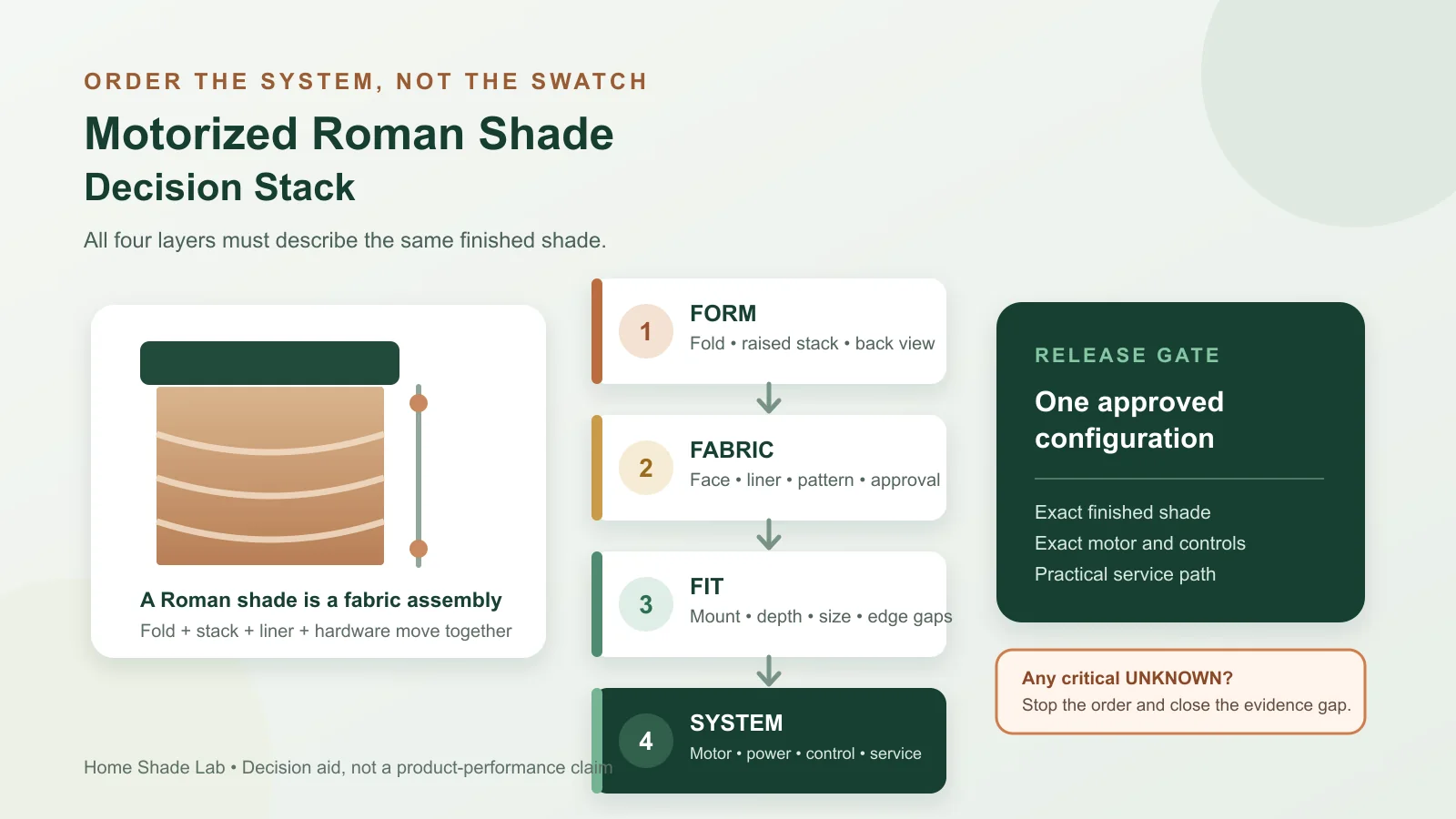
Choose a motorized Roman shade as one finished fabric system. The fold style changes how it moves and stacks. The face fabric and liner change its body and finished load. The mount changes the visible glass and edge gaps. The motor and controls must then be approved for that exact fabricated shade—not for a product-family name or a loose fabric swatch.
The simplest way to avoid a disappointing order is to require four views before approval: front while lowered, rear while lowered, partway through travel, and fully raised. Each view exposes a different decision that a catalog thumbnail can hide.
A Roman shade changes shape while it works
A roller shade wraps fabric around a tube. A cellular shade compresses a repeated structure. A Roman shade forms the decorative panel into folds as it rises. That transformation is part of its appeal—and part of its risk.
If the room needs the smallest possible raised stack, perfectly repeatable geometry or a low-maintenance surface, compare Roman construction with the other choices in the motorized shade type comparison before committing to fabric. Roman is strongest when the visible textile and folds are worth the extra fabrication decisions.
| View | What it reveals | Question the order must answer |
|---|---|---|
| Front, fully lowered | Fold memory, face-fabric drape, pattern placement and visible edge gaps | Is this the intended fold and pattern at the exact finished width and drop? |
| Rear, fully lowered | Liner, battens, lift elements, window-facing finish and accessible cords | What will be visible from outside, and what safety/service elements remain behind? |
| Partway through travel | How folds form, whether pattern lines distort and how the bottom rises | Does the chosen construction form the look expected throughout movement? |
| Fully raised | Stack depth/height, retained view, fabric bulk and headrail access | How much glass is covered, and can the motor/power still be serviced? |
Choose the fold before falling in love with the fabric
“Roman shade” does not specify one moving shape. Current product lines distinguish flat/full folds and rolling/stacking behavior. Hunter Douglas, for example, currently presents Vignette configurations with rolling or stacking operation, 4-inch full folds or 6-inch flat folds, and separate sheer, light-filtering and room-darkening choices. Those are options within a named system, not standards for every Roman shade. Review the current Vignette configurations.
Ask to see the proposed fold at a width and drop comparable to the order. A narrow sample does not show how a wide panel will behave. Decide whether the folds should be crisp or soft, whether the bottom should appear flat or layered, and how much stacked fabric can remain at the top before it interrupts the view.
The face fabric becomes part of the lift
Once a fabric becomes a Roman shade, its weight, thickness, body, stretch, seams and liner all affect the fabricated object the motor must move. A beautiful upholstery-weight swatch is not automatically an approved shade fabric. Neither is a delicate textile automatically suitable for repeated folding, sunlight or the room’s cleaning needs.
The fabricator should own the answer for the exact face fabric, liner, fold style, finished width/drop and motor system. Ask whether seams are required, how the bottom and sides are finished, whether the textile is railroaded or joined, and whether the selected pattern orientation changes the usable width. Do not substitute a rough fabric weight calculation for fabrication approval.
A repeating pattern has to survive the folds
Pattern placement has at least three states: lowered, moving and stacked. A large motif centered while lowered may disappear unevenly into the folds. Horizontal lines can emphasize small differences in fold formation. Across several windows, “same fabric” does not guarantee that motifs start at the same height.
For a multi-window order, specify the reference point for pattern alignment and whether the fabricator will match the repeat across panels. Ask for the tradeoff: matching may require additional fabric and still cannot make independently moving soft goods look identical at every intermediate position. Approve the lowered alignment and accept a defined moving-state tolerance rather than assuming both.
Lining changes the panel, not the perimeter
A liner can change privacy, face-fabric appearance, light transmission and the window-facing finish. It also adds material to the fabricated panel. It cannot by itself remove light that travels around the sides, above the headrail or below the bottom.
Use opacity terms only for the exact fabric-and-liner selection. If the room goal is darkness, ask for the finished mount drawing and expected perimeter gaps as a separate answer. An outside mount with deliberate overlap may control edges differently from an inside mount, while also changing trim coverage and the visible stack. Avoid turning a “room-darkening” or “blackout” fabric label into a promise about the whole room.
Mount the stack, not an empty opening
Measure at the intended mount plane and include the headrail and raised fabric in the finished envelope. The measurement checker records depth, trim, handles and obstructions. The inside-versus-outside mount guide then helps compare recess fit with overlap.
Roman-specific questions remain: how far the full stack projects, how much glass it covers, whether folds rub a handle or sill, and whether the chosen headrail/motor can still be reached for reset or power service. A recess may fit the lowered fabric but not provide the preferred depth for the motorized headrail. An outside mount may improve overlap yet put the stack over decorative trim.
Blinds.com’s current Roman buying guide highlights flat versus hobbled folds, liners, raised stack and inside-mount depth as purchase variables. Use it as orientation, then obtain the exact dimensions from the selected fabricator. See the current Roman shade buying variables.
The product-family name does not approve the size
Maximum width and height can change with control type, fold, opacity and fabric. Hunter Douglas Architectural’s current size chart shows those dependencies within named Roman product lines and notes that maximum dimensions can also vary by fabric. The lesson is not to copy its numbers into another order; it is to demand approval of the exact combination. Consult the current exact-system size chart.
The quote should bind finished width and drop to the selected face fabric, liner, fold, control and motor. If a seller gives only a broad product maximum, ask whether that maximum applies to this configuration. “Within the collection’s range” is weaker evidence than a configuration line that names every selected field.
The motor belongs to the fabrication recipe
A motor does not operate a loose textile. It operates the lift system constructed into a finished Roman shade. The Lutron Triathlon/Serena Roman fabrication documentation is a useful exact example: it addresses a named fabrication kit, compatible controls and the way a custom-fabricated Roman shade becomes part of that system. It is not a universal DIY recipe or cross-brand compatibility statement. Review the current Lutron fabrication document for the named kit.
Require the responsible fabricator to approve the finished load and construction for the exact motor. Then specify power and controls. Local open/stop/close should be clear before adding schedules, a bridge or voice control. Also identify the charge port, battery or supply and how it remains accessible behind the raised fabric stack.
Look behind the shade before calling it cordless
A motorized Roman shade may have no operating pull cord while still using internal lift elements behind the fabric. The U.S. Consumer Product Safety Commission distinguishes operating cords from inner cords in its window-covering guidance. Motorization therefore does not justify ignoring the rear view. See the CPSC distinction and current business guidance.
For rooms used by young children, CPSC says cordless coverings are the safest option. Ask the manufacturer or fabricator to identify the exact compliant construction and any reachable loop or cord; do not improvise around the lift system. Read the current consumer cord-safety guidance.
Ask for one configuration, shown four ways
The final quote should name one combination: fold/movement style, face fabric and orientation, liner, pattern placement, finished width/drop, mount and overlap, headrail, motor, power, local control, optional integration, service position and rear safety construction. Attach or request representative drawings for the four views rather than accepting unrelated marketing photos.
| Approval | Evidence | Redirect when missing |
|---|---|---|
| Fold and views | Named construction plus lowered, rear, moving and stacked representation | Keep the fabric choice provisional |
| Fabrication | Fabricator approval of face fabric, liner, repeat, seams and finished load | Choose an approved fabric or another shade type |
| Fit | Finished mount envelope, stack, projection, overlap and expected gaps | Change mount or construction |
| Motor system | Exact motor, power, local control, integration dependencies and service access | Hold the order |
| Safety | Exact rear construction and applicable cord/inner-cord compliance | Use a documented safer configuration |
Approve the Roman shade in its three important states: fully lowered, the most-used daylight position, and fully raised. If the folds stack poorly, cover the wrong part of the glass, or cannot be serviced safely, a motor will only repeat the problem.