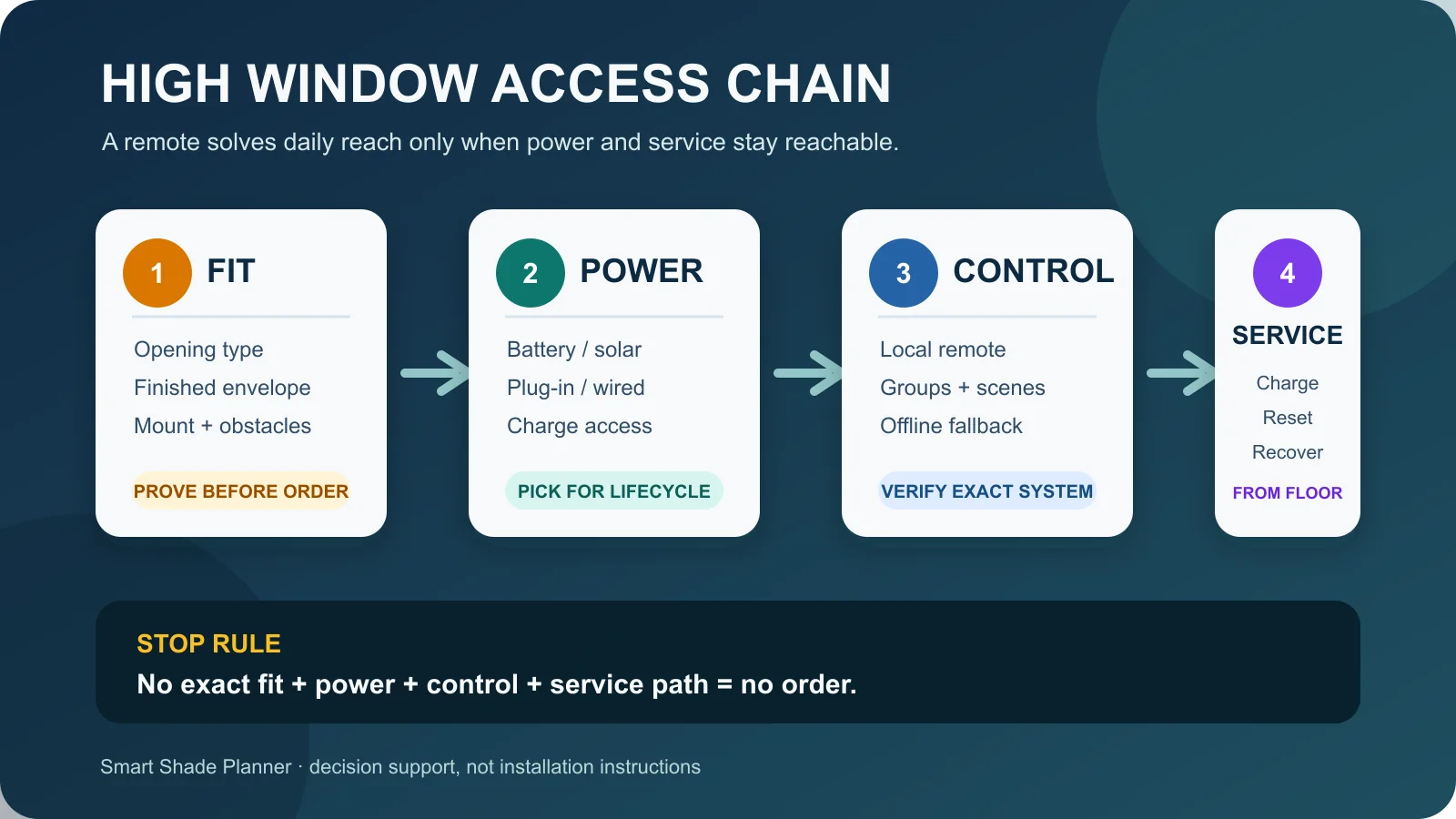
Motorized blinds are often the right answer for high windows, but a remote control is only half the answer. It solves the reach problem you experience every day. The system must also solve the reach problem that appears later: charging a battery, reaching a reset button, identifying a failed unit, cleaning the fabric or replacing a component.
For a two-story window, clerestory or stairwell opening, accept the order only when two things are true. You can operate the shade from a normal floor position, and every predictable service event has either a supported floor-level method or a named professional access plan. Height should remove guesswork from the quote, not postpone it.
The second reach problem arrives after installation
Daily reach is easy to demonstrate: press the local remote and watch the covering move. Ownership reach is less visible. Ask what will force a person to approach the headrail after the installers leave:
- connecting a charger or removing a battery wand;
- pressing a program, limit or reset control;
- re-pairing one shade that no longer follows its group;
- inspecting a solar lead, power supply or cable;
- cleaning, removing or repairing the fabric and motor.
A system can pass the remote demonstration and fail every item on that list. “The installer can reach it” describes installation day, not ownership.
Locate the unreachable component
Record the proposed headrail height, but also mark the position of the motor head, battery, charge port, solar connector, local button and reset control. A fascia or outside-mount valance can change which side is reachable. A stair landing, tub, sink, built-in bench or fixed furniture can make the floor beneath the window unusable as a service position.
Use the measurement checker for the opening and nearby obstructions. Then use the inside-versus-outside mount guide to compare the finished bracket and fascia envelope. For a high window, the better-looking mount is not automatically the better choice if it hides the only practical charge connection.
Keep specialty geometry separate. A vertical clerestory may use an ordinary lift path within the product’s size limits. A sloped skylight needs a geometry-specific system; an arch needs its own operability proof. Height does not cancel those requirements.
Choose power by the next service event
Instead of asking which power option sounds most convenient, ask: what is the next event that will require access, where will it happen, and who owns it?
| Power path | Next likely access event | Evidence needed before order | What remains serviceable |
|---|---|---|---|
| Replaceable battery pack or wand | Remove or replace batteries | Exact battery, estimated interval, removal direction and supported reach method | Motor, pack, controller and fabric |
| Built-in rechargeable battery | Connect the specified charger | Port position, cable/adapter, indication and floor-level connection method | Battery, motor, port and fabric |
| Compatible solar assist | Investigate low charge or inspect panel/lead | Exact motor/panel match, panel count, placement rule and depleted-battery fallback | Panel, lead, battery, motor and fabric |
| Plug-in supply | Diagnose supply, outlet or cable | Approved supply, route, disconnect point and visibility | Supply, motor, controller and fabric |
| Low-voltage or in-wall wired | Diagnose motor, supply or control | Preconstruction electrical plan, service points, responsible trade and outage behavior | Motor, power supply, controls and fabric |
“Wireless” therefore means no building power cable at the shade; it does not mean no future contact with the shade. “Wired” removes routine charging but does not make the motor, controller or fabric permanent.
A battery estimate needs a service method
Battery duration changes with the finished shade and how often it moves. Hunter Douglas currently says PowerView battery life varies with shade size and operation frequency and gives roughly one year as a typical example for its named battery wands. That is not a universal high-window interval. Read the current PowerView battery statement.
The related charging instructions show why the method belongs beside the estimate: the exact configuration may require removing a wand or using specified cables, adapters and extension-pole access, and the port position can vary with build and fascia. Check the current charging path for the quoted PowerView configuration.
Ask the supplier for four connected facts: exact motor and battery, finished shade size/fabric, assumed operations, and the complete floor-level service method. A long interval with no workable connection method is still a failed plan.
Solar moves the visit; it does not erase it
A compatible solar panel may reduce manual charging visits. It also adds a panel, cable and exposure requirement, while the rechargeable battery and motor remain. Somfy’s current support says its named Li-ion panel works only with compatible WireFree motors and requires one panel per motor/window. That count belongs to the Somfy system; another product needs its own rule. Verify the exact Somfy motor and panel relationship.
Ask where the panel and lead will sit, how tint, overhang and seasonal exposure affect the manufacturer’s placement requirements, and what happens after a low-charge condition. “Solar” should change the expected service pattern, not erase service from the drawing.
Wired power moves the hard decision earlier
Permanent power can be compelling when walls are open or many high units would create recurring battery work. Its cost is earlier coordination: supply location, approved wiring path, control architecture and future access must be designed before finishes close.
Order-time choices can be irreversible. Lutron’s current Serena FAQ says its battery and wired models are selected at order and cannot later be converted between those power types. Treat that as a Serena-specific warning to ask the same question of every candidate system. Review the current Serena power boundary.
In-wall or mains-related work belongs to the appropriate qualified professional. The shade quote should identify interfaces and responsibility; it should not leave the electrical route as an installation-day improvisation.
Floor-level control must survive the internet
Specify a local control that can open, stop and close the shade from the room without relying on an app, account or internet connection. Then add only the automation layers the room actually needs: schedules, scenes, away control, voice or ecosystem integration.
Write down which accessory owns each layer. A remote, hub, bridge, app and voice assistant are not synonyms. Also ask whether limit-setting or recovery requires a button at the headrail. A local remote that works during an outage does not help if re-pairing the shade later requires inaccessible physical contact.
A window bank is several service lives
A two-story wall may look like one design feature, but it is made of separate finished units. Each has its own size limit, motor, battery or feed, charge port and possible failure. If the opening must be split, plan bracket lines and visual gaps before controls. The large-opening planning guide handles those splits; this page adds a service identity for every upper unit.
Label each shade on the drawing and in the controller. “Upper left” is more useful during troubleshooting than one unnamed six-shade group. Preserve the model, motor, power accessory and fabric data for each unit after installation.
Group the task, not just the shades
Create groups around a room decision: upper glare row, lower privacy row, west exposure or whole-room close. Then test open, stop and close for every unit and every group. Record what happens if one shade misses a command or reaches a limit at a different time.
Group capacity is system-specific. Current PowerView Gen3 guidance recommends no more than twelve shades per remote for responsive behavior and suggests scenes for larger groups. This is not an industry limit; it demonstrates why the exact controller and shade count belong in the acceptance test. Check the current PowerView grouping guidance.
Design the four unavailable states
| Unavailable | Question to close | Acceptable evidence |
|---|---|---|
| Internet | Can the room control still open, stop and close the shade? | Demonstrated local remote or wall control |
| Hub, app or account | Which schedules/scenes disappear, and what local behavior remains? | Exact dependency map and local fallback |
| Building power | What happens to wired, plug-in and network components? | Documented resting state and recovery sequence |
| Motor or battery | How is the unit identified, reached and made serviceable? | Named access method, responsible service party and replacement path |
Do not assume a manual override. If privacy, sleep or glare control is critical, decide which resting position is less harmful and whether another layer is needed. That is a room decision, not a prediction that the motor will fail.
Only then choose fabric and darkness
Once fit, power, control and service pass, choose the covering around the real room job. A west-facing clerestory may need scheduled glare reduction. A high bedroom opening may prioritize night privacy. A two-story living room may value view and balanced daylight more than full closure.
Keep fabric performance separate from finished geometry. “Blackout fabric” does not describe side, top or bottom light gaps, and a solar-shade label is not an energy-savings guarantee. Require the exact finished-size and fabric combination to be approved with the selected motor and mount.
Where young children are present, inspect every accessible cord or loop even if the high shade is motorized. The U.S. Consumer Product Safety Commission says cordless coverings are the safest option in that setting. See the current CPSC cord-safety guidance.
Put the access drawing into the quote
For each high opening, the final quote or configuration sheet should show the finished shade and mount, motor side, exact power components, local controller, optional hub path, charge/reset points, next expected service event and the person or company responsible for it. Add the handoff tests: individual operation, every group, local operation without internet, and the documented recovery method.
The acceptance sentence is simple: the finished shade fits; its power path was chosen before manufacture; it operates from the floor; its next service event has a safe method; and its failure behavior is acceptable. If the quote cannot complete that sentence, it is not ready for a high window.
For a high window, service access is part of the product. Approve the charging, reset, removal, and fallback-control path from floor level before you approve the motor; otherwise every routine failure becomes an access project.
If high windows share a project with ordinary openings, use the Smart Motorized Blinds Planner to keep their special access burden from distorting the power and control plan for every other room.