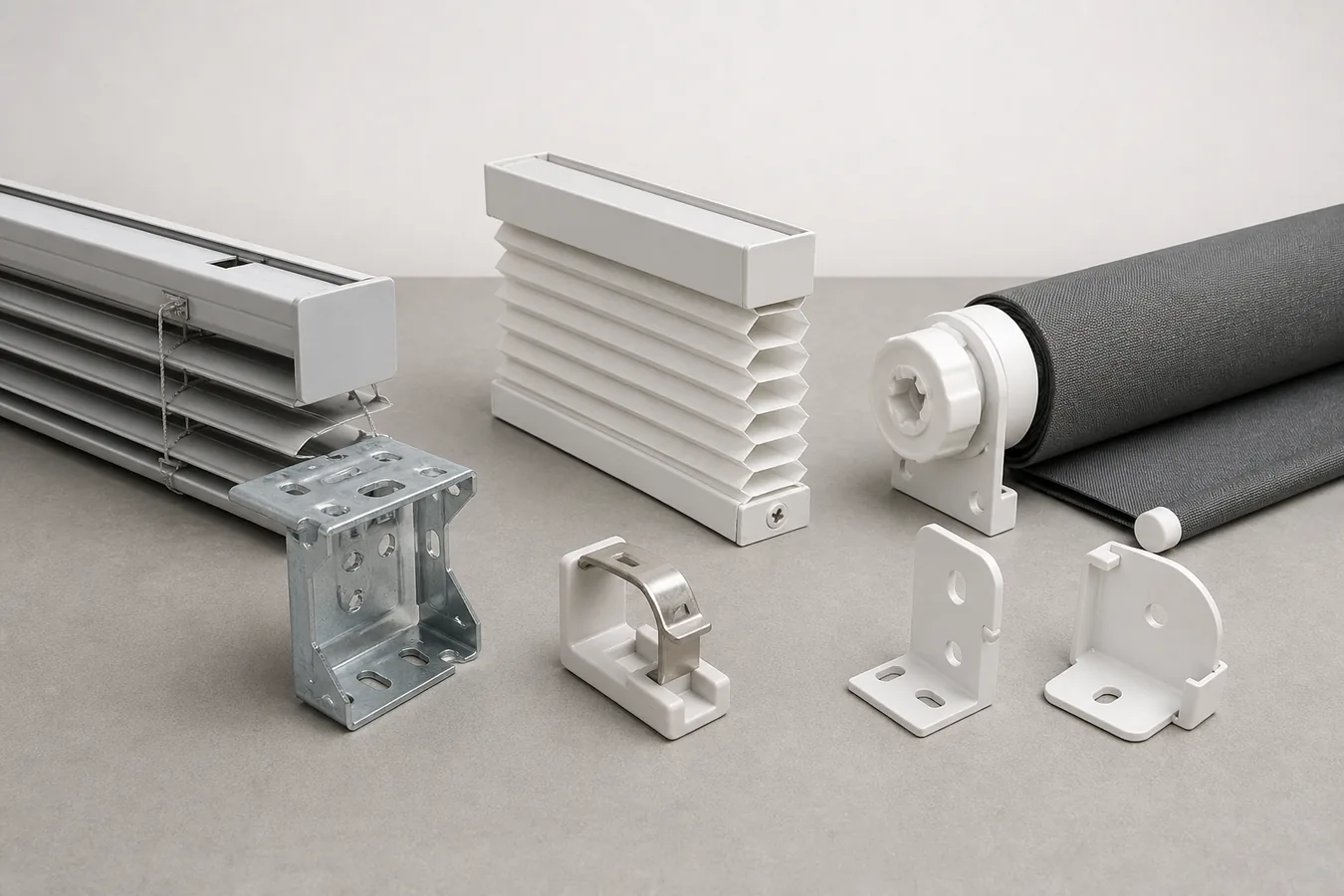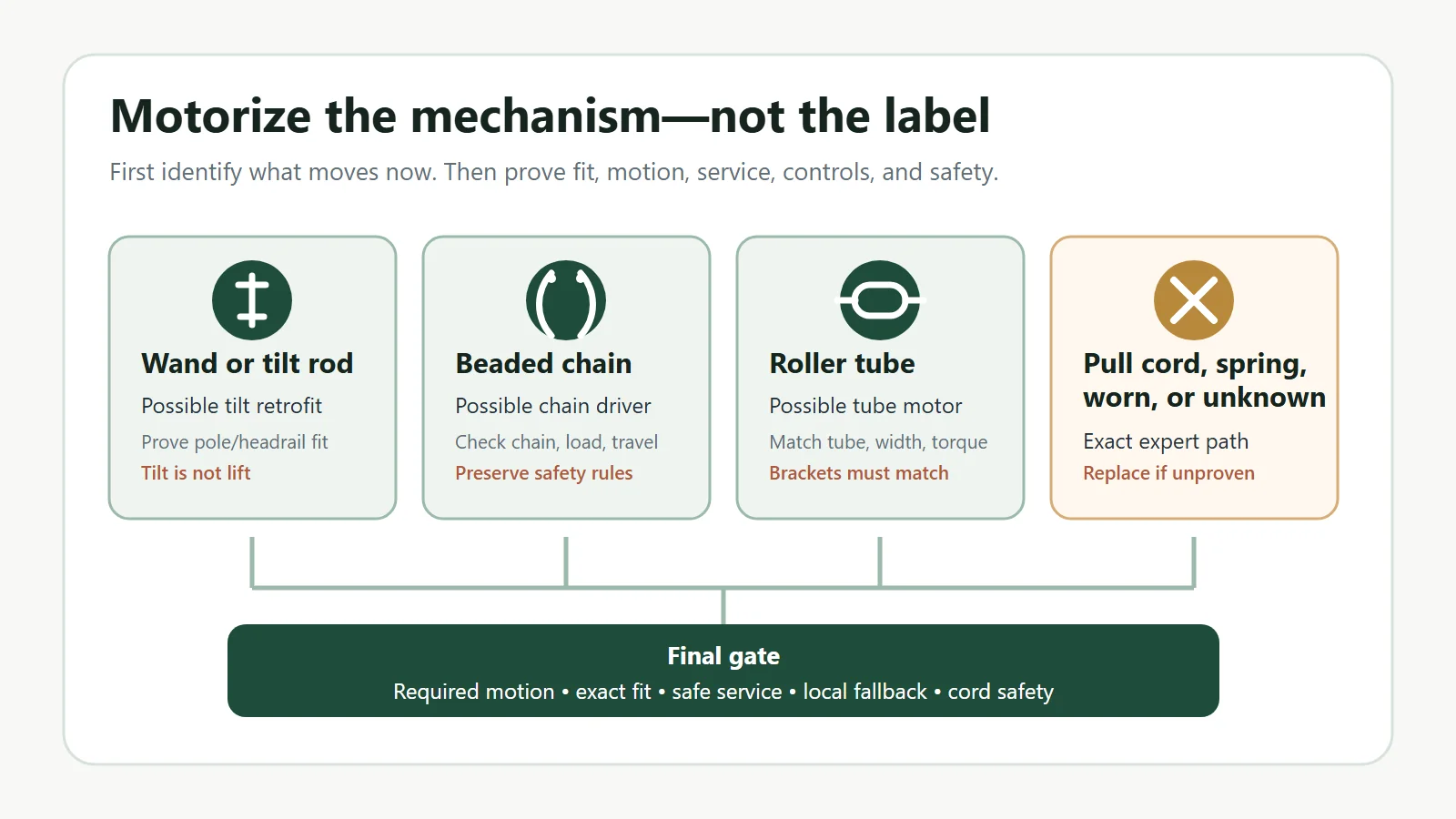
Yes, some existing blinds can be motorized—but “existing blinds” is not a compatibility specification. A retrofit succeeds only when a current motor can take over the exact movement your covering already makes. A wand rotator can tilt slats without lifting them. A chain driver can pull a compatible loop without fixing a worn clutch. A tube motor can raise a roller shade only when the tube, width, brackets and load match its documented system.
Think of the project as a motion chain. Your desired result sits at one end; the fabric or slats sit at the other. Between them are the control you touch now, a mechanical interface, the covering’s resistance, power, controls and a way to service the device later. One unsupported link is enough to turn a cheap-looking retrofit into the wrong purchase.
Start with the motion you refuse to lose
Describe the result without using the words “smart” or “motorized.” Do you need to rotate horizontal slats for glare control? Raise the entire blind to clear the glass? Roll a shade up and down? Traverse a vertical covering? If the blind uses one control to tilt and another to lift, those are two separate jobs.
This distinction can make a partial retrofit either useful or pointless. A horizontal blind that normally stays lowered may benefit from automated tilt throughout the day. The same tilt-only device will disappoint someone who expects a voice command to expose the whole window. Decide which motion may remain manual before comparing hardware.
Trace the force path without opening the headrail
Operate the covering normally from fully closed to fully open. Do not disassemble it for this first check. Note what your hand moves, what the covering does, and whether it completes the trip smoothly:
- a wand that rotates slats while a separate cord or handle lifts the blind;
- a looped beaded chain that raises, lowers or traverses the whole covering;
- a clutch at the end of a rigid tube around which the fabric rolls;
- an internal tilt rod driven from inside a horizontal-blind headrail;
- a spring, cordless handle, pull cord or mechanism you cannot identify.
Also note hesitation, scraping, drifting, uneven travel or the need to help the bottom rail by hand. Those are covering problems, not evidence that a stronger motor is needed. Record the opening and nearby handles or trim in the measurement checker; a retrofit still needs physical room to work.
| What moves now | Possible motor interface | What it may automate | What remains unproved |
|---|---|---|---|
| Tilt wand | External wand rotator | Slat angle | Wand geometry, attachment room, and all lifting |
| Internal tilt rod | Headrail tilt mechanism | Slat angle | Headrail/rod fit and all lifting |
| Beaded chain | External chain driver | The same motion produced by that chain | Chain match, load, alignment, mounting and safe loop treatment |
| Roller tube | Internal tube motor | Roller-shade lift | Tube profile, width, torque, brackets and service access |
| Cord, spring, cordless or unknown mechanism | Exact manufacturer conversion, if one exists | Unknown | The complete conversion path; replacement is the baseline comparison |
Tilt retrofits leave lift behind
External wand motors and internal headrail kits solve different interfaces, even though both can change slat angle. SwitchBot’s current support page limits Blind Tilt to horizontal blinds with a pole and lists supported pole diameters of 6.2–10.2 mm and 12 mm. Those numbers belong to that exact device; they are not a general wand standard. The page is useful because it shows the level of detail a real fit claim needs. Check the current Blind Tilt compatibility statement.
An internal headrail conversion asks a different set of questions. Somfy’s current Clever Tilt path specifies 2–2.5 inch indoor wood, composite or faux-wood horizontal blinds, corded lift, a compatible metal headrail and centered tilt rod. It replaces the tilt mechanism; it does not turn the separate lift cord into a motorized lift. Review Somfy’s exact compatibility questions.
For either route, the real decision is whether automated tilt alone creates enough value. If the answer is no, stop looking for a better tilt motor and compare a complete replacement that performs the required lift.
A chain motor inherits the chain’s problems
An external driver pulls the same loop that you pull today. That can preserve good fabric and avoid replacing a roller, but it also preserves the clutch, chain path, alignment and resistance already at the window. A chain that jumps, needs a hard tug or passes a connector badly will not become healthy when a motor takes your hand’s place.
Exact limits matter. RYSE’s current US specifications for model GR-0103 name a #10 beaded chain and state a supported boundary up to 9 × 9 feet or 10 pounds. The same page separates Bluetooth/on-device operation from routines and voice integrations that use an additional SmartBridge. These are product-specific facts, not a promise for every chain-driven shade. Verify the current RYSE specifications.
Before pursuing this path, photograph the chain and connector, observe one full cycle, locate the proposed mounting surface, and confirm the exact product’s treatment of the tension or hold-down arrangement. The inside-versus-outside mount guide can help expose a collision between the added driver and trim, glass or a handle.
A tube conversion changes the inside of the shade
A tube motor can produce a cleaner-looking conversion because it replaces the manual clutch inside a compatible roller tube. The tradeoff is stricter mechanical evidence. “Roller shade” is not enough: the tube’s outside diameter and profile, usable width, adapters, brackets, fabric roll and required torque all belong to the fit decision.
Eve’s current MotionBlinds Upgrade Kit support page illustrates the specificity. It lists one family for 25–30 mm outer-diameter tubes with a 570 mm minimum blind width and 0.5 Nm torque, and another for 38–51 mm tubes with a 680 mm minimum width and 1.1 Nm torque. It also identifies USB-C rechargeable power and a Thread-based smart-home route requiring a compatible Matter Controller and Thread Border Router. Use the current Eve page only for the exact kit being considered.
A tube between listed ranges is not “close enough.” Nor does a matching diameter prove that the profile, adapters, brackets or shade load match. Ask the manufacturer or responsible fabricator to confirm the complete combination.
A good covering can still be a bad retrofit candidate
Preserving a well-made, well-fitting covering is the strongest reason to retrofit. But condition is only one part of the burden. A device may fit mechanically and still create a charger or reset button that cannot be reached safely, protrude into a handle’s path, require a modification the renter cannot approve, or leave the most important motion manual.
Replacement becomes the better baseline when the covering binds, fits the opening poorly, has damaged fabric or hardware, or needs several add-ons just to approximate the desired result. Somfy’s general retrofit FAQ makes the broader point: existing coverings cannot all accept every motor, and an exact confirmation may require a qualified expert. See the current existing-covering boundary.
For a high window, remote operation solves daily reach—not future service. Decide who can safely charge, reset, recalibrate or remove the motor before calling the project accessible.
Local control is the floor
Define how the covering works when a phone, internet connection or hub is unavailable. That may be an on-device button, a dedicated remote or another documented local control. Only then add schedules, out-of-home control, voice assistants, Matter or group behavior.
Platform logos do not describe the whole path. SwitchBot’s current product page, for example, distinguishes functions available in Bluetooth range from voice, remote and Matter paths that require a separately sold compatible SwitchBot hub. Somfy similarly separates the Clever kit’s remote from its TaHoma-based app and voice route. Count the motor, power hardware, remote, bridge or hub, and the failure behavior you are willing to accept. Confirm the current control stack for the exact SwitchBot route.
Child safety can end the retrofit decision
Adding a motor does not automatically make a covering cordless. An external chain driver may continue to use a loop, and a tilt motor may leave the lift cord untouched. The U.S. Consumer Product Safety Commission states that cordless window coverings are the safest option where young children are present and warns that continuous-loop cords require an appropriate anchored hold-down or tension arrangement. Read the CPSC window-covering cord guidance.
If the conversion would move, remove or improvise around a safety device, the retrofit has not passed. The exact product manufacturer must own the approved configuration. Where a child can reach the window and no documented path resolves the cord or chain, compare an appropriate cordless replacement instead.
Compare the burden, not just the box
| Decision | Retrofit earns its place when | Replacement gains the advantage when |
|---|---|---|
| Value preserved | The existing covering fits well, moves smoothly and is worth keeping | Fit, condition or appearance already needs correction |
| Motion delivered | The exact device performs the action the user needs | A key action remains manual or unsupported |
| Evidence burden | Every interface, dimension, load and bracket is documented | Fit depends on visual similarity or approximation |
| Operating system | Power, local fallback and optional hub behavior are acceptable | Add-ons multiply without delivering a coherent control path |
| Lifetime burden | Charging, reset and removal remain safely accessible | Routine service creates a recurring ladder or access problem |
| Safety | The exact conversion preserves a documented safe cord/chain path | A reachable loop, tension device or damaged mechanism remains unresolved |
Use dated quotes if price matters, but do not compare only the motor box with a finished replacement. Include all required motors, remotes, power accessories, hubs, mounting work and safe future service. Also assign a value to the motion the retrofit does not automate.
Sign off one retrofit chain
Before buying, write one sentence that a manufacturer or installer can answer without guessing:
Compatibility request: “I need this covering to [tilt / lift / roll / traverse]. It currently uses [exact wand, rod, chain or tube], moves smoothly through [full travel], measures [required interface and opening dimensions], and has [mounting and service space]. Please confirm the exact motor, adapters, capacity, brackets, power method, local control, hub requirement and approved cord/chain arrangement for this configuration.”
A retrofit is worth pursuing only when the existing tube, brackets, fabric, limits, power, and local control can all be matched to a supported motor. If the installer cannot name that compatibility chain, replacing the complete shade is the safer comparison.
Once that retrofit-or-replace choice is clear, the Smart Motorized Blinds Planner can reconnect it to the project’s measurement, room, power, and control decisions.