A fabric can be sold under a linen color, a linen collection, a linen blend, or a linen look. Only the composition line tells you what the Roman blind is made from. One current IKEA Roman blind is described as having a linen look while its material is listed as 100% recycled polyester. Gotain’s current Woven Linen Roman blind instead lists 67% linen and 33% viscose. Neither product settles whether another linen-labeled shade is natural fiber, a blend, or a visual description.
Before ordering, attach the exact fabric code and color to its fiber percentages, weave or weight, liner, fold construction, care instructions, stated variation, control, and finished size. Ask for that same combination in a full-width or finished sample. If the seller cannot return the material identity and completed construction together, the choice is not ready for fabrication.
Separate the sales name from the fiber line
Treat the product title as a route to a specification, not as the specification itself. “Flax,” “natural,” “oatmeal,” and “linen” may describe a color or surface. A collection can also contain more than one fiber recipe. Nordic Knots, for example, currently groups both linen and cotton-linen products in its US linen Roman-shade collection. That is useful for browsing, but it does not replace the composition line of the selected fabric.
The range inside one merchant’s records can be wider still. A current Blinds.com Roman-shade fabric listing identifies Brant Cream Linen as 100% polyester, Venice as 55% linen and 45% rayon, and Linen Stripe as 80% rayon and 20% linen. These exact catalog examples do not rank the fabrics. They show why a linen-containing name cannot establish the fiber percentages.
Copy the composition exactly as the seller gives it, including the order of fibers and percentages. Save the fabric code and color on the same line. A detached swatch with “natural linen” handwritten on the back is not enough when the quote later uses another code, color, or collection.
If the shade family itself is still undecided, compare roller, cellular, and Roman shades first. The Roman format makes the face fabric part of the room, but it also makes that fabric travel through folds, hems, lining, support, and a repeated raising cycle. Material identity matters because it belongs to a completed moving shade, not a loose textile.
Put six material lines on the quote
The useful record is short enough to fit beside the quote. It does not need a textile essay; it needs six lines that remain attached to the selected fabric through approval and fabrication.
| Quote line | What to record | Evidence to accept | What it decides | Mark unresolved when |
|---|---|---|---|---|
| 1. Identity | Seller, range, fabric code, color, and current URL or dated spec | Exact product record plus labeled swatch | Ensures every later answer belongs to the same face fabric | The swatch and quote use different names or codes |
| 2. Fiber and surface | Fiber percentages, weave description, weight if stated, pattern repeat, and face/back orientation | Current composition line and supplier data | Separates fiber from look and flags full-width questions | “Linen” is the only material answer |
| 3. Lining | Unlined or exact liner code; liner fiber/color when supplied; which areas it covers | One configured sample or written construction | Changes light, exterior view, body, thickness, and folds | The liner is a generic checkbox with no matched sample |
| 4. Fold and support | Roman style, battens/rods/pockets, seams, hems, rear attachments, and normal stack | Front/back image or sample of the selected construction | Shows how the fabric is supported and repeated across the shade | Only a flat swatch or front beauty photo is available |
| 5. Care and variation | Cleaning method, stated shrinkage or tolerance, roll/lot variation, and reorder warning | Product-specific care and variation record | Determines whether the room and maintenance expectation fit | Care is borrowed from another linen product |
| 6. Finished configuration | Mount, finished width/drop, control, side-by-side quantity, and approved sample reference | Final quote or shop drawing | Freezes the fabric as one completed shade | Fabric, liner, size, fold, or control changes after approval |
Use CONFIRMED, NOT APPLICABLE, or UNRESOLVED beside every line. “Probably” is not a fourth state. A supplier may use different field names, and some products will not publish weight or repeat. The point is not to force a number that does not exist; it is to expose which decisions are still being inferred.
The fabric record does not replace window measurements. Keep opening dimensions, mount depth, obstructions, and the intended shade plane in the smart-shade measurement checker, then attach the supplier’s finished width and drop to line six. That separation prevents an opening measurement from being mistaken for a fabricated shade size.
Carry a hand-size swatch across the full window
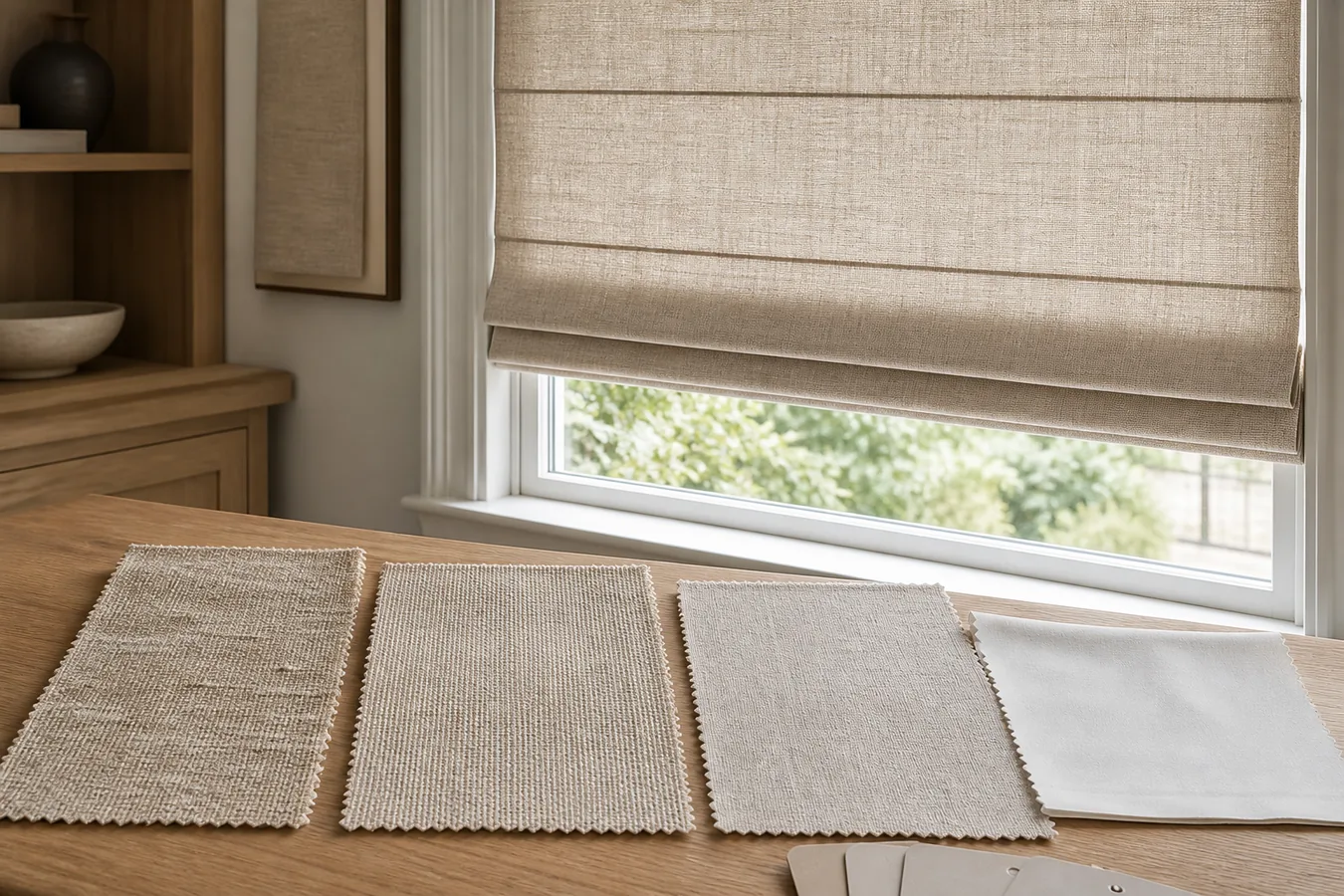
A small swatch can confirm color, hand, and close-up weave under your room light. It cannot show how the material reads over a six-foot width, where a repeat lands, whether a seam is needed, or how several horizontal folds stack. It also cannot show whether slubs and tone shifts feel quiet or distracting at room scale.
Ask for one of three forms of evidence: a full-width hanging sample, a finished sample shade in the exact fabric and liner, or a supplier image that identifies the fabric code, approximate size, fold construction, and lighting. A styled room photograph without that identity can provide inspiration but cannot approve the order.
Roll and lot variation matters most when several shades must read as a set. Gotain’s exact Woven Linen Roman page currently warns of slight shade and texture variation between rolls. That statement belongs to its product, but the question travels: ask whether all shades for one room will be cut from the same lot and how a future reorder might differ. For a coordinated window set, record shade order, seam position, fabric orientation, and the acceptable range of visible variation. The relaxed Roman shade guide owns the separate task of proving consistent drape across multiple windows; this page keeps the material identity that feeds that test.
The finished raised position belongs in the sample too. A material that looks calm at full drop may build a thicker or more textured stack once repeated in folds. If clear glass at full raise is important, compare the Roman and roller formats at that state before trying to solve a format problem with a different linen label.
The liner becomes part of the fabric system
Do not approve the face fabric in one meeting and choose the liner from a menu later. The liner sits behind the face, but it can change the light passing through, the color seen from the room, the exterior appearance, the body of each fold, the total stack, and what rear construction remains visible.
Request an unlined sample and the exact lined sample when both paths are offered. View each at full drop and the ordinary partly raised position. The purpose is not to declare one universally better. It is to find which completed combination preserves the texture you wanted while meeting the room’s privacy, light, and fold requirements.
SelectBlinds’ current Classic Roman product page illustrates why the choices must stay together: fabric, liners, control, exterior-facing material, and construction notes are all parts of one configurable product family. Its details cannot prove another brand’s result. They do support a sound purchase rule—approve the configured shade, not independent option labels.
When darkness is the requirement, move to the blackout Roman shade fabrication task. A dark-sounding liner name alone does not prove the finished edges, seams, or mount will control leakage. When a light, see-through face fabric is the priority, the sheer Roman shade guide handles the separate day/night privacy and rear-hardware evidence. Here, the narrower job is to keep the selected face and liner identified as one material system.
Let the care line choose where the fabric works
There is no single care rule hiding inside the word linen. IKEA currently lists its 100% recycled-polyester linen-look RINGBLOMMA as machine washable under product-specific instructions. Gotain’s 67% linen/33% viscose Woven Linen Roman page instead gives its own vacuuming, steaming, spot-treatment, and shrinkage guidance. Those records are not contradictory; they belong to different materials and products.
Start with the room rather than a fiber stereotype. A kitchen-adjacent shade may face airborne grease or frequent touch. A family room may need simple dust removal. A rarely handled bedroom shade may place more weight on texture than on aggressive cleaning. Ask what can be cleaned while mounted, what requires professional handling or removal, and whether the instructions apply to the face fabric, the liner, or the complete shade.
Then ask how cleaning interacts with the control and support. Rods, battens, magnets, pockets, or a motorized headrail can make a generic fabric-care instruction incomplete for the assembled product. The motorized Roman shade guide owns power, motor fit, movement, and service access. Keep its approved control configuration on line six rather than assuming a care method for loose fabric applies to a motorized shade.
If the required care is not realistic for the room, change the documented fabric before fabrication. Do not solve the mismatch by promising yourself unusually gentle use for years.
Choose the blend on purpose
Fiber content is not a quality score. A documented linen-rich blend, a lower-linen blend, a linen-look synthetic, or another face fabric can each be a rational choice if its exact evidence and completed behavior fit the room. Compare what the record proves instead of ranking the label.
| Material path | What the label can establish | Evidence still needed | Useful when | Do not assume |
|---|---|---|---|---|
| Documented linen-rich blend | The listed fibers and percentages for that fabric | Full-width appearance, liner, folds, care, roll/lot notes, and control | The exact texture and variation are wanted and the care record fits | Natural fiber percentage guarantees better folds or longer life |
| Documented lower-linen blend | The stated share of linen and other fibers | The same completed-shade evidence | Its exact surface and construction suit the room | The word linen describes the dominant fiber |
| Linen-look synthetic | A visual direction only, plus the separately listed synthetic composition | Exact care, lining, fold, and finished sample | The documented product behavior and maintenance fit better than a fiber preference | Linen look carries linen’s fiber properties |
| Another documented fabric | Its own composition and seller record | The same six quote lines | The room task is more important than preserving a linen label | Cotton, polyester, or another name predicts one universal result |
This comparison keeps cotton, striped, patterned, white, and other appearance phrases inside one material decision rather than turning each into a near-duplicate shopping page. If a pattern or stripe is selected, add repeat placement and alignment to line two. If multiple windows must match, add roll/lot allocation to line five. The asset expands because the buyer’s evidence changes, not because another adjective deserves another URL.
Close one material identity before fabrication
The order is ready when the swatch label, composition line, liner, fold/support method, care record, control, and finished size all point to the same configured Roman blind. Attach a dated product/spec page, the labeled sample, and the returned quote or drawing. If any of those records conflict, ask the seller to correct the identity rather than choosing the version you prefer.
Reopen approval when the fabric code or color changes, when another liner is substituted, when a manual sample becomes a motorized order, when the width changes enough to alter seams or support, or when a later window is cut from another lot. These are changes to the evidence object, not clerical edits.
A linen Roman blind is not resolved by proving that linen appears somewhere in the name. It is resolved when the exact material and the finished shade remain connected from the first swatch to the fabrication order.