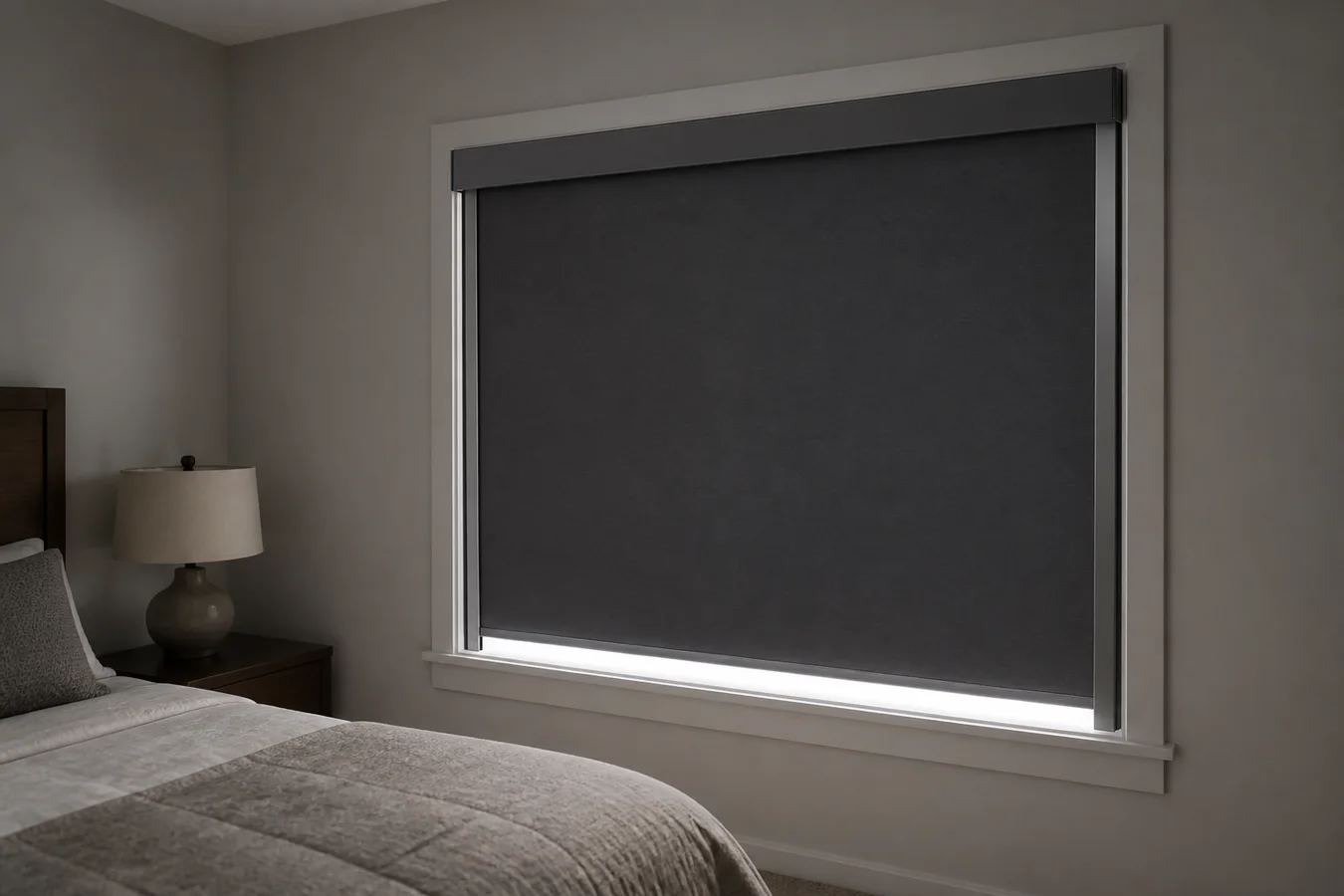
Side tracks do not create darkness by themselves. They control the two vertical edges. The top treatment, lower edge, fabric opacity, frame alignment and moving hembar still decide how much light reaches the room.
Before buying a tracked blackout shade, ask for one drawing that shows the cassette or pocket, both side channels, the fabric path and the sill detail together. A side-track accessory shown beside an opaque fabric sample is not the same evidence.
Start with the stripe of light you can actually see
Define the room result before choosing hardware. A shade that reduces glare for a media room has a different job from one intended to protect daytime sleep. Use the room-by-room shade planner to record that outcome, then inspect the window when the troublesome daylight is present.
Stand where the sleeper, screen or reflective surface will be. Note whether the bright path appears above the shade, along one jamb, under the hembar or through the fabric itself. Also note whether it changes as the shade moves. This is more useful than asking whether a catalog swatch is “blackout,” because the visible stripe identifies the part of the installed system that has to change.
Do not turn that observation into a universal darkness guarantee. Exterior conditions, pale interior surfaces and the viewer’s light sensitivity all affect the result. The goal is to connect the room’s actual failure to a component the supplier can document.
Build the perimeter in four connected parts
| System edge | What must meet it | What the quote should show | Failure signal |
|---|---|---|---|
| Top | Cassette, fascia, pocket or another documented top treatment | How the top component meets the channels and where the fabric drops as the roll changes diameter | A bright line over the fabric or an open corner where a channel stops below the head |
| Left and right | The exact channel profile and the fabric edge or retention feature designed for it | Channel mounting plane, channel-to-head joint, usable fabric capture and tolerance for the real frame | Visible jamb light, rubbing on one side, fabric leaving the channel or a track fastened to an unsuitable surface |
| Moving lower edge | A hembar shaped and sized to travel with the selected channels | Hembar position, end treatment, pile or seal contact and clearance through a full raise-and-lower cycle | Binding, twisting, noisy drag, incomplete closure or a hembar that cannot enter the intended bottom detail |
| Fixed sill or floor | Sill channel, angle, seal or an accepted unsealed gap | The final lower interface, mounting substrate, drainage and any access or egress constraint | A continuous line of light under an otherwise well-tracked shade |
This is one perimeter, not four independent upgrades. Lutron’s current light-blockage application note coordinates a top treatment, side channels and a lower sill detail for named roller-shade systems. Its value here is the system logic, not a promise that another brand’s components will fit or perform the same way.
Insolroll likewise separates side leakage from lower-edge leakage: side tracks address the vertical gaps, while a sill channel addresses the bottom. If a proposal contains the tracks but no answer for the lower edge, describe it as side-light reduction until the remaining gap is accepted or closed.
The fabric has to travel through the drawing
A static section drawing can look perfect while the moving shade fails. As fabric rolls onto the tube, the roll diameter changes and the drop line can shift. Lutron’s application guidance warns that misalignment or obstacles in named systems can contribute to binding, buckling, telescoping or fabric pulling out of a channel. That is why the drawing must show the fabric path, not only the metal profiles.
Run the proposed shade through the positions that matter:
- Fully raised: the hembar, fabric edge and roll clear the cassette or pocket without catching.
- Mid-travel: the fabric remains centered and does not scrape one channel more than the other.
- Nearly closed: the hembar enters the intended lower interface without twisting or stopping early.
- Fully closed: the top, sides and bottom meet as drawn, and the control still reaches its intended limit.
Friction belongs in this review. Lutron’s current Sivoia QS hembar guidance explains that wool pile used for light sealing adds friction and that hembar selection matters for named side-channel builds. Do not borrow its component choice for another system. Ask the selected supplier to approve the channel, pile or seal, hembar, fabric and control as one configuration.
For a motorized shade, include the real upper and lower limits, power route and service position. The motorized blackout shade room guide helps decide whether motorization adds enough value for the room; the tracked-system quote must still prove that the chosen motor can move the completed shade through its added friction and geometry.
A side channel is not one universal accessory
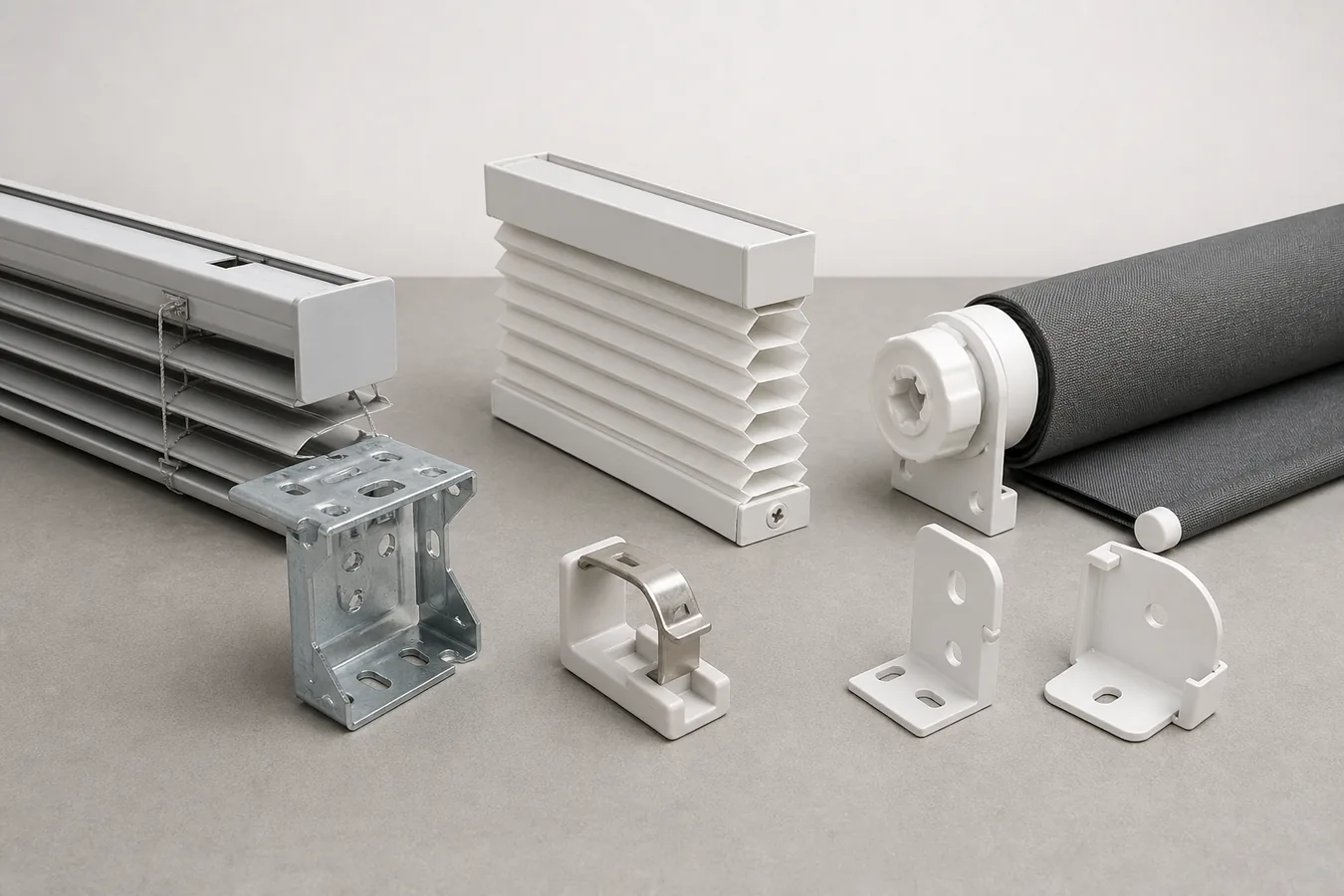
“Side track” describes several different ideas. An L-shaped angle can block a direct line of light without capturing the fabric. U- and H-shaped profiles can form different channel or shared-channel conditions. Draper’s current side-channel product detail distinguishes U-, H- and L-style options and also shows that these options are not compatible with every shade product.
A proprietary cellular-shade channel is another category. Hunter Douglas describes LightLock as a U-shaped channel system for named Duette cellular shades. That is evidence for the complete named system, not a channel profile to combine with an arbitrary roller shade.
Outdoor ZIP-style systems add fabric-edge retention for wind and tension. They should not be assumed to be an indoor roller-shade upgrade just because both products use the word “track.” Choose the shade family first, then use only the retention, channel, hembar and bottom details approved for that exact family and size.
The practical request is simple: put the shade model, fabric, finished size, channel part or profile, hembar and lower closure on the same quotation. If one item is described only as “standard side track,” the compatibility decision is still open.
Choose the smaller system when near-dark is enough
Not every room needs a captured or fully channeled perimeter. If the observed problem is a mild vertical glow, an approved side light blocker may be enough. If the opening has flat wall area, a wider outside-mounted roller shade can move the fabric edge beyond the glass without adding track friction. The outside-mount roller-shade guide shows how overlap, projection, trim and hardware compete in that approach.
A layered treatment can also be the honest choice. A roller shade can handle most direct light while side-return drapery or another compatible layer softens the remaining edge glow. This is not the same as proving total darkness, but it can meet an ordinary bedroom or media-room target with fewer proprietary parts and easier cleaning.
Keep the engineered perimeter for the cases that justify it: a bright low sun striking the edge, daytime sleep, a nursery schedule, projection use or another situation where a thin light path materially defeats the room. Buy the smallest documented system that meets the stated result, not the most elaborate accessory list.
Make installation and service part of the quote
Channels need a straight, secure mounting plane. Record the opening, both jambs, the head, sill, trim, handles and nearby obstructions in the Smart Shade Measurement and Compatibility Checker. Preserve those as field conditions; let the selected manufacturer or installer convert them into finished product dimensions and deductions.
Ask what happens if the frame is out of square. A channel that follows a crooked jamb may pinch the fabric, while a channel installed plumb may need a visible filler or leave a changing reveal. Neither choice should be improvised after a custom shade arrives.
Service access matters too. The cassette or fascia must open without destroying surrounding trim. Pile and channels collect dust. A motor, battery or wired connection needs an accessible service path. If the lower detail crosses an operable door, required exit or usable sill, confirm the exact access and local safety implications before adding it. A lower angle that improves darkness is not automatically acceptable in every opening.
Make the installer own the completed cycle, not just the attachment of parts. The acceptance check should lower and raise the shade several times, observe both fabric edges, confirm the hembar reaches the intended lower position, inspect the four perimeter joints under the relevant daylight and preserve access to the control and service points.
Approve one drawing, not four separate promises
A credible tracked-blackout proposal should let you trace one continuous path: top treatment to left channel, left channel to lower closure, lower closure to right channel, and right channel back to the top. The fabric and hembar must travel inside that perimeter without losing alignment or access.
If the drawing omits an edge, names no exact compatible channel, or proves the fit only with the shade stationary, hold the order. If the supplier intentionally leaves a gap, record that trade-off and call the result room darkening or side-light reduction. Approve a stronger darkness claim only when the complete exact system—not the fabric label and not the side tracks alone—supports it.