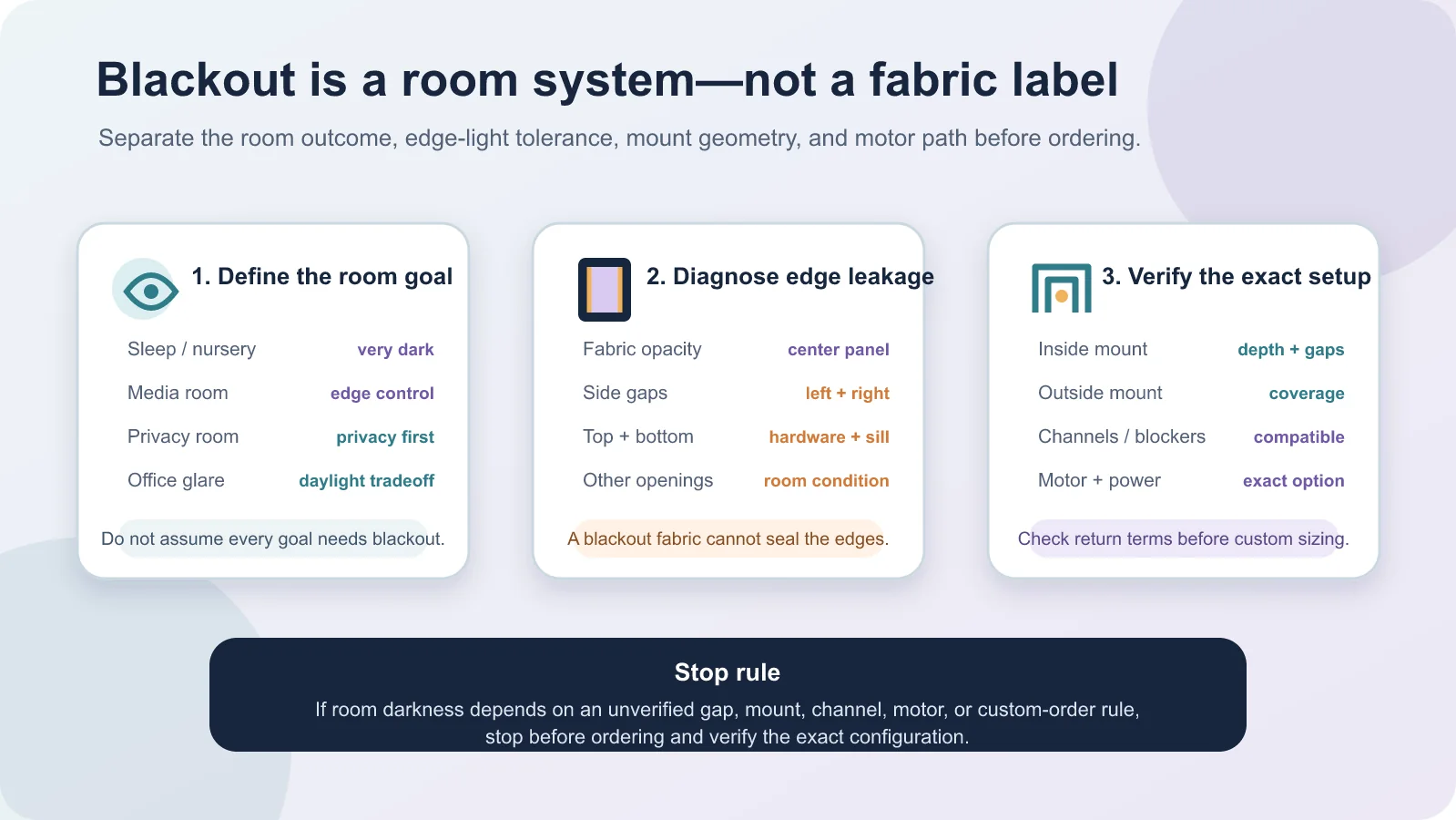
Motorized blackout shades work as a room system, not as a fabric label. The result depends on how dark the room must be, how much edge light is acceptable, whether the mount can create the needed coverage, and whether the exact motor and power option fits the opening.
A fabric described as blackout can still leave light at the sides, top, or bottom. An outside mount can increase coverage but may conflict with trim, handles, wall space, or a cassette. Side channels and light blockers can reduce leakage, but they must be compatible with the exact shade and aligned so the fabric can move safely.
Choose the room outcome before the shade
| Room task | Likely edge-light tolerance | What matters most | Do not assume |
|---|---|---|---|
| Daytime sleep or a nursery | Low | Side, top, and bottom leakage; outside coverage or a compatible channel/blocker system; repeatable motor control | That a blackout fabric label will make the room fully dark |
| Media room | Low to moderate | Edge light near the screen, reflections, window orientation, and the room’s other openings | That fabric opacity alone predicts screen glare |
| Street-facing privacy | Often moderate | Privacy at the required time of day, view-through, and whether room darkening is sufficient | That privacy automatically requires blackout |
| Office glare reduction | Task-dependent | Sun angle, monitor position, useful daylight, and whether a solar or light-filtering layer fits better | That the darkest fabric is the best working-light solution |
If you cannot state the room outcome in one sentence, stop before comparing brands. “I need enough privacy for a street-facing bedroom” and “I need very low edge light for daytime sleep” lead to different systems.
The three layers of blackout performance
1. Fabric opacity
Fabric opacity describes light passing through the selected material. It does not include the clearance between the fabric and the window frame, the space around a cassette or headrail, or light from adjacent openings. Treat every percentage or blackout label as a source claim tied to the exact fabric option.
2. Edge control
Roller systems need operating clearance. Lutron’s system-specific measuring guidance publishes different light-gap dimensions for different roller families and distinguishes inside- from outside-mount conditions. That is useful evidence for the general principle—finished shade width and fabric width are not the same—but those Lutron dimensions must not be copied to another brand.
Integrated channels can change the outcome. Lutron documents side channels, top treatments, and bottom details as parts of a complete light-control system, while Hunter Douglas describes its proprietary LightLock design as using overlapping side channels. These examples show why near-zero edge leakage is a system specification, not a fabric upgrade. Compatibility, alignment, power type, and safe movement still need exact verification.
3. The room itself
Wall color, sun angle, sill geometry, corner windows, doors, transoms, and other openings affect perceived darkness. A shade comparison cannot predict a room result without those conditions. If the outcome is critical, plan how you will assess the actual opening and verify the chosen system before committing to multiple custom units.
Inside mount, outside mount, or an integrated blocker system?
| Path | Potential advantage | Main risk | Verification before custom sizing |
|---|---|---|---|
| Inside mount | Contained appearance and no extra wall overlap | Usable depth, out-of-square frames, fabric deductions, and visible side gaps | Measure at the actual bracket location; check the exact cassette/valance depth and expected fabric-to-frame clearance |
| Outside mount | Can extend coverage beyond the opening and avoid shallow recesses | Trim, handles, wall flatness, mounting surface, hardware width, and top/bottom leakage | Confirm the manufacturer’s coverage instructions and whether the wall/trim provides a suitable mounting surface |
| Compatible side channels or light blockers | Targets edge leakage directly | Binding, misalignment, incompatible hembar/fabric, power restrictions, or damage during travel | Use only components approved for the exact system and follow the manufacturer or qualified installer’s alignment requirements |
| Layered treatment | Can separate daytime light control from nighttime darkness | More stack depth, wall space, cost, and control complexity | Plan the order of layers, collision clearance, and which layer handles privacy, glare, and darkness |
Before choosing a mount, run the measurement checker before choosing blackout shades. Then use the inside-versus-outside mount decision guide to resolve depth, trim, obstructions, and overlap.
What current product examples can prove
The examples below show how exact fabric, mount, and motor fields affect a blackout plan. They do not predict the finished room by themselves. Product pages were rechecked on July 19, 2026; recheck the current model and order terms before custom sizing.
| Exact row | Current documented field | Useful planning conclusion | Required stop rule |
|---|---|---|---|
| SmartWings Motorized Zebra Shades 100% Blackout 95mm Chloris | The exact product page identifies a blackout Chloris fabric and multiple motor paths. SmartWings’ zebra measuring guide also distinguishes fabric width from valance/order width. | Use it to research a zebra-shade blackout fabric with configuration-specific motor and gap questions. | Do not infer room darkness or universal ecosystem support; verify the selected motor, valance, depth chart, deduction, and edge gaps. |
| Graywind Motorized Blackout Roller Shades — Vinyl Series | The product page lists inside/outside mount, a 1 7/8 in minimum inside depth, and says the valance projects when frame depth is below 2 3/4 in. | Use it to compare usable recess depth with valance projection and desired edge coverage. | The reviewed product documents do not establish the protocol and hub path needed for an ecosystem conclusion. |
| Yoolax Motorized Blackout Roller Shades | The exact product page lists inside/outside mount and a 2.4 in minimum inside depth, with several motor/control options. | Use it to compare recess depth and exact motor selection in a blackout roller-shade path. | The manufacturer’s light-blocking language is not a room test. Verify the selected fabric, motor, hub path, edge treatment, and current policy terms. |
None of these rows is a “best” pick. The correct next step depends on the opening and room outcome. A product that clears the depth requirement can still fail the edge-light goal; a product with a strong fabric claim can still have the wrong motor or return boundary.
Room-by-room decision rules
Bedroom or daytime-sleep room
Write down the light leak you are willing to accept at the side, top, and bottom edges. If a thin dawn line would defeat the goal, ordinary roller fabric plus a standard inside mount is not a sufficient specification. Verify outside coverage, a compatible blocker/channel system, or a layered treatment before custom sizing.
Nursery
Separate darkness from the control system. Check edge leakage, the selected shade’s cordless operating design, reachable accessories, power or charging access, and the manufacturer’s current guidance. Treat sleep or health goals as separate from the shade specification.
Media room
Map where direct and reflected light reaches the screen. A fabric label cannot predict reflections from side gaps, a bright sill, or another window. Decide whether the room needs reduced daylight, very low edge light, or a layered daytime/nighttime treatment.
Privacy room
Test the real task: privacy by day, privacy at night with interior lights on, or both. If darkness is not required, a privacy or room-darkening fabric may preserve more useful daylight. Confirm the exact fabric’s view-through behavior rather than defaulting to the darkest option.
Office or glare-sensitive room
Blackout can remove useful daylight while still failing to solve every reflection path. Compare solar, light-filtering, room-darkening, dual-layer, or blackout paths according to sun angle and screen placement. No glare-performance claim is made here because the site has not tested these fabrics in a room.
Motor, power, and smart-home checks
Blackout performance and smart-home compatibility are separate fields. Verify the exact motor option—not the brand in general—before relying on an app, voice assistant, hub, bridge, protocol, or schedule.
- Confirm whether the selected motor is rechargeable, solar-assisted, plug-in, or professionally planned hardwired.
- Make sure charging access or cable routing still works with the chosen valance, outside overlap, drapery layer, or channel system.
- Check whether the listed ecosystem path is native, hub-required, bridge-based, motor-specific, or still unknown.
- For multiple shades, verify grouping, alignment, width limits, and whether one treatment or multiple panels create new center gaps.
- Do not improvise electrical work or attach unapproved blockers where they could interfere with shade travel.
Stop before ordering when any of these is unknown
- The room goal requires near-zero edge leakage, but only the fabric opacity has been checked.
- The usable flat mounting depth is smaller than the exact bracket/cassette requirement.
- The outside-mount width ignores trim, handles, wall flatness, hardware width, or the desired overlap.
- A channel or blocker has not been confirmed compatible with the exact shade, hembar, power type, and travel path.
- The selected motor, hub, bridge, protocol, app, or ecosystem path varies or remains unknown.
- The order is custom-made and the current cancellation, remake, return, and warranty terms have not been read.
- A current price or promotion is pushing the order ahead of unresolved fit, gap, power, or compatibility questions.
Product documents checked
- Lutron measuring guidelines and system-specific light-gap dimensions
- Lutron application note on side, top, and bottom light-control components
- Hunter Douglas description of the proprietary LightLock side-channel system
- SmartWings measuring guidance for zebra and roller shades
- SmartWings exact Chloris zebra product specification
- Graywind exact vinyl blackout roller product specification
- Yoolax exact motorized blackout roller product specification
Final decision rule: do not order from a blackout label. Order only after the room outcome, edge-light tolerance, exact mount, usable depth, blocker/channel compatibility, motor path, and custom-order terms all agree.
Use the smart shades room by room pillar to compare this decision with the rest of the verified planning path before ordering.
Judge the finished room at the times darkness matters. The winning option is the one whose fabric, gaps, mount, motor, and service plan meet that room’s threshold together—not the one with the strongest blackout label.