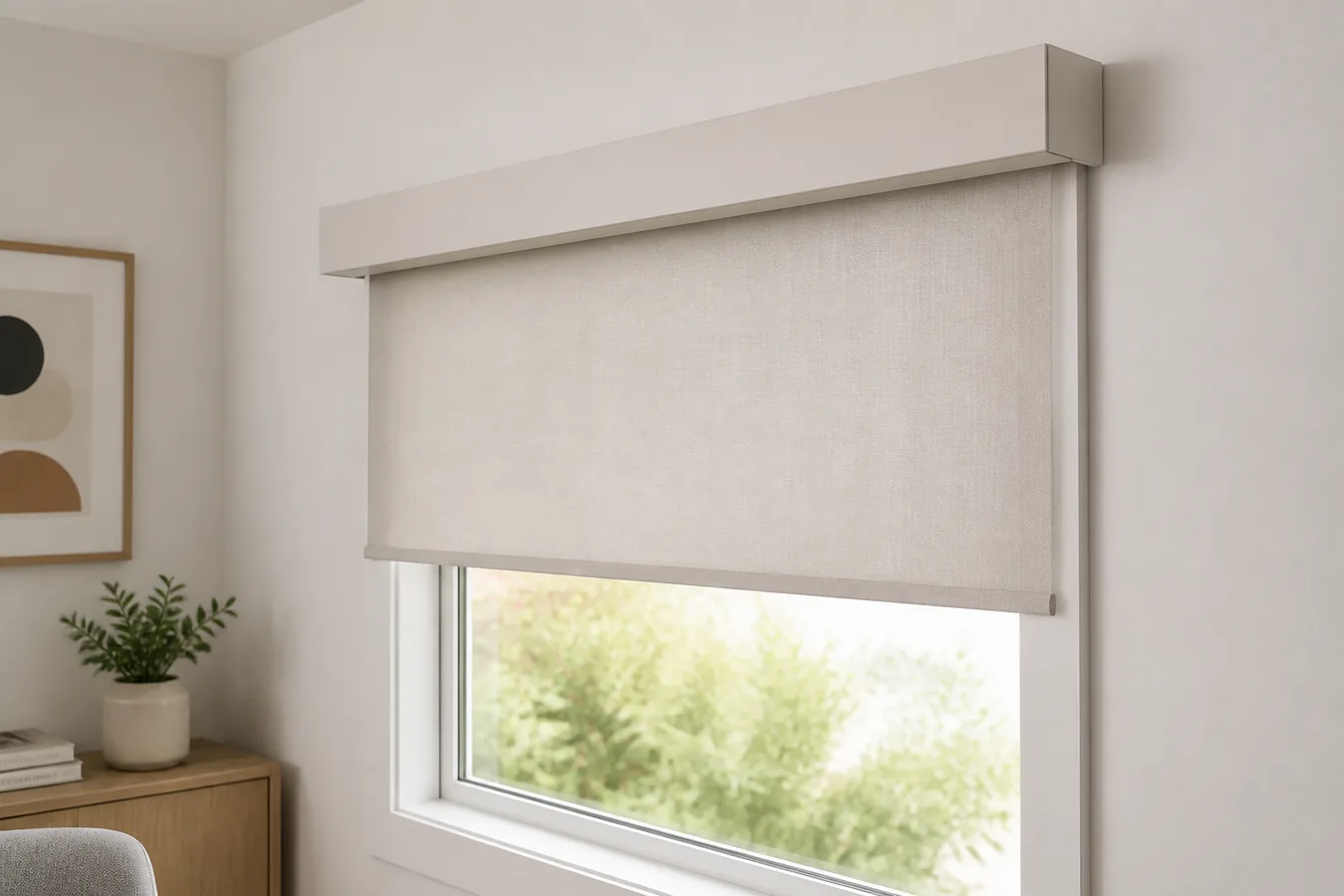
A cassette roller shade is not simply a neater fabric choice. The cassette is another object at the top of the window. It hides the roll, but it also occupies height and depth, changes where the fabric leaves the tube, and can make the brackets, motor or release clips harder to reach.
Before paying for the upgrade, ask the supplier for a side section of the exact completed shade. It should show the mount, exterior cassette, largest rolled-fabric condition, fabric exit, finished cloth edges, control or power end, and the direction used to remove the cassette. If the only evidence is a front-view rendering or the word “cassette,” the fit is not proved.
Decide what you are trying to hide
An exposed roll leaves the tube and fabric visible. A fascia or front cover can screen the roll from the room while leaving more of the top or back accessible. A full cassette encloses more of the assembly. An architectural pocket moves the roll into a recess coordinated with the ceiling or wall.
Those terms are not reliable dimensions. Manufacturers package their top treatments differently, and even one product family can restrict which drop direction, control, or valance can be combined. Lutron’s current manual roller shade specification, for example, publishes different envelopes for named fascia and pocket configurations. That proves the need for an exact record; it does not create a universal cassette size.
Write the visual goal first: hide the fabric roll from the room, conceal the brackets from below, align a row of shades, or integrate the shade into the architecture. Then compare only exact configurations that satisfy that goal. The broader roller, cellular, Roman, and zebra shade comparison belongs one step earlier if the shade family itself is still undecided.
Put the whole box on the window section
A front elevation can make almost any cassette look tidy. The useful drawing is a side section through the completed assembly. Give every field below either a supplier value, a product-document reference, or a clear “not supplied” mark. A missing number is not zero.
| Section field | What the exact drawing must show | Why it changes the order | Hold when |
|---|---|---|---|
| Mount and fastener plane | Wall, trim, jamb, ceiling, or pocket surface; bracket position; fastener direction; suitable substrate | The box can clear the glass but miss a secure mounting surface | The image floats the cassette above the window without brackets or substrate |
| Exterior housing | Completed cassette height, depth, width, end caps, and clearance from trim, ceiling, handles, and doors | A clean face still consumes room-side projection and vertical space | Only fabric size or a generic profile name is supplied |
| Roll and fabric exit | Tube, largest rolled-fabric condition, regular or reverse drop, cloth exit, and finished cloth plane | The fabric may hit trim or controls even when the cassette itself fits | The roll direction or cloth plane is absent |
| Finished coverage | Bracket or housing width, finished fabric width, left/right gaps, and bottom-rail landing | The box can be wider than the cloth and does not prove privacy or darkness at the edges | Ordered width is treated as fabric coverage |
| Control and power end | Clutch, motor, battery, wire, connector, charging access, end clearance, and control side | The cassette may fit in the middle but fail at one end | Motorization or cordless operation is named without a completed end condition |
| Engagement and release | How the cassette meets its brackets, the direction used to release it, tool access, and removal clearance | Installation fit is incomplete if the shade cannot be removed for service | Ceiling, trim, crown molding, or an adjacent cassette blocks the release motion |
Lutron’s roller shade measuring guidelines separate operator, tube, mount, regular/reverse roll, side treatment, power, hardware, top trim, and finished gaps. Use that separation as a way to question a quote, not as a substitute for the purchased manufacturer’s specifications.
Record the opening, depth, mount plane, and obstructions in the smart shade measurement checker. Keep those site observations separate from the seller’s finished-product dimensions so that an assumption cannot silently become an order value.
A top housing does not close the other three edges
A cassette manages the roll at the top. It does not automatically close the left, right, and sill edges or change the fabric’s opacity. A wider housing can even make a front view look complete while the finished cloth remains narrower than the bracket-to-bracket assembly.
If the real task is near-darkness, identify the observed light path and specify the whole perimeter. The blackout shades with side tracks guide covers compatible top, side, lower-edge, and full-travel evidence. Do not turn “cassette” into shorthand for that separate system decision.
For an outside mount, overlap and projection also belong on the same wall section. The outside-mount roller shade guide shows why the fabric—not only the brackets or cassette—has to cover the intended line of sight.
Regular and reverse roll change where the fabric leaves
With a regular roll, the fabric commonly descends from the window side of the tube; a reverse roll moves the fabric toward the room side. That change can help clear a handle or trim, but it also moves the cloth plane and can affect the housing or valance configuration.
Do not treat the drop direction as an isolated preference. Confirm the exact combination of cassette, roll direction, fabric, tube, control, and finished edge. One current Blinds.com roller shade, for example, says reverse roll cannot be used with a valance. That is useful evidence that compatibility must be checked; it is not a rule for every roller shade.
When the supplier changes the drop, return to the section card. Move the fabric exit, recheck handles and trim, and update the finished gap. A verbal “we can reverse it” does not complete those consequences.
The cleanest face can hide the hardest service job
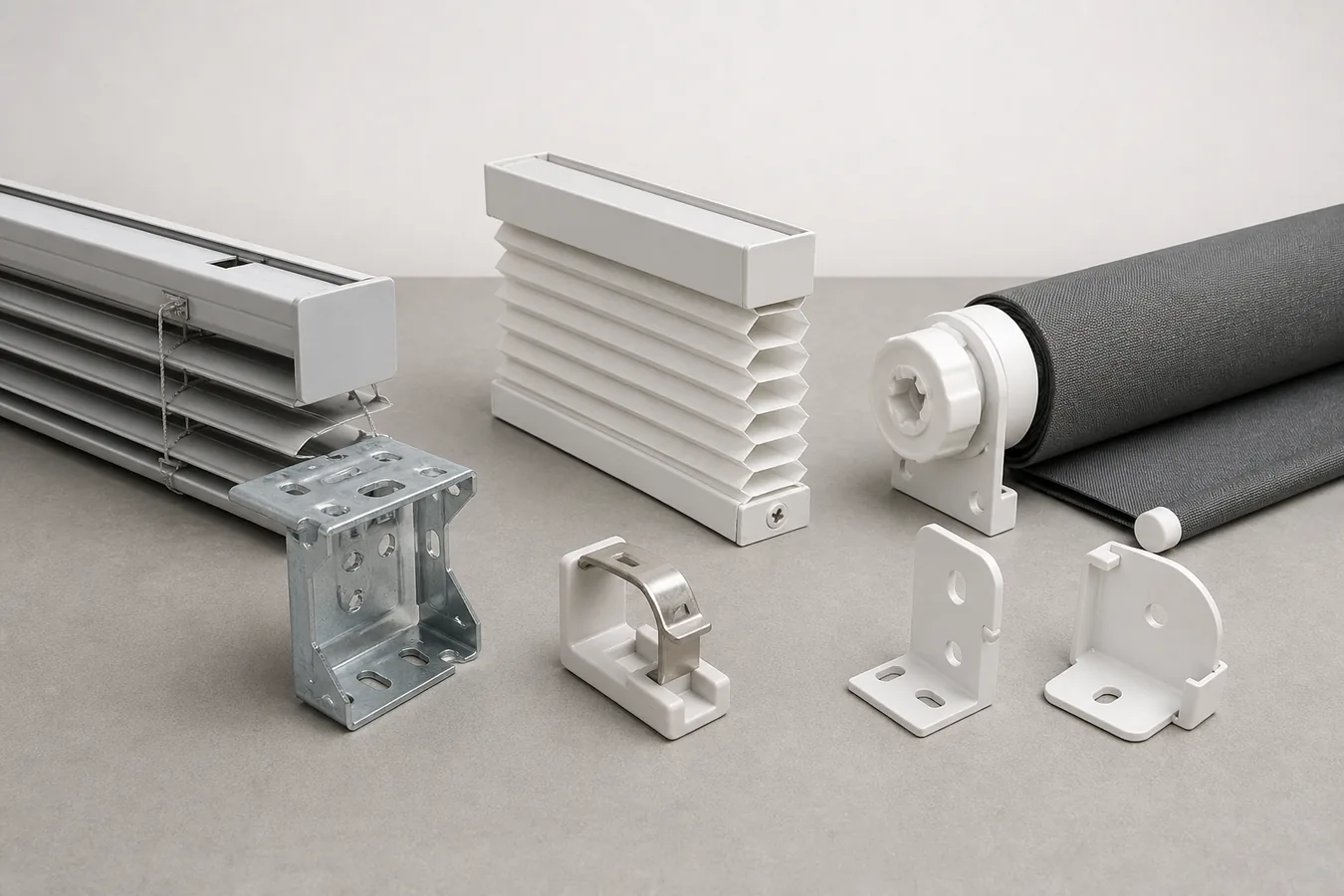
Installation instructions for one current SelectBlinds cassette roller shade describe a preassembled cassette and roller that snaps onto product-specific brackets. Other systems use different clips, screws, end caps, or pocket access. The transferable lesson is not the mechanism; it is that attachment and release occupy space.
Ask where the fasteners land, how the cassette engages its brackets, which direction it moves for removal, and whether trim or ceiling blocks that motion. Add the route to reach batteries, charging ports, wires, connectors, and limit-setting controls. If several shades meet at a corner or share one continuous visual line, show which unit can come down first.
A clean front elevation can hide an expensive service conflict. The section is complete only when a technician can reach the exact control end and remove the enclosure without dismantling the surrounding finish.
Compare the four top treatments by what they consume
| Top treatment | What it can accomplish | What it consumes or exposes | Evidence to request | Choose another path when |
|---|---|---|---|---|
| Exposed roll | Keeps the assembly visually and mechanically simple when the roll is acceptable | Leaves tube, fabric roll, brackets, and control end visible | Exact bracket, tube, roll, fabric path, gaps, and control-end drawing | The exposed mechanism conflicts with a real visual requirement |
| Fascia or front cover | Screens much of the room-facing roll while potentially preserving more top/back access | Adds a cover and model-specific clearance; may leave other faces or ends visible | Profile, attachments, finished ends, drop compatibility, and service access | The required view is not actually concealed or the cover blocks access |
| Full cassette | Creates a self-contained finished enclosure around more of the roll assembly | Adds a defined box, end conditions, bracket engagement, and removal motion | The complete section card plus exact option compatibility | The enclosure or release route does not fit, or a smaller cover meets the goal |
| Recessed pocket | Moves the roll above or into the visible architecture | Requires building depth, finish coordination, power/control routes, access, and a defined opening for fabric travel | Architectural and shade-shop sections reconciled before finishes close | The pocket is an afterthought or future service requires damaging the finish |
No option wins by name. Choose the smallest top treatment that meets the actual visual goal and preserves the exact fabric path and service route.
Ask for one section, not a finish name
The final quote should return the exact product and top treatment, mount and substrate, exterior housing size, roll and fabric exit, regular or reverse drop, finished cloth width and gaps, control/power end, bracket engagement, release direction, removal clearance, and any separately documented side or lower closure.
Where young children may be present, keep the completed control configuration in the decision. The US Consumer Product Safety Commission recommends cordless window coverings for those rooms, and the cordless and motorized blind safety guide explains why the completed product and reachable zone still matter.
Approve the order only when the one section shows that the box fits, the fabric travels in the intended plane, the finished edges meet the actual room need, and the cassette can be serviced after the room is finished. A cassette can be a useful finish. Its name is not evidence that the finished system works.