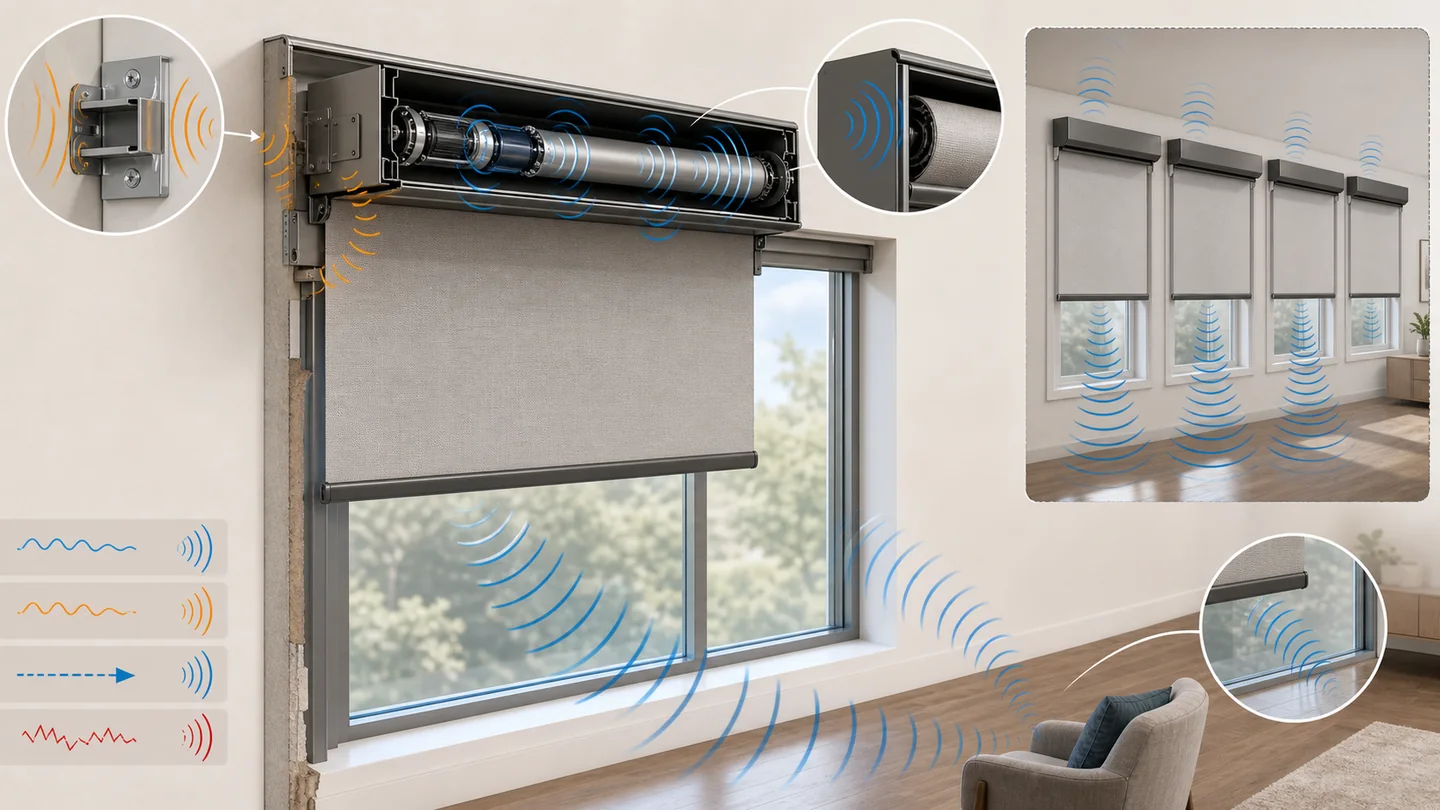
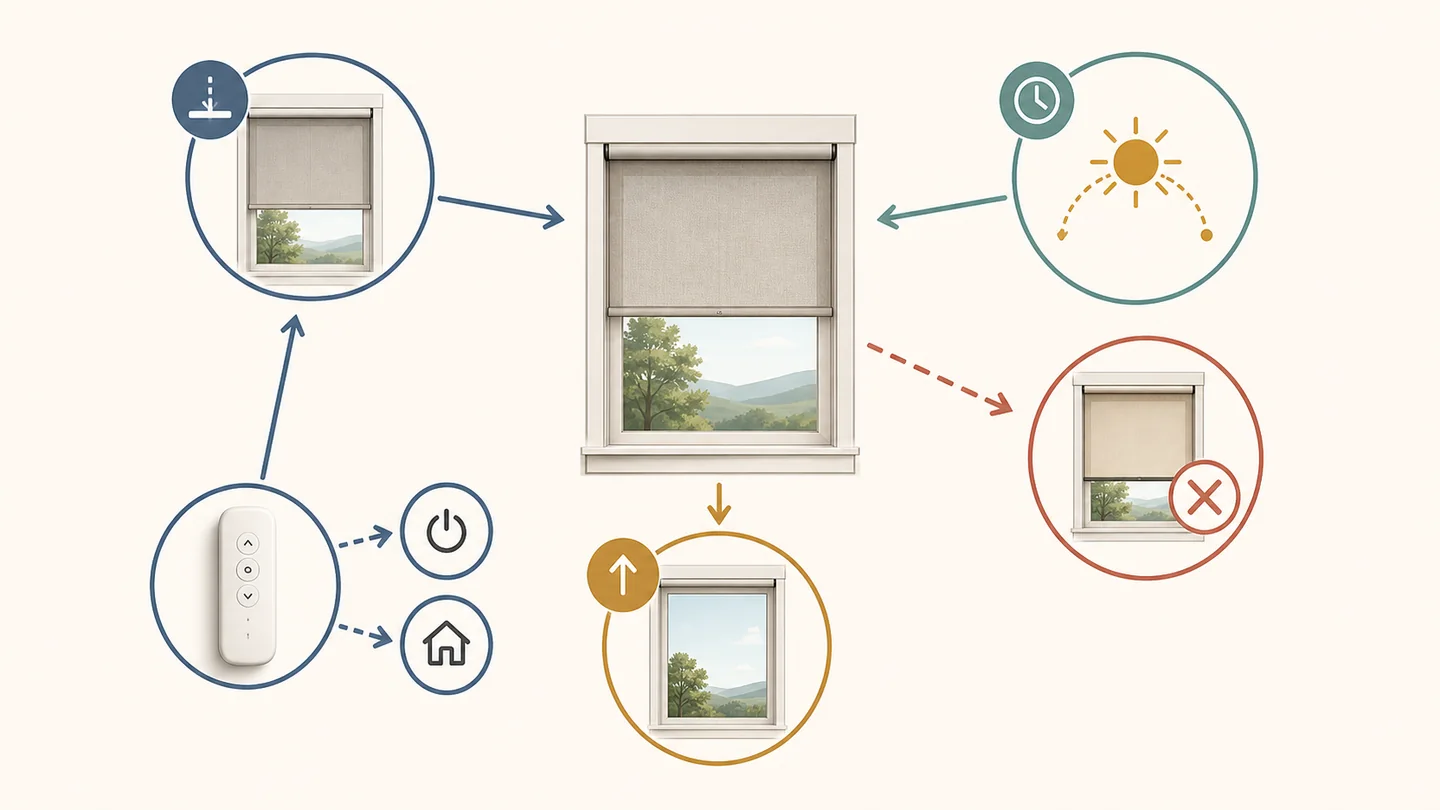
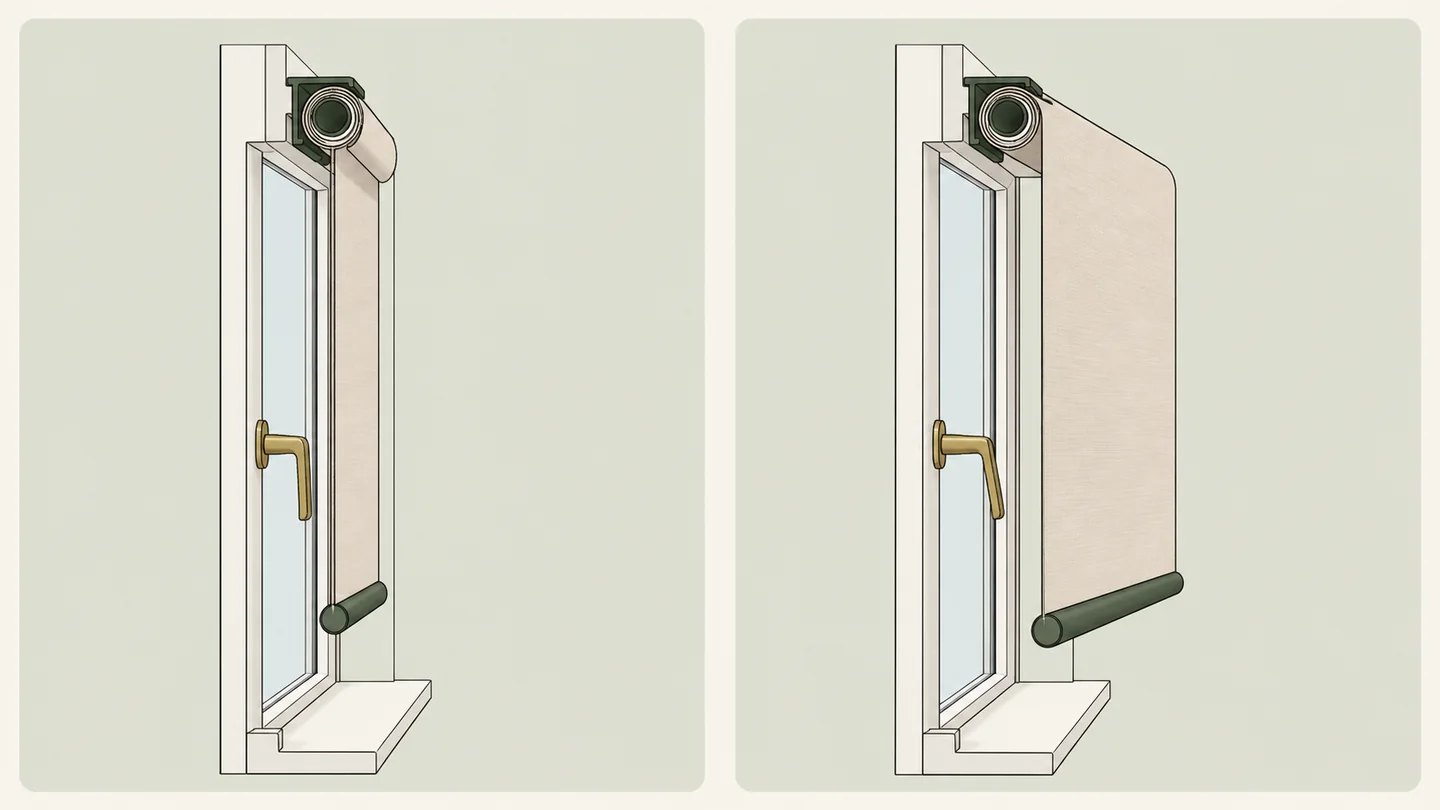
Set two cordless window coverings halfway down. Put a hand under the first bottom rail and lift: the covering may follow your hand and stay where you stop. Give the second covering the same push and nothing useful may happen; its guide may call for a short downward pull and release instead. Both can be sold as cordless.
That is the useful answer to how cordless blinds work: cordless is not one mechanism or one hand motion. It tells you that a long operating pull cord is not the user control you should be looking for. The exact blind or shade may move from a bottom rail, hem bar, movable middle rail, ring, wand, button or motorized control. Identify that control and its documented response before applying force.
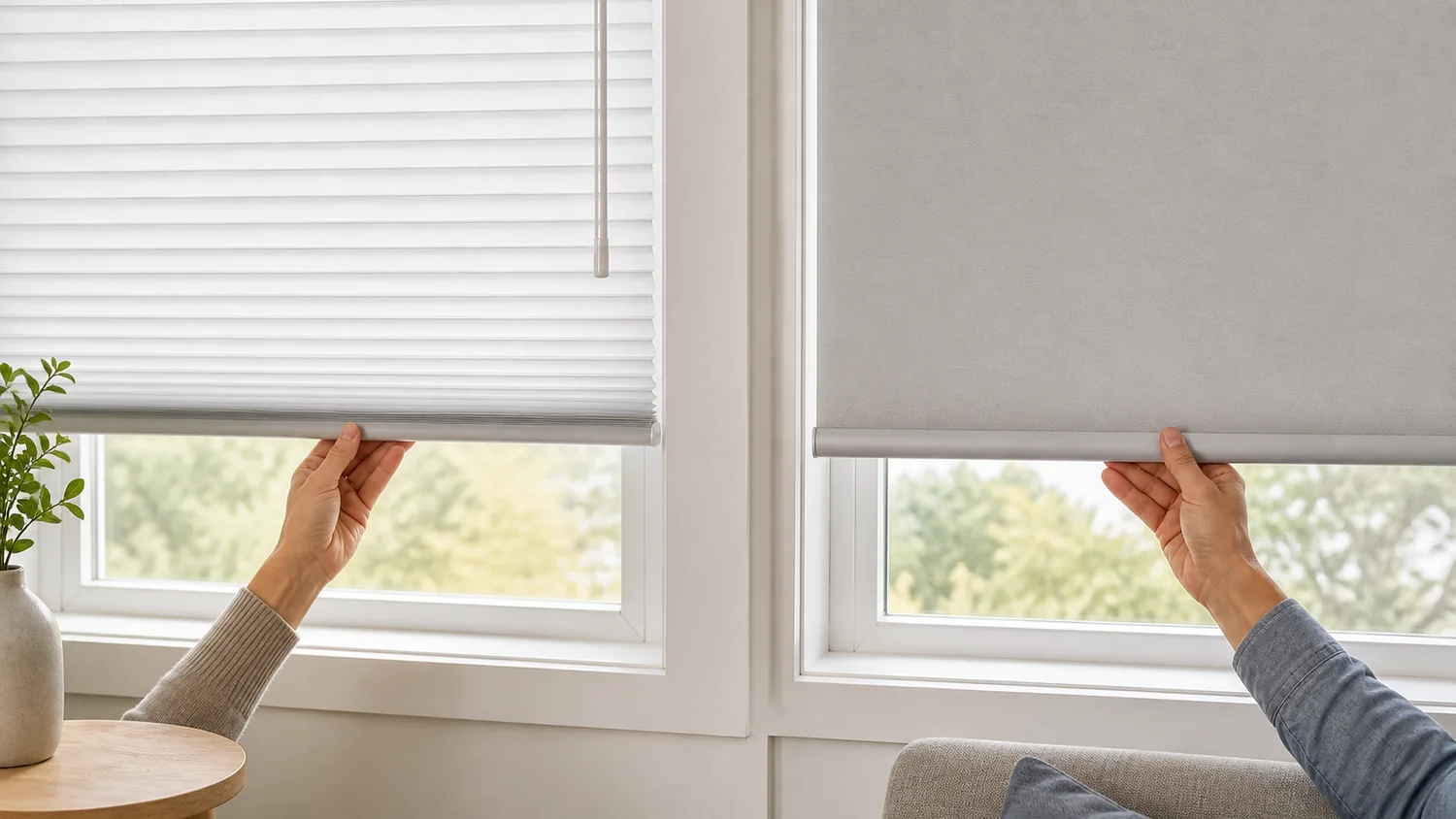
The control point can look similar even when the required motion is different.
Put your hand on the control the guide names
Start with the visible covering family, but do not stop there. A family narrows the possibilities; the maker, product line and operating-system name close the instruction. Use the table as a routing map, not as a substitute manual.
| Visible family | Control to identify | Documented response you may find | Evidence needed before moving it |
|---|---|---|---|
| Horizontal blind | Bottom rail for lift; often a separate wand for slat tilt | The rail rises or lowers with direct hand movement; the wand changes slat angle | Exact manual showing both lift and tilt controls |
| Cellular or pleated shade | Bottom rail, one or two movable rails, handle or button | Direct lift may position one rail; a top-down/bottom-up build may let a second rail move separately | Product name, operating-system name and a diagram of the rail or handle to move |
| Roller or screen shade | Hem bar, lower rail or handle | One named system may move directly with the hand; another may need a short pull and release to unlock spring-assisted travel | Current guide for the exact roller product and lift option |
| Roman or natural shade | Bottom rail, handle or ring, depending on the ordered system | The shade may rise with the rail or respond to another named spring-assisted control | Order line and manufacturer operation section; the fabric style alone is not enough |
| Vertical blind or panel track | Traveling wand or another named control | The wand may traverse the covering; on some vertical products it also rotates the vanes | Instructions separating traverse from vane rotation |
| Motorized covering | Remote, wall control, app, voice path or local headrail control, if documented | A motor moves the covering after a command; available positions and controls depend on the exact system | Motor/control identity, pairing instructions and an allowed local fallback |
This map deliberately says “may.” For example, Graber documents bottom-rail lift for named cellular, pleated and horizontal products, while horizontal slat tilt remains a separate wand action. LEVOLOR’s horizontal-blind manual likewise shows a wand for tilt, but it distinguishes a standard bottom-rail lift from its Simple Cordless version, which adds a center button. Those are product-scoped examples, not permission to copy the same motion onto an unlabeled blind.
If the control in the room does not match the control in the guide, stop at identity. Look for a label on the headrail, the order record or an exact product page. A generic video titled “cordless blind reset” cannot resolve a different operating system.
Direct lift and pull-and-release are different promises
The sharpest contrast appears within one manufacturer’s roller and screen-shade support. Hunter Douglas describes its named LiteRise system as a position-anywhere push/pull control. On the same support page, its system named Cordless is spring-activated: a brief pull and release starts travel. The support page applies to the specified Designer Roller and Screen products. It does not establish a naming rule for every brand.
That difference changes what your hand is asking the product to do. With a direct-lift control, the rail or handle is the position input: you move it to the height you want. With a documented pull-and-release control, a short motion is a release signal; holding or pushing the bar as if it were direct lift may not be the intended command.
There are more branches than those two. The Hunter Douglas operating-system overview names bottom-rail controls, a spring-assisted headrail system, a ring-operated spring-assist system and traveling-wand controls across different product families. A top-down/bottom-up shade can also have two rails with different jobs. This is why an exposed spring diagram cannot answer the query for every cordless covering: even when springs or tension are involved internally, the correct user input still comes from the exact system’s instruction.
Do not infer a mechanism from appearance alone. Two lower rails can look nearly identical while one expects continuous hand movement and the other expects a release action. The operating-system name is part of the product, not a minor accessory label.
Cordless can still have parts you cannot see
“Cordless” does not necessarily mean “there is no cord anywhere inside the finished covering.” The U.S. Consumer Product Safety Commission’s window-covering guidance treats operating cords and inner cords as separate subjects. For stock products covered by its rule, an operating cord may be cordless—including a motorized system—short or inaccessible; inner cords are addressed separately for accessibility and hazardous-loop risk.
That distinction matters because operation and safety are different decisions. The absence of a hanging pull cord helps you identify what not to grab, but it does not certify the complete product, installation or room. For a room used by children, carry the exact model, inner-cord construction, accessible controls and furniture layout into the cordless and motorized child-safety review rather than treating the marketing label as the last check.
It also prevents a bad repair inference. An inner cord, spring or clutch that may exist inside one product is not a user control and is not evidence that another product should be opened, retensioned or pulled harder.
A correct motion can still be a poor room fit
A manual cordless control works only if the regular user can reach the correct control in every useful position. The fully closed position is usually the easiest one to touch, so it is a weak reach test by itself. Picture the rail where it will sit when the room needs full daylight, glare control, privacy and night closure.
Use the room to make the next branch:
- All required positions are reachable and the guide’s motion is comfortable. Keep the manual candidate and verify that the exact size, fabric and lift option are available together.
- The closed rail is reachable but the open or privacy position is not. Compare another control, another mounting choice or motorization; do not assume a reach pole is authorized.
- A wide rail is awkward to move as the guide demonstrates. Ask the seller to demonstrate the exact ordered width or specify another operating system. Do not translate a small display sample into a force or balance promise.
- Lift and light control use different controls. Confirm both. A horizontal blind that raises from the bottom rail may still need a wand for slat angle; a vertical blind may separate rotation from traverse.
- The product listing gives only “cordless.” Leave the operating-system row unresolved until the seller supplies the matching manual or manufacturer record.
The room-by-room smart-shade planner can preserve the required positions and users before a lift is selected. When both manual and powered versions are genuine candidates, the cordless lift versus motorized lift comparison keeps the shade, window and required behavior constant instead of comparing feature lists.
Make the product prove one complete trip
Before buying—or before applying a troubleshooting trick—ask the product record to show one uninterrupted operating sequence:
- Match the label or order line to the maker, product family and operating-system name.
- Watch or read the exact instruction from fully closed to a useful open position and back again, including any separate tilt, traverse or second-rail action.
- Point to the control used at each step and confirm that each position will be reachable at the installed window.
- Compare the demonstrated response with the covering in front of you. If the control, motion or response differs, hold the operation instead of forcing a match.
For a cordless Roman candidate, the cordless Roman shade build guide carries the decision into fabric stack, rear construction and the exact lift. If a known control has stopped giving its documented response, move to cordless blind troubleshooting by symptom and keep the exact model with the symptom.
The word on the listing can begin the search. The product earns a usable answer only when its named control completes the full trip exactly as its guide describes.