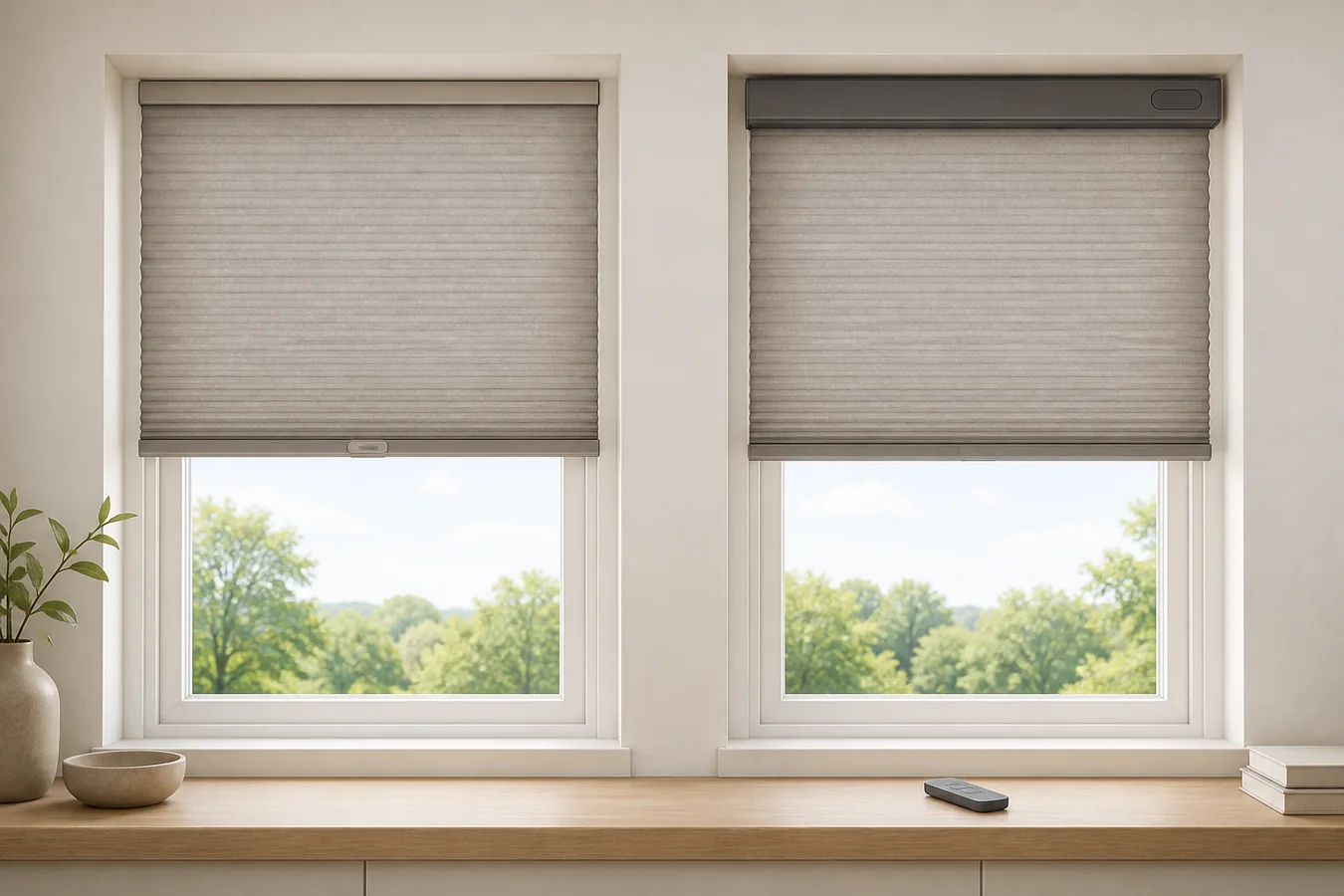
Choosing a lift can change the shade you are actually ordering. The cordless and motorized versions may share a fabric name, but they can have different headrails, size limits, available positions, controls and service parts. A price beside each lift option is not yet an equal comparison.
Choose cordless when the exact configuration fits and every useful bottom-rail position is comfortably reachable. Choose motorized when documented local, group or scheduled control changes how the window will be used—and the exact configuration closes power, fallback and service. If different windows give different answers, mix the lifts rather than forcing one system across the house.
First settle what is being compared. The smart blinds versus motorized shades guide separates a complete covering, a powered shade and a retrofit motor. This comparison begins after that category is fixed: one new blind or shade, offered with both a cordless lift and a motorized lift.
Name the two orders before you compare them
Give both quotes the same window ID, measured opening, mount, product line, fabric, color, opacity, required open position and required closed position. If a seller changes the fabric, mount or shade construction to make one lift fit, record that as a different candidate rather than quietly accepting it as the motorized version.
Do the product check before discussing convenience. A motor, battery housing or different internal mechanism can change the headrail and bracket relationship. The selected lift can also change which widths, lengths or compound functions are available with a particular fabric.
The LEVOLOR custom cellular technical guide accessed on August 14, 2026 illustrates the point. For the products covered by that guide, its depth table lists a 1/2-inch minimum mounting depth and 2 1/8-inch flush depth for cordless, versus 1 1/4 inches and 2 1/4 inches for motorized. Its dimensional tables also separate cordless and motorized configurations. Those values belong to that LEVOLOR guide; they are evidence that lift can change the order, not dimensions to borrow for another shade.
Use one row for every fact that can change the order. The last column is important: it turns a feature list into a decision record.
| Field held or checked | Cordless configuration | Motorized configuration | What changes the decision |
|---|---|---|---|
| Shade identity | Exact product, fabric, opacity and mount | The same four items, or a clearly named substitute | A substitute becomes a separate product comparison |
| Buildable size | Width and height accepted for this lift and fabric | Width and height accepted for this motor and fabric | An out-of-range configuration is eliminated |
| Mount and headrail | Required depth, projection and bracket surface | Required depth, projection, battery or power access | Trim, handle or service obstruction can veto one side |
| Useful positions | All required positions plus who can reach the rail | All required positions plus available local control | A required state that cannot be reached or commanded is a failure |
| Extra functions | Top-down, day/night or other option confirmed | The same option confirmed for the exact motorized build | Do not assume a function survives the lift change |
| Controls and power | Physical operation and any separate tilt control | Remote, wall or app control; grouping; power path | Only documented controls and maintainable power count |
| Recovery and service | Adjustment, repair route and warranty scope | Local operation, outage behavior, reset, charging and motor service | An unanswered failure or access path keeps the order on hold |
| Completed quote | Shade, lift, controls, installation and warranty | Shade, motor, power, controls, gateway if required, installation and warranty | Compare totals only after both scopes are complete |
Save the product guide date and quote date beside each column. “Available” without an exact fabric, size and lift is not a passed row. The Smart Shade Measurement and Compatibility Checker can preserve the window, mount depth and obstructions, while the two quotes preserve product-specific rules.
Follow the bottom rail through a normal room
A cordless shade is operated at the moving rail or another product-specific manual control. That makes reach part of the configuration, not an afterthought. Test reach where the rail will actually stop—not only when the shade is fully lowered.
Mark the positions the room needs during an ordinary week: fully open, privacy, glare control, night closure and any intermediate state used to protect a screen or view. Then check the shortest regular user, the normal furniture layout and the floor area that must remain clear. A sofa, deep sill, bathtub or countertop can make a seemingly low rail awkward to reach. A high window can make the open position unreachable even when the closed rail is easy to touch.
This does not automatically make motorization the answer. Another manual operating system, a different mounting position or a different treatment may be better. The useful result is simply that the cordless candidate fails this window’s operating task.
Do not use the word “cordless” to close every safety question. In rooms used by children, review the completed covering, inner cords, accessible controls and climbable furniture through the cordless and motorized child-safety audit. Lift choice is one input to that room decision.
Put the promised controls on a weekly schedule
Motorization has a strong case when reach is genuinely difficult, several shades must move together, or a position must happen at a time people routinely miss. It has a weak case when the shade is easy to operate and the proposed remote or schedule has no job beyond novelty.
Write one sentence for the behavior you expect: “close the west-facing group before afternoon glare,” “raise the upper windows from the room,” or “move the bedroom shade without crossing the room.” Then require the quote to name the control that performs it. A generic “smart compatible” line is not enough.
For example, Hunter Douglas documents remote groups, scenes and schedules for its named PowerView system. That supports those functions for the covered system; it does not make every motorized shade a scheduled or app-controlled shade. Other systems may offer only a local wand or remote. The manufacturer’s operating-system overview is a useful reminder that both cordless and motorized are categories containing different mechanisms.
If ecosystem control is non-negotiable, finish the exact motor, protocol, hub and controller path separately. A shade can be motorized and still fail the required smart-home route.
When the columns stop describing the same shade
The two-column comparison can survive different operating hardware. It cannot survive a silent change of product. Reconcile the quotes after the reach and control review, because the requested behavior may have pushed one seller toward a different fabric, mount or construction.
If both configurations retain the same product, fabric, opacity and mount, keep the comparison and record the lift-specific headrail, depth, size and control differences. If the motorized quote substitutes a fabric or shade family, give it a new column and judge its light, privacy, stack and care results again. If a required function such as top-down/bottom-up, day/night or multiple shades on one headrail disappears, the affected configuration fails even if its basic up-and-down motion works.
Ask the seller to confirm three things in writing: the exact width and height are accepted for that lift and fabric; the headrail, bracket and power components clear the recorded trim and handles; and every required compound function remains on the order. An unlabeled sample or a family-level product page cannot close those rows.
If the motorized cellular candidate still describes the same acceptable shade, the motorized cellular deployment guide takes over the separate questions of installed gaps, positions, grouping and operating schedule. If it became a different shade, return to construction choice before approving automation.
Build the ownership difference into the quote
Compare a complete cordless order with a complete motorized order. The motorized column should include the specified motor, battery or power supply, charger or cable, remote, wall control, gateway if required, installation, setup, warranty and service access. Otherwise the base shade on one side is being compared with an operating system on the other.
Power is a window-by-window maintenance decision. The battery, solar and hardwired comparison can record charging access, sunlight, nearby outlets and professional wiring scope. Do not accept a runtime estimate from another motor or window as evidence for this configuration.
Recovery needs its own answer. Ask what still works if the app, hub, remote, household power or shade battery fails. A headrail button or remote may still depend on the motor and available power; it is not proof that the fabric can be moved by hand. The motorized-shade fallback guide explains why the exact documents must say what is allowed before anyone pulls on a stalled shade.
Finally, name who can reach the battery, reset point and serviceable parts after installation. A convenient daily remote does not erase an awkward charging visit. If access requires moving heavy furniture, reaching over a stairwell or disturbing trim, put that burden in the motorized quote before accepting it.
Use the first failed row as the split point
Read down the paired card once without discussing preference. If one configuration fails size, depth, a required position, power access or a necessary control, eliminate it. If both fail, choose another product or mount. If a field is merely unanswered, keep the order on hold rather than awarding the point to the better sales presentation.
When both configurations pass, return to the actual room:
- Choose cordless when the rail is reachable in every useful state, manual operation suits the regular users and the smaller ownership burden matters more than controls the room will not use.
- Choose motorized when a documented remote, group or schedule solves a repeated reach or timing problem, and power, recovery, service and the completed price are acceptable.
- Mix by window when ordinary low windows pass cordless reach while high, grouped or schedule-dependent windows earn motorization.
- Choose another product when the required lift removes a necessary fabric, size, mount or function.
- Leave the order unsubmitted when either quote hides the exact operating system, exclusions or service path.
The winning lift is not the one with the longer benefit list. It is the configuration that can be built for this window, operated through every required state and owned without an unresolved burden.