“Waterproof blinds” is often a sentence fragment. Does waterproof describe the slat, the face fabric, a coating, or the complete treatment after the headrail, tapes, controls and brackets are added? A material claim cannot answer that question by itself.
For a window that may receive water, approve the blind only when the exact product record covers every component inside the real wet path. If the maker documents humidity resistance but says nothing about direct splash, use that as humidity-only evidence. Move the treatment beyond the splash line—or choose a different privacy solution—rather than upgrading the claim yourself.
Follow the water, not the product name
The room name is too broad. A powder-room window, a window across a ventilated bathroom and a window inside a shower can all appear under “bathroom blinds,” yet they place different loads on the treatment.
The image shows one finished horizontal blind beside a shower screen. The lower slats and sill have visible droplets; the tapes, rails, headrail and brackets remain distinct. It is not a waterproof product test. It is a reminder to trace where water can actually go.
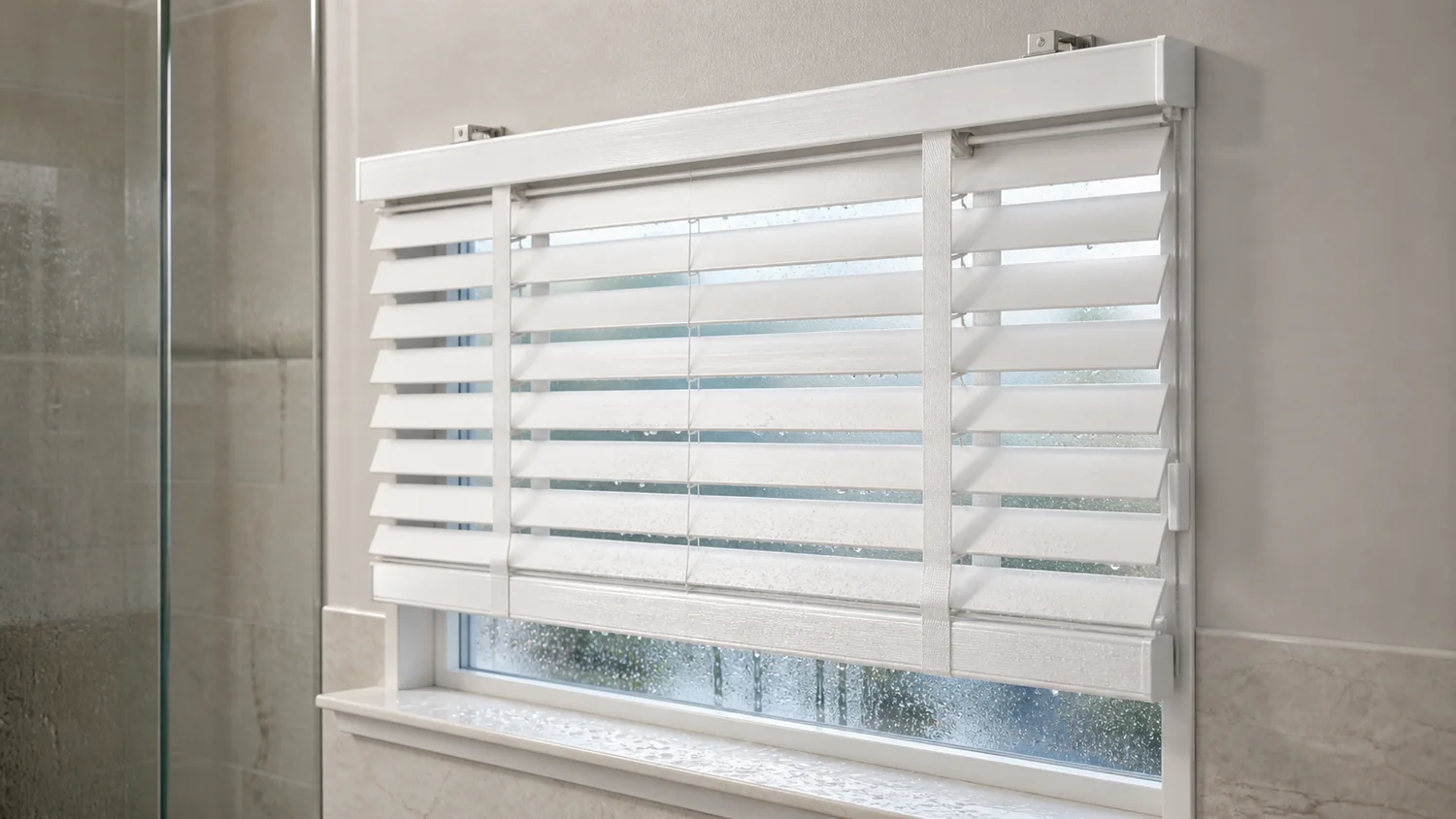
Water can reach the slats, tapes, rails, controls and mount differently. The product record has to cover the parts inside the real wet path.
| Exposure at the window | Parts the path may reach | Evidence the exact product must supply | Buying decision |
|---|---|---|---|
| Humid air, with no expected liquid contact | Face material, connections, rails and finish over time | Named high-humidity or bathroom suitability for the exact product and configuration | Keep only if the location and ventilation match the stated use |
| Condensation on the glass or sill behind the blind | Rear face, lower edge, bottom rail, tapes or seams and nearby mount | Permission for that recurring contact plus a practical way to open, observe and dry the area | Move the treatment forward or change format if the rear cannot be inspected and dried |
| Occasional splash from a sink, bath or shower edge | Lower slats or fabric, bottom rail, control end and sill-side hardware | Written splash/contact scope and the exact drying and care method | Accept only the documented splash zone; do not generalize it to the full blind |
| Repeated direct shower spray | Face, edges, connections, rails, controls, brackets and fasteners | Explicit permission for the complete exposed assembly in that installed position | If any exposed part is absent from the proof, move the covering outside the spray or use another privacy method |
| Deliberate wet cleaning | Whatever the method wets, including parts behind or above the face | Current manufacturer cleaning instructions naming water amount, product, exceptions and drying | Follow that method only; “waterproof” on a sales page is not a cleaning instruction |
Draw that wet path while the window is closed, open and in its ordinary privacy position. Splash can approach from the room; condensation starts at the glass; cleaning water may be applied from the front. Those routes do not reach the same components.
If the wider decision still includes night privacy, airflow, an operable sash and cleaning access, use the bathroom window-treatment guide for the room plan. The narrower decision here is whether the water claim survives the finished assembly.
A finished blind is a chain of materials
A listing photo makes the treatment look like one surface. The order creates a chain.
The face may be a PVC slat, vinyl vane, coated roller fabric, composite louver or another named material. Record the exact composition and finish; do not treat “faux wood” as a formula. If two sellers use overlapping material labels, the composite-versus-faux-wood guide shows how to compare disclosed constructions instead of names.
Connections include ladder tapes or cords on a horizontal blind, seams and hems on a roller product, or carriers and hangers on a vertical system. A claim about the broad face does not automatically name these pieces.
Rails and closures include the headrail, bottom rail, end caps, valance and any cassette. Ask whether the same exposure language covers them. A rail can have a different material, finish and care rule from the slat or fabric below it.
The operating system may add a wand, cordless lift, chain, spring, battery, motor, remote or sensor. Keep electrical and electronic parts outside the wet path unless the exact product documentation expressly defines their permitted location and care. “Motorized option available” is not a water rating.
The mount adds brackets, fasteners and the window surface that supports them. Do not infer corrosion life or structural suitability from appearance. Ask the seller or installer to identify the actual parts and approve their location under the current installation record.
Read the sentence that carries the claim. “Waterproof PVC fabric” proves a claim about the fabric. “Moisture-resistant slats” proves a claim about the slats. Neither sentence should be silently rewritten as “the complete blind may be sprayed.”
Let the care page challenge the sales label
Cleaning instructions are useful because they have to name an action, not just a benefit.
Graber currently describes its named PVC faux-wood and polymer-composite slats as moisture-resistant and positions those blind families for high-humidity rooms. That supports the manufacturer’s stated room use. It does not, by itself, say that every complete configuration may sit in direct shower spray.
The distinction becomes clearer on Graber’s care page. Its table gives different methods to different product families. Vinyl vertical vanes are the listed water-immersible case; faux-wood blinds receive dust, vacuum and spot-clean permissions but are not marked water-immersible. The same page says remote controls should be lightly wiped and not submerged or sprayed. One brand therefore has several water boundaries inside its own catalog.
A current LEVOLOR real- and faux-wood technical guide is narrower still. Its care section says not to use water, solvents or abrasive solutions on the blind, then permits a soft, lightly damp cloth for named NuWood blinds. Keep both parts together: a limited damp-cloth exception for a named product is not permission to rinse the assembly.
Even a documented immersion method can split at the component level. Hunter Douglas’s cleaning guidance describes lukewarm-water immersion for a named metal-blind family, but excludes decorative tapes and tells readers not to immerse several named headrails or a named bottom rail. The method applies to a named blind while the complete configuration still has component exceptions.
This is why a merchant’s “wipe clean,” “waterproof” and “bathroom suitable” badges are not interchangeable. The current care page must tell you what can get wet, how wet, with what, and which parts stay out.
Warranty language is a separate test
A bathroom guide, a care sheet and a warranty answer different questions. Read all three; do not use the most generous sentence as a substitute for the others.
Hunter Douglas’s bathroom buyer guide tells shoppers to consider the window’s location, privacy needs and exposure to high heat and humidity. It highlights one named faux-wood shutter for that environment. Its current general warranty help, however, lists exposure to moisture or water among exclusions while separately discussing coverage for mechanisms, brackets and components under normal use.
Those statements serve different scopes; they do not decide your claim here. They show why the exact written product terms and intended location belong in the purchase record. Ask whether the proposed exposure is normal use, what water-related conditions are excluded, and whether a dealer recommendation changes any written term. If the answer is only verbal, save it as an unresolved risk rather than a warranty promise.
Water resistance cannot solve privacy or ventilation
A product can have adequate moisture evidence and still be wrong for the window.
Test privacy with the blind in the position you will actually use. Slats that shed an occasional drop may still leave an unacceptable angle from outside. A coated light-filtering fabric may look private in daylight and reveal a silhouette when the room is brighter after dark. Water performance does not prove opacity or sightline control.
Keep the window’s opening path usable. If the sash provides ventilation, the blind must move far enough to reach the handle and clear the opening. The installed treatment also needs enough separation and access for you to see recurring condensation and let the glass, sill and rear surfaces dry. A blind that hides the wet area makes inspection harder even when its face is easy to wipe.
Control choice adds another branch. The broad smart-blinds-versus-motorized-shades comparison can help when the product format and control path are still open. In this wet-zone decision, a manual or motorized label wins nothing on its own; the exact control and service parts must stay within their documented environment.
Ongoing care is also independent. Use the easy-to-clean blinds comparison to match the room’s real residue to the manufacturer’s permitted method and the surfaces you can reach. If marks are already present and may be mold or mildew, do not improvise a cleaning recipe from shopping advice; preserve the pattern and use the mold-on-window-blinds triage.
Put the exact wet-zone claim on the order
Before paying, ask the seller or manufacturer to confirm one sentence in writing: the exact product, material and control being quoted for the US order is permitted at the stated distance and direction from the water source; that permission covers a named exposure—humidity, condensation, occasional splash or repeated direct spray—and names the face, connections, rails, control, brackets and fasteners included; the allowed cleaning method and every part that must remain dry are stated; and the applicable warranty scope is identified.
A complete answer can support the stated location. A partial answer may support a drier position outside the wet line. If the answer covers only the slat or fabric, buy only that claim: relocate the treatment, change the configuration, or choose another way to provide privacy.
The missing fields are not minor specifications. They are the distance between “waterproof material” and a finished blind that is documented for the water it will actually meet.