Do not begin by spraying, brushing or vacuuming the specks. A dark mark cannot tell you what organism is present, how far it extends or whether the blind tolerates the method you found online. Disturbing the area first can also erase the pattern that points to condensation, a leak or a hidden wet surface.
The decision is not simply clean versus replace. Photograph the blind and nearby glass, frame and wall before moving it. Then resolve five independent questions: who could be exposed, how large and water-damaged the area is, where the growth sits, what the exact covering permits, and what is keeping the window wet. A small mark earns a DIY cleaning path only when all five answers support it.
First, preserve what the pattern is telling you
Take one straight-on photo and one close view without touching the covering. Note whether the marks are limited to one slat, repeat along the lower edge, disappear behind an overlap, sit inside a fabric fold or honeycomb cell, continue into the headrail, or match spotting on the glass, sill, trim or wall.
Also record when the window was last wet. Morning condensation, a shower, cooking steam, a roof or plumbing leak, and flood water are different source questions. If the blind is in a rental, save the date and notify the property owner under the applicable lease and local process rather than discarding evidence.
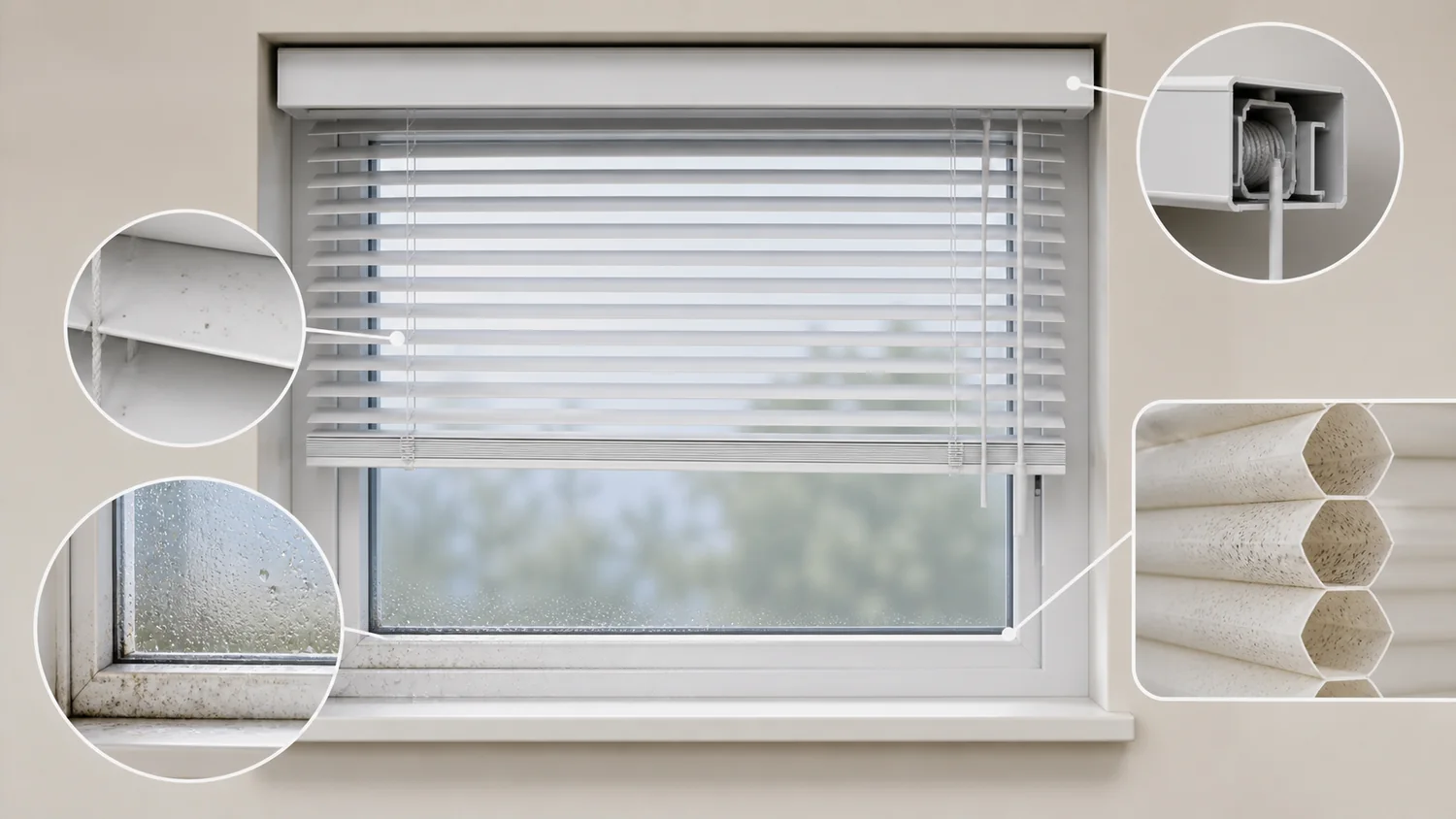
The inspection image shows why location comes first. Specks on a smooth slat may be a surface-care question. Specks inside a porous cell can be inaccessible. Marks around a wet frame can mean the blind is only one affected item. A clean-looking headrail can still contain parts that must stay dry. The color proves none of those conditions by itself.
Two gates come before any cleaner
The first gate is the person doing the work. CDC says people with allergies, immune suppression, underlying lung disease, asthma or COPD should not take part in mold cleanup. Its cleanup guidance also calls for at least a NIOSH-approved N95 respirator, protective gloves and goggles, and warns never to mix bleach with ammonia or other cleansers. If that gate does not pass, move directly to an appropriate professional or property owner; a small blind does not cancel the exposure boundary.
The second gate is extent and water damage. EPA says an area under roughly 10 square feet can often be handled by a homeowner, but that is a screening point, not an automatic permission. A larger affected area, substantial water damage, suspected hidden growth, contaminated water or uncertainty about the source changes the scope. Count the blind together with related growth on the frame, wall and nearby materials rather than measuring one convenient patch.
These gates are independent. A tiny patch can still be a poor DIY job for a sensitive person, an unknown porous covering or a wet headrail. A wipeable slat does not make a larger wall or leak problem small.
Read the covering from the specks inward
Use the visible location to decide what evidence is missing before choosing a method.
| Where the marks appear | What must be identified | Decision while evidence is incomplete | Cleaning becomes plausible only when |
|---|---|---|---|
| Face of a smooth hard slat | Exact material, finish, tapes, cords and maker care instructions | Keep the method unresolved; “faux wood” or “metal blind” is not a complete product record | Area and occupant gates pass, the surface is confirmed cleanable, the maker permits the method and every part can dry fully |
| Painted wood, real wood, textured composite or unknown coating | Whether the mark is on a finish, inside a porous material or beside a damaged edge | Ask the maker or a qualified cleaner; do not infer nonporous behavior from appearance | The exact finish and care owner authorize a bounded method without swelling, stripping or trapped moisture |
| Roller fabric, Roman folds, fabric vanes or cellular/pleated construction | Fabric, backing, adhesive, seam, internal access and approved professional process | Manufacturer or specialist review; replacement may be more reliable than escalating home chemistry | The exact guide covers that location and process, and the material can be cleaned and completely dried |
| Inside a cell, cassette, valance, headrail, bottom rail, motor or control space | Exact assembly, access route, electrical/control exclusions and serviceability | Do not spray, soak or dismantle it on generic advice | The manufacturer supplies a documented service or cleaning route for that assembly |
| Blind plus glass, frame, wall or sill | Total affected area, leak/condensation source and surrounding material condition | Treat the blind as one item in a wider moisture investigation | The wider area is in scope, the source is corrected and each material has its own admissible path |
Current Hunter Douglas care guidance illustrates why the exact identity matters: dusting, light vacuuming, spot cleaning, moisture and professional processes vary by product and fabric, while some rails, headrails and controls have separate exclusions. Another brand’s blind may use a different construction, so a Hunter Douglas permission is evidence that care varies—not permission for an unidentified blind.
If the material inside a honeycomb is ordinary dry debris or a non-mold spot and the exact care record supports routine treatment, the cellular-shade cleaning guide owns that narrower task. Suspected growth inside a cell remains on this page’s service-or-replacement path because access, depth and complete drying are unresolved.
If cleaning is admissible, keep it narrower than the stain
EPA’s general hard-surface path is detergent and water followed by complete drying. For a blind, that path is admissible only after the exact manufacturer instructions agree. The visible slat, ladder tape, cords, finish, rail and motor do not automatically share one permission.
Prepare the area and protective equipment according to the government guidance and product label. Use only the maker-approved amount of moisture and tool on the confirmed surface. Keep liquid away from parts the instructions exclude. Do not combine products, strengthen a dilution, substitute a viral recipe or turn a spot treatment into bathtub immersion because the first pass did not restore the original appearance.
Stop if the finish changes, color transfers, the material swells, a seam opens, liquid reaches a rail or control, the affected boundary is wider than recorded, or the covering cannot dry completely. EPA notes that porous materials may be difficult or impossible to clean fully. A remaining stain is not proof that stronger chemistry is the next step; it can be the point where a professional or replacement becomes the defensible choice.
Removal is not a casual shortcut. A contaminated covering can be awkward to handle, and unknown brackets or a powered headrail add another failure path. If the cleanup or replacement plan calls for removal, first identify the exact product and use its documented route; the blind-removal guide handles the bracket and support questions after that identity is known.
A clean slat can still sit in a wet window
Cleaning addresses what is visible today. It does not close the reason water reached the covering. Compare the pattern with the glass and frame after ordinary room use. Condensation concentrated at the lower glass, a damp recess, staining after rain, or marks that return in the same line each need a source owner.
Correct leaks and other water problems and dry affected items completely. For recurring condensation, record room humidity and ventilation conditions without assuming the blind caused the whole problem. Open the covering when appropriate so the glass and recess can be observed and dry, while keeping the product within its operating instructions. Persistent water, wall damage or an uncertain source belongs with the relevant building or water-damage professional.
In a bathroom, the replacement covering still has to pass the room’s splash, condensation, privacy, ventilation and cleaning constraints. The bathroom window-treatment guide owns that choice. Replacing a spotted fabric with another product that sits against the same wet glass is a material change without a moisture repair.
Put one disposition beside the photo
Close the incident with one sentence, not a vague “cleaned” note. Name the photographed location and approximate area, exact product/material if known, occupant gate, care document, chosen action, moisture-source owner and the condition that would reopen the decision.
- Clean: use only when the problem is small and bounded, the person and water-damage gates pass, the affected surface is confirmed hard and accessible, the exact care guide permits the method, and complete drying is realistic.
- Manufacturer or professional service: use when the product is valuable or serviceable but fabric, wood, hidden construction, extent or an approved process needs expertise.
- Replace or assess the wider area: use when a porous covering cannot be cleaned and dried reliably, growth is hidden or recurring, controls/rails are involved, the covering is damaged, or the blind is one part of a larger water problem.
- HOLD: use when product identity, area, exposure, care permission or moisture source is still unknown. HOLD means preserve the evidence and obtain the missing owner; it does not mean leave a wet condition unattended.
If replacement is the disposition, compare the real room exposure and future care burden in the easy-to-clean blinds comparison, then return to the window-treatment planner for fit, privacy, operation and control. A new blind closes this incident only when the water source and the replacement specification are both resolved.