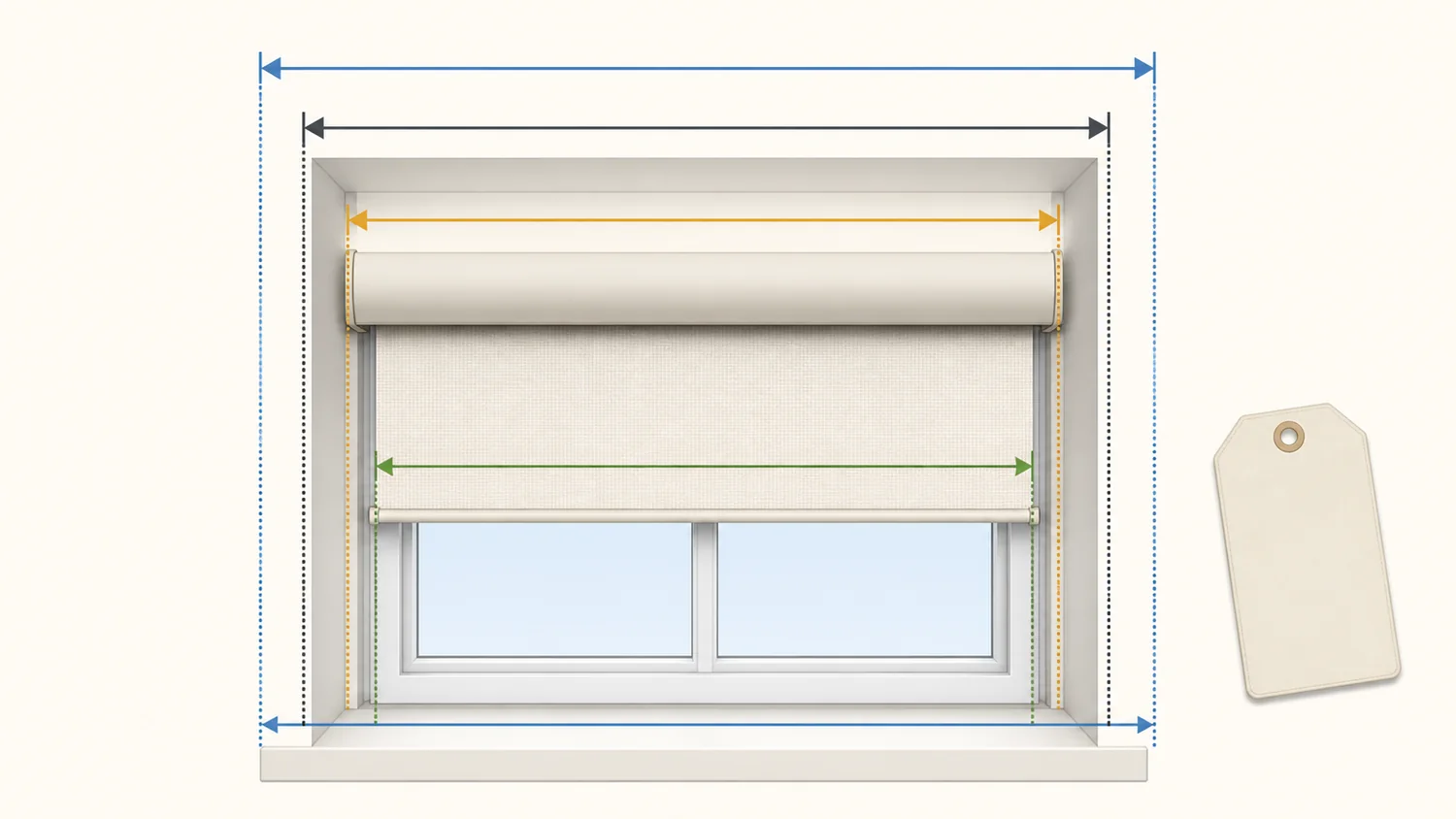
A carton marked 35 × 64 looks precise. Yet “35” might be a stock label, the number a seller wants entered at checkout, the finished headrail width, or the width of the material that covers the glass. Those values can differ even when they sit on the same product page.
Use a window blind size chart to find candidates, not to certify fit. Before comparing any chart number with your window, identify who owns that number: the room, the seller’s order form, or the factory’s finished specification. If the listing does not say, the size is still undefined.
Keep your untouched opening measurement in the Smart Shade Measurement and Compatibility Checker. The chart begins after that record exists. Its job is to help you locate a product row; the selected product’s current measuring and specification documents must carry the row through to a finished blind.
A size line is not one measurement
The Home Depot’s current measuring guide describes a broad band of standard windows—often 24 to 60 inches wide and 36 to 72 inches long—then immediately returns the reader to exact measurements, mount choice and a product-specific guide. That is the proper boundary for a standard-size chart: it describes where stock candidates are common, not what a particular carton will finish at.
Translate every candidate into the following record before calling it a fit.
| Layer | What belongs in it | Who defines it | What it can decide |
|---|---|---|---|
| Window opening | Unadjusted widths, heights, depth and obstructions at the intended mounting plane | The physical window and your measurement record | Whether the recess or coverage area can receive a candidate |
| Mount and coverage target | Inside or outside mount, desired overlap and the glass or trim that must be covered | You, constrained by the room and exact hardware | Which finished dimensions matter |
| Nominal label | The stock or package name printed in the chart or listing | The seller, if it explains the convention | Which product row to investigate—nothing more |
| Order entry | The width and height the current form asks you to submit | The seller’s current measuring instructions | What the factory treats as the ordered dimensions |
| Finished hardware | Headrail, tube, cassette, fascia or complete blind width after stated factory adjustments | The exact product specification | Whether hardware fits the mount and clears the room |
| Material field | Fabric, slat or vane width and the resulting edge coverage | The exact configuration | How much of the glass or opening is actually covered |
| Deduction, tolerance and limits | Factory subtraction or addition, allowed finished variation, and control-specific minimum or maximum | The current manufacturer or seller record | Whether the calculation is valid and orderable |
A nominal label that cannot be assigned to one of those definitions remains an identifier, not a dimension. Do not “correct” it with a deduction borrowed from another retailer.
Read the listing from the material back to the opening
Product pages encourage a chart-first reading: choose a familiar width, select a length, then look for a color. Reverse that order when fit matters.
Start with the material field because it controls visible coverage. On a roller shade, ask for finished fabric width. On a horizontal blind, ask whether the stated finished width refers to the headrail, the complete blind or the slat field. On a vertical blind, keep track width and vane coverage separate. If the listing gives only one width, it has not yet answered this question.
Next move outward to the hardware. Record the finished headrail, tube, cassette or fascia width and its depth. A product can have hardware that fits inside the recess while its fabric leaves a larger edge gap than expected. The reverse can happen on an outside mount: enough material coverage does not prove that the brackets and headrail have a suitable mounting surface.
Only then return to the order field. Write down whether the seller wants the raw opening, a desired finished size or another number. Note who applies each inside-mount deduction. If mount is still undecided, resolve the inside-versus-outside mount choice before using the order box; switching mount changes the measurement owner and often the factory adjustment.
Finally, compare that chain with the untouched opening in the measurement checker. The chain should read clearly in both directions:
opening and mount → seller’s order field → factory adjustment → finished hardware → finished material.
If one arrow has no current source, a matching chart row is only a candidate.
Watch 36 inches become three material widths
A current Blinds.com Veneta roller specification makes the distinction concrete. The sheet publishes separate order-to-tube and order-to-fabric formulas for chain-loop, cordless and motorized inside-mount configurations, with another change when fascia is selected.
The table below applies that one document to an illustrative 36-inch order width. It does not describe other Veneta products, other sellers or roller shades in general.
| Configuration in the reviewed sheet | Order width | Published finished calculation | Resulting fabric width |
|---|---|---|---|
| Chain loop, no top treatment | 36 in | tube = order − 1 1/4 in; fabric = tube − 1/8 in | 34 5/8 in |
| Cordless, no top treatment | 36 in | fabric = order − 1 3/16 in | 34 13/16 in |
| Motorized, with fascia | 36 in | fabric = order − 1 9/16 in | 34 7/16 in |
Nothing about the 36-inch order changed. The control and top treatment changed what reached the glass. The difference between the widest and narrowest fabric result here is 3/8 inch, before installation position, window squareness or any separate coverage objective is considered.
This is why a listing that shows “36 in” without identifying the order convention and finished material width cannot settle an inside-mount light-gap decision. It may still be a valid product candidate; its record is simply incomplete.
The control can disqualify the width
Finished width is not the only configuration-specific field. The same Veneta sheet lists different eligibility ranges: the reviewed chain-loop configurations begin at 12 inches, the cordless configuration at 18 inches and the motorized configuration at 14 inches. It also gives a shorter maximum length for the reviewed cordless option than for the chain-loop and motorized options.
Those values are not a market-wide size chart. They demonstrate why the control must be attached to the product row before a width is approved. A nominal size that exists with a chain loop may disappear when cordless operation is selected. Motor hardware, tube choice, fascia and fabric can create another valid range.
LEVOLOR’s general reference guide uses the same ownership pattern at a broader scale: mounting depth, hardware profile and certain dimension fields vary by product and operating system, and the guide directs the reader to individual product specifications for detailed values. A chart does not override that branch.
When the window is close to a product’s minimum width, move to the narrow-blind guide rather than assuming that the smallest displayed stock size preserves useful glass and straight travel. For a complete vertical-blind order, use the vertical-blind measuring guide; track, vane, stack and door passage are different objects from a roller-shade fabric field.
Put tolerance after the deduction
A deduction and a tolerance answer different questions. The deduction converts an ordered dimension into a stated finished dimension. The tolerance describes how far the manufactured result may vary around the finished-dimension rule.
LEVOLOR’s January 2025 general guide illustrates this order. Its finished-dimensions example applies allowances from ordered dimensions and then explains notations such as a finished value that may be smaller by up to 1/8 inch or vary by plus or minus 1/16 inch. The same page tells readers to use each product section for its specific tolerances.
Do not subtract a tolerance from the order width as if it were extra clearance. Do not add it to the material width as guaranteed coverage. Record the factory deduction exactly once, calculate the stated finished field, then keep the published tolerance beside that result as a range of possible manufacture.
For an inside mount, compare the worst permitted hardware outcome with the narrowest opening at the correct mounting plane. Compare the possible material-width outcome separately with the edge gap you can accept. For an outside mount, compare hardware and material with the coverage rectangle and mounting surface. The broader custom-size ordering guide owns the remaining policy, power and compatibility risks; this page only keeps the size math honest.
Mark four widths on the listing
Print the listing or save a dated copy. Put a blue box around the opening measurement you will use, a charcoal box around the exact order field, an amber box around the finished headrail, tube, cassette or fascia, and a green box around the finished fabric, slat or vane width. Beside the boxes, write the selected mount, control, top treatment, deduction, tolerance and valid size range.
Do not let one printed number occupy all four boxes unless the current product record explicitly says those values are identical. If the amber or green field is absent, ask for the finished specification rather than inventing it from the chart. If the control-specific range is absent, the configuration remains unproved.
The chart has done its job when it leads to a row you can decode. The order is ready for the next fit check only when every width has one owner and every change between widths has one current source.