A blind can rise to the top while its slats refuse to tilt. It can also tilt normally while the bottom rail stays put. Those are different failures, even if both controls look like “string.”
So the first step in fixing a blind string is not cutting a replacement cord. It is naming the motion that stopped. Operate only the controls as they were meant to be used, without opening the headrail, and compare lift with light control separately. That observation tells you whether to look for a lift-cord, tilter, vertical-traverse, continuous-loop or safety-hardware document.
Run two separate motion checks
Use normal hand pressure only. If a control catches, a rail twists, a loop is loose or a cord is visibly frayed, record that symptom instead of pulling harder.
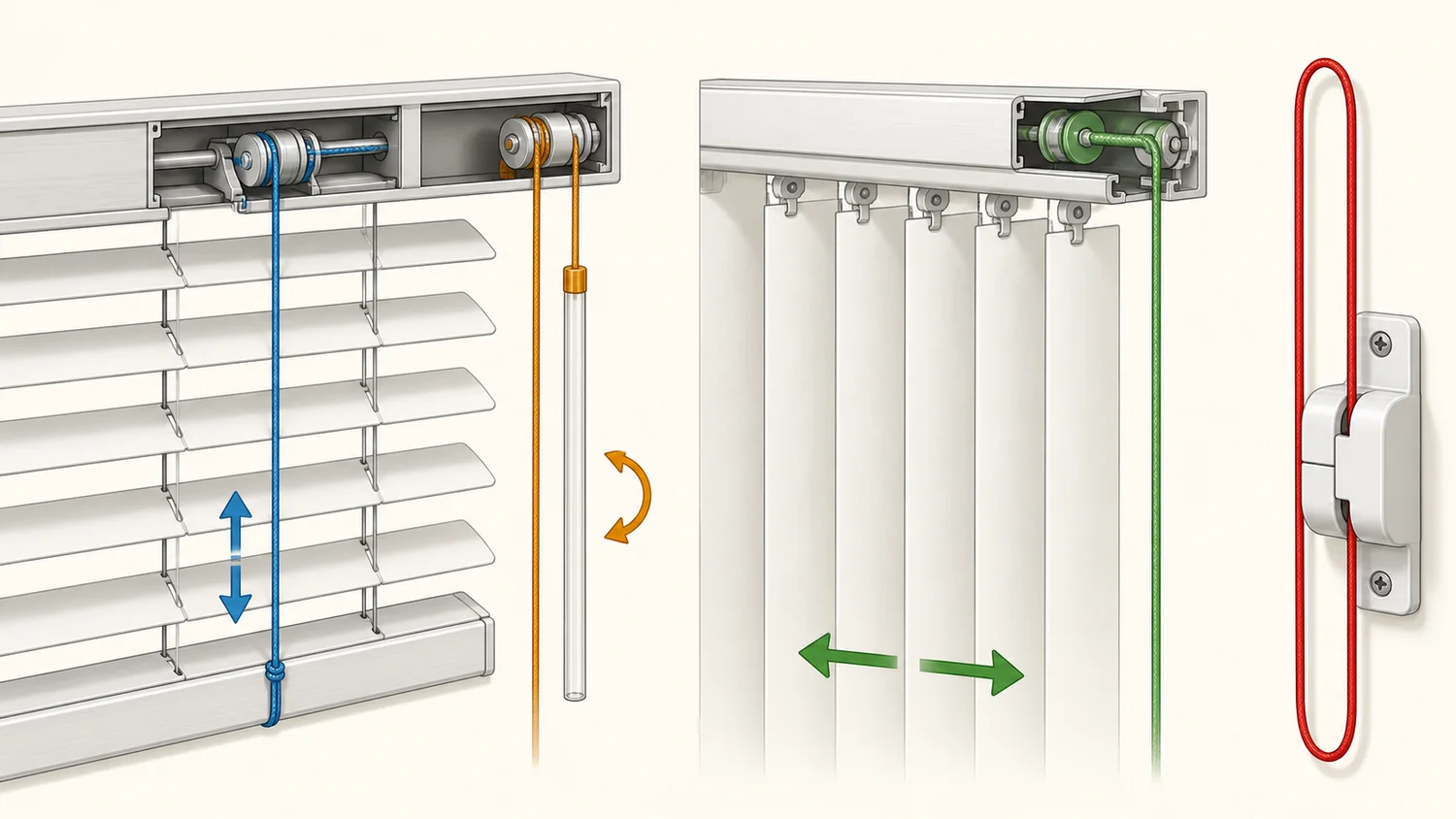
For a horizontal blind, first ask whether the whole blind raises and lowers. Watch the bottom rail rather than the slats. Then leave the blind at a comfortable height and use the separate control that changes the slat angle. Watch the slats rather than the bottom rail.
The useful result sounds like one of these:
- “The blind raises level, but the slats do not rotate.”
- “The slats rotate, but the bottom rail will not rise.”
- “One side rises and the other side stays low.”
- “The cord moves, but neither motion begins.”
The first statement points toward a tilt-control route. The second and third belong on a lift or cord-lock route. The last statement still does not reveal the cause; it is a reason to identify the product and use its own troubleshooting document.
A vertical blind needs a different pair of observations. Check whether the vanes travel left and right across the track, then check whether they rotate from open to closed. A traverse problem is not automatically a vane-rotation problem. Some products use a cord and chain, some use a wand, and internal layouts differ. Describe the motion, not the part you assume is broken.
Name the control by the job it performs
Once the failed motion is clear, look at what your hand actually touches. Do not remove a cover yet.
A pull cord that changes height
This is the lift route. Record whether the covering stays level, whether the cord is slack or broken, where damage is visible, and whether the control can still hold the blind at a height. “Will not stay up” can lead to a different manufacturer document from “one side will not rise.”
If the covering has no pull cord and will not rise, it belongs to the separate cordless mechanism problem—not to a string-repair procedure.
A wand, short cord or chain that changes slat angle
This is the horizontal tilt route. If the blind still raises and lowers, say so. That single fact helps separate the tilter path from the lift path. Do not buy a generic lift cord merely because the failed control is also made of cord.
A cord, chain or wand that moves vertical vanes
Record two verbs: traverse and rotate. State whether the vanes travel along the track and whether they turn. Also note whether one vane is out of position while the rest respond normally. This is enough to enter a vertical-blind support route without claiming that the carrier, gear, control or vane itself is at fault.
A loop that drives a roller or other shade
A continuous loop is a drive control, not a dangling lift cord. Record whether it is cord or bead chain, whether it remains engaged with the control, whether the shade moves in either direction, and whether its wall restraint is secure. If a manual roller shade moves unevenly or slips, the compatibility questions may involve the clutch and tube rather than replacement string; use the roller-shade clutch guide for that separate decision.
Treat loose loops and stops as safety hardware
A broken string is not only an operating problem when a loop, connector, stop or tassel has a safety function. Do not discard those parts or improvise a substitute from spare cord.
For a home where a young child can reach the window, the U.S. Consumer Product Safety Commission currently recommends choosing a cordless covering. The agency’s window-covering guidance also treats continuous-loop restraints and cord stops as specific safety measures, not optional accessories. If a loop is no longer restrained, a stop is missing, or loose cords are reachable by a child, restrict access and use the current manufacturer or CPSC route before treating the job as an ordinary repair.
A tied knot, shortened loop or generic connector does not establish that the safety system is restored. The product family, control type and approved part still matter. Our child-safety guide explains how that issue changes a replacement decision; it does not turn a generic cord repair into a safety certification.
Choose the smallest repair scope the product supports
The right scope is the narrowest one supported by the exact product evidence—not the most elaborate tutorial you can find.
Start with the label or purchase record. Look for the brand, product family, model or collection, approximate purchase date and control type. Photograph the whole covering, the headrail or roller, the hand control, the visible failure point and any label. An older instruction for the same brand is not automatically an instruction for the same mechanism.
Then compare your motion sentence with the current support library. Bali’s troubleshooting library, for example, separates horizontal-blind, continuous-loop and vertical-blind topics. Hunter Douglas likewise publishes repair guidance for named product families and individual components. That separation is useful evidence that “blind string repair” is not one universal operation.
There are five sensible outcomes:
- Correct the operation only. The manufacturer’s exact document shows that the control is intact and the issue is how that control is engaged. Use the document for the named product.
- Use one exact procedure and part. The brand, family, generation, failed motion and supported component all match. Follow that current procedure without borrowing steps from another headrail.
- Use manufacturer or professional service. The mechanism is known, but the work is not supported as a homeowner procedure, the internal path is unclear, or the rail no longer stays level.
- Replace the covering. Parts or documentation are unavailable, the safety system cannot be restored through an approved route, or repair cost and uncertainty no longer make sense. If motorization is part of the replacement plan, start with the Smart Motorized Blinds Planner rather than treating a motor as a repair part.
- Hold. The product cannot be identified and no exact procedure covers the observed control. Do not cut, melt, splice or rethread on the strength of a universal length formula.
For a motorized blind, the visible symptom belongs to a power, control, limit or mechanical handoff—not a pull-string repair. Keep that route separate with the motorized blinds troubleshooting guide.
Send one motion sentence to support
A useful support request is shorter than a guessed diagnosis. Send the brand and product identity you found, then write:
My [horizontal blind / vertical blind / shade] still [working motion], but it no longer [failed motion]. The visible control is [pull cord / wand / chain / continuous loop]. It [stays level / lifts unevenly / does not move], and the [anchor / stop / connector] is [intact / loose / missing]. Which current procedure and exact part apply to this product?
Attach the label and control photos. That gives the manufacturer or repairer a failed motion, a product identity and a safety condition to work from. It is the information a generic “How do I fix the string?” question leaves out.