An order form accepting your width does not prove that a narrow blind will work. On a tall, slim opening, the headrail may fit while the operating mechanism consumes the useful width, the fabric leaves larger-than-expected edge gaps, or a slight skew becomes obvious by the time the bottom bar reaches the sill.
Measure the opening at the top, middle and bottom, then check both diagonals. Choose the operating system before trusting its minimum width. Ask for the headrail width, finished fabric or slat width, edge gaps and any height-to-width or tracking limit for that exact product. The order is ready only when two straight travel edges, the control/service lane and the bottom landing all fit on one elevation.
Treat the opening as a vertical run
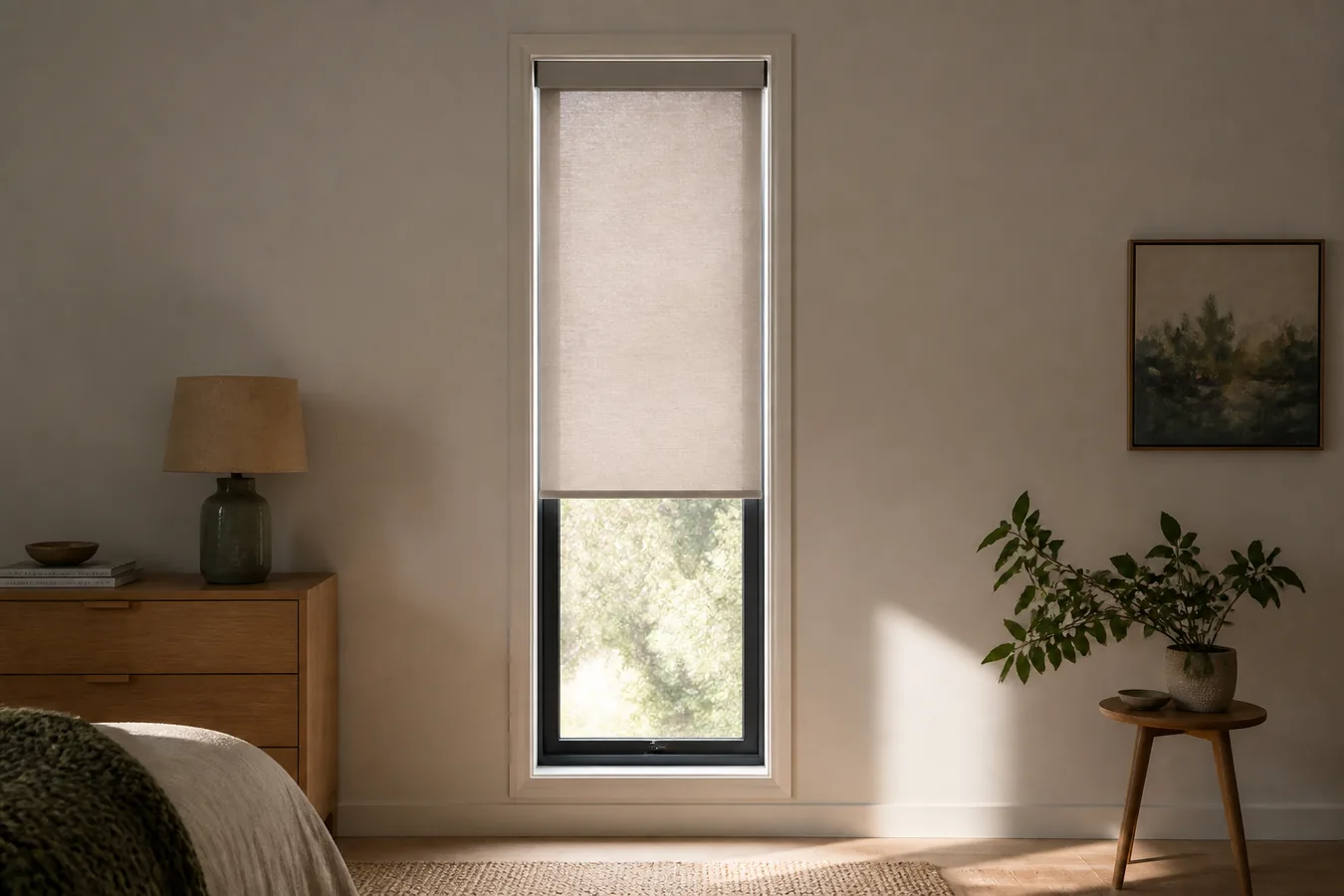
A small-window question asks how much glass survives the hardware. A tall-narrow question adds another problem: can the moving part stay where it belongs for the entire drop?
Start with the mount plane, not the visible glass alone. Record the width at the depth where the brackets or clips will sit. Then measure the width at mid-height and at the bottom. Check both diagonals, note handles and vents, and mark where a battery wand, charging connector, remote receiver or tension device would be reached.
The Blinds.com-hosted roller measurement guide tells buyers to compare widths through the opening and use diagonal measurements to judge whether an inside mount is suitable. Its exact rounding and deduction instructions belong to that document, not every shade. The transferable lesson is simpler: a narrow corridor must remain usable below the headrail.
Use the smart shade measurement checker to record the opening, depth and obstructions. Keep the raw opening dimensions separate from every number the fabricator later supplies.
Put four reference lines on the elevation
Draw the window straight on. You do not need rendering software; a clear photograph or scaled sketch is enough. Add these four marks before comparing colors or fabrics.
| Mark | Where it goes | What the quote must show | Reject or pause when |
|---|---|---|---|
| Left travel edge | From the left finished fabric, slat or rail edge to the bottom landing | The same edge at the headrail, mid-drop and sill | It crosses trim, glass, a handle or the privacy line |
| Right travel edge | Mirror of the left edge | Finished coverage and clearance for the exact control end | The quote shows only order width or overall cassette width |
| Control and service lane | Beside or within the headrail, continuing to the reachable service point | Motor, battery, charger, wand, tension device or removable cover with hand clearance | Charging or removal depends on taking down adjacent trim or furniture |
| Bottom landing | Across the intended lowest position | Level bottom bar or rail, sill clearance and final privacy coverage | One corner lands visibly high, hits a crank, or exposes the critical sightline |
The two vertical edges are not promises that a shade can never drift. They are acceptance lines. If the seller cannot plot the finished product inside them, the choice is still unresolved.
Minimum width belongs to the operating system
“Available in narrow widths” is incomplete until the control is named. A current Blinds.com Classic Roller Shades product page, observed in August 2026, lists different minimum widths for four systems on that one product: 8 inches for cord loop, 12 inches for SmartRelease, 18 inches for cordless and 16 inches for motorization. Those figures are useful because they demonstrate the dependency; they are not category-wide limits.
Pick the control first, then obtain the current specification for the exact fabric, lift and hardware combination. A compact manual mechanism may fit where a spring or motor does not. The reverse can also happen when safety or reach rules remove the apparently smaller option.
In a home where young children are present, the US Consumer Product Safety Commission says cordless window coverings are the safest option. Do not use a free-hanging cord simply because its headrail fits a very narrow opening. If the required safe control does not fit, change the treatment or the mount.
Motorization is not a universal rescue. The motor, tube, power connection and service access all need room. If you are considering a cellular product instead, the same discipline applies: verify the exact rail and motor configuration rather than assuming that all cellular shades fit narrow windows. The motorized cellular shades guide shows which power and service details belong in that configuration.
Order width is not the width that covers glass
A narrow roller can lose a meaningful share of its coverage between the bracket ends and the fabric edges. One roller measurement guide says the fabric in its example is about 1 1/4 inches narrower than the opening on an inside mount. Another current product publishes light-gap and minimum-width information by operating system. Neither number should be carried to a different product.
Ask the seller to put these dimensions on the same drawing:
- opening width at the mount plane;
- order width;
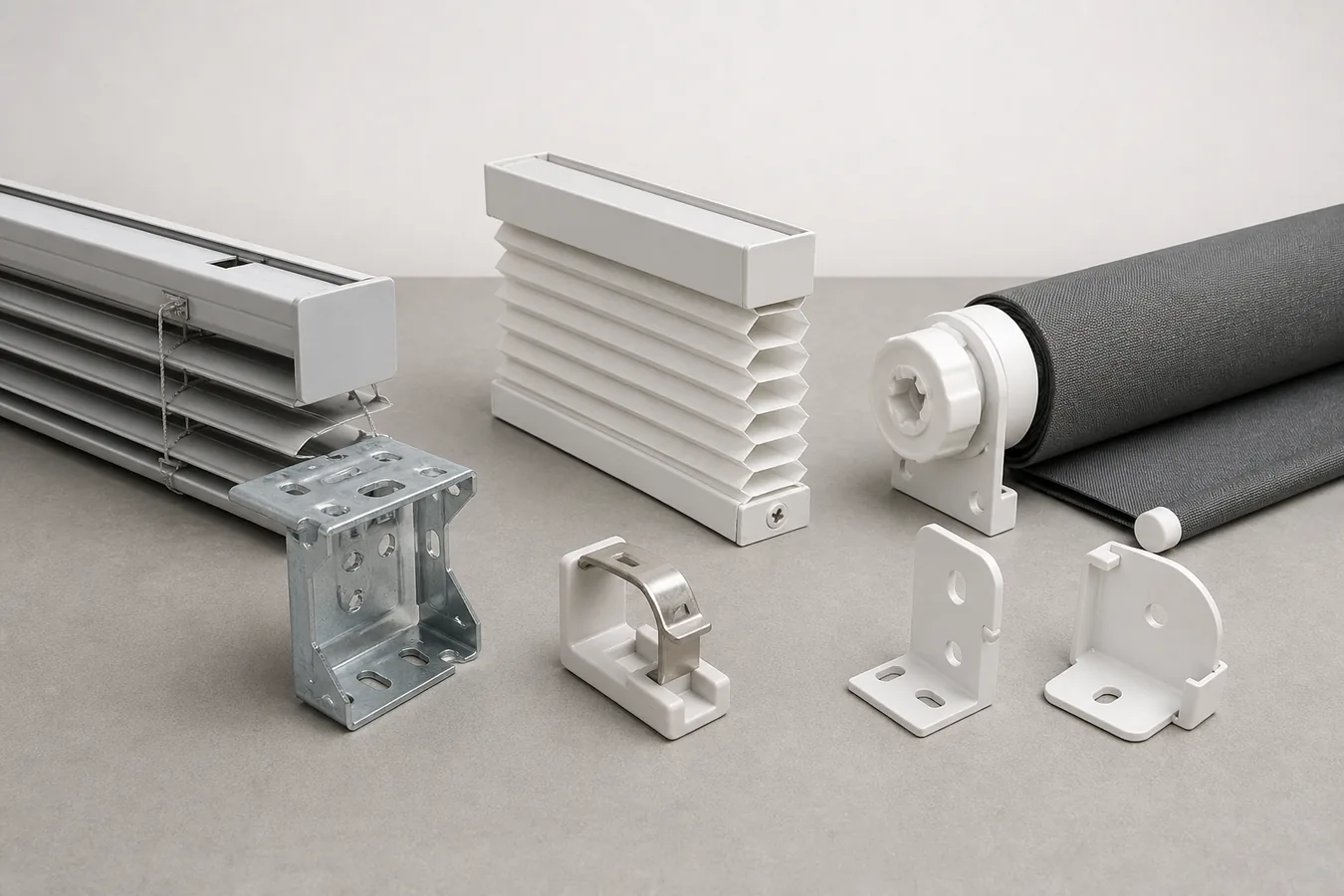
- bracket-to-bracket or headrail width;
- finished fabric or slat width;
- left and right edge gaps;
- control-end projection and service clearance.
This is where a narrow window can pass the manufacturing limit but fail the room task. A roller that technically fits may leave too much of a nighttime sightline open. A slatted blind may cover the width yet lose lift capability at the chosen size. Blinds Chalet, for example, says some wood and faux-wood products under 12 inches in its catalog can tilt but not lift because the headrail lacks room for all the mechanisms. Treat that as a product-family warning, not a rule for every narrow blind.
If the opening is small in both directions, use the separate small-window blind guide to calculate what remains visible after hardware and stack. Here, keep your attention on whether the finished edges remain acceptable all the way down.
A small lean becomes obvious at the sill
Tall, skinny geometry magnifies what the eye can ignore near the headrail. A bracket that is slightly out of level, an opening that narrows, an uneven roll or fabric that begins to telescope may finish far from the intended bottom line.
One solar-shade specification hosted by Blinds.com warns that shades over a 3:1 height-to-width ratio may experience telescoping and says that condition is not considered a defect under that specification. That is not an industry-wide cutoff. It is evidence that ratio and tracking can be written into a product’s limits and warranty language.
For the product you are actually buying, ask:
- Is this exact ordered width and height inside the standard size table for the selected control?
- Does the manufacturer publish a height-to-width, fabric-roll or tracking limitation?
- What amount of edge movement is considered an adjustment issue, and what is excluded as normal?
- Who corrects a shade that reaches the sill outside the agreed travel lines?
Measure the opening before answering any of them. If top, middle and bottom widths differ, or the diagonals reveal an out-of-square frame, an inside-mounted shade may have less usable corridor than the top width suggests. Follow the chosen product’s own measuring rules; published tolerances and deductions are not interchangeable.
Compare formats by the constraint they remove
Do not rank narrow-window treatments in the abstract. Cross out any option that fails the constraint in your drawing.
| Format | It remains plausible when | Evidence still required | Choose another path when |
|---|---|---|---|
| Manual roller shade | The exact mechanism fits and the finished fabric covers the required privacy line | Minimum width, finished edges, tracking language and safe control | Edge gaps or control choice fail the room task |
| Motorized roller shade | The motor and tube fit, and charging or wired service remains reachable | Exact motor minimum, power hardware, tube/cassette size and service removal path | The motor fits only by obscuring glass or becoming unserviceable |
| Cellular shade | The exact rail and lift system fit the width, and the stack and side gaps are acceptable | Product-specific rail, control and finished-size drawing | “Cellular shades run narrow” is the only evidence offered |
| Horizontal blind | The chosen product retains the required tilt and lift functions at this width | Headrail drawing, control functions, slat/ladder placement and bottom-rail landing | A narrow configuration deletes a function you need |
| Outside-mounted treatment | Wall or trim gives a wider, flat and secure mounting plane | Exact overlap, projection, trim relationship and final silhouette | The wider outline blocks adjacent trim, hardware or a walkway |
| Static privacy layer | Privacy matters more than daily opening and closing | Material suitability, sightline coverage, removability and window operation | Glare, view or ventilation requires an adjustable treatment |
This matrix is allowed to end with “leave the window uncovered.” A narrow architectural opening that has no real privacy or glare problem does not need hardware merely because a product can be made.
Move outside only if the new outline is acceptable
An outside mount can escape a cramped recess, widen the hardware span and increase overlap. It also draws a new rectangle around the window. That rectangle may cover trim, crowd an adjacent wall, project into a passage or make a slim feature look heavier.
Use the inside-versus-outside mount guide to decide whether moving the mounting plane is justified. If a roller shade is still the likely choice, the outside-mount roller guide separates bracket width from fabric coverage and projection.
Do not borrow a universal overlap number. Even the source documents reviewed for this page give different recommendations for different products and contexts. Ask the selected seller for the exact ordered width, finished material width and mounting surface required to meet your privacy or light-control line.
Make the quote land at the bottom
Before paying a deposit, ask for one drawing or written schedule that closes the whole vertical path:
- Exact product, fabric or slat, control and mount.
- Opening width at top, middle and bottom; height; diagonals; usable depth.
- Order, headrail and finished material widths, with left and right gaps.
- Headrail, cassette, bracket, motor, battery and charger dimensions that apply to this configuration.
- Product-specific height-to-width, tracking and adjustment or warranty language.
- Both travel edges, the service lane and the level bottom landing shown against trim, handles and the privacy line.
- The person responsible if the installed bottom edge misses the agreed position.
If any line is missing, the useful answer is not “it should fit.” Pause the order. Change the control, product or mount, or use a non-moving privacy treatment until the complete path can be documented.
The best narrow blind is not the product with the smallest headline minimum. It is the one whose exact mechanism fits at the top, whose finished material covers what matters, and whose bottom edge has a credible place to land.