Do not start by wetting the mark. A cellular shade turns one cleaning question into several: loose dust sits on the pleated face, grit or an insect can sit inside a cell, an isolated spot may be bonded to the fabric, and broad speckling may be coming from a damp window. The method that helps one can deform, pill or stain another.
Start dry. Find the brand, model or order record, then check the care instructions for that exact fabric. Use the lightest method that reaches the dirt and stop before adding suction, water, heat or chemicals the guide does not permit.
The dirt’s location chooses the first move
Before touching the shade, look at it lowered in daylight and from the side. Decide whether the material is on the outer face, loose inside an open cell, limited to one spot or spread over a damp area.
| What you see | Where it is | First method to verify | Do not | Escalate when |
|---|---|---|---|---|
| A light gray film or loose lint | On the face and pleat edges | Dry dusting; a low-suction brush vacuum only if the care guide allows it | Press the cells flat or use an uncovered vacuum nozzle | The fabric bows, puckers or the dust will not release |
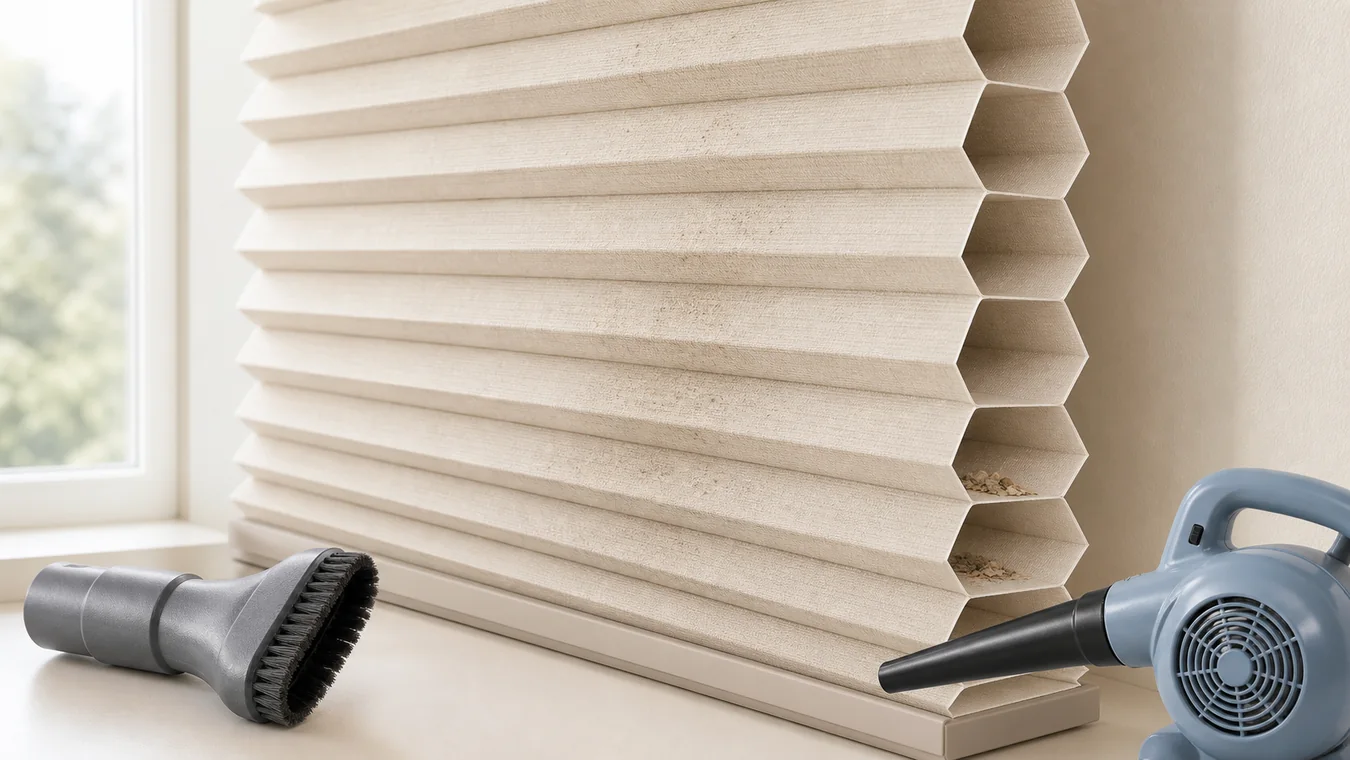
| A bug, grit or a dry particle | Inside an open honeycomb cell | Gentle compressed air or a hair dryer on Cool, aimed toward an open exit | Insert a stick, brush or vacuum nozzle into the cell | The object is stuck or reaching it requires dismantling the shade |
| One isolated mark | On a small part of the face fabric | Remove loose dust, then blot minimally only if the exact guide permits spot cleaning | Rub, scrub, spray or substitute a stronger cleaner | Color transfers, the mark spreads or a water ring forms |
| Widespread grime or discoloration | Across several pleats or cells | Product-approved professional cleaning or replacement | Assume soaking, steam or ultrasonic cleaning fits every fabric | The maker excludes wet cleaning or the cells have lost shape |
| Recurring dampness, speckling or odor | Near the glass, sill, lower edge or wall side | Find and correct condensation, leakage or another moisture source | Repeat a fabric treatment while the window stays wet | The affected area is extensive, returns after drying or the water source is uncertain |
The table deliberately does not name one universal cleaner. “Cellular” describes the construction; it does not tell you whether the exact face fabric, backing, adhesive, rail or motor can tolerate the same treatment as another product.
The model number decides how far you can go
Look for a label on the headrail, an order confirmation, an installer invoice or a saved fabric name. Search the manufacturer’s support site for that product and its care section. If the shade came with the home and no label is visible, send the manufacturer or dealer clear photos of the full shade, side profile, headrail and controls before trying a wet method.
Hunter Douglas’s current home-care guidance says cellular recommendations vary by fabric and tells owners to follow the instructions for the specific product. Its general methods include gentle dusting, brush vacuuming and cool air, but the same page also lists products that should not be spot cleaned and warns against warm or hot air.
A LEVOLOR manual for one motorized cellular family permits feather dusting, clean forced air, a low-suction brush attachment and warm water with mild soap for a spot, yet explicitly says not to immerse that shade. It also warns that improper cleaning can damage the shade and affect warranty coverage. That is useful evidence for that family, not permission for every honeycomb shade.
If the shade is motorized, keep any liquid away from the headrail, charging connection, battery and controls unless the exact manual directs otherwise. Use the motorized-cellular planning guide when power and service access are part of the problem.
Give loose dust the lightest contact possible
For ordinary face dust, begin with the method that produces the least pressure. A clean feather or microfiber duster can lift loose material from many cellular fabrics. Work along the pleats rather than pressing across their edges, and keep the shade in the stable position its manual recommends.
Move to a vacuum only if the care guide allows it. Use a clean brush attachment, low suction and a light pass. The brush should collect dust, not flatten a cell or pull the fabric toward the nozzle. If the fabric bows, the pleat starts to collapse or the nozzle leaves a track, stop; stronger suction is not the next step.
Dust the sill and frame separately. Do not spray glass cleaner toward the shade and do not let a wet window cloth brush the fabric. Otherwise a simple frame-cleaning job can create the mark you were trying to avoid.
Give trapped debris an exit
A bug or bit of grit inside a honeycomb is not a surface stain. Do not push a pencil, skewer, vacuum nozzle or brush into the cell. That concentrates force on a small area and can move the debris farther inward.
Hunter Douglas advises using compressed air or a hair dryer on a cool setting for trapped insects and debris, while keeping objects out of the fabric. Aim from an open end so the particle has a clear route out. Use gentle air and stop if the cell distorts; warm or hot air is not a shortcut.
If the object is stuck, the opening is inaccessible or the shade must be dismantled to reach it, contact the manufacturer or a cleaner familiar with that product. A remaining speck is usually a better outcome than a punctured cell.
A spot is where generic advice stops
First remove the loose dust around the mark. Adding moisture to a dusty surface can spread the material and enlarge the visible area.
If the exact care guide permits spot cleaning, follow its water, cloth and detergent instructions. The common manufacturer pattern is a clean soft cloth or sponge, lukewarm water, a small amount of mild non-abrasive soap when allowed, and blotting rather than rubbing. Wring the cloth out; the job is to touch the spot, not saturate the cell.
Do not substitute carpet cleaner, bleach, solvent, stain remover, steam or a bathtub because a generic cleaning page used it on a different covering. Do not assume a professional process is suitable either: ultrasonic and injection/extraction methods still depend on the product and fabric.
Stop if color transfers to the cloth, the mark spreads, a water ring develops, the face puckers, the cell seam opens or the rail becomes wet. Let the manufacturer or an experienced shade cleaner decide whether another treatment is appropriate. A fixed discoloration may have become a replacement decision rather than a stronger-cleaner problem.
Recurring dampness is a window problem first
Broad speckling, a musty odor or a damp lower edge changes the task. Check the glass, sill, frame and wall for condensation or a leak before treating the fabric again. The US Environmental Protection Agency explains that moisture can condense on cold surfaces such as window glass and that continuing moisture can encourage mold growth.
Dry the area and correct the water source or humidity condition. Keep the shade away from the wet surface while you work. Do not invent a bleach or mold-treatment recipe for absorbent cellular fabric; use the product maker’s advice and appropriate professional help, especially when the affected area is extensive or the water source is uncertain.
If dampness keeps returning, note when it appears, whether the shade touches the glass, and whether air can move behind it. Cleaning may improve the appearance today, but it cannot prevent the same problem if the window remains wet.
Let the dry shade make the final call
Do not operate a damp shade. Once it is fully dry, inspect it from the front and side. The pleats should keep their shape, the cells should not be stuck together, and the rails should move without dragging or skewing. A lighter but still visible spot is not a reason to repeat an unapproved treatment.
Write down the method, the product guide you followed and any remaining mark. That record makes the next call with the manufacturer or cleaner useful and prevents another person from starting over with a harsher method.
If the shade is clean enough and moves normally, put it back into service. If it remains distorted, smells damp, delaminates, carries a permanent stain or is too difficult to maintain for the room, compare the maintenance tradeoff in the shade-type matrix. If you are considering a different physical format, the blinds-versus-shades comparison separates wipeable slats from continuous fabric without pretending either is maintenance-free.