A cloth-tape sample can be easy to love and impossible to order with the blind you actually need. In one current LEVOLOR wood-blind guide, decorative tapes are unavailable on its 1-inch Real Wood, Cordless, Classic Value Faux Wood and Privacy Route configurations. That is a rule for those documented LEVOLOR rows, not every blind. It proves why color cannot be the first decision.
Choose blinds with cloth tape only after the exact product confirms that the tape works with the required slat, route construction, lift and tilt controls. Then approve the room-side and street-side appearance, the realistic closed-light result, the care method and the service path. If any of those fields is missing, keep the standard ladder option or choose another blind instead of guessing.
Start with the blind that can actually accept the tape
Decorative cloth tape is a wide woven ladder detail used across the face of some horizontal blinds. It replaces the thin visual line of a conventional ladder with a stronger vertical band, often repeated at several positions across the blind. The tape is part of the blind’s slat-support and tilt construction; it is not adhesive trim added after installation.
That distinction matters when shopping for parts. Hunter Douglas’s current decorative-tape repair procedure applies to named horizontal blinds originally built with decorative tapes. It explicitly says the repair is not a conversion from standard ladder cords. Its steps use matching tape rolls, supports, lift-cord routing and tilt-rod assembly. A roll of tape that looks right is therefore not proof that an existing headrail can accept it.
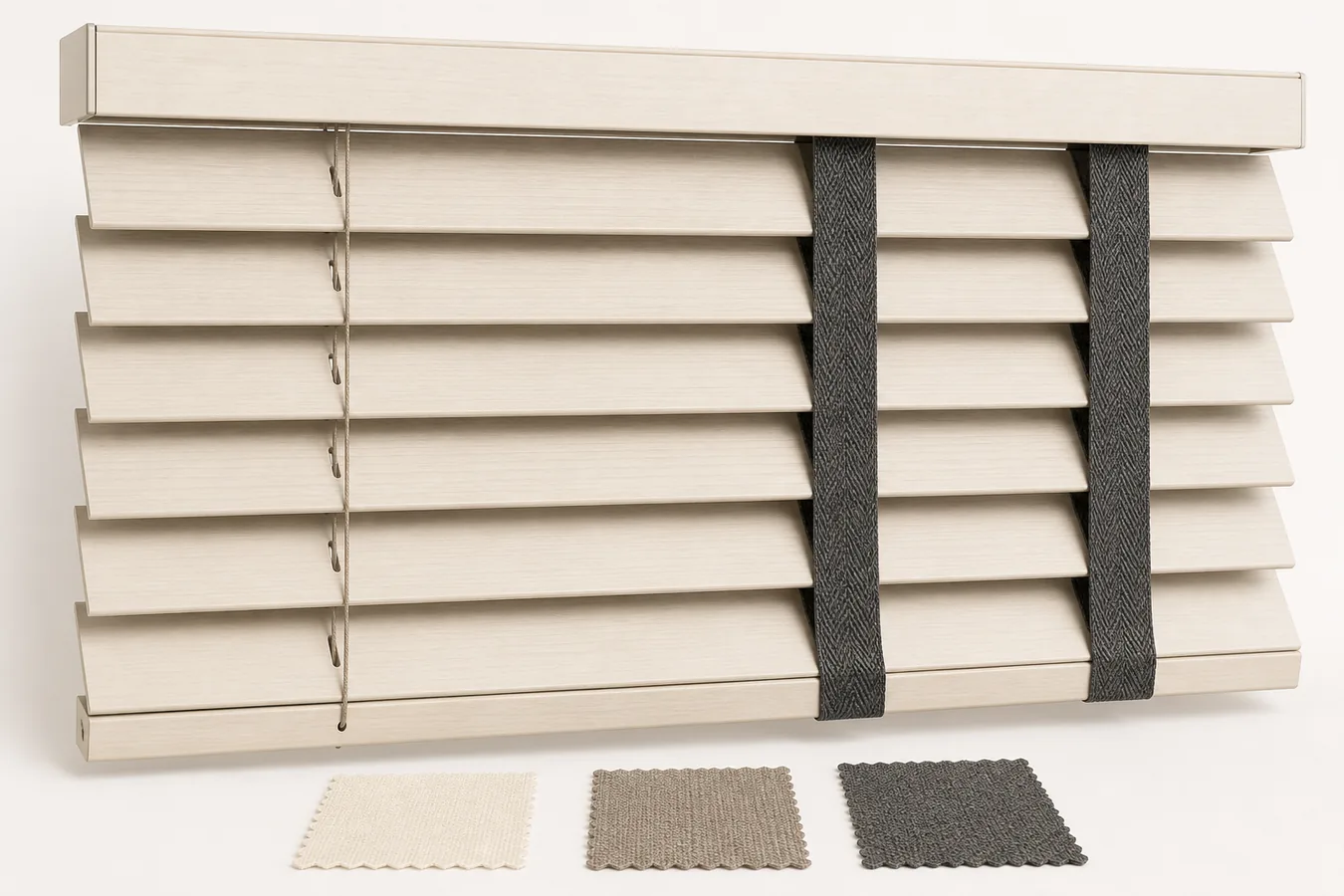
Use a swatch to judge color and texture. Use the manufacturer’s current option table, a configuration printout or a written fabricator reply to decide whether the tape can be built.
Make one option sheet answer nine fields
Keep the tape inside the same record as the blind. Do not combine a product-page feature, a dealer’s color card and a repair part from three different systems.
- Product identity
- Manufacturer, exact collection/model, document or quote date and region.
- Ordered size
- Finished width and height, including any multi-blind split.
- Slat and route
- Material, slat size, standard route, privacy route, rear route, routeless or another documented construction.
- Controls
- Exact lift and tilt systems, including operating side and any power or service access.
- Tape
- Official option name, eligibility, width, fiber when disclosed, color/pattern and number or code.
- Two visible sides
- Room-side and street-side sample or rendering with the chosen slat.
- Closed-light expectation
- Product-specific evidence for the completed configuration, without assuming blackout.
- Care
- The tape’s cleaning method, prohibited methods and concealed test area.
- Service
- Replacement tape/roll/support identity or the named service route for that generation.
If all nine fields belong to one buildable row and suit the room, approve the tape. If tape removes a required control or route option, use the standard ladder or another blind. If the record is incomplete, hold the order; another brand’s guide cannot fill the blank.
Keep decorative tape separate from lift and tilt controls
Cloth tape does not raise the blind, and it does not choose how the slats are tilted. Those jobs belong to the configured lift and tilt systems. The option relationship still matters because a manufacturer may not offer every tape, route and control combination in the same product row.
The current LEVOLOR guide is a useful example: decorative tapes are not offered with the guide’s Cordless or Privacy Route choices. The safe reading is narrow—those documented combinations are unavailable in that line. It would be wrong to turn the example into “cloth tape cannot be cordless” across the market. It would be equally wrong to assume a cordless badge elsewhere guarantees the tape option.
If cordless operation is required, do not quietly accept an exposed-cord configuration just to keep a preferred tape. Preserve the control requirement and move to another exact product or remove the tape option. The cordless and motorized blinds child-safety guide explains how to keep the completed product, not a feature label, as the safety decision.
When the control choice itself is unresolved, finish the smart-blinds-versus-motorized-shades decision before locking a decorative blind detail. A tape upgrade should not decide the operating architecture by accident.
Judge the room side and street side as different color decisions
A loose tape swatch shows texture. It does not show the repeated vertical rhythm across a full-width blind, the contrast at every slat edge or the color seen through the window from outside.
Request the chosen slat and tape together. A short assembled sample with several slats is more useful than two loose chips because it shows scale, overlap and contrast. For a wide or prominent opening, add a straight-on rendering or installed example at a comparable width. Keep the evidence product-specific; a beautiful photo from another collection can use different tape spacing, slat color and hardware.
Approve the two viewpoints separately. From the room, decide whether the band should disappear into the slat color or become a deliberate stripe. From the street side, check whether the back of the tape, route area and slat finish create an acceptable repeated pattern. A dark tape on pale slats can be a feature indoors and a much sharper signal outdoors.
Slat scale changes the same composition. If 2-inch and 2.5-inch slats are both under consideration, close that geometry with the 2-inch-versus-2.5-inch blind comparison before judging the final tape-to-slat proportion.
Covered route holes do not make a blackout blind
Merchant pages often describe cloth tape as covering route holes and improving light control. That can be a useful visual effect in a particular construction. It does not establish a sealed blind.
Light can still appear at slat overlaps, headrail and bottom-rail areas, side clearances or any route detail the tape does not cover. The same current LEVOLOR guide also treats Privacy Route and Decorative Tapes as mutually unavailable in its documented rows, so “add tape to the privacy route” is not even a buildable answer there.
Ask for comparable closed-state evidence from the exact configuration. Record the seller’s construction term and the physical cord path with the routeless-versus-routed blinds guide. If the goal is privacy rather than a darker visual face, use the outside-sightline method in the blinds-up-or-down privacy guide. Tape color is not a substitute for either route documentation or a finished-window privacy result.
Treat “better room darkening” as a claim to verify, not the reason to skip verification. A bedroom that needs blackout usually depends on perimeter coverage and the complete window system, not on one vertical component across the slats.
Choose the cleaning rule before a pale tape
Cloth tape puts a fabric surface where dust, hands and window-cleaning spray can reach it. The care rule can therefore change which color and fiber is practical.
LEVOLOR’s cloth-tape care reference illustrates why the material field matters. It recommends testing in the concealed area where tape wraps around the bottom rail. It permits a cool-distilled-water blotting method for its identified 100% polyester tapes, while warning against water on shiny or lustrous tape that may be rayon or acetate. Those are LEVOLOR instructions for the tape types described in that guide, not permission to wet an unidentified tape.
Ask the exact product owner to name the fiber and return the current tape-care sentence. If the answer is only “wipe the blind,” ask whether that applies to the slats, the tape or both. A moisture-tolerant faux-wood slat does not automatically transfer its care rule to a woven tape. The composite-versus-faux-wood guide can close the slat material label; the tape still needs its own line.
For a pale or high-contrast tape, also ask what happens when one run is stained or frayed. Hunter Douglas’s current repair record shows that a tape system can use generation- and product-specific supports and rolls. That does not promise that every tape is replaceable. It makes a named part or service route more valuable than a generic assurance that “a dealer can fix it.”
A tape swatch earns approval only when it stays inside one finished, serviceable configuration. Product identity comes first; route and controls follow; color gets its vote after both sides, light behavior, care and repair are documented.
If the tape survives that sequence, it is a deliberate design choice. If it removes a required function or leaves an undocumented service burden, the standard ladder is not a downgrade—it is the configuration that still meets the job.