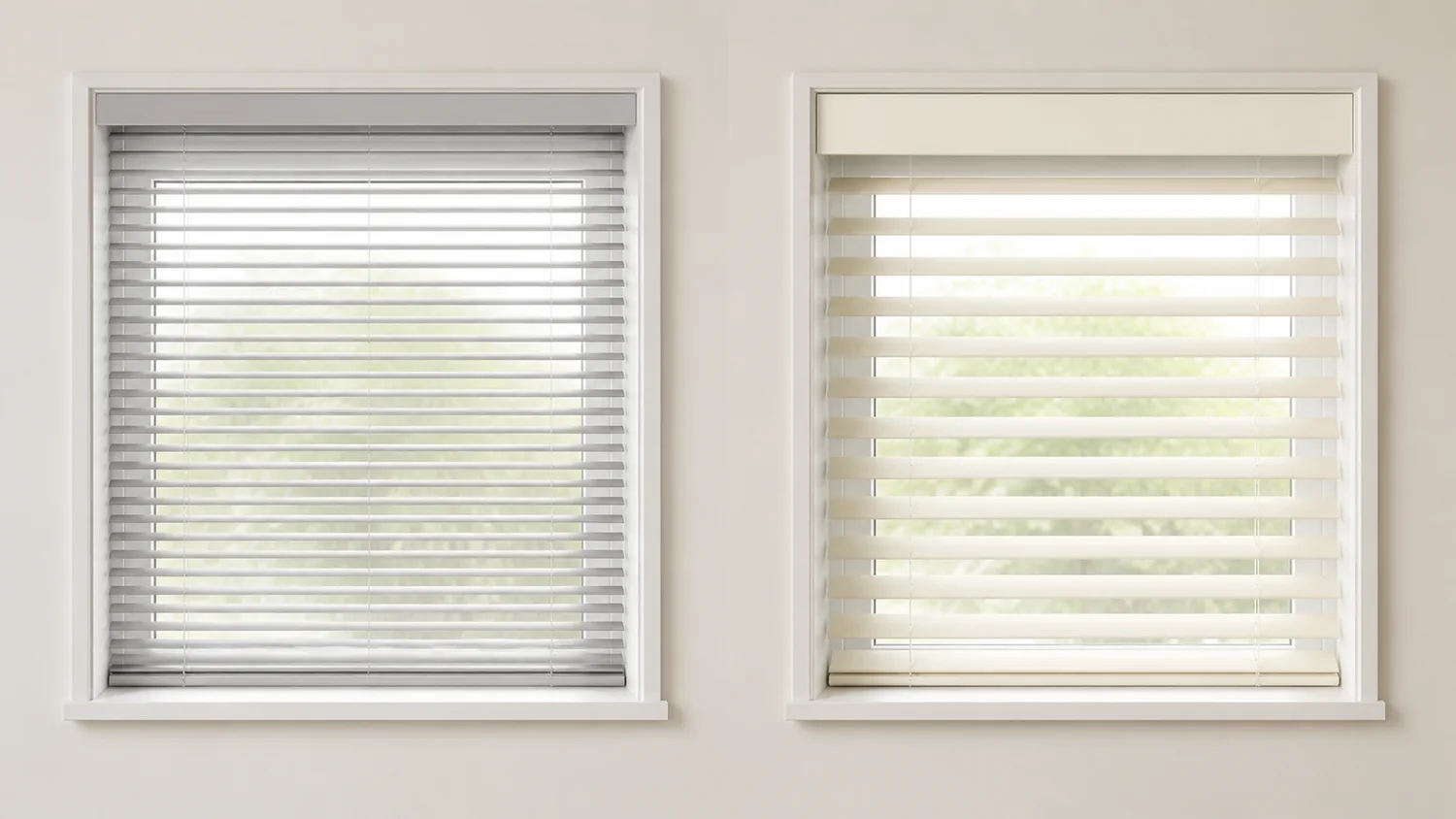
A routeless blind can remove the pinpoints of light caused by route holes and still be the wrong blind for a moving door. Removing a hole can also change how each slat is held. That matters when a blind is bumped, cleaned or carried by a door every day.
There is no automatic winner. Choose a true routeless construction only when the exact product documents its no-hole or notched path and it suits the opening. Choose a documented routed construction when positive slat retention matters more than eliminating those pinpoints. A rear or privacy route may offer a useful third choice—but it is not necessarily hole-free.
Three product labels can hide three cord paths
“Routed” and “routeless” sound binary. Current product literature shows at least three physical arrangements:
- Standard routed: a lift cord or lift path passes through holes in the slats. The holes can be visible when the blind is closed, but the path can also help keep the slats captured and aligned in that particular design.
- Rear or privacy route: the holes and lift path are moved toward the rear of the slat or otherwise made less visible from the room side. Norman’s current SmartPrivacy page is one brand-specific example; it describes rear-positioned route holes, not a completely hole-free slat.
- True routeless or notched: the visible slat face has no through-hole for the lift path. One documented arrangement uses notched slats resting on ladder rungs, with the lift cord running outside the slat field.
Those descriptions are construction families, not cross-brand specifications. A seller may use “privacy,” “no holes” or “routeless” differently, and an option may change with the material, slat size or operating system. Ask for the exact model’s current diagram or written construction before assigning it to a family.
Follow one slat from the route to the ladder
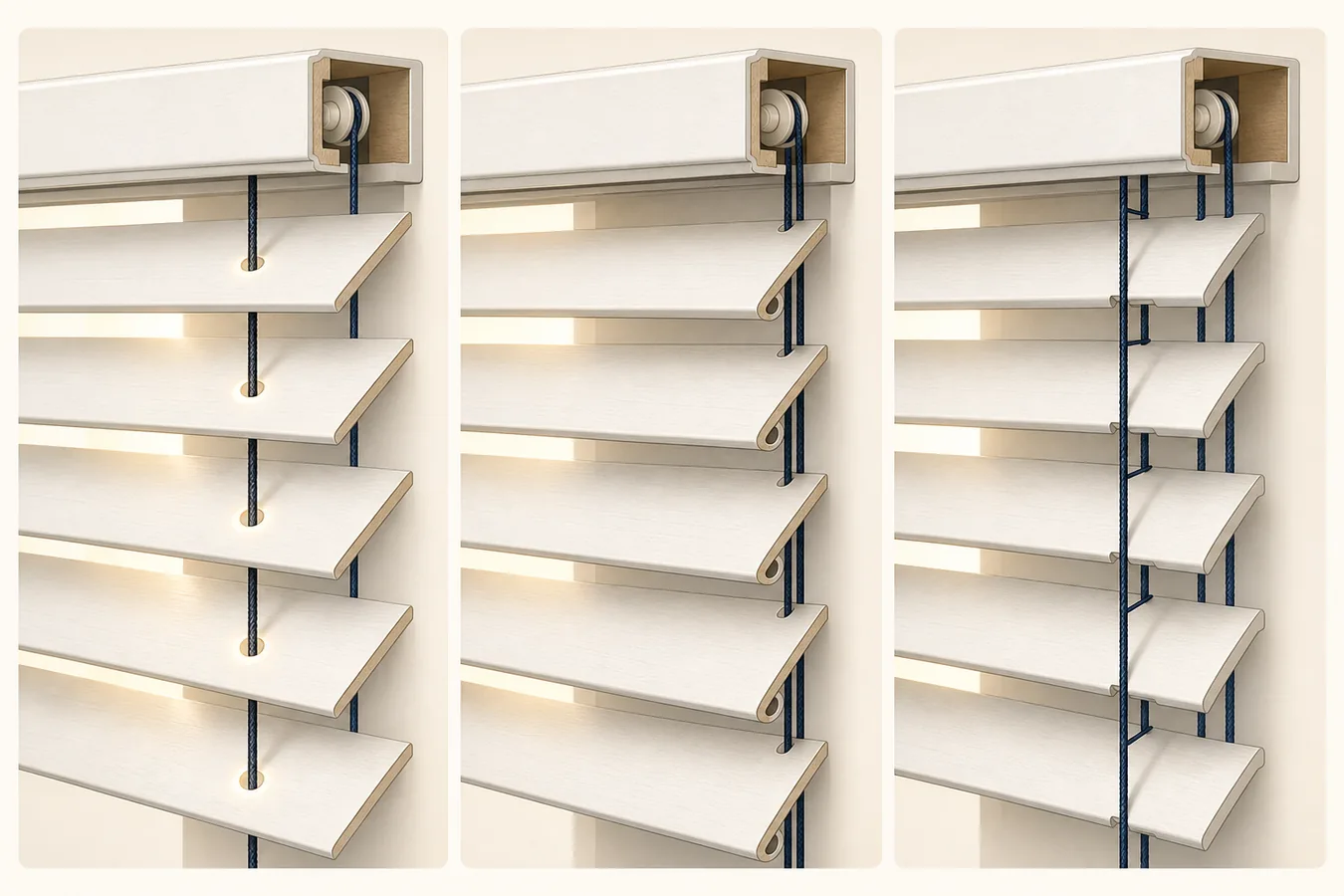
The lift cord and the ladder do different jobs. The ladder supports each slat and tilts the slat field. The lift path raises the blind. In a standard routed design, that lift path passes through the slat. In a true routeless design, it may run beside or behind a notch while the slat rests on the ladder.
That difference changes more than the light pattern. Bali’s no-route troubleshooting sheet, for example, shows a notched slat sliding out of the ladder for replacement. That is useful service information for that design. It also demonstrates why “no holes” does not describe how firmly every other routeless product holds a slat under motion.
The illustration above is conceptual, not a manufacturer drawing. Use it to ask the right question, then complete this route card from the current product guide or written quote:
- Identity
- Manufacturer, exact product/model, material, slat size and quote date.
- Route designation
- The seller’s term plus a diagram or sentence showing through-hole, rear-hole or notch/no-hole construction.
- Slat support
- What carries the slat when the blind is lowered, and what prevents it from shifting sideways.
- Operating system
- The exact lift and tilt controls included in this configuration.
- Opening approval
- Whether the manufacturer permits this configuration on the intended window or door, including any hold-down hardware.
- Closed-light evidence
- A sample or product-specific image under a comparable light direction, not a generic “blackout” adjective.
- Service method
- The stated cleaning method and how a damaged slat is removed or replaced.
If the seller can name the option but cannot show the path, mark the construction unresolved. Do not fill the blank with a category assumption.
Let the window motion veto the fragile option
A blind over a stationary window does not experience the same movement as a blind carried by a frequently used door. On a moving opening, consider door swing, repeated stops, nearby handles, hold-down brackets, children or pets brushing the slats, and the path used for cleaning.
This is where old generic advice becomes risky. Some routeless product documents warn against door use; other routed or rear-routed systems describe different retention arrangements. Neither fact proves what a current quoted product allows. Require current written door eligibility for the exact route, material, size and control combination.
If that approval is missing, the door is not a place to “see how it goes.” Hold the choice. For a stationary opening, a removable or laterally movable slat may be an acceptable service feature. For a moving door, the same behavior may be an unwanted failure mode. The opening decides which interpretation matters.
Cleaning needs the same specificity. A slat that can be shifted for replacement is not automatically easier or harder to clean, and a captured slat is not automatically more durable. Use the manufacturer’s care and service instructions for the named blind.
Judge the closed blind without promising blackout
Route holes are only one path for light. A true routeless slat can remove those particular pinpoints, and a rear/privacy route can make them less visible from some viewing angles. Light can still pass between overlapping slats, at the headrail and bottom rail, and around the sides of the installation.
Current LEVOLOR technical material is useful precisely because it ties light-control performance to named route and operating-system combinations and says the blinds are not 100% light blocking. That is a better decision boundary than turning “routeless” into “blackout.”
Decide what problem you are actually trying to solve:
- If isolated bright dots through the slat field are the objection, route position may directly help.
- If the objection is a silhouette or view through tilted slats, route construction may not fix it. Use the actual outside sightline and lighting condition in the blind-tilt privacy check.
- If the room needs near-darkness, include side gaps, slat closure, headrail geometry and the full window treatment—not just the route label—in the plan.
Ask to see the exact blind closed, in the chosen color, with strong light behind it. A dark marketing photo and a written privacy claim are not equivalent to that view.
Routeless is not the same as cordless
Routeless describes the path through or around the slats. Cordless describes how the completed blind is operated. One does not prove the other.
Verify the lift and tilt controls on the exact configuration even after the route is settled. In homes where young children are present, the US Consumer Product Safety Commission advises going cordless. The relevant unit is the completed product and the child-reachable window area, not the presence or absence of route holes. Our cordless blind safety guide covers that separate operating-system decision.
This distinction also prevents a purchasing mistake: a route option shown in one manual configuration may not be offered with the cordless or motorized control you intend to buy. Make the seller confirm the combination on the same line item.
Approve the route only when the quote names it
A complete choice fits into one sentence:
For [exact product and date], the slats use [through-hole, rear-hole, or notch/no-hole path], are supported and retained by [documented method], use [exact lift and tilt controls], are [approved/not approved] for this opening, and produce the acceptable closed-light result shown in [named sample or image].
Choose true routeless when that record proves the reduced route-hole light path is valuable and its slat support, service method and opening approval fit the installation. Choose standard or rear/privacy route when documented retention, configuration availability or moving-opening fit matters more and the remaining pinpoints are acceptable.
If the route card cannot be completed, the quote is not ready to approve. If the unresolved question is broader—whether this should be a tilting blind or a rolling shade at all—return to the smart blinds versus motorized shades decision before comparing route options. If slat width is still open, settle the headrail and depth consequences in the 2-inch versus 2.5-inch blind comparison before asking for the final construction.