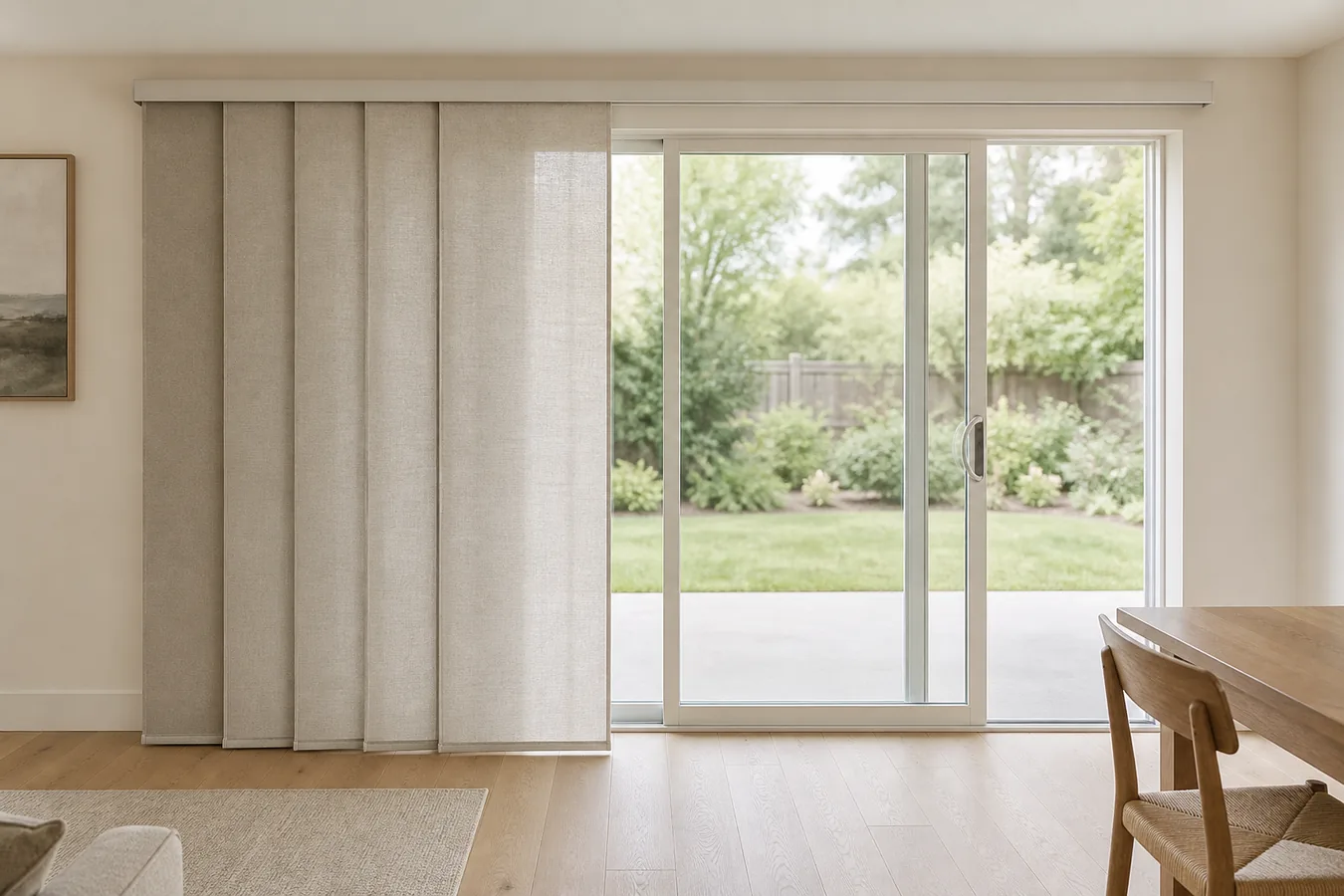
A panel blind can uncover the doorway and still leave part of it unusable. The broad panels do not disappear when they traverse; they park in an overlapping stack at one end, at both ends, or in another configuration the selected headrail actually supports. If that parked stack sits over the moving door leaf, its handle, or the walking line, a correct-width order can still be a poor fit.
Mark the door you routinely move, the fixed glass, and the minimum passage you want before choosing fabric. Then ask for the finished open-stack width and a top view of every panel in its track channel. The useful panel blind is the exact configuration that covers the closed opening and parks clear of the way you use it.
Park the panels where the door does not need to be
Stand inside the room and identify the active leaf by use, not by symmetry. Mark its leading edge, handle, lock, travel direction and the path a person takes through the opening. The other glass leaf may offer a natural parking area, but only if the selected panel-track system can stack there and the parked panels do not cover a control, wall return, switch or piece of furniture.
For a fixed wide window, replace “active leaf” with the view or daylight zone you most want to uncover. The geometry is the same; only the reason for preserving clear glass changes. If you are still choosing among panel tracks, rollers, cellular shades and vertical systems, use the sliding-door and large-opening guide first. This page begins after a panel blind is a serious candidate.
Put these fields on one top-view drawing:
| Opening fact | Answer the selected system must return | Reject the quote when |
|---|---|---|
| Active door leaf | Moving panel, direction and fully open position | The drawing does not identify which door is used |
| Required passage | Clear width and walking line with the blind fully stacked | The panel stack or control enters that line |
| Parking zone | Fixed-glass side, opposite side, split sides, or another documented arrangement | “Left/right/split” is named without showing the room |
| Headrail | Finished width, channel count, depth, projection and mount plane | Only opening width or a front rendering is supplied |
| Panel sequence | Count, finished panel width, channel order, facing and overlap | Panels are shown as interchangeable rectangles |
| Controls and lower edge | Control side/method plus bottom-weight clearance over sill, floor or threshold | Access or travel depends on an unshown part |
| Service route | How panels/headrail are identified, reached and removed under current instructions | A future change is promised without a named procedure |
Record the opening, mount plane, depth, trim and handle projection in the Smart Shade Measurement and Compatibility Checker. Keep those site observations separate from factory order dimensions. The selected manufacturer or seller still has to derive and accept the finished blind size under its current method.
The track lanes decide how the panels nest
A panel-track headrail is not one empty slot. Its carriers run in multiple channels so broad panels can overlap when closed and nest into a narrower group when open. That means panel count is not an isolated style choice: it interacts with channel count, panel width, overlap count, stack arrangement and finished headrail depth.
LEVOLOR’s June 2025 Panel Track reference guide illustrates the dependency in one current product line. Its configuration charts pair particular panel counts with channel counts, width ranges and named stacks. Those combinations belong to that guide; they are not a formula for another brand.
Ask the supplier to draw the headrail from above. Number the room-side channel first, then the remaining channels toward the glass. Give each finished panel a matching number and show where it lands when closed and when fully stacked. If two panels share part of a lane sequence or the system uses a split stack, the drawing should make that visible. A collection photo cannot prove the sequence supplied for your width.
This channel view also reveals whether a very broad opening should remain one system. If the candidate exceeds a documented limit or produces an unacceptable stack, do not invent another panel. Reopen the very-large-window split decision and compare a supported single headrail with deliberate divisions.
Stack side and panel facing are separate choices
“Stacks left” answers where the parked group ends up. It may not answer which way the overlapping panel sequence faces.
The current LEVOLOR Premier Panel Track manual lists six configurations that combine right, left or split stacks with right- or left-facing panel orientation. It also says installation order changes with the purchased configuration. That is useful evidence that two fields exist; it does not establish the same terminology or change procedure for every panel blind.
Put stack side and panel facing/orientation on separate lines of the quote. Add the control side on a third line. Then make the panel numbers on the top view agree with all three. If the seller says orientation is automatic, ask it to mark the resulting order anyway. “Automatic” should remove a choice from the buyer, not remove the finished answer from the record.
Do not substitute a narrow vertical blind for this sequence in the drawing. Vertical vanes rotate as well as traverse, while broad panel-track panels primarily glide and overlap. If rotation is part of the desired light control, compare that separate two-motion requirement in the motorized vertical-blind guide.
Closed coverage comes from ordered overlaps
Fabric opacity describes the material. It does not by itself describe the seams between panels, the two outside edges, or the gap created by an obstruction. A set of opaque panels can still show lines of light if the finished overlap or perimeter does not suit the room.
In LEVOLOR’s named reference guide, the fully closed configuration includes an approximate material overlap. Treat that number only as a current product example. Your order record should state the selected system’s finished overlap, which panel leads at each seam, and where the first and last fabric edges stop relative to the frame.
Review the closed drawing from the actual problem position. For nighttime privacy, that may be an exterior sightline with the room lit. For glare, it is the seated or working position and the real bright-sky path. For simple view control, it is the line you want to uncover when the panels park. None of these observations turns a fabric label into a guaranteed room result.
If the requirement is near-darkness, panel overlap is only one part of the perimeter. The blackout shade and side-track guide separates fabric opacity from top, side and lower-edge closure. A panel track should not inherit that result because both products use the word “track.”
More track lanes also consume more depth
The top-view sequence has a side-view consequence. Additional channels need physical space, and an outside-mounted headrail also projects from the wall. The panel plane must clear trim, handles and locks through its entire travel—not just when the blind is centered in a rendering.
LEVOLOR’s current reference guide publishes different mounting-depth and outside-mount clearance values for headrails with different channel counts. Its measurement section separately warns that handles or cranks can interfere with the panels. The exact numbers apply only to the configurations in that guide, but the purchasing question transfers: what is the completed exterior envelope of the headrail, brackets, optional valance and hanging panels?
Add a side view at the handle location. It should show:
| Side-view field | What to record |
|---|---|
| Mount plane | Inside jamb, wall, ceiling or other supported plane |
| Exterior headrail | Finished depth and room-side projection, including valance when selected |
| Panel plane | Closest moving fabric and bottom hardware relative to glass and trim |
| Obstruction | Maximum handle, crank, lock or trim projection in the position that matters |
| Lower clearance | Finished relationship to floor, sill and door threshold |
The inside-versus-outside mount guide can resolve the broader mount tradeoff. This article cannot approve the substrate, fasteners or structural support from a photograph; the quote or project record must name who accepts those responsibilities.
A later change may not be a simple reversal
It is tempting to treat stack side, control side and panel facing as preferences that can be flipped after installation. Current product documents show why that promise needs an exact source.
In its named troubleshooting procedure, LEVOLOR says reversing the headrail changes the stack side but not the purchased panel orientation. The same manual ties correct panel installation to carrier color and sequence. Hunter Douglas’ current Skyline repair guidance treats panel orientation, carriers, links, stack-side changes and some control changes as product-specific service topics, with several repairs potentially requiring a qualified professional.
These are not universal instructions to reverse a headrail or move parts yourself. They are reasons to settle the room-facing configuration before fabrication and to retain the exact order label and current manual. Ask what can change with the blind installed, what requires panel or headrail removal, which parts must remain in sequence, and who is authorized to do the work.
If an older slatted vertical blind is being repaired rather than replaced by broad panels, keep that service job separate. The replacement-vane guide explains why carrier, attachment, profile and direction belong to the existing headrail; those parts do not make a panel-track order compatible.
Put the whole configuration in one sentence
The useful quote should be readable without the product gallery open. Ask the supplier to return one complete sentence in this form:
The returned order record names the exact product and version; finished headrail width, channel count and mount; panel count, finished panel width and overlap; stack side; panel-facing order; control side and method; exterior projection; the handle, threshold and passage clearances in the closed, normal-passage and fully stacked positions; and the documented service or removal route.
Attach the matching top and side views. If the sentence cannot be completed, the issue is not a missing decorative choice. The panel blind has not yet proved that it can both cover the opening and get out of the doorway.