Before comparing apps, remotes or voice assistants, ask the seller to make the exact blind do three things: rotate the slats, stop the bottom rail halfway up, and rotate the slats again while the blind is halfway up. Those three motions reveal more than the word motorized.
Some motorized faux wood blinds power the slat tilt while you still raise and lower the blind by hand. Others power both lift and tilt. A product page can use the same broad label for either result, so the quote needs verbs: tilts, raises, lowers, and—if it matters—tilts while partially raised.
Start with the bottom rail’s required positions
Picture the window at three times, not the blind in a product photo. At the privacy hour, can the blind remain fully down while the slats close? During the day, is a tilted full-height blind enough, or must the bottom rail stop partway up? When the view matters, must the blind leave the glass completely clear?
If all useful states keep the bottom rail down, powered tilt may complete the job. If a routine needs partial or clear glass, powered lift becomes a requirement. This is the branch to settle before choosing a remote or smart-home platform.
Reach changes the answer, too. A manual height adjustment can remain practical on an ordinary window that is raised twice a year. The same action can defeat the point of automation on a tall opening, behind a deep counter or anywhere the bottom rail cannot be handled comfortably and kept level.
Two orders can share the same headline
A horizontal blind has two mechanisms to think about. Tilting changes slat angle while the covering remains across the window. Lifting moves the bottom rail and the slat stack, exposing glass. Automating the first mechanism does not automate the second.
Current product documents show both patterns. LEVOLOR’s real- and faux-wood installation manual names its system as motorized tilt operation; a current seller configuration describes cordless manual lift paired with powered tilt. By contrast, the current SouthSeas DualMotion page says its named option independently powers lift and tilt, including slat adjustment while the blind is partly raised.
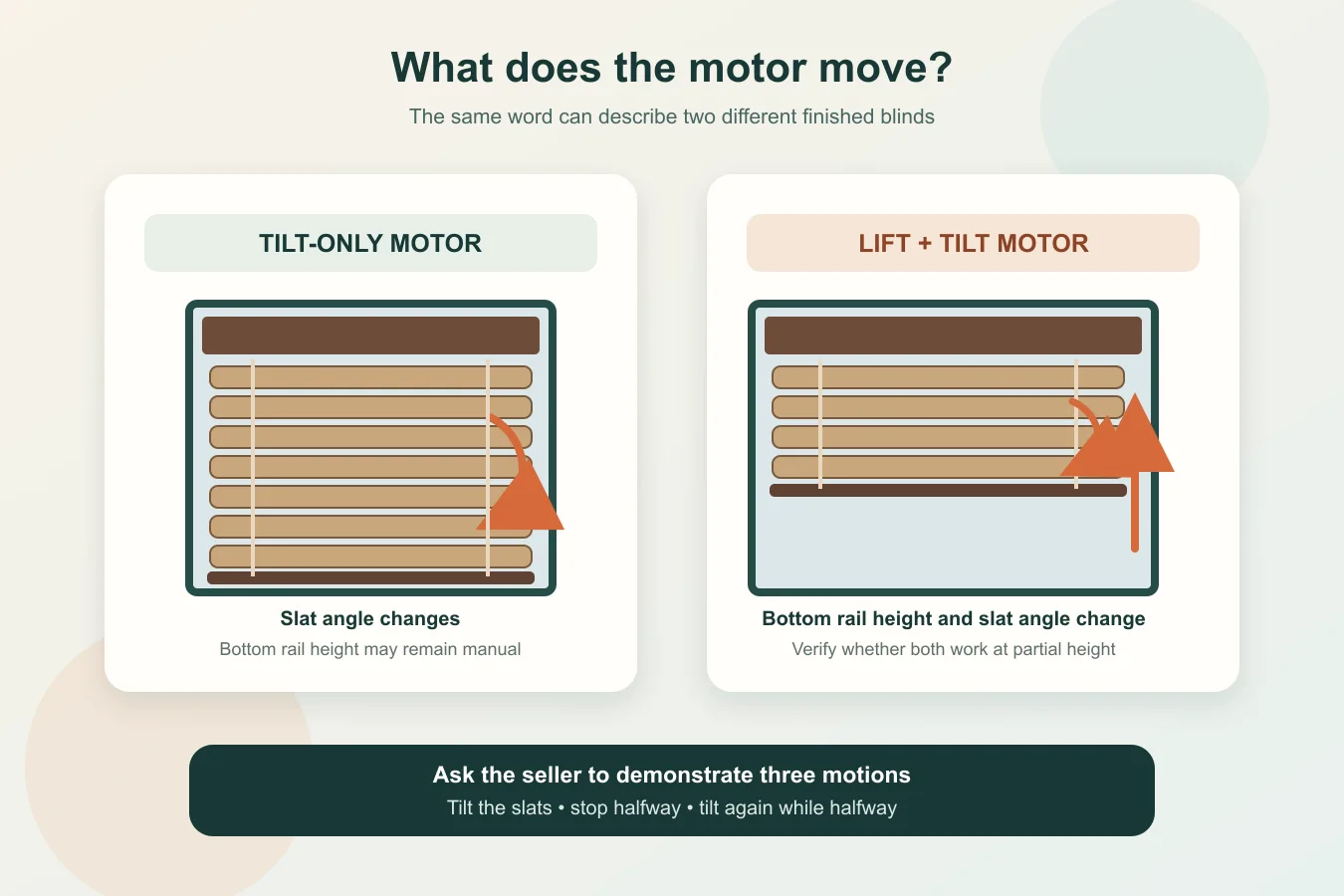
Neither pattern is universally better. They are different finished products under a similar headline. The illustration makes the two motion families visible; it is not a performance test or a picture of either commercial system.
One quote card separates the two orders
Start the record with the manufacturer, collection, operating-system name, document date, slat material and width, finished blind size, mount, and whether the headrail holds one blind or several. Then make the seller complete every motion row for that same configuration.
| Required window state | What the motor does | What remains manual | Proof to attach |
|---|---|---|---|
| Full height, slats closed | Record the exact verb | Record it | Product option or operation manual |
| Full height, slats tilted open | Record the exact verb | Record it | Product option or operation manual |
| Bottom rail stopped halfway | Record the exact verb | Record it | Demonstration or written sequence |
| Slats adjusted at partial height | Record the exact verb | Record it | Explicit statement or demonstration |
| Blind fully raised | Record the exact verb | Record it | Exact configured-size approval |
| Power or hub unavailable | Record the fallback | Record it | Charging and service instructions |
Do not accept “remote controlled” as a motor action. A remote can send an open command to slats, move the entire blind, or do both, depending on the mechanism behind it. An app button labeled open is equally ambiguous until the seller names the physical result.
Manual actions belong on the card as well. If the motor tilts but the bottom rail moves by hand, record the reach height and how the rail is kept level. If both motions are powered, confirm that they can be commanded independently and that the slats still tilt at the partial height you plan to use.
The tilt-only branch
Keep this branch when full-down slat positions deliver the useful daylight, glare and privacy states, while any height change is infrequent and comfortable by hand. Powered tilt can then automate the action the room actually repeats without adding a powered lift that contributes no new state.
Leave the branch when “open in the morning” means uncovering glass rather than changing slat angle. A scheduled scene cannot lift a bottom rail that has no lift motor. The same mismatch appears when the blind is out of reach or when partial height is the only way to combine view with lower-window privacy.
The order description should be plain: powered slat tilt, manual cordless lift, exact local control, and the documented app or hub option if selected. If any sentence says only motorized, ask the seller to rewrite it with the missing motion.
The lift-and-tilt branch
This branch must prove two independent results on the finished blind. The bottom rail reaches every required height, and the slats reach every required angle—including at partial height if that state matters. A product that raises and lowers but locks out tilt while moving or while partly raised is not automatically the same as a system that does both independently.
Powered lift also moves a larger mechanical package than tilt alone: the completed slat stack, bottom rail and lift components travel through the headrail. Ask for the exact configured eligibility and fallback instead of transferring a claim from a lighter shade or another slat size.
The useful premium is not “more automation.” It is the new window state the lift motor makes possible: scheduled clear glass, reachable partial height, synchronized bottom rails or an accessible control path for a window that cannot be handled manually. If none of those states belongs to the room, return to the tilt-only branch.
When the opening breaks the preferred branch
Material and slat labels cannot approve the mechanism. Faux wood and composite can cover different disclosed constructions, and sellers do not always publish finished blind weight. The site’s composite-versus-faux-wood guide keeps that question tied to the named product instead of assuming one standard recipe.
Slat width can change the available headrail, ladder spacing, size limits and motorized options. The 2-inch-versus-2.5-inch comparison shows how to compare two completed builds without borrowing one version’s controls for the other. A wide multi-on-one headrail adds another boundary: ask how many motors are present, which sections each motor moves and whether they move together or independently.
The current LEVOLOR InMotion wood-blind technical guide illustrates the configuration effect. Its named tables give separate motorized dimension and area limits by slat width, describe one tilt motor operating both sections of a motorized 2-on-1 blind, and mark motorization unavailable in the shown 3-on-1 rows. Those are product-guide facts, not universal limits or approval for a live order.
Measure the raw opening, mount depth and obstructions with the Smart Shade Measurement and Compatibility Checker. Keep those numbers separate from the seller’s finished blind dimensions and deductions. Only then match the chosen tilt-only or lift-and-tilt configuration to its current option table.
If the desired branch fails, change one real input: split the opening, use another slat or product construction, accept powered tilt with manual lift, or move to a lighter shade format. A broad maximum-width claim cannot make that choice.
Connection comes last
Smart-home controls sit above the mechanics. LEVOLOR currently describes an InMotion family ranging from a 15-channel remote to an optional app and hub with grouping, scenes and integrations. These control layers can be useful, but they command only the motion built into the exact blind.
Secure a local path before adding cloud features. Record the battery or wired source, charging connector and access, indicators, paired remotes, hub requirement, supported ecosystem and service owner. The blind still needs a documented operating method when the internet is down, the hub is being replaced or someone in the room does not have the app.
Use the smart-blinds compatibility guide after the physical state is settled. Starting with a HomeKit, Alexa, Google or SmartThings logo can produce a beautifully connected blind that never reaches the height you need. If the remaining question is whether manual cordless lift or powered lift earns its place in the room, the cordless-versus-motorized-lift comparison handles those two buildable orders.
Resolve the exact order
Return to the three bottom-rail positions. Choose tilt-only when every required state works with the blind down and manual height changes remain practical. Require lift and tilt when partial height, clear glass, grouped bottom rails or inaccessible operation is essential. Keep a manual cordless blind when automation adds no useful state, and change construction when the required lift cannot be built for the selected slat package.
Safety belongs to the finished product, not the headline. CPSC treats motorized operation as cordless for the operating-cord requirement while separately addressing inner cords and permanent product identification. The site’s cordless and child-safety guide carries that product-and-room question; a motor label alone is not a safety certificate.
Use the Smart Motorized Blinds Planner to return the result to fit, power, compatibility and room goals. The successful quote names every moving part, survives the exact configuration table and reaches the window states you will actually use. If the seller cannot say whether the blind lifts or only tilts, the order is not ready.