A blackout fabric can fill the middle of an arched window and still leave a bright crescent around the curve. If the arch sits above a rectangular window, a horizontal stripe can also appear where the two treatments meet. The room does not experience a fabric label; it experiences the brightest path left in the completed opening.
Start with the scene that bothers you. Stand in the room at that time, photograph the window, and mark the curve, the arch-to-lower joint and the outside edges. Then choose a complete coverage plan. A darker swatch cannot correct a gap that the plan never covers.
Blackout starts with the room, not the swatch
Decide what “dark enough” means before asking for blackout blinds for an arched window. A bedroom used after sunrise, a media room used in the afternoon and a decorative foyer do not need the same result. You may want the upper glass permanently covered, adjustable daylight during the day, or only enough control to remove a distracting beam.
Blackout is useful fabric information, but it is not a promise about the whole window. Graber’s explanation of shade opacity treats blackout as one material category. The installed result still depends on what happens at the curved edge, the bottom of the arch treatment, the meeting line with a lower shade and any exposed perimeter. If the material category itself is still undecided, compare light filtering, room darkening and blackout before solving the arch.
Do not quietly upgrade “room darkening” into “no visible light.” Even a fitted category can have a bounded result: Norman’s current guide says its arched shutters do not block 100 percent of light. Ask for the result the seller is actually willing to document.
If this is one room within a larger project, settle its daylight, privacy and darkness states in the room-by-room shade plan before paying for a specialty shape.
Read the window as an arch, a joint and a lower field
An arched opening needs more than one overall width and height. First identify the curve. A true half-circle, an eyebrow arch, a quarter-round and an elongated arch do not share one template. If the naming is uncertain, use a trace or template method accepted by the exact manufacturer instead of translating the curve into your own label.
Next, find the joint. Some windows are an arch above a separate rectangular unit. Others look divided but are treated as one opening. Decide whether the upper and lower areas will receive one covering or two. With two treatments, the meeting line becomes its own light path: a perfect fabric match does not prove overlap or closure there.
Finally, mark the lower field and the outside boundary. Record handles, trim, depth, mullions and any sash that opens. The public measurement checker is a useful place to keep the mount plane and obstructions, but the shaped template still has to follow the selected product’s instructions. For a broader treatment choice that is not specifically about darkness, use the separate arched-window blinds guide.
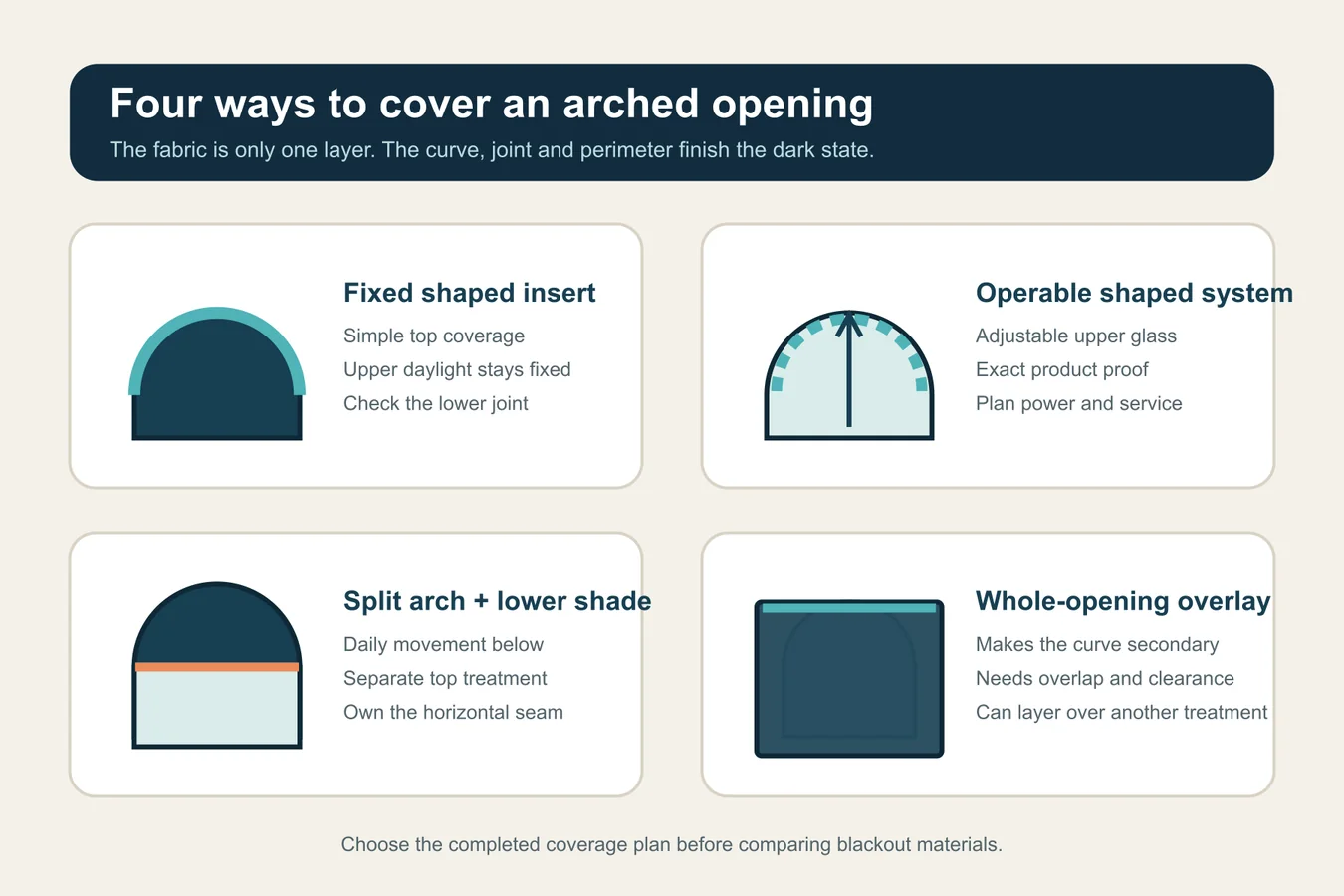
Four coverage plans solve four different problems
Choose the plan before comparing colors, cells or controls. Each plan gives a different part of the window a permanent or moving job.
| Coverage plan | Best fit for the decision | What the quote must prove | Honest compromise |
|---|---|---|---|
| Fixed shaped insert | The arch can remain covered while the lower window handles daily light and privacy. | Accepted shape or template, curve coverage, attachment, bottom edge and the joint with the lower treatment. | Upper daylight is no longer adjustable. |
| Operable shaped system | You need the arch itself to change between open and dark states. | Exact shape eligibility, full motion, fabric orientation, closed-state edges, controls, power if used and reachable service. | More moving parts and fewer products can satisfy the shape. |
| Split arch and lower shade | The upper treatment can be fixed but the lower rectangle must move every day. | Separate finished dimensions plus the real relationship at the horizontal meeting line. | The seam may be the most visible light path. |
| Whole-opening overlay or second layer | The shape is difficult, the room needs a stronger dark state, or a rectangular system is easier to verify. | Top and side overlap, bottom closure, wall or trim clearance, stack, operation and access to the window. | The covering may hide the arch and occupy more wall or trim area. |
The first and third rows often look similar in a product list, but they are not the same decision. A fixed insert answers what happens in the arch. A split plan also has to show how that answer meets the movable treatment below. Likewise, an operable arch is not simply a fixed insert with a motor added; the exact system must support travel in that geometry.
If no row can be drawn against the real opening, the project is not ready for a product choice. A category name such as cellular, shutter or roller does not fill the missing boundary.
A fixed arch trades adjustable daylight for a simpler top
Many cellular treatments made for arches are stationary, as Hunter Douglas notes in its current arched-window treatment guide. That can be a sensible result when the high glass is difficult to reach and the room consistently needs less light. It can also be the wrong result if the arch is an important daylight source.
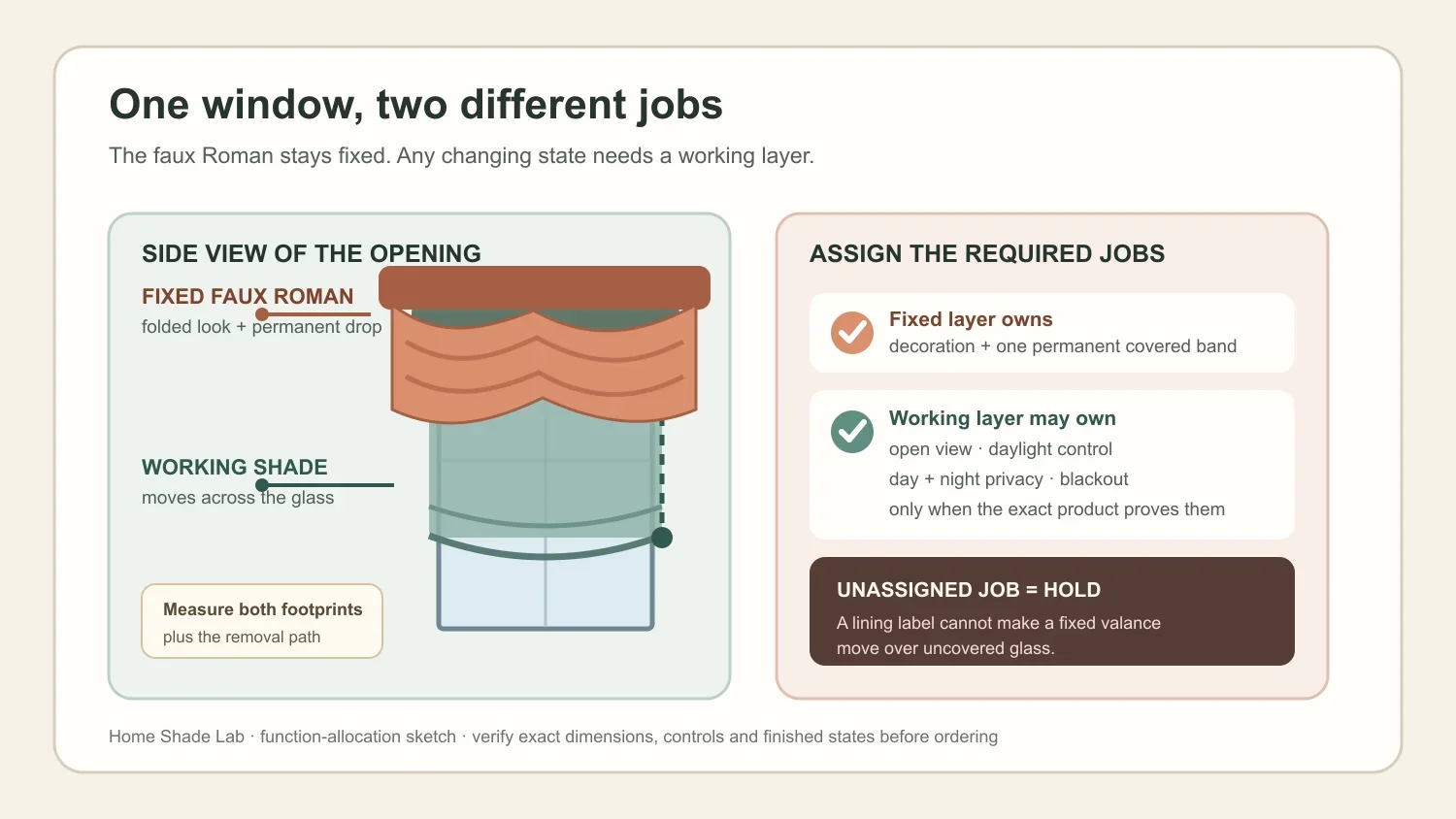
For an arch above a rectangle, a fixed upper insert plus an operable lower shade keeps daily control in the easy section. The critical detail is not whether both fabrics have the same color. It is whether their finished edges meet, overlap or leave a deliberate gap. Ask for a front elevation of the completed pair, not two separate product drawings.
Also decide what happens during service. If the upper insert must be removed to reach a window latch, sensor or fastener, the quote should show who can remove it and whether doing so affects the warranty. “Fixed” should describe daily use, not make the window permanently inaccessible.
A moving arch needs product-specific proof
Operable shaped shades exist, but that fact does not make every arched shade operable. Graywind, for example, publishes one current motorized perfect-arch shade with its own fit, fabric, power and control conditions. Treat that as evidence for that configuration, not permission to transfer the mechanism to an eyebrow arch, a quarter-round or another manufacturer.
The product record should answer four questions in one place:
- Does the manufacturer accept this exact curve and finished size?
- What moves, and where does the fabric or cellular structure collect in the open state?
- What remains visible around the curve and at the bottom when the treatment closes?
- How will power, charging, reset and removal be reached after installation?
If the upper sash opens, run the sash and treatment through their complete paths on the same drawing. If the treatment is motorized, the separate motorized arched-shade guide covers movement and service planning in more detail. The blackout decision here remains narrower: the closed state must own every light path you care about.
A rectangular overlay can make the curve irrelevant
Sometimes the cleanest darkness plan is not shaped like the glass. An outside-mounted shade, drapery panel or other verified layer can cover the rectangular envelope around the arch. This converts a difficult curved boundary into straight top and side boundaries, but it needs enough wall or trim area for overlap and enough space for the open stack.
Draw the overlay at its finished size. Mark where its top sits, how far it extends beyond both sides, what happens at the sill or floor, and whether it clears crown molding, adjacent windows, furniture and the opening sash. If the first layer is kept for daytime appearance, show both layers in the service position rather than assuming they can occupy the same space.
A whole-opening system may also support more deliberate edge control. The separate guide to blackout shades with side tracks explains why straight side channels still need a compatible top, traveling fabric and bottom closure. Side tracks are not automatically the answer for an arch; they are one reason a rectangular overlay may be easier to specify than a track following a curve.
Do not hide the tradeoff. The overlay may cover trim or reduce the architectural view of the arch. If that visual cost is unacceptable, return to a shaped plan and accept only the darkness that the seller can demonstrate.
Judge the window under the light that caused the problem
Review the completed window in the same condition that started the purchase: morning sun in a bedroom, afternoon sun in a media room, or exterior lighting at night. Close the treatment, let your eyes adjust, and compare the real bright areas with the marked photo from the beginning.
Read the result by location. Light through the material points to the fabric or fabrication. A crescent around the top points to shape, template, mount or coverage. A horizontal stripe points to the relationship between upper and lower treatments. Side or bottom light points to perimeter design, alignment or the selected overlay. This is a diagnosis, not a promise that every system can be made light-free.
Before accepting the order, ask the quote to name the exact fabric, the complete coverage plan, the moving section, the shaped-template owner, the expected gaps and the person responsible for adjustment or service. Approve it when those details match the room’s required state. Revise the topology when a gap is knowingly left open. Hold the order when “blackout” describes only the swatch.