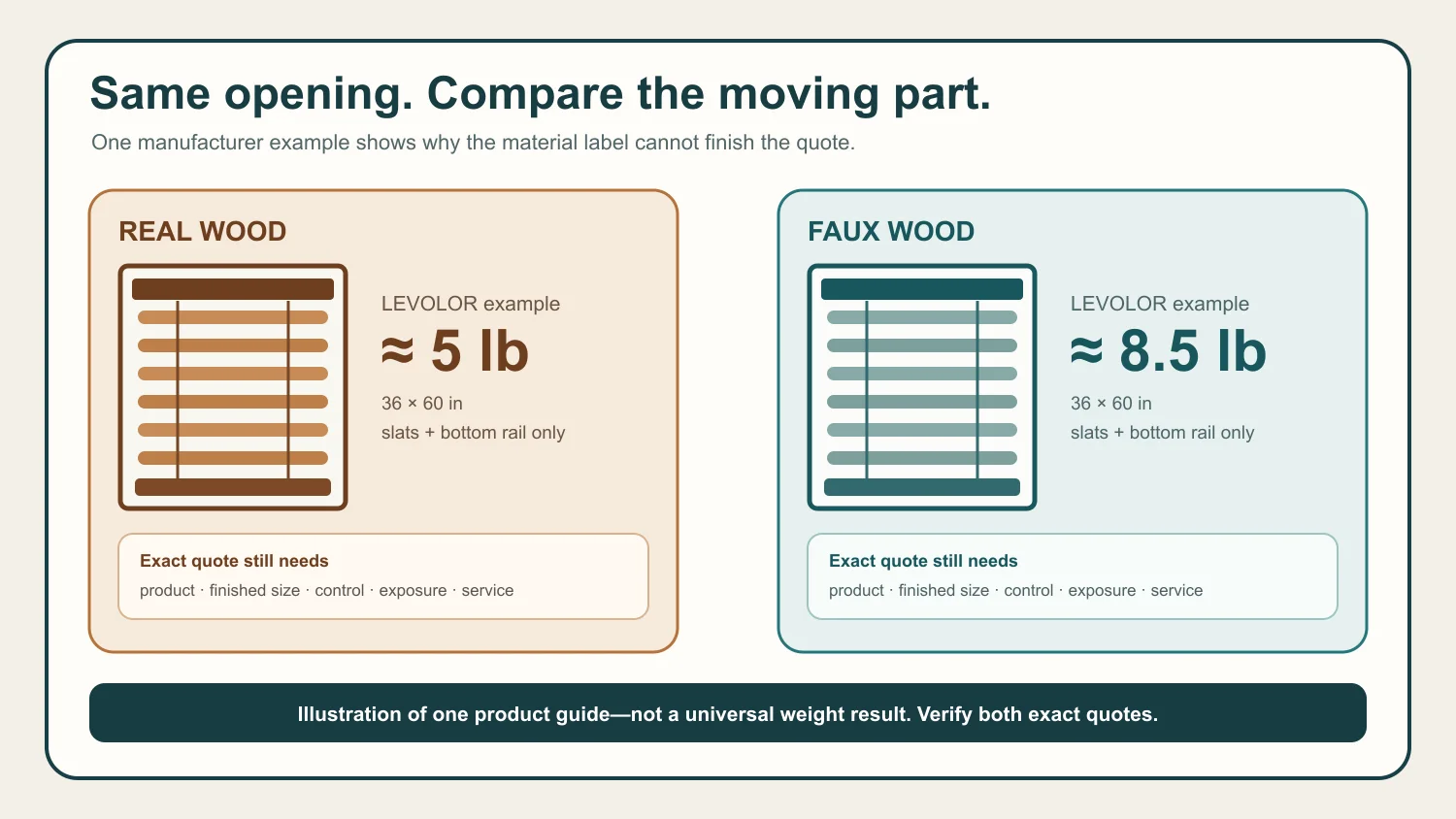
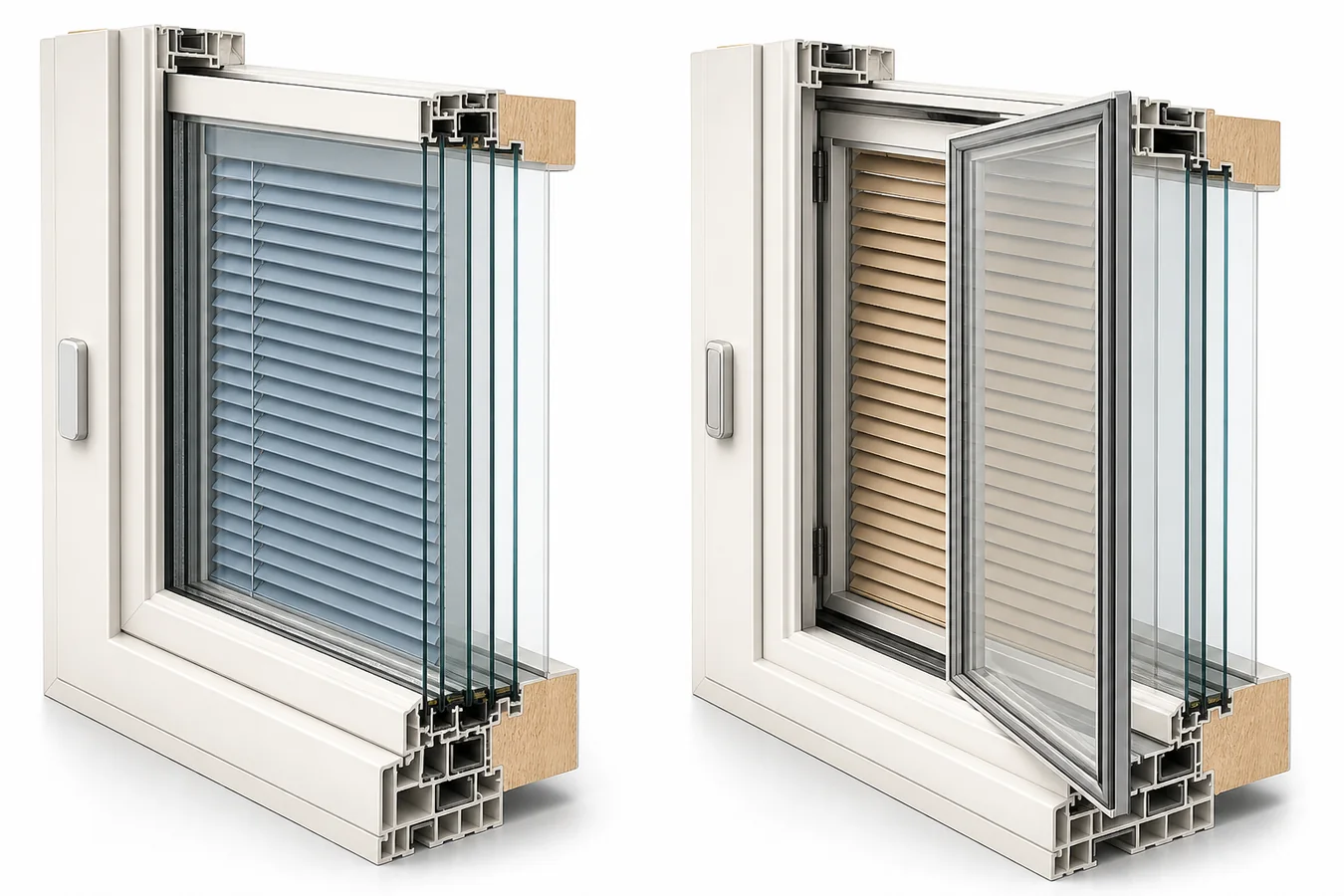
The faux-wood sample may look heavier and more finished than the vinyl sample. That does not mean the material caused every difference. The two quotes may also change slat width, headrail depth, lift, tilt, maximum size and the unit a warranty will replace.
Start with two exact products on the same measured opening. Faux wood is the better choice only if that completed blind passes the fit, required window states, room exposure and service checks more convincingly. Vinyl wins only by the same test. If either seller cannot complete its row, the honest result is HOLD—not a category winner.
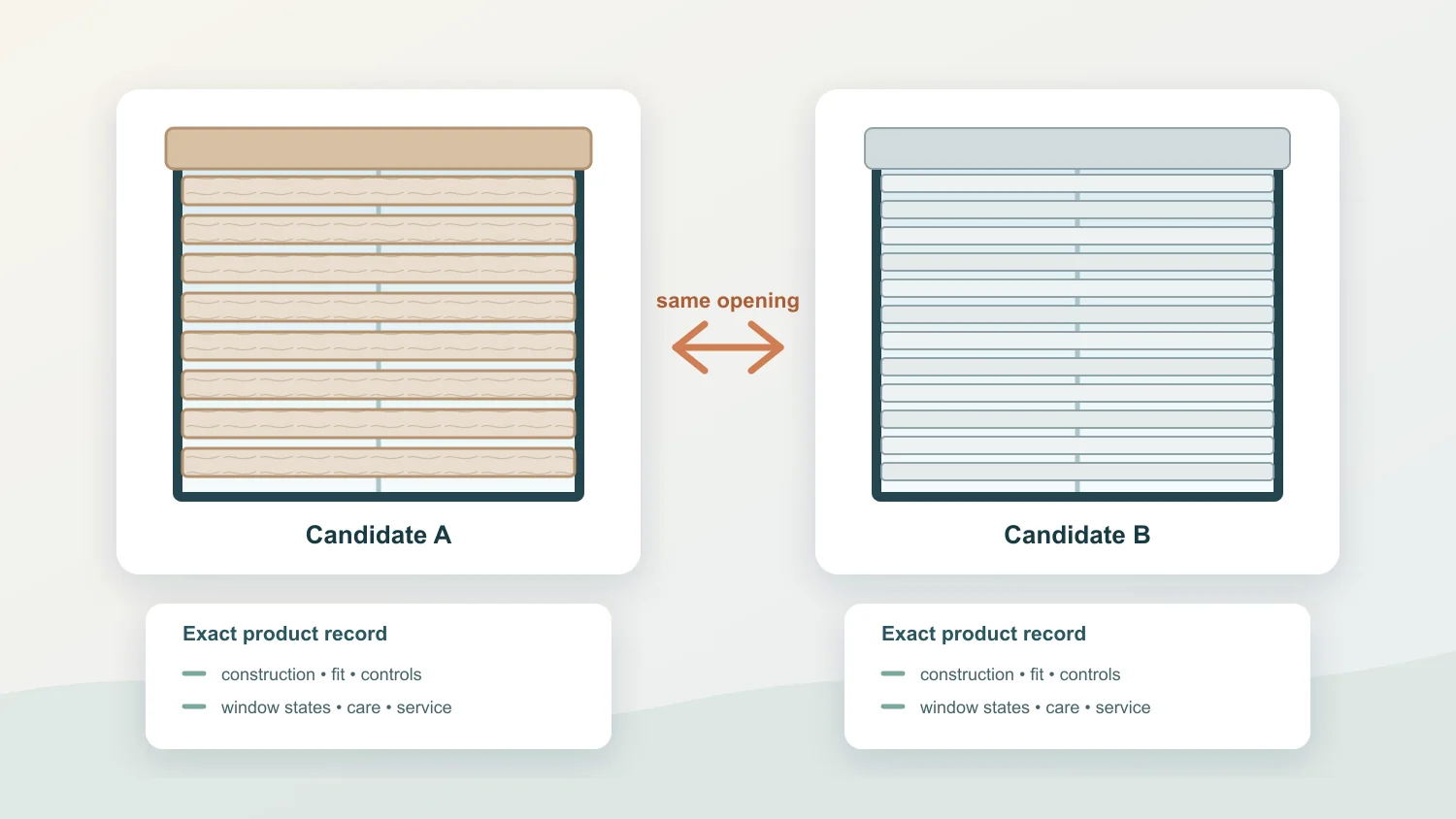
The openings in the diagram are identical. The paired cards show that construction, headrail, controls and service have to be compared separately. The illustration does not prove that either material will fit or perform better.
The labels overlap before the comparison begins
“Vinyl” sounds like a material. “Faux wood” sounds like an appearance. In current product catalogs, faux wood may also be a PVC/vinyl construction or a separate polymer-composite line. Graber, for example, currently describes faux-wood slats as PVC while listing composite blinds as a different polymer-composite product. That is one manufacturer’s present taxonomy, not a definition that every seller must follow.
Ask each seller for the maker, collection, product code, slat-material wording and document date. A swatch marked “white faux wood” or “vinyl” is not a complete identity. If the seller cannot disclose more, write “construction not disclosed” instead of filling the gap with a market-wide assumption.
This narrow comparison begins after the two named candidates are real horizontal blinds. If one seller is using composite and faux wood as overlapping labels, resolve that terminology in the composite-versus-faux-wood guide. If the broader choice is still slatted blinds versus a fabric shade, settle that format in the smart-blinds-versus-motorized-shades comparison first.
Make both sellers return the same record
Use one row for each candidate and one column for the evidence that closes the field. Copy facts from a current technical guide, written quote, order screen or manufacturer response—not from a generic category article.
| Field | Faux-wood candidate | Vinyl candidate | The field is closed when… |
|---|---|---|---|
| Product identity | Maker, collection, code, revision/date | The same fields | Each blind resolves to one current product record |
| Slat construction | Disclosed material, width, thickness if stated, finish, route pattern | The same fields | Labels and missing disclosures remain visible |
| Same opening | Raw width/height/depth, mount plane, obstructions | The identical opening | Raw measurements stay separate from order deductions |
| Finished hardware | Headrail, bracket, valance, bottom rail, minimum and flush depth | The same fields | A side section or installation record shows the full envelope |
| Build limits | Accepted size, one-on-one or multi-on-one, split and deduction | The same fields | The exact chosen configuration is eligible |
| Operation | Lift, tilt, control side, reach, no-lift case, motor if any | The same fields | Every required motion is included in the quote |
| Window result | Lowered/tilted, closed, raised; edge and route-hole light | The same states | Exact sample, drawing or product evidence covers the required states |
| Room boundary | Cleaning, humidity, splash, heat and sun instructions | The same fields | Current care and warranty sources cover the actual exposure |
| Service unit | Covered components, remedy, discontinued finish, installation owner | The same fields | Warranty and seller answer name what happens after failure |
Do not score blank fields as neutral. A candidate with an unknown construction, unsupported size, missing control or incompatible care rule is not “almost as good.” It is not ready to order. Appearance and price can break a tie only after both candidates pass the non-negotiable fields.
Open the Smart Shade Measurement and Compatibility Checker with the field dimensions, mount plane and obstructions before either quote supplies an order size. This keeps a factory deduction from one candidate out of the other candidate’s raw measurements.
Fit can decide before material does
Current manufacturer pages make the configuration problem visible. Bali’s current full faux-wood family describes sizes up to 96 inches, while its separate value faux-wood line states a smaller 78-by-78-inch limit. The useful lesson is not that one number governs faux wood. It is that even one manufacturer can place different limits under the same broad label.
LEVOLOR’s current wood and faux-wood technical guide goes further: it separates single-blind, two-on-one and three-on-one configurations and changes eligibility by slat width and control. Those tables apply only to that named guide and version. They show why a category maximum copied into another quote is not evidence.
For both candidates, request the accepted finished width and height, whether the blind is a single unit or multiple blinds on one headrail, and the minimum depth for secure mounting versus the depth needed to sit fully recessed. Add the valance and most projecting control to the side view. A blind that technically attaches but blocks a handle, collides with trim or leaves an unacceptable projection has failed the opening even if its slats are attractive.
Slat width can change the comparison again. Wider slats may change the number of slats, headrail, raised package, view and required depth. If the faux-wood quote uses two-inch slats and the vinyl quote uses another size, keep that mismatch visible and use the 2-inch-versus-2.5-inch blind comparison where applicable. Do not assign the resulting difference to material alone.
Run the room backward from what could fail
Room labels are a weak shortcut. “Bathroom,” “rental” and “living room” hide the actual exposure and operating load. Start with the likely failure, then ask whether the named product’s instructions and warranty cover it.
For humidity or splash, trace the exposure across the whole blind: slats, route holes, ladders or tapes, rails, controls, brackets and fasteners. Graber and Bali currently market named faux-wood products as moisture resistant, but that wording does not establish submersion, persistent condensation, cleaner compatibility or coverage for every component. The waterproof-blind guide separates those exposures before a seller’s adjective becomes a decision.
For dust, grease, fingerprints or pet contact, write the real soil and normal cleaning reach. A broad “easy to clean” claim is incomplete until the current care owner permits the method you will use on the exact finish. The site’s easy-to-clean blind guide is the better branch when the mess, not the appearance, is likely to decide.
For sun and heat, record orientation, direct-sun duration, nearby glass conditions and the exact color/finish. Ask for product-specific placement limits and warranty exclusions. Do not turn PVC, vinyl, composite, a light color or a wood-grain coating into a universal fading, warping or energy-performance claim.
For frequent handling, identify who operates the blind, how high the bottom rail sits and what contact the lower slats receive. Do not invent a bend test or lifespan forecast from a loose sample. Ask whether the selected finished size remains operable, which component can be replaced and whether the named slat/finish is a supported service item.
Judge the installed states, not the loose slats
A loose slat can show color, texture and some flexibility. It cannot show headrail depth, route-hole light, perimeter gaps, the raised package or how the selected control behaves at the installed height.
Name the state that earns the covering’s place. If the daily job is redirected daylight, compare both completed blinds lowered and tilted from the same observer position. If nighttime privacy matters, request the closed state with the room brighter than outdoors and keep slat overlap, route holes and edge gaps in view. If clear glass matters, record the raised package and the effort or control needed to reach it.
Neither “faux wood” nor “vinyl” proves blackout, privacy or view. Those results come from the complete geometry: slat width and shape, ladder and route pattern, tilt closure, finished width, headrail and perimeter. A prettier sample can still lose if the accepted configuration misses the required state.
Control belongs to this same record. The finished blind should state whether it lifts, tilts, does both or remains no-lift. If the faux-wood option is motorized, verify whether the motor powers tilt only or also lifts the blind in the motorized faux-wood guide; connectivity cannot create a motion the mechanism does not provide.
For homes where young children live or visit, CPSC consumer guidance says to choose cordless window coverings. Apply that safety requirement to the finished product, not the slat material. An unresolved accessible operating cord blocks the order even when every appearance and fit field passes.
Let service break a close tie
If both candidates fit and deliver the required states, compare what the manufacturer and seller will support. Read the current warranty at component level: slats, ladders, headrail, tilt mechanism, lift mechanism, finish and accessories may not share one term or remedy. Bali’s current warranty is a useful example because it distinguishes coverage for particular components rather than promising one universal material lifespan.
Ask who owns remeasurement, removal, shipping and reinstallation; whether one damaged slat is a serviceable unit; what happens when the finish is discontinued; and whether a replacement must reuse the existing brackets or requires a complete blind. Save the quote revision, product code, finish code, receipt and a photo of the installed label.
Now the final choice is allowed to be ordinary. If both complete records pass, choose the appearance, verified option set, quoted price and service burden you prefer. If one fails a required field, eliminate that exact configuration—not the material category. If a field is still missing, return the card to the seller and hold the order.