Two product pages can both promise an easy installation while describing very different jobs. One picture may stop after two end brackets even though the configured blind also has center supports and a valance. Another product may clip onto two small brackets but require a mounting depth or surface your window does not provide.
The easiest blind to install is the exact eligible product whose difficult operations are already solved for your opening. Get the current instructions for both candidates, count the work after “attach the brackets,” and do not order either one while its mounting surface, support count, lifting plan or setup remains unknown.
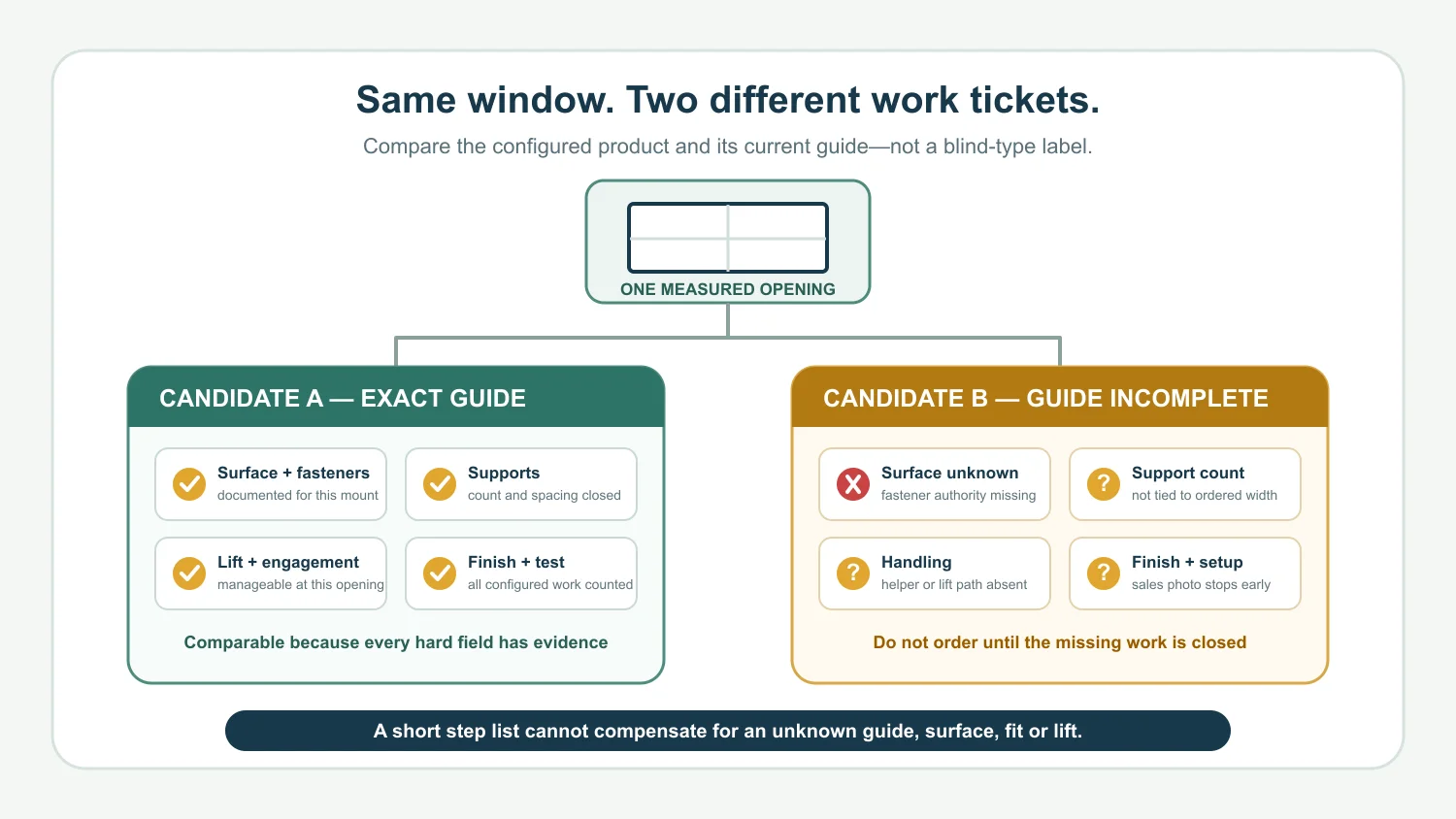
Both work tickets in the illustration use the same measured opening. Their blocks represent documented operations, not scores or universal difficulty rankings.
Start with the guide, not the blind type
“Roller,” “cellular,” “faux wood” and “no-drill” are useful shopping labels. None is an installation plan. The maker, collection, control, finished size, mount and hardware revision decide which instructions actually arrive in the box.
Blinds.com’s current installation hub tells readers to keep the manufacturer’s instructions because details vary by style. Its separate roller guide also notes that cassette configurations can use different brackets. Those are useful warnings against deciding from a generic product photo.
Save the PDF, video transcript or written guide for the exact configured product before checkout. Put the maker, collection, control, inside/outside mount, finished width and height, document title and revision date at the top. If the seller cannot identify the right guide, the comparison has already found an unresolved job.
If the mount itself is not settled, decide that first in the inside-versus-outside mount guide. If the attraction is “no holes,” use the no-drill fit checklist; a no-drill mechanism still needs an eligible frame, size and operating path.
Turn each installation into a work ticket
Read both guides once without trying to rank them. On the second pass, convert every required action and prerequisite into the same fields.
| Work field | Copy from each exact guide or order | What makes the field unresolved | What the result changes |
|---|---|---|---|
| Product and guide | Maker, collection, control, mount, size, guide title/revision | Only a generic family tutorial is available | Do not compare or order yet |
| Mounting premise | Surface, permitted location, depth/clearance and who approves the fastener | Surface or concealed condition is unknown | Change mount, obtain qualified help or change product |
| Supports and holes | End brackets, center supports, clips, hold-downs, holes and stated spacing | Parts/count do not match the ordered width or control | Ask for the configured parts list |
| Tools and fasteners | Required bits, drivers, level, ladder, anchors or maker-specified hardware | The guide excludes the real surface or leaves fastener selection open | Route the structural question before purchase |
| Lift and engagement | Finished assembly, safe working height, helper rule and headrail/roller engagement | The user cannot support and engage it as shown | Choose help, another configuration or another product |
| Finish work | Valance, cassette, returns, vane hanging, tensioner, handle or hold-down | Sales photos omit an included operation | Add the work or remove the option |
| Power and controls | Battery/charger access, transformer, wiring, remote/app pairing and limits when applicable | The configured control has no complete setup path | Resolve the system or choose a simpler control |
| Test and future release | Engagement check, operating test and documented removal path | “It clicked” is the only verification | Get the exact check before treating the job as complete |
Blank cells are not easy steps. They are work that has not been described yet. Do not average them away with a five-minute marketing claim or a low bracket count.
Open the Smart Shade Measurement and Compatibility Checker with one original field record, then attach that unchanged opening, mount plane, depth and obstruction set to both tickets. The factory may make different order deductions; do not let one seller’s finished width become the other seller’s field measurement.
The mounting surface gets a veto
A short manual may begin with “mark and drill.” That sentence hides the only part of the job that transfers the blind’s load to the building.
Name the surface where every fastener is supposed to land: sound wood trim, a documented top surface, drywall with known support, masonry or something else. Then ask whether the exact instructions cover that surface and who is qualified to select the fastener. Do not turn a convenient old hole into permission to reuse it.
Blinds.com’s general guide mentions studs and drywall anchors, but that is not a structural assessment of your wall. If the surface is damaged, hollow in an unexpected place, conceals utilities, or falls outside the exact guide, the product is not yet “easy for this opening.” The next step is a qualified installer or another documented mounting plan, not a larger screw chosen from a generic article.
Renters have an extra authority field. Lease permission and damage expectations are separate from physical fit. A tension or adhesive mechanism is not automatically damage-free, and a drill-mounted product does not become renter-safe because its guide is short.
Count what has to be held, aligned and attached
The number of product types is irrelevant here; count the loaded operations for the configured size.
Current faux-wood instructions from Blinds.com show end brackets, possible additional support brackets, headrail engagement and valance clips. Its roller instructions use a different end engagement and can add a separate valance or cassette operation. A current LEVOLOR cordless-cellular manual ties bracket count to the ordered width, specifies two screws per bracket, lists optional pieces and shows a defined headrail engagement. These examples apply only to those guides. Together they show why “two brackets” is not a safe category assumption.
Draw the support points across the finished width. Mark any keep-clear zone for a control or internal mechanism. Then write who will hold the assembly while it engages. A long but light shade and a compact but heavy slatted blind can present different handling problems; the exact guide or seller must close that question. If no finished weight or helper guidance is supplied, judge the physical handling conservatively rather than inventing a number.
Working height matters just as much as product width. The installer must be able to see the engagement point, keep the assembly level and use both hands as the instructions require from a stable position. A product that is manageable at eye level may be an installer job above stairs or behind a deep counter.
Alignment is not decoration. Roller instructions call for the brackets to be straight so the tube engages and runs as intended; headrail systems require every clip or box to seat. Add a full-width alignment check and a supported first test to the ticket. Do not count a click at one bracket as proof that the remaining supports are engaged.
New products should arrive with their documented hardware. If the plan depends on adapting old brackets or buying a look-alike replacement, that is a separate identity problem handled by the blinds-mounting-brackets guide—not a shortcut for this comparison.
“Mounted” is not the finish line
The visible shade can be hanging while the installation still has unfinished work.
A faux-wood configuration may add valance clips, a valance and returns. A roller configuration may change when a cassette or separate valance is selected. A vertical treatment may leave individual vanes, weights or a safety device to fit. Count only the pieces shown for the exact product, but count all of them.
Controls can extend the job in another direction. A manual shade may need a handle, wand, tension device or stop check. A motorized one may require accessible charging, a transformer or wire path, remote or app pairing, travel-limit confirmation and a way to service the motor later. “Wireless” describes communication, not necessarily power or commissioning.
Finish with the maker’s operating test. Raise, lower, tilt or traverse only the motions the product provides, and inspect every support while the assembly is still safely controlled. If it binds or sits unevenly, the exact troubleshooting path belongs in the job; forcing the product is not a quick final step.
Also look one service visit ahead. Can the headrail or roller be released without removing trim, cutting a wire or guessing at a concealed clip? The blind-removal guide is useful when a product is already installed. Before purchase, the simpler move is to verify that the new product’s own instructions show how it can be released for service.
Choose the candidate whose hard parts are already solved
Imagine three shopping carts. These are decision examples, not type rankings.
The first contains a small open roller shade. Its exact guide matches the chosen mount, the two end brackets land on a known suitable surface, the roller can be held at working height, and there is no cassette or powered control. Its ticket may be short because every operation is closed—not merely because it is a roller.
The second contains an inside-mount cellular shade. The opening has the required depth, the current guide identifies all brackets and fasteners, and the buyer can support the rail while engaging each clip. It may have more holes than the roller yet still be the more manageable product for a different window.
The third contains a wide faux-wood blind for a high opening. The order includes center supports and a valance, but the seller has not supplied the finished handling guidance and the buyer cannot keep the headrail level from a safe position. Calling faux wood “moderate” or counting seven printed steps does not solve that job. The cart needs a documented helper/installer plan, a different configuration or a different product.
Now compare your real tickets. First eliminate any candidate with an unknown guide, unsupported mount, unresolved fastener authority, failed fit or unmanageable lift. Among the survivors, prefer the work you can perform and verify: fewer loaded operations, clearer engagement, less overhead handling, less finish/setup and an accessible service path.
If both survive, either can be a reasonable purchase; choose on the window result, price and features you actually want. If only one survives, that exact product is easier for this opening. If neither survives, keep the window measurement and change the products—not the definition of easy.