Choosing fabric for Roman shades is not a fiber contest. The material you order will be cut, possibly seamed, paired with a liner, formed into a named fold and attached to a lift system. A loose swatch can show color and texture in one light. It cannot approve the finished shade.
The useful short answer is to audition one exact combination: face fabric, color, liner, fold style, rear construction and control. View that same construction flat from the room, with light passing through it, folded into a representative stack and from the back. If the supplier changes any of those ingredients, the sample result no longer closes the order.
The sample must already know what it will become
Start by naming the fabricator or exact product line. Then attach the face fabric and color code, liner, fold style and control to that identity. “Linen Roman shade with privacy lining” is still too broad if the quote does not say whose linen, which lining and how the shade will fold.
Current seller guidance illustrates why those fields belong together. Blinds.com’s Roman fabric guide discusses material weight and thickness alongside fold behavior, while The Shade Store’s current fabric guide maps different fabric bodies to named Roman styles and treats lining as another configuration choice. These are seller-scoped guides, not universal weight rules. They show why the workroom that will make the shade must approve the exact pairing.
A product-family name is not enough either. Hunter Douglas currently offers its Vignette Roman system in rolling and stacking styles with named fold options. That is evidence about Vignette, not every Roman shade. Ask your supplier to return the equivalent construction facts for the product actually quoted.
If the shade family itself is still unsettled, pause the fabric choice. The roller, cellular and Roman shade comparison helps decide whether visible textile folds are worth the extra fabrication decisions. This page begins once Roman is a real contender.
Put four views on the same sample card
A persuasive room photograph usually shows one flattering state. Your order has to survive several. Ask for a finished sample, mock-up or documented example that is close enough in construction to reveal the effects you are deciding. Label it so the face fabric, liner and fold cannot be separated from the evidence later.
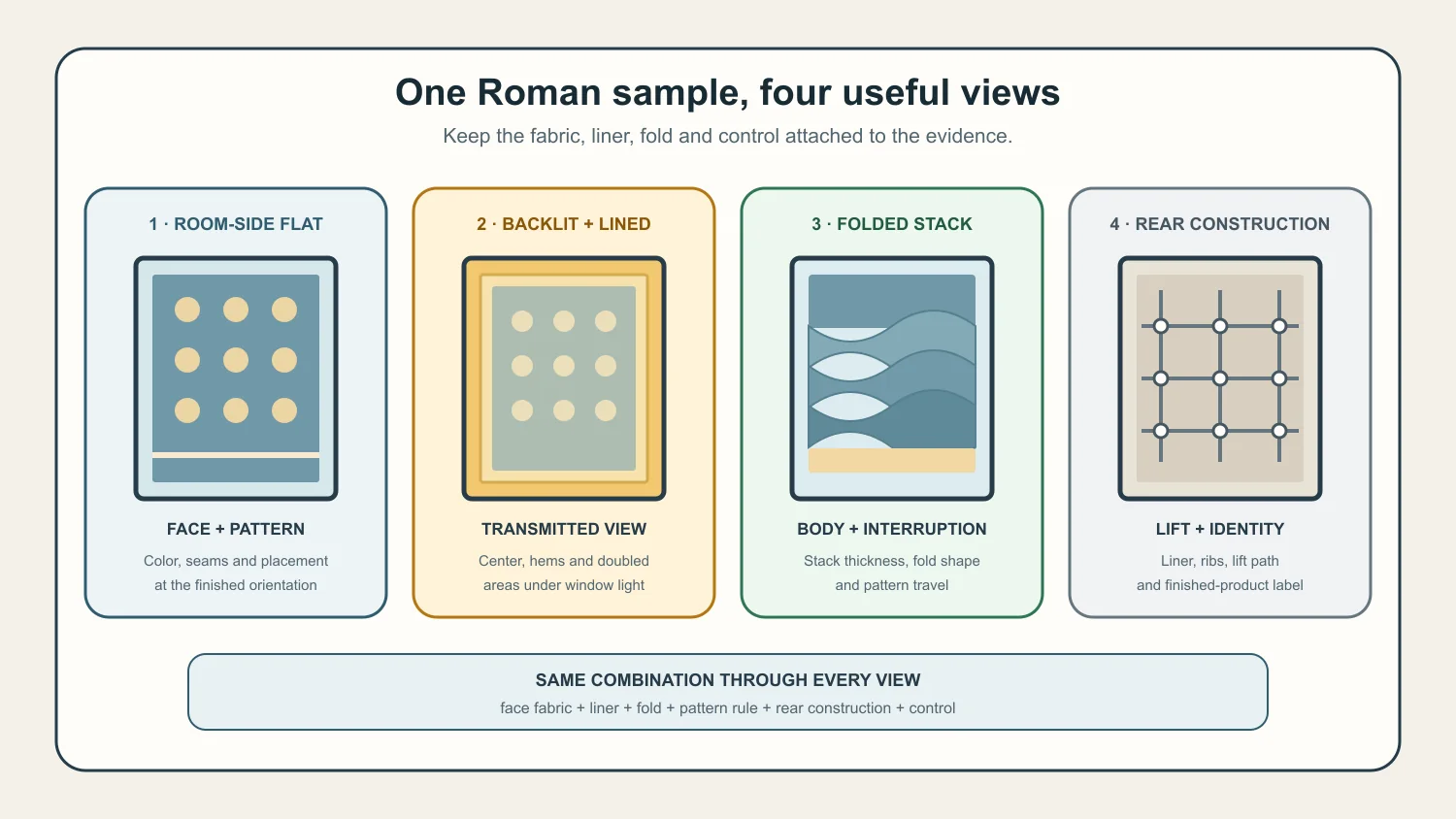
| View | Keep constant | Question it answers | Revise or hold when |
|---|---|---|---|
| Room-side, fully lowered | Exact face fabric, color, liner and fold | Color, texture, seam and pattern placement in the room | The evidence shows another color, unlined fabric or a different fold |
| Transmitted daylight | Same sample and orientation | How weave, liner, seams and doubled areas read with the window bright | Only an opaque tabletop photograph is available |
| Representative folded stack | Same construction, shown in the quoted fold | Pattern interruption, thickness, glass coverage and whether the fold looks intentional | The swatch has never been folded or the sample is materially smaller than the order |
| Rear of the shade | Same liner, ribs, battens, lift lines and control family | What the window sees, what can show through and what the lift actually moves | Rear hardware or the permanent product identity is hidden |
These are not laboratory scores. They are comparable observations for one proposed build. Record the lighting direction, sample size and which details were supplied rather than converting the result into a claim that the fabric is always private, crisp or easy to operate.
Let the pattern travel through a fold
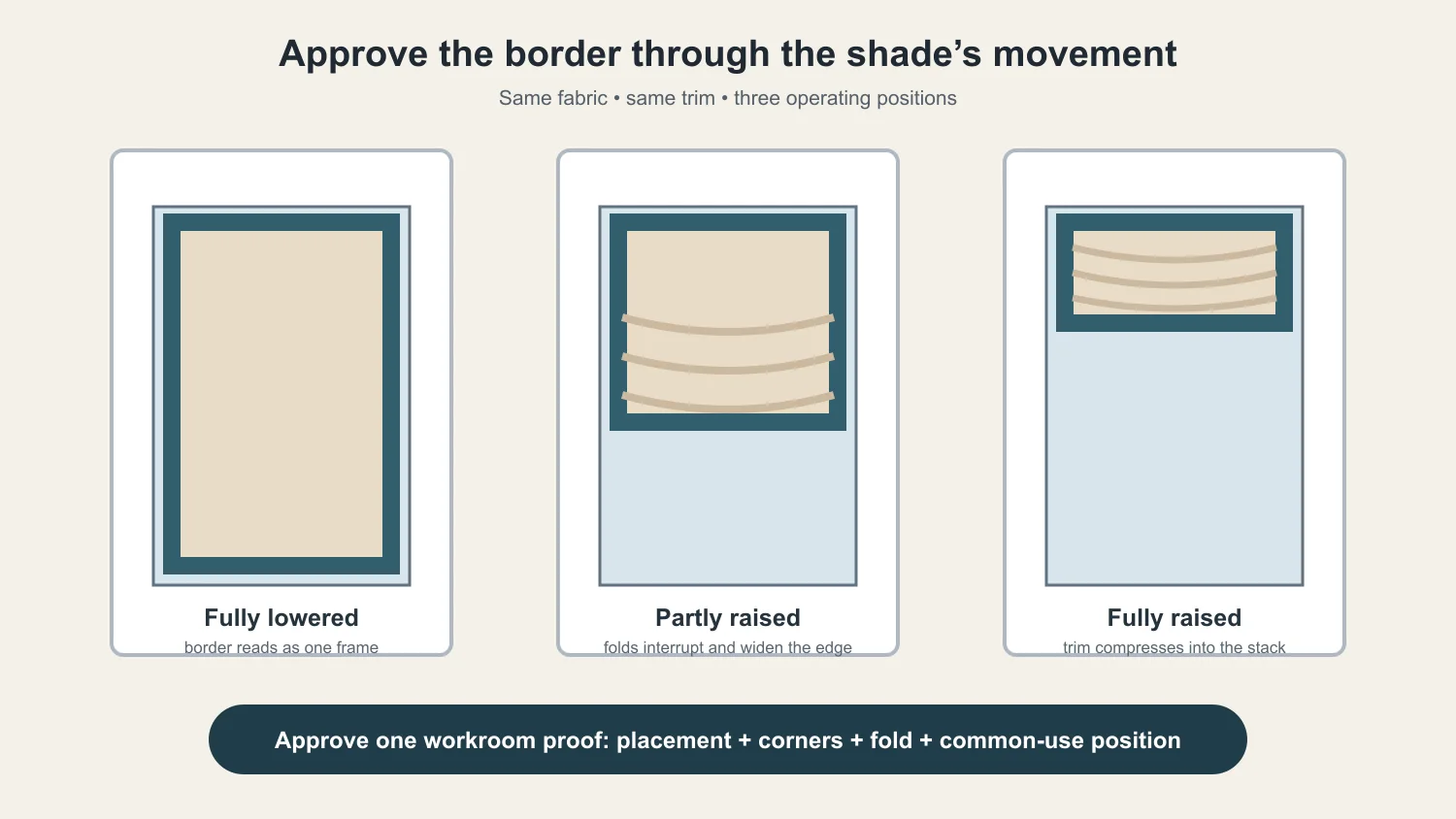
A patterned fabric has more than a colorway. Ask for the horizontal and vertical repeat, the intended fabric direction and the cut position on the finished shade. A motif centered on a flat rectangle can disappear into the first fold, split at a seam or land differently on two adjacent windows.
For one window, request a front elevation at the finished width and drop. Mark the visual center, top attachment, fold lines and lowest visible repeat. Then ask for a second view at the height the shade will commonly occupy. The goal is not perfect pattern visibility in every moving position; it is an accepted change rather than a surprise after cutting.
For several windows, decide what “matched” means. It might mean the motif starts at the same height, each shade is individually centered, or the set merely uses the same fabric lot. Those are different instructions. A fabricator may need extra material to place repeats, and independently moving soft panels will not become one continuous mural. Put the chosen alignment rule on the quote.
Natural-looking variation needs the same discipline. The linen Roman shade guide keeps fiber identity, slubs, color variation and care tied to the exact textile. If the desired bottom is deliberately soft, the relaxed Roman shade guide handles curve consistency across the window set. Neither question can be settled by renaming the pattern.
A liner edits more than opacity
A liner sits behind the face fabric, but its effect is not confined to the back. In the cited Shade Store range, unlined, privacy, blackout and interlining choices are separate materials that change body and light control. Another fabricator may use different names or constructions, so request the actual liner identity rather than carrying a label across sellers.
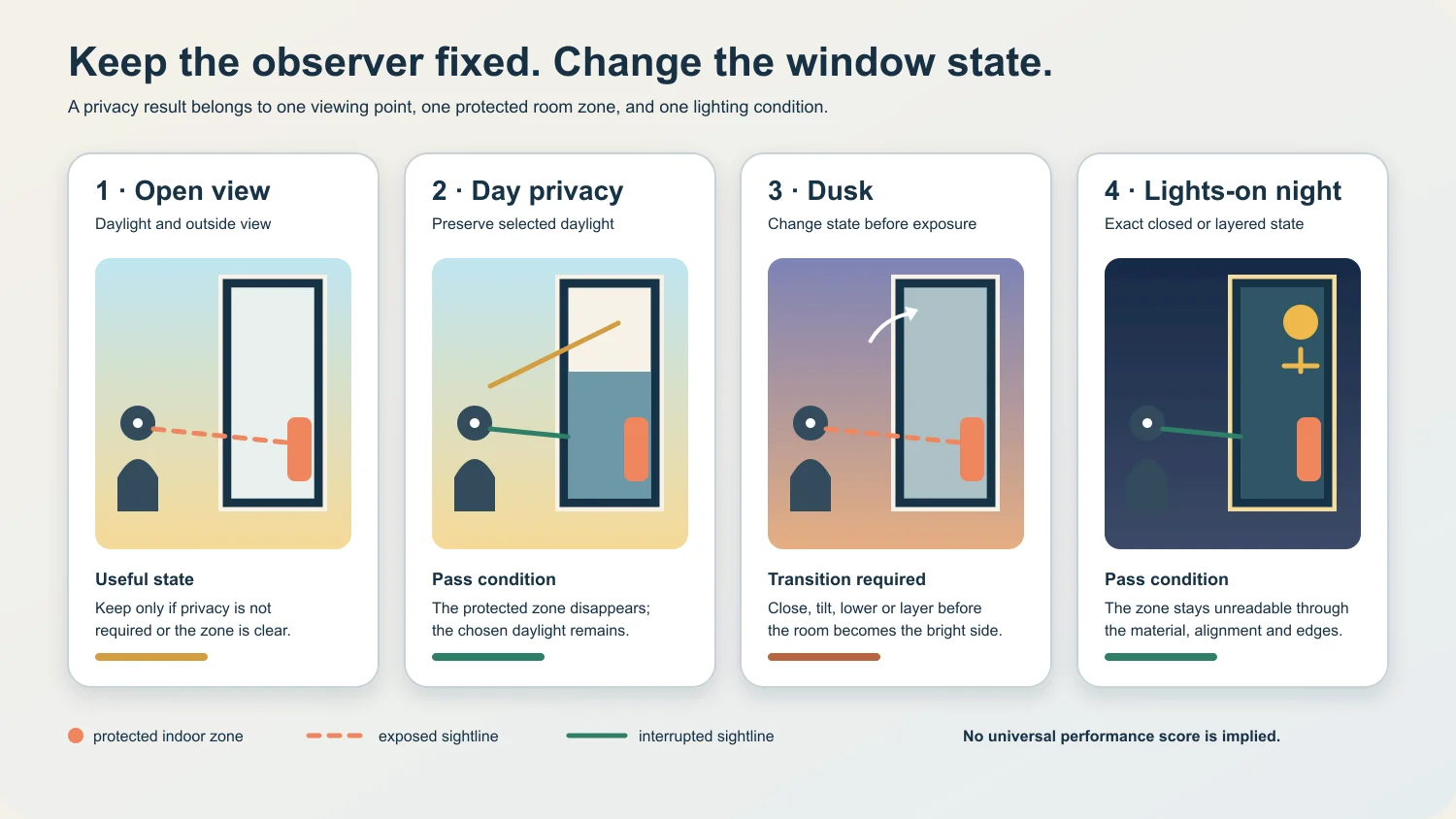
Audition the face and liner together. Compare them first with outdoors brighter than the room, then after dark with the room lights on. Look at the center field, hems, seams and any doubled construction separately. A liner that improves the center may also make the front color look cooler, reduce a woven texture’s glow or make the folded stack fuller. Those are observations to accept or revise, not reasons to assume the heaviest option wins.
If the room task is still expressed only as “light filtering,” “room darkening” or “blackout,” use the light-filtering versus room-darkening comparison to define the needed state. A sheer Roman needs its own daylight and lights-on night privacy views. A demanding darkness project belongs with the blackout Roman construction audit, where liner, stitch points and perimeter gaps remain separate. P135 does not turn a lined sample into a whole-room blackout promise.
Turn the sample around before choosing the control
The back of a Roman shade is working structure. Depending on the exact design, it can contain rings, shrouds, lift lines, ribs, battens, pockets or another mechanism. Those parts affect what may show through a light fabric and what gathers when the shade rises. Ask for a rear drawing or photograph of the same configuration—not a generic diagram from another fold.
Control safety also belongs to the completed product. The current US CPSC window-covering FAQ addresses operating cords, inner cords and permanent manufacturer labels as separate requirements. A cordless or motorized front control does not authorize guessing what is behind the fabric. Confirm the finished product identity and the exact rear construction with the manufacturer or fabricator.
Then attach the control to the sample record. For a manual shade, identify where a hand or handle contacts the finished panel and whether the normal reach suits the window. For a powered build, the motorized Roman shade guide keeps finished load, fold, stack, motor, power and service together. Motor approval must come from the exact fabricated system; fabric weight alone is not a motor calculation.
The rear view is also where care can become practical or impossible. Record the supplier’s permitted cleaning method, whether the liner can be treated separately and who can remove or service the shade. The cleaning-burden guide helps compare exact permitted care without promising that a fiber name is low maintenance.
Return one combination, not a favorite swatch
Before the sample can become an order, connect it to the real opening. Record width, height, mount plane, depth and obstructions in the Smart Shade Measurement and Compatibility Checker. The fabricator still owns the finished headrail, fabric width, drop, deductions, raised stack and product limits. If an outside mount is proposed to change coverage or stack position, use the outside-mount Roman geometry guide before approving the new proportions.
| Field | Acceptable evidence | Disposition if missing |
|---|---|---|
| Face fabric | Supplier, collection, code, color and current sample identity | Hold the material choice |
| Liner | Exact unlined, privacy, room-darkening, blackout or interlining construction used in the sample | Request a new combined sample |
| Fold and pattern | Named fold, repeat/direction and approved lowered plus common-use views | Change fold, reposition pattern or request a drawing |
| Rear construction | Ribs, battens, rings, shrouds or lift path shown for this build | Hold the completed product |
| Finished system | Width, drop, headrail, stack, control, care, warranty and service owner | Return the quote for configuration approval |
Write the approval as one line: exact face fabric and color + exact liner + named fold + pattern rule + finished size + control + accepted four views. If the sample is beautiful but one of those terms changes in the quote, do not argue about whether the fabric is “good.” Ask for the new combination to be shown, revise the affected term, or keep the order on hold.