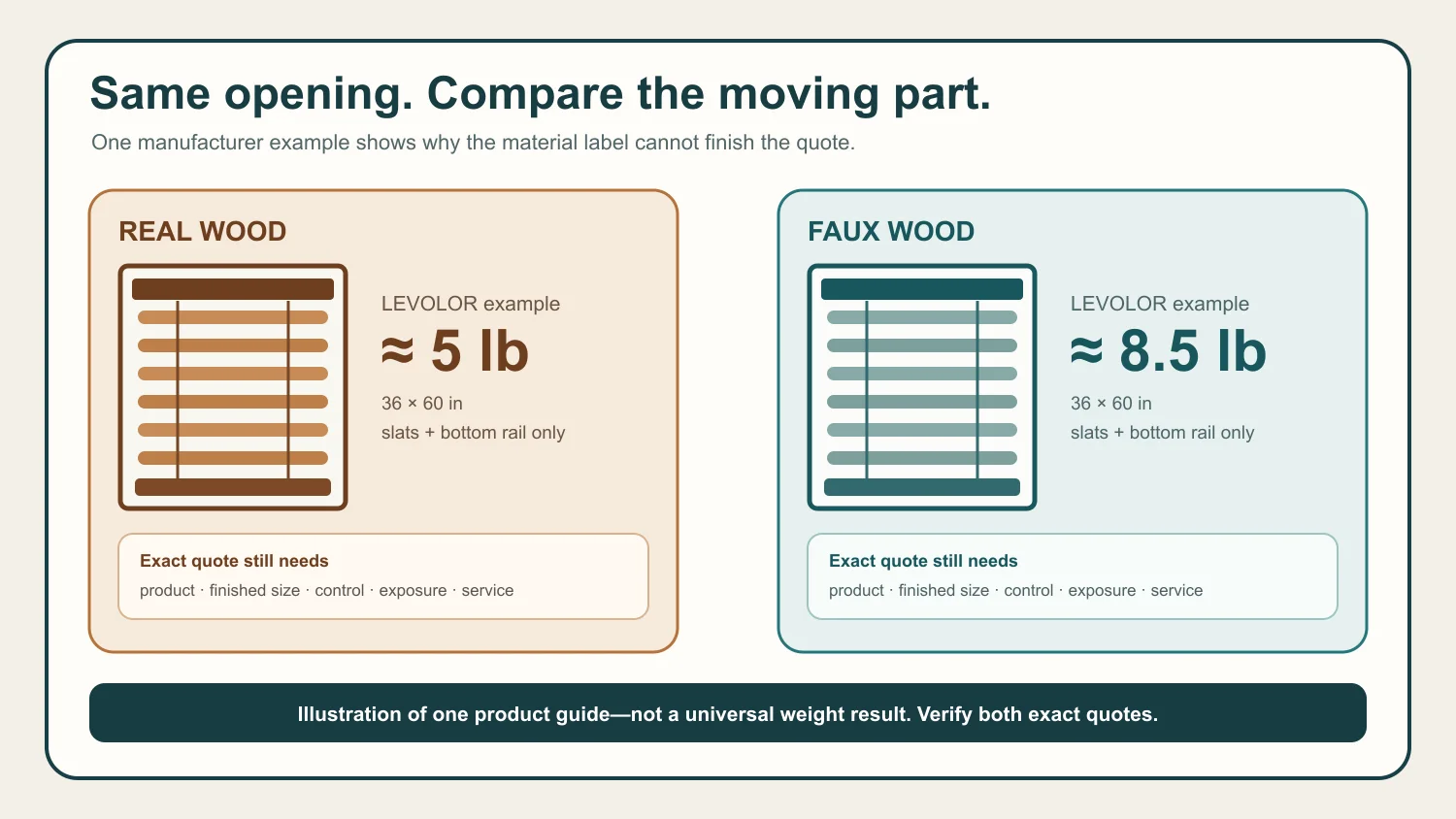
At the same nominal size, faux wood is not automatically the lighter blind. In LEVOLOR’s current technical guide, an approximate 36 × 60-inch example lists 5 pounds for real wood and 8.5 pounds for faux wood. The asterisk matters: those figures cover the slats and bottom rail only. They exclude the stationary headrail, valance and other components.
That is not an industry average, and it is not a number to paste into another brand’s quote. It is a useful warning. A wood-versus-faux decision should compare two exact blinds for the same opening, at the same finished size and with the same requested function. If a seller cannot document that configuration, the material label has not finished the decision.
If the quotes still use “smart blind,” “motorized blind” and “motorized shade” as if they were the same product, start with the smart-blind and motorized-shade terminology comparison. This page starts after horizontal blinds are already the intended product.
Start with the part that moves
“How much does it weigh?” can produce four different answers:
- the shipping weight, including packaging;
- the complete installed blind, including stationary hardware;
- the moving package, such as the slats and bottom rail in LEVOLOR’s example; or
- an operating or control limit that may not be expressed as weight at all.
Only like-for-like numbers belong in the same comparison. LEVOLOR labels its 5-pound and 8.5-pound figures as approximate lift weight for one size and then defines the included components. That makes the example comparable inside that guide. It does not establish the completed weight of either blind, the force a person will feel, or the capacity of a motor.
When a seller does not publish a moving-load number, do not manufacture one from square footage. Ask whether the exact finished width, height, slat, control and configuration are supported, and ask what changes when the opening gets wider. A documented eligibility answer is more useful than an unscoped weight.
Put both quotes in the same box
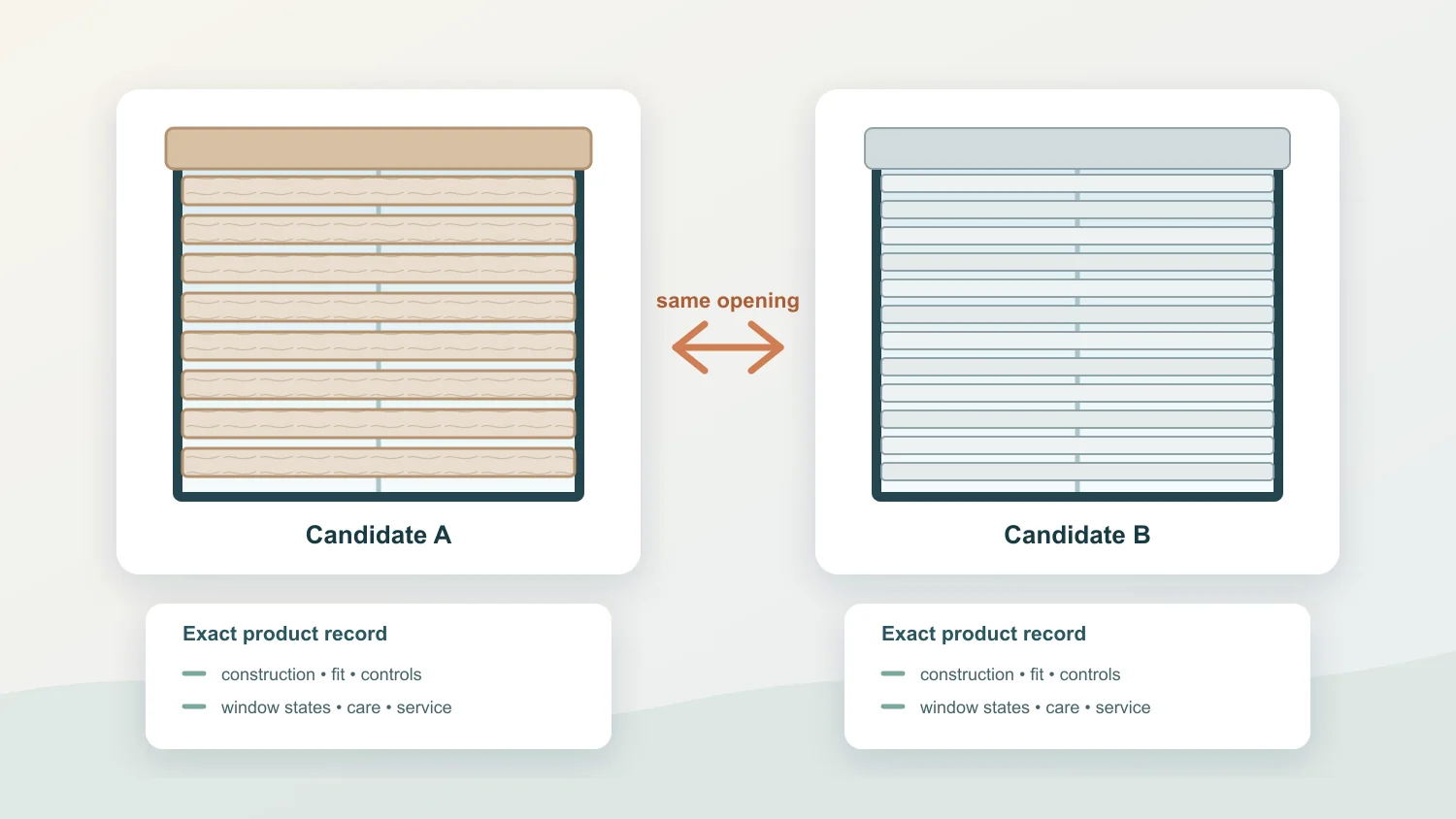
Begin with one opening record. The measurement checker gives you the width, height, depth, mount plane and obstructions that both sellers must use. Then complete the two product columns below. A blank is not a point for the other material; it is a request for evidence.
| Same-opening field | Real-wood quote | Faux-wood quote | What changes if the field differs? |
|---|---|---|---|
| Exact maker, collection, revision and quote date | Record it | Record it | You cannot carry a claim from one product family into another. |
| Ordered and seller-confirmed finished size | Width × height | Width × height | Different deductions or finished sizes invalidate a load or coverage comparison. |
| Material record | Wood species and finish | Disclosed vinyl, composite or other construction | “Faux wood” is not one recipe. Use the composite-versus-faux material check when the seller’s terms overlap. |
| Moving load or operating evidence | Value, unit and included parts—or seller eligibility statement | Value, unit and included parts—or seller eligibility statement | Unmatched scopes cannot decide which blind is easier to operate. |
| Slat, bottom rail and ladder layout | Slat width; route or tape; ladder count | Slat width; route or tape; ladder count | These change the moving assembly, view and light paths. |
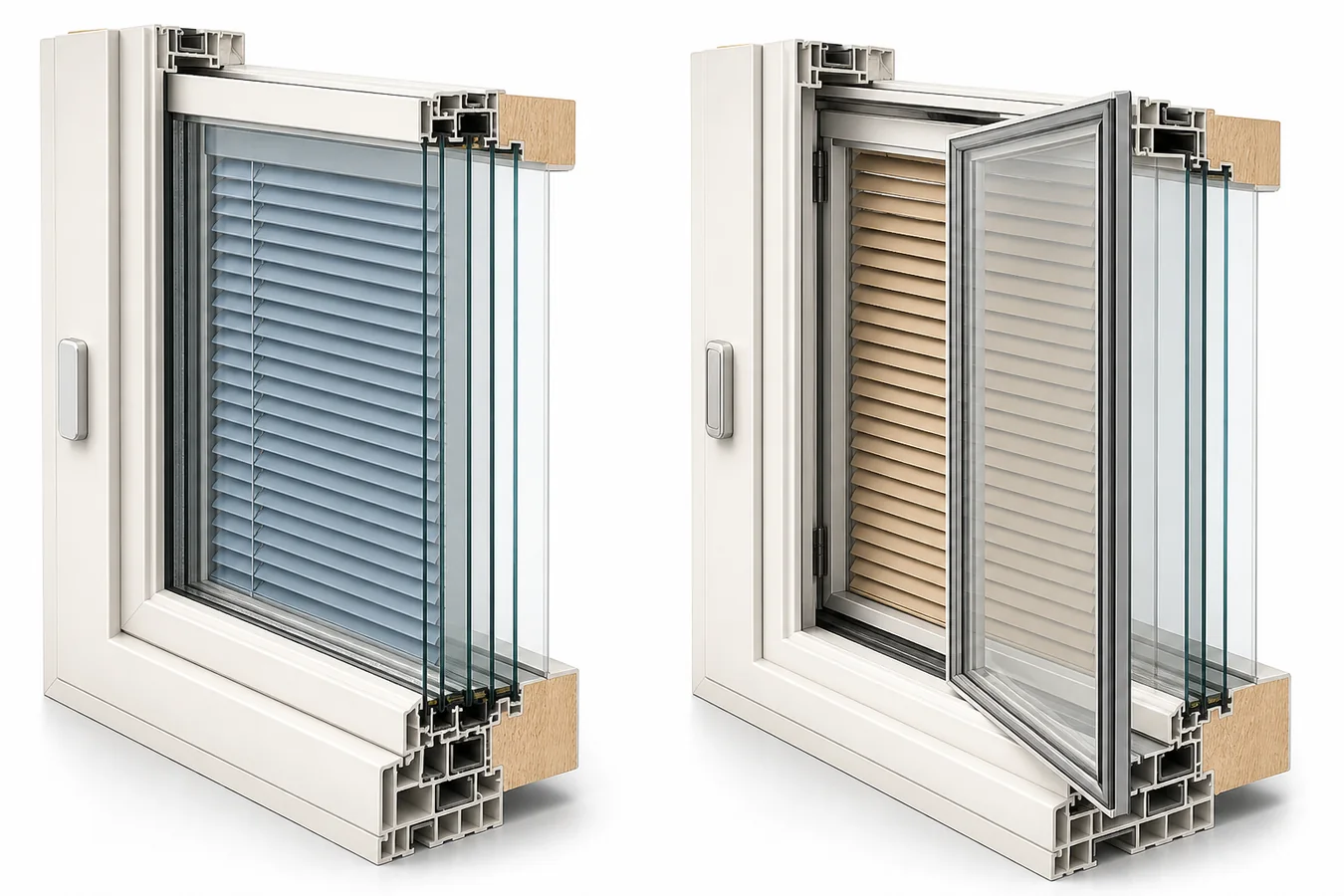
| Headrail, valance and mount depth | Minimum and flush depth | Minimum and flush depth | A material winner that does not fit the recess is not an orderable winner. |
| Control and size limits | Cordless, tilt, lift, motorization; single or multiple blinds | Same requested function | A wider blind may lose a control option or require more than one blind. |
| Raised stack and clearance | Seller’s finished stack | Seller’s finished stack | The open view, handle clearance and access may differ even at the same window size. |
| Room exposure and approved care | Humidity, splash, heat, sun and care instructions | Same conditions | The exact product may be excluded before appearance is considered. |
| Finish, warranty and service unit | Variation policy; covered component; repair or replacement path | Same records | This decides what you are accepting now and what can be supported later. |
The material row is necessary, but it is only one row. If one seller quotes a 2-inch cordless blind and the other a 2½-inch motorized blind, the cards are not describing the same purchase. Re-quote before choosing.
Width changes the blind before material settles it
A small sample shows color and texture. It does not show how a wide blind is divided, supported or operated.
LEVOLOR’s current guide changes ladder count across width ranges, and the ranges are not identical for its real- and faux-wood offerings. The same guide lists control-specific minimum and maximum sizes and tells buyers to use current price grids for exact limits. Those tables make the cause-and-effect clear: width can change the moving assembly, the available control and whether one blind is still the right configuration.
Hold the opening constant and test these questions in order:
- Are both products available at the exact finished width and height?
- Do both retain the same lift and tilt functions at that size?
- Does either quote switch to two or three blinds on one headrail, or require separate headrails?
- Do the headrail, valance and support brackets fit the measured depth and mounting surface?
- Is the raised stack acceptable at the window’s handle, view or access point?
If the quotes use different slat widths, settle the 2-inch versus 2½-inch geometry before treating weight as the remaining variable. Route holes and cloth tape also change the ladder system and light paths; compare routed and routeless construction or cloth-tape blinds as separate configuration choices.
Motorization needs especially precise wording. “Motorized” may mean powered tilt, powered lift, or both. The current guide’s size tables are tied to named controls, not a generic smart-blind label. If powered faux wood is in the quote, verify the exact motion in the motorized faux-wood guide rather than assuming the motor removes every lifting constraint.
Let the room disqualify a product
Once the configurations are comparable, exposure can end the decision quickly.
Current Hunter Douglas guidance steers high-humidity rooms away from its real-wood product and toward its alternative-wood offering. Bali describes its current faux/composite family as moisture-resistant. Those are useful product-family signals, not proof that every faux-wood blind is waterproof or suitable beside a shower, sink or heat source.
Write the actual exposure into both quote cards: routine humidity, direct splash, condensation, strong sun, nearby heat and the cleaning method the room will require. Then ask each seller to point to the current care and warranty language for that exact product. If the answer is only “faux is fine in bathrooms,” the environmental row remains incomplete.
Appearance also carries a product-specific trade. LEVOLOR notes that grain and color variation are inherent in its real wood. That variation may be the reason to choose it, or the reason a multi-window room needs more careful sample approval. A faux finish may be more visually consistent, but its resistance, color and cleaning limits still belong to the named product—not to the word “faux.” For a room where residue drives the purchase, use the care-method comparison before accepting “easy to clean” as a sales shortcut.
Let the incomplete quote lose
Real wood earns approval when the exact size and control are supported, the moving-load scope is acceptable, the room is suitable for that product, natural finish variation is welcome, and the service record is clear. Faux wood earns approval under the same standard: exact configuration first, then supported exposure, care and service—not a category promise.
A wide or demanding opening may produce a third answer. Change the control, split the opening or rework the mount if that creates a supportable blind. Hold the order if the seller cannot document both candidates at the same size.
Send this request with the opening record:
Please quote one real-wood and one faux-wood blind for the same finished width, height, mount and requested control. For each, identify the slat and bottom rail, ladder layout, headrail and required depth, size/control limits, raised stack, and any published moving-load or operating evidence with its included components. Please also attach the current humidity, care, finish-variation, warranty and service terms.
The reply should leave you with two equal records. If it leaves you with two material names and two prices, the comparison is not finished.