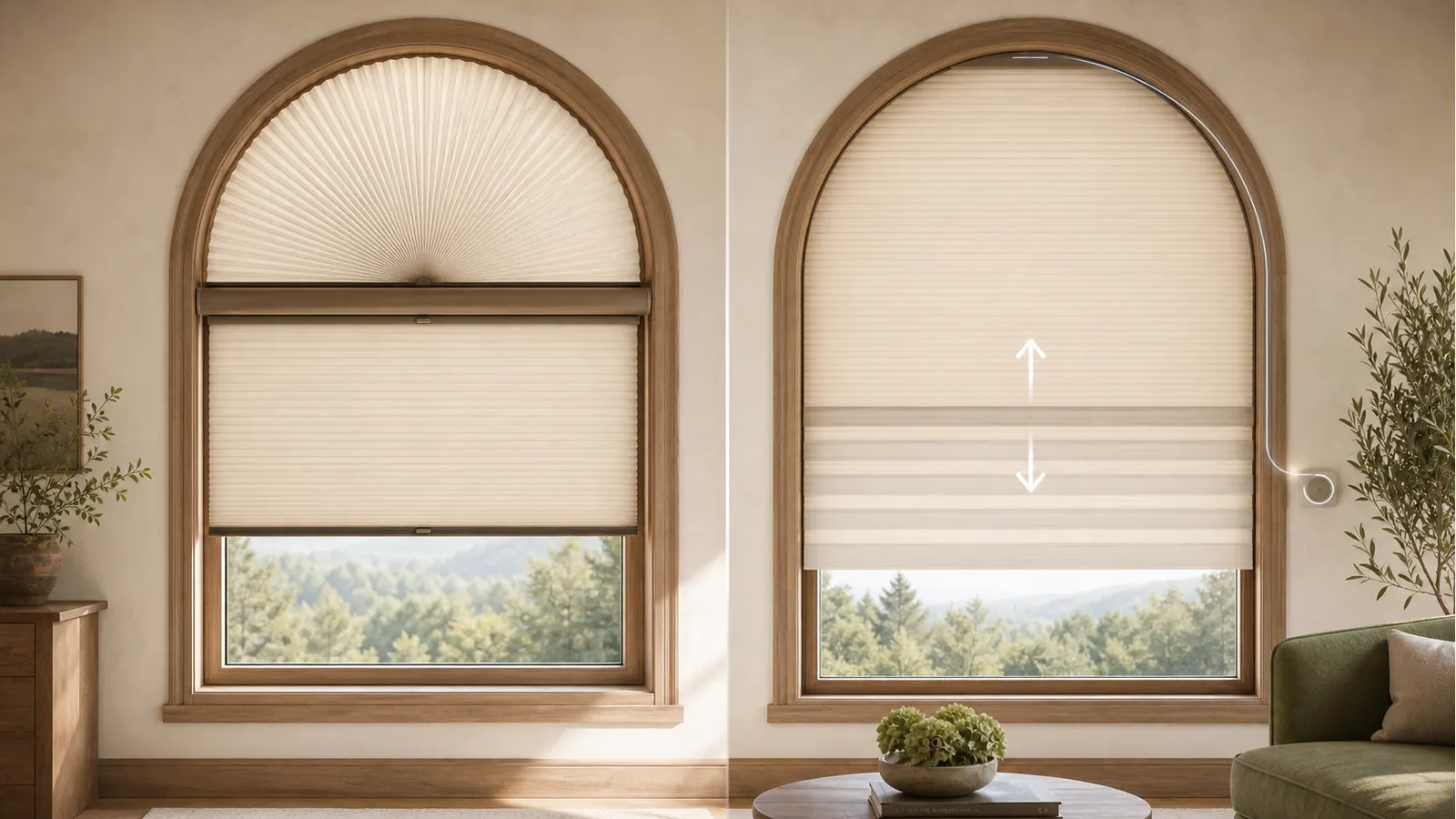
An arched window blind can match the curve perfectly and still be wrong for the room. A fixed fan-shaped shade may look finished but leave the upper glass covered every day. A motorized arch may move, yet put its charger or reset point where nobody can reach it. Those are operating problems, not style problems.
Decide which part of the window must move before choosing cellular fabric, shutters or drapery. The practical choices are a fixed arch, a fixed arch with a separate lower shade, adjustable shutters, a treatment that covers the whole opening, or an exact specialty product whose arched section really operates. Once that choice is clear, the curve, mount and measurements have a purpose.
Decide which part of the window must move
“Operable” is too vague on its own. It might mean shutter louvers tilt, the lower rectangular shade raises, drapery clears the whole window, or the arched shade itself travels. Write the expected movement in plain language and compare it with the treatment being quoted.
| Treatment plan | What actually moves | What it is good at | Proof to get before ordering |
|---|---|---|---|
| Fixed arch insert | Nothing in the arched section | Softening or covering glass that does not need daily adjustment | Finished coverage, material orientation, mount and whether the fixed light level is acceptable |
| Fixed arch + separate lower shade | The rectangular lower shade; the arch stays fixed | Frequent privacy or glare control below while the upper treatment remains simple | The junction between units, separate mounting surfaces and the lower shade’s fully raised position |
| Arched shutters | Louvers may tilt; panel or hinge behavior depends on the exact design | Adjusting light through the arch without a soft shade traveling through the curve | Which louvers, panels and hinges move, plus frame depth and projection |
| Whole-opening drapery or shade | A rectangular treatment clears or covers the arch and lower glass together | Full-window privacy without requiring the fabric to follow the curve | Wall space, stack or roll position, overlap and clearance around trim or furniture |
| Operable specialty arch | The shaped covering itself, in the exact direction stated by the product | Changing the arched section during the day when a compatible product exists | Exact model, motion, motor/control, power, charging, reset, removal and manual fallback |
There is also a valid sixth choice: leave the arch uncovered. If the upper glass causes no glare or privacy problem, covering it for symmetry can add cost and permanently reduce the daylight or view you wanted to keep.
Name the curve before you send dimensions
Start with a front-on drawing. Mark the horizontal base of the arch, its widest point, the vertical rise from that base to the highest point, any straight legs, and the rectangular window below. Note whether the curve is a semicircle, eyebrow, elongated arch, quarter arch or another shape. A photo helps identify the layout, but it does not replace the dimensions or template a supplier requires.
One current Blinds.com arch measuring guide calls an opening a “perfect arch” when the rise is exactly half the base width. The same guide says non-perfect arches may require a paper template and tells shoppers to measure each opening individually. Treat that as the rule for the product path covered by the guide, not a formula that authorizes an order from every seller.
The horizontal line where the curve begins matters just as much as the top point. It may be a mullion, a shelf, a separate casing or simply an imaginary spring line across one continuous opening. That detail affects whether a fixed arch and lower shade can mount independently, whether a combined product is possible, and where a headrail or shutter frame would sit.
Record usable depth, flat mounting surface, trim, handles and nearby obstructions with the Smart Shade Measurement and Compatibility Checker. Keep the result as a question list for the seller; specialty shapes are a poor place to turn a rough room measurement into a final order size.
A fixed arch can be the right answer
A fixed treatment is not automatically a budget compromise. It is often the cleanest answer when the arch only needs steady light softening, the lower window handles privacy, and nobody expects the upper section to change during the day. The mistake is buying it without noticing that “stationary” is part of the design.
Hunter Douglas describes many cellular arch treatments as stationary while also showing adjustable specialty options, shutters with movable louvers and drapery mounted above the whole opening. Those choices do different jobs. A shutter louver can change the light angle without making the whole arched panel disappear. Drapery can expose the entire window, but it needs wall space and changes the look of the trim.
Judge the fixed state at the hour that matters. Stand in the normal seat, look toward the window and check the screen, floor or artwork that receives the light. Then repeat after dark with the room lights on if privacy matters. If the fixed fabric passes those two moments, lack of movement may not be a loss. If the arch needs to open every morning or close every evening, it is the wrong category no matter how well it fits the curve.
Operable arches make service part of the fit
An operable specialty shade solves one problem and creates another: the drive and power system now live inside an unusual shape. Ask where the motor sits, which edge travels, where the charging connection lands, how the shade is reset, and what has to be removed for service. A control app is not a service plan.
The differences are model specific. For example, the current Hunter Douglas support page for PowerView Gen 3 motorized arches in named Duette and Applause products describes remote/app operation, an internal rechargeable battery, a specialty charging connection and no manual override. That is useful evidence for those products. It is also a warning not to assume that another motorized arch has the same charging point or fallback behavior.
Reach changes the decision. A charger on a low arch above a door may be easy to use; the same task on a two-story window may require a safe access plan every time. If ordinary charging, reset or removal requires a ladder, carry that problem into the high-window service and power plan before accepting the motor.
Have the quote name both grouped and individual control. A dramatic arched window may sit beside rectangular shades that should move together for glare, but the specialty unit may use different hardware or timing. “Works with the app” does not prove that the arch can join the intended scene, stop at the needed position or still move when a bridge or internet connection is unavailable.
Keep the lower rectangle separate until the combined product is proven
Many arched windows are really two visual zones: the curved top and a standard rectangle below. They can be covered by two independent products or by one product family designed for the combined shape. Do not let a single product name hide which section is fixed.
A current Bali cellular and pleated specialty-shape guide documents one “Arch Over Standard” construction in which the arch portion is fixed while the lower standard portion operates. The guide also requires a template for certain non-perfect shapes. That is a useful implementation example, not a universal description of every combined arch shade.
Two independent treatments can make replacement and daily control clearer, but they need two legitimate mounting zones and a deliberate meeting line. A combined treatment can look more unified, but only if its fixed and moving sections match the room’s use. Ask for a front drawing that labels the headrail, fixed material, moving material, finished gaps and fully open position.
If the recess is shallow, the trim is uneven or the frame projects into the room, compare inside and outside mount before the template is made. For a broad opening, a door-and-arch assembly or several neighboring sections, use the large-opening fit, stack and power planner to keep passage, stack and split decisions tied to the whole elevation rather than one attractive arch sample.
Put one operation sentence on the quote
The quote should make it impossible to confuse a matching shape with a working window treatment. For each arched opening, require six things in writing:
- the window ID and a front drawing showing base, rise, lower section and any straight legs;
- the supplier’s shape classification and whether a full-size template or professional measure is required;
- the exact section that stays fixed and the exact section that moves;
- the fully open, normal daytime and full-privacy states;
- the mount, finished coverage, projection and meeting line between upper and lower units;
- for a motorized product, the exact motor, control, power, charging, reset, service and manual-fallback terms.
A useful final sentence sounds like this: “For window A1, the fan-shaped arch remains fixed, the separate lower shade raises fully to the spring line, and both mounting surfaces, finished gaps and service points are shown on the attached drawing.” If the supplier cannot complete that sentence for the selected product, the order is not ready—even if the fabric and color already look perfect.