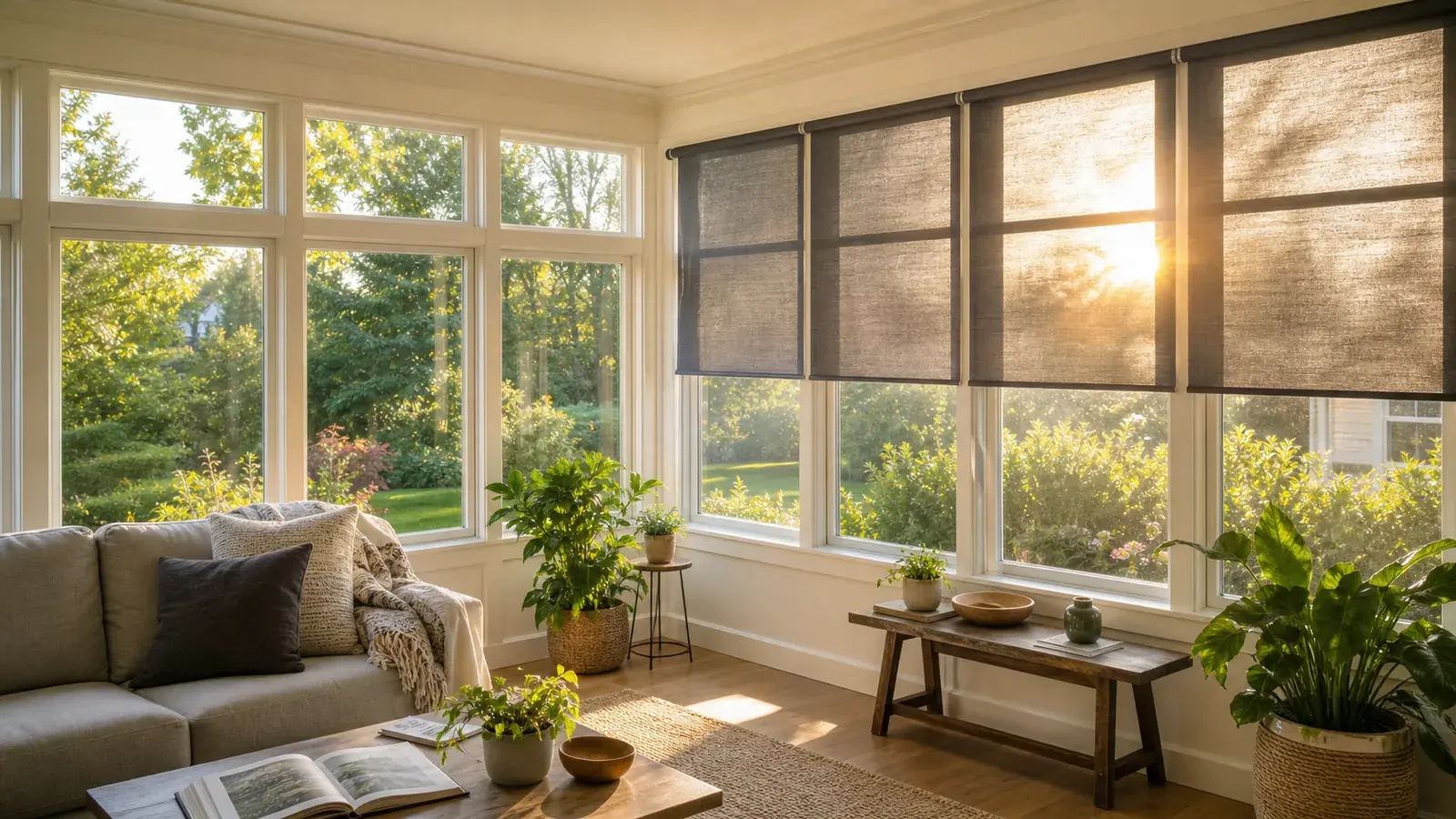
One wall can make a sunroom miserable at 4 p.m. while the windows beside it are doing exactly what you wanted: filling the room with light and a garden view. Cover every pane with the same blind and the glare may disappear, but so can the reason you like the room.
Treat the sunroom as a set of window groups, not one wall of glass. Observe the room when it becomes uncomfortable, circle the windows responsible, and leave the useful windows out of the solution until they prove they need one. Then test the exact fabric on one representative opening before multiplying it across the group.
If you are coordinating shades across several rooms, the broader smart-shades room-by-room planner sets the order of decisions. Here, the job is narrower: divide one glass-heavy sunroom into openings that should not all behave alike.
Begin with the hour the room stops working
Write down one real event rather than a general complaint such as “too sunny.” Record the time and season, where you were sitting, what you were trying to do, and what failed. Was direct sun in your eyes? Was a bright rectangle reflected on a screen? Did the room feel warmer, or did the brightness merely make it feel harsh? Could neighbors see the seating area after the room lights came on?
Those are different jobs. The U.S. Department of Energy distinguishes visible transmittance from solar heat gain. DOE also notes that properly used interior shades and blinds can reduce unwanted solar heat gain while preserving useful daylight. That is a reason to shade the problem area deliberately, not a promise that an unnamed blind will lower the room by a certain temperature.
Repeat the observation on a clear day at the problem hour. A quick phone photo from the usual seat can help identify the offending panes, but judge glare and privacy in the room, not from the camera exposure. Seasonal sun paths move; trees, roof overhangs and neighboring buildings can matter more than a compass label.
Divide the glass into window groups
Draw the room perimeter and give every window, door and overhead pane a simple ID. Now group openings by the job they share. Matching windows may end up in different groups, and visually different windows may move together.
| Window group | What puts a window in it | Likely starting path | What not to assume |
|---|---|---|---|
| Direct-sun group | The beam or bright reflection causes the critical glare event | Exact solar or light-filtering sample; partial lowering may be enough | That every wall needs the same openness or fabric |
| Open-view group | It supplies the outdoor view or soft daylight and does not fail the critical event | Leave open; add a treatment only for a second proven job | That visual symmetry requires identical daily operation |
| Privacy group | A named outside position can see an unacceptable level of detail after dark | Opaque, adjustable or layered coverage tested with normal room lights on | That a daytime photo proves night privacy |
| Awkward-access group | The window is high, overhead, behind furniture or difficult to reach safely | Motorized or extended-control path with a service plan | That motorization removes charging, reset or removal access |
| Door or vent group | A sash, handle, screen or walking path must keep moving | Separate treatment or control group with clearance recorded | That a matching shade can share the neighboring window’s mount or schedule |
A window can sit in two groups. A street-facing west window may need glare control by day and stronger privacy after dark. That does not automatically mean every window needs two layers; it means this group has two acceptance tests.
Keep the open-view group visible on the drawing. It is the part most likely to disappear once quotes are organized by product rather than by outcome.
Use the lightest treatment that fixes each group
For direct-sun windows, begin with the least closed position that solves the observed problem. A solar-screen fabric can preserve some outward view while changing glare and light, but openness, color, weave and nighttime appearance belong to the exact fabric. “Solar shade” is a category, not a result.
Use the motorized solar-shade glare and view trial when that path leads the shortlist. It shows how to compare the actual sample at the critical sun time instead of choosing from an openness number alone. One current Lutron tensioned-shade specification, for example, defines its light-filtering and blackout fabrics with specific openness language. That definition belongs to that product document; another seller may define or measure its materials differently.
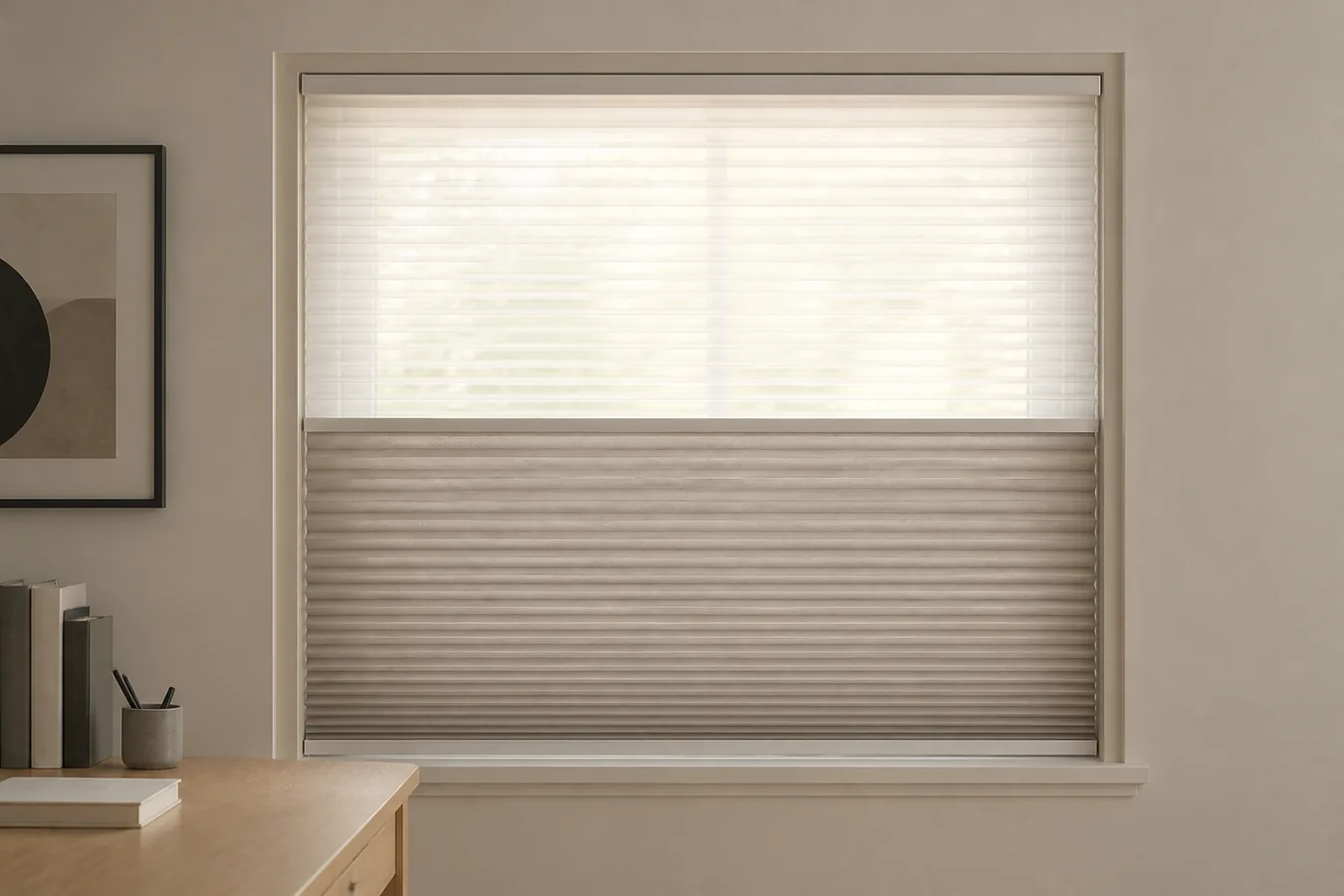
Light-filtering roller or cellular shades can be reasonable when softening the room matters more than preserving a clear view through the covered fabric. An opaque shade belongs where privacy or darkness is the real job. Adjustable slats can redirect a sightline or beam without covering the entire opening, but the finished angle, stack and cleaning burden have to work in the actual window.
Do not turn a fabric label into a heat or energy claim. If thermal performance is a purchase driver, ask for applicable product data and the conditions behind it. Climate, glazing, fit and operating schedule all affect the result. A sample can tell you about appearance and glare in your room; it cannot establish an annual utility saving.
Privacy changes after the room lights come on
Many sunrooms feel secluded during the day because the outdoors is brighter than the interior. The relationship reverses after dark. Turn on the lamps you normally use, then stand at the sidewalk, neighboring side or yard position that matters. Decide whether your threshold is glow, silhouette, face, activity or complete visual separation.
Test the sample both from the normal seat and close to the glass. Solar and sheer materials that preserve a daytime view may reveal more at night than their daytime appearance suggests. If the direct-sun fabric cannot meet the night threshold, the privacy group may need an adjustable or opaque path, a second layer, or a different operating state.
If young children live in or visit the home, controls are a safety decision as well as a convenience choice. The U.S. Consumer Product Safety Commission says cordless coverings are the safest option when young children are present. A continuous loop that remains in an existing or proposed configuration requires the specified anchoring and still does not eliminate the hazard.
Motorize the repeated work, not every pane
Motorization earns its cost when a group has to move together often, moves at a predictable sun event, or cannot be reached safely for ordinary operation. Four west windows that need the same partial position every afternoon form a stronger motor case than one reachable window that closes twice a month.
The open-view group may need no motor at all. A privacy group used only in the evening may be comfortable with a cordless manual control. High clerestory or skylight shades may justify motors, but only if power, reset, removal and future service can be performed safely. Count those tasks before counting windows.
On the quote, require the exact motor, power method, local control, group and individual operation, saved-position behavior and what remains available when the app, bridge or internet is unavailable. The motorized-shade power guide separates rechargeable, plug-in, compatible solar-accessory and professionally planned wired routes without assuming one path exists for every shade.
Groups should reflect real use. A symmetric five-window wall can still have a four-window glare group plus one door-adjacent window that stays independent. Appearance can remain coordinated while controls differ.
Repeated windows still need separate order lines
Once a group works, it is tempting to copy one width and height across every opening. Measure each one. Framing, trim, depth and squareness can vary enough to change a custom order, even when the windows look identical from across the room.
Use the Smart Shade Measurement and Compatibility Checker to record opening width and height, usable depth, trim, handles, cranks, screens and other obstructions. Then compare inside and outside mount if recess, overlap, projection or finished edge coverage is unsettled. For every unit, keep the seller’s exact measuring rule attached to the line item.
A useful grouped quote identifies:
- each window ID and group;
- exact fabric, color and openness or opacity designation;
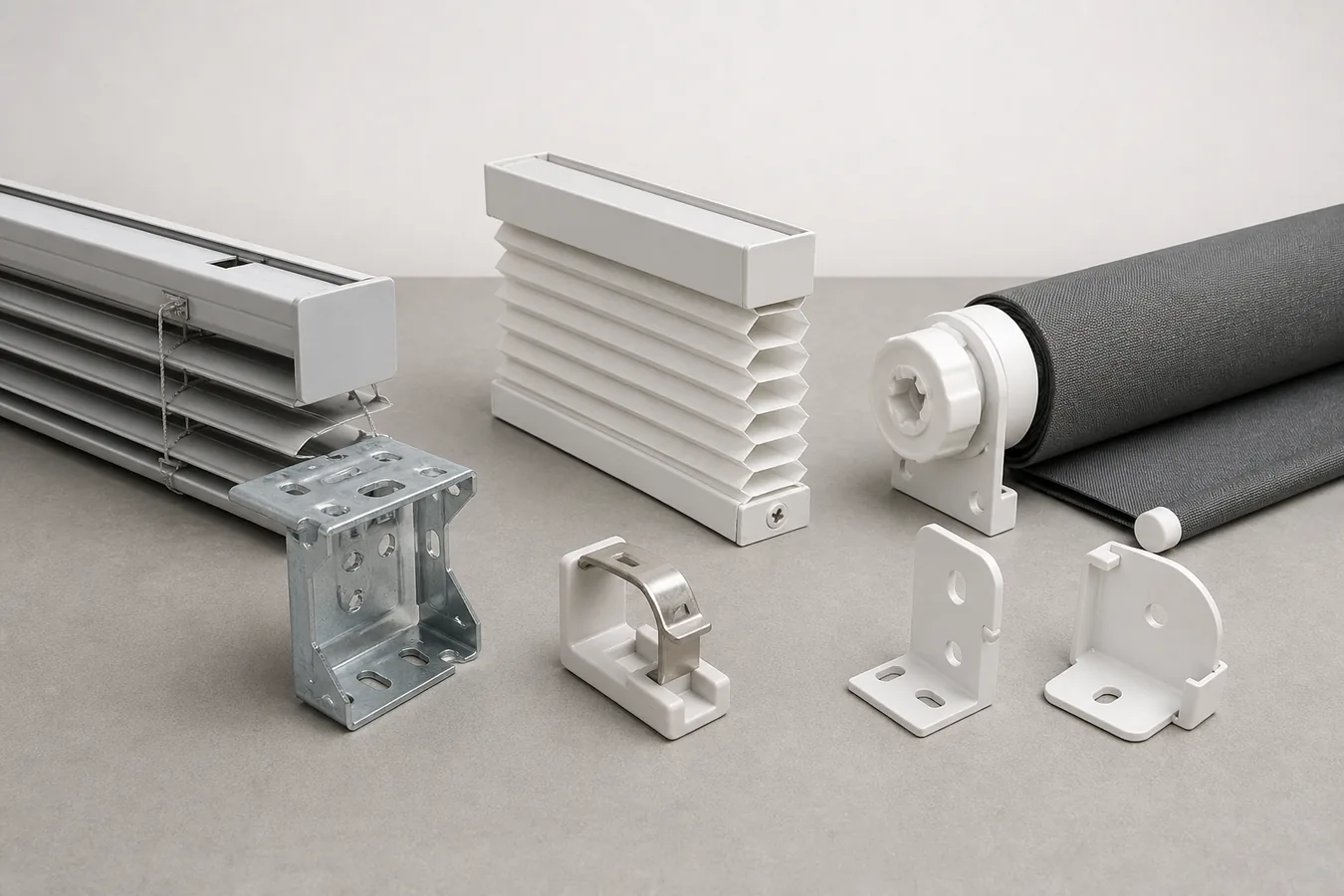
- mount, finished fabric coverage, side/inter-panel gaps and stack or roll zone;
- exact control and power configuration;
- which units move together and which remain independent;
- service access, cord-safety configuration and unresolved fields;
- current measurement, remake, return and warranty responsibility.
One representative sample or installed unit can authorize repetition only across openings that share the relevant geometry and problem event. It does not prove another wall, another fabric color or a different motor configuration.
Buy by group, not by room
Return to the perimeter drawing before approving the order. Every covered group should point to a failure it solves, an exact material or control, and an observation that will count as a pass. Every open group should still be visible. Every unresolved group should stay out of the order.
The room is ready when the glare windows can close without taking the garden with them, the privacy windows pass after dark, doors and vents still work, and the motors exist only where repeated movement or reach makes them useful. That is a sunroom plan—not simply the same blind multiplied by the number of panes.