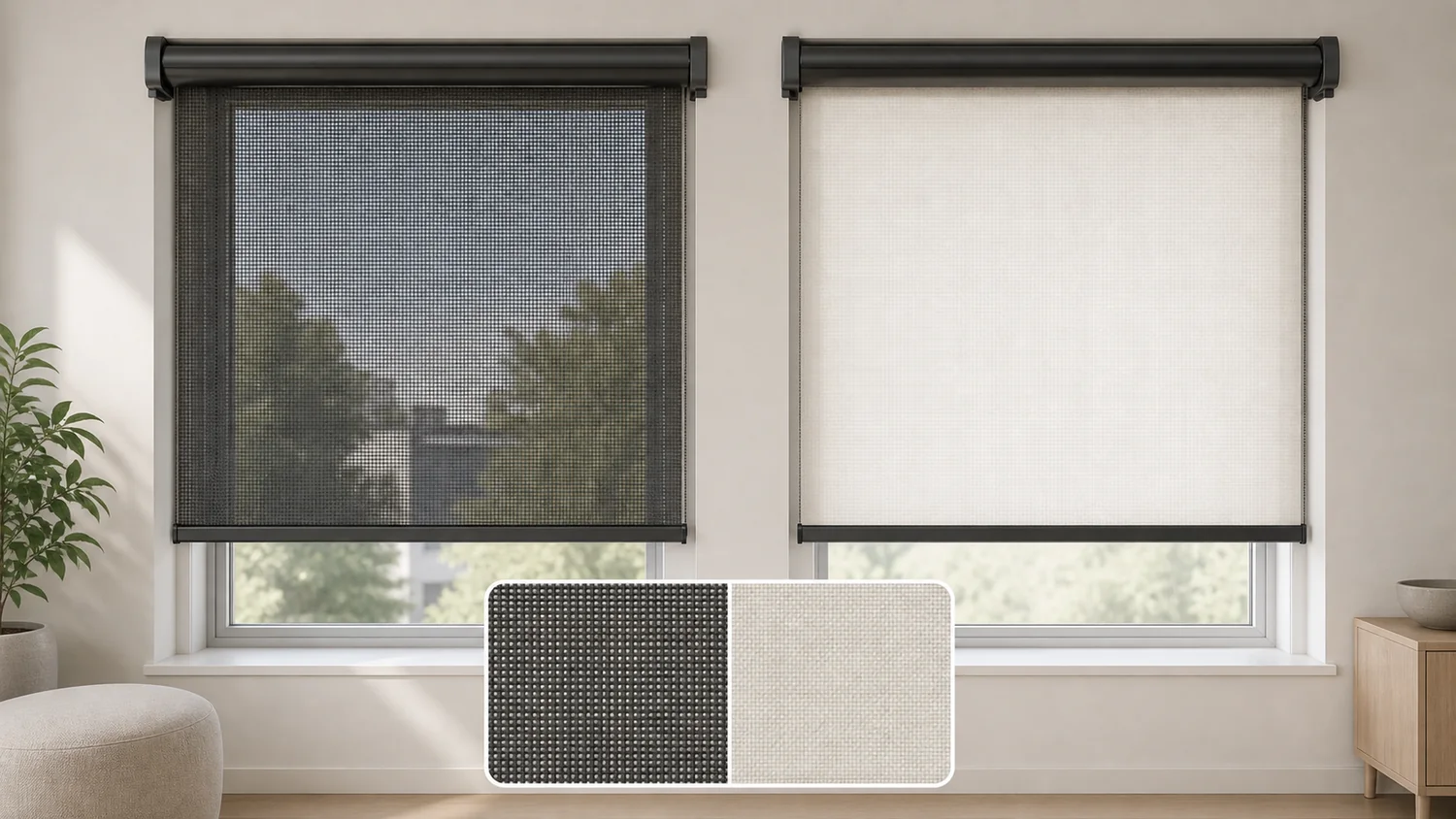
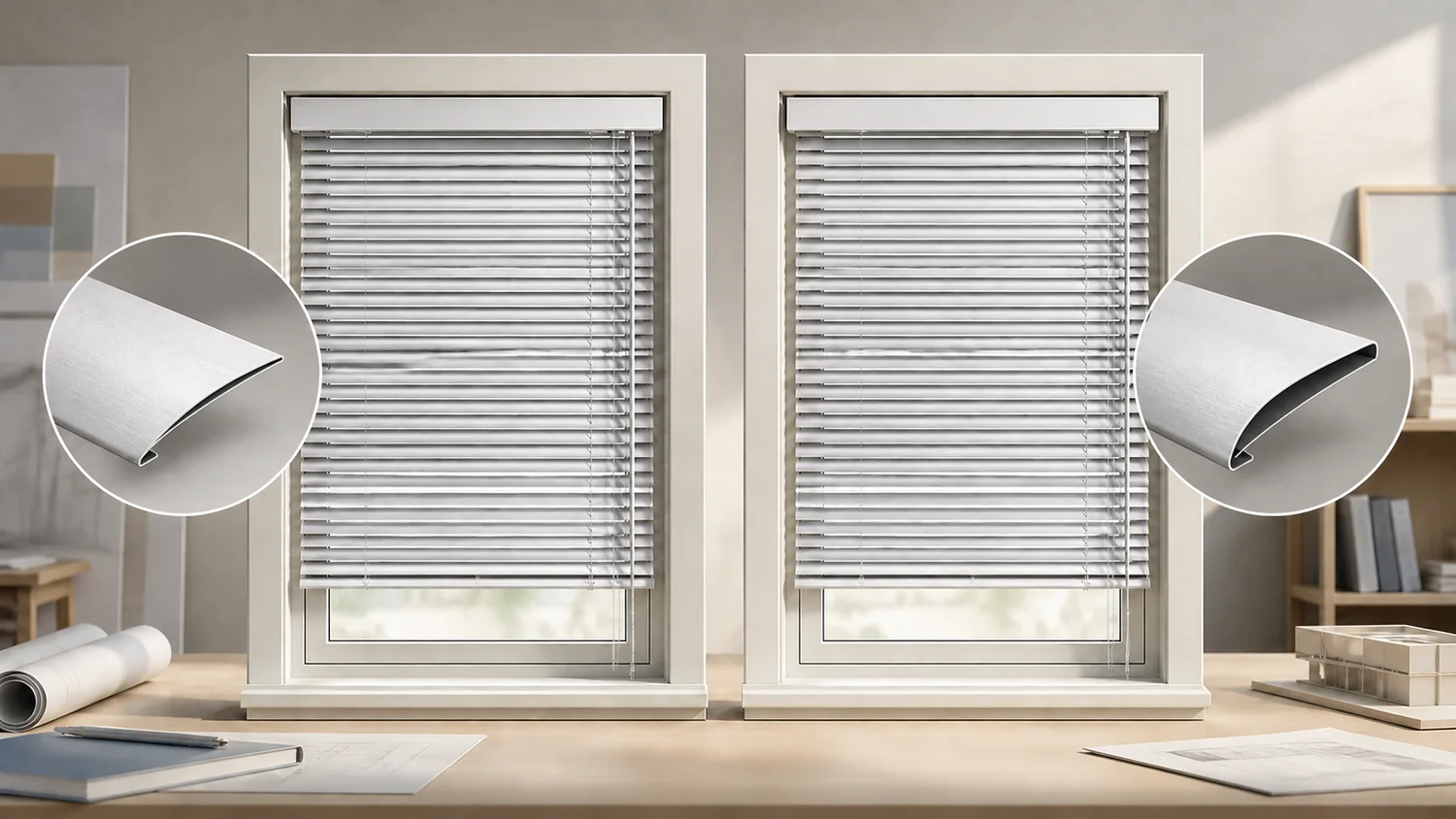
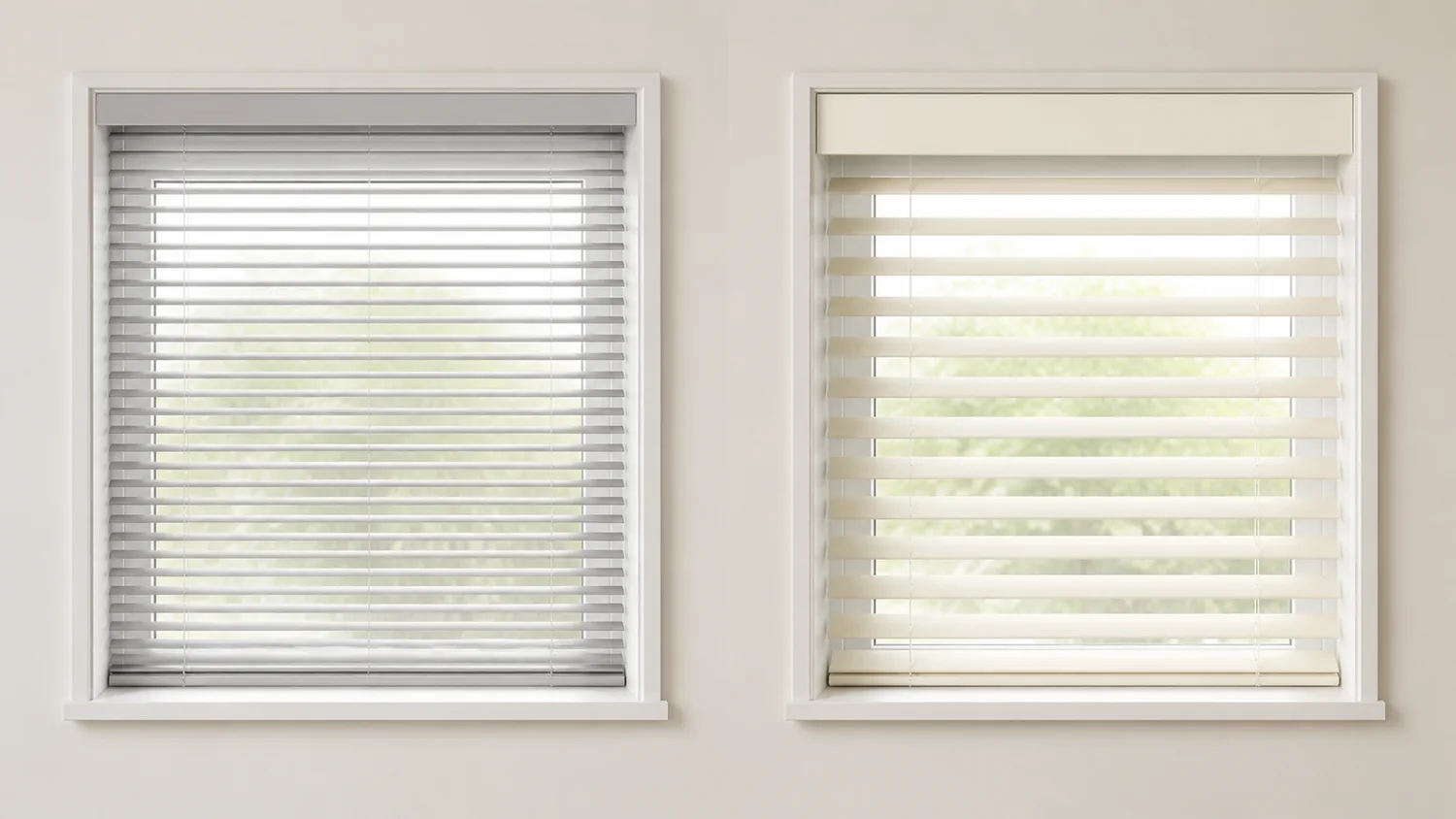
An opened blind has not disappeared. A liftable horizontal blind gathers its slats above the glass. A traversing vertical blind gathers its vanes beside the glass. On a fixed window, the top band may be the easier obstruction to accept. At a sliding door, a side stack may preserve headroom but still take part of the passage.
Choose a horizontal candidate when its documented raised stack fits above the view you need and the lift and tilt controls remain reachable. Choose a vertical candidate when its documented side or split stack stays outside the active door or critical view and its traverse and tilt controls suit the regular user. If the quote cannot show the finished stack and remaining opening, neither orientation has earned the order.
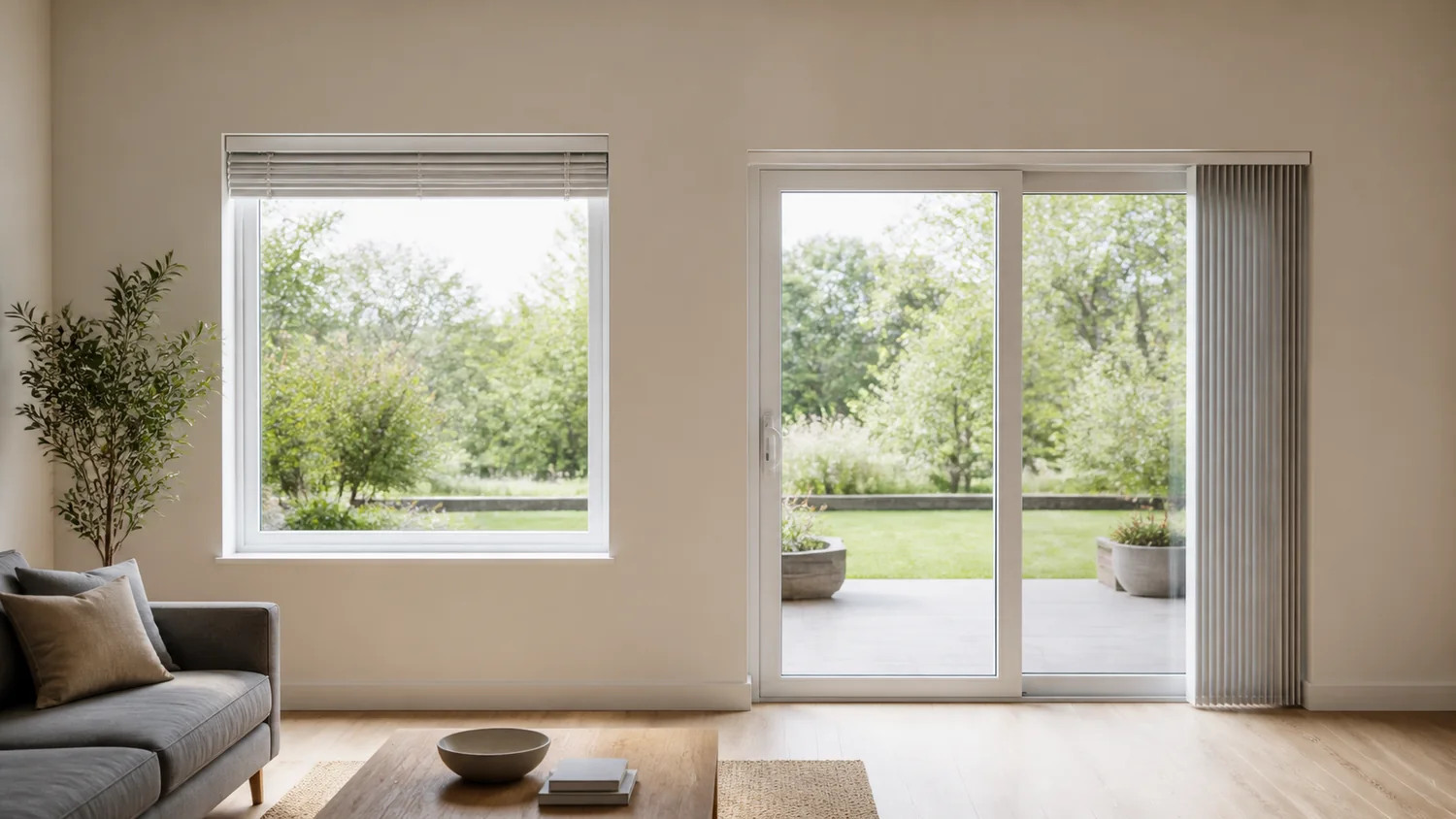
An open blind still occupies space: horizontal slats collect above the glass, while vertical vanes collect beside it.
The open blind still occupies the opening
Do the comparison on one drawing of the real opening. Mark the glass you want to uncover, the sash or door that moves, the handle sweep and the place a person must stand or walk. Then place each candidate’s finished stack on that drawing.
| State to preserve | Horizontal candidate | Vertical candidate | Evidence to put on the quote |
|---|---|---|---|
| Covered | Slats span the opening and rotate for light control. | Vanes span the opening and rotate for light control. | Finished coverage, overlap, edge gaps and control side. |
| Adjusted for light | Slats remain across the glass while their angle changes. | Vanes remain across the opening while their angle changes. | A sample or demonstration at the relevant view and light angle. |
| Fully parked | A liftable system collects slats and rails at the headrail. | A traversing system collects vanes at one side or splits them between both sides. | Finished top stack or side/split stack for the quoted size and control. |
| Opening in use | The raised stack must clear the view and any moving sash or handle path. | The parked vanes and headrail must leave the active door or sash path usable. | Remaining clear opening with the door or sash in its real operating positions. |
| Regular user operating | Lift and tilt may use different controls and reach points. | Traverse and rotation may use different actions even when one wand controls both. | Exact manual, control location and reach at every required position. |
| Quote is incomplete | “Horizontal” does not prove stack height or lift option. | “Vertical” does not prove draw direction, stack width or floor clearance. | Exact product, mount, finished size, controls and configuration drawing. |
Hunter Douglas’ category guide distinguishes horizontal blinds that raise and lower from vertical blinds that traverse, while noting that blind slats can rotate. That is useful motion vocabulary, not a finished-size promise. Graber’s current wood-blind page and LEVOLOR’s January 2025 horizontal guide also separate lift from tilt on named products. The order still needs the record for the exact product and size.
Do not add points for occupying less area in the abstract. Add the obstruction to the room. Ten units of parked material above an unimportant band of wall can be less disruptive than a narrower stack beside the handle—or the reverse. The useful comparison is lost glass, passage and reach, not stack area alone.
Let the sash or door move first
A blind can clear the view and still conflict with the opening it covers. Give the door or sash priority because its path is fixed after installation.
For fixed glass, mark the sightline or daylight area that must remain visible. The candidate can park outside that zone at the top, side or both sides. There is no moving leaf to decide the choice, so control reach and the exact finished footprint carry more weight.
For an operable window, sketch the fully open sash and the hand path to its lock or crank. A top stack that leaves the glass clear can still crowd a handle or project into an inward-moving sash. A side stack can do the same at the hinge or meeting rail. The mounting plane and hardware projection decide whether the apparent free space is real.
For a sliding door, choose the active passage before choosing the blind draw. If people normally use the left panel, a left-side stack may be the worst location even though a generic guide says vertical blinds suit patio doors. A right stack or split draw changes the remaining passage, but only a configuration available for the exact product counts. Ask for a drawing with the vanes fully parked and the active panel open.
The current LEVOLOR vertical-blind technical guide makes stack width, patio-door access, floor clearance and obstruction clearance visible as separate specification questions. It does not create one universal allowance. When a vertical candidate remains viable, carry the chosen mount plane, controls and obstruction record into the vertical-blind measurement guide instead of converting a raw opening width directly into an order size.
Tilt is not the same as getting out of the way
Both orientations can change slat or vane angle while continuing to cover most of the opening. That is the light-control state. Fully parking the covering is a different state.
Hunter Douglas’ current support page for named Cadence, Vertical Solutions and Somner products with its PermAssure control says that walking the wand side to side traverses the vanes, while twisting the wand rotates them. One control can therefore send two different motions. The page also warns about the inherent lead-vane and wand gap on that system. Those instructions belong to the listed products; they are not a command for every vertical blind.
LEVOLOR’s horizontal-blind guide similarly shows a wand for slat tilt, while lift comes from the bottom rail on one covered configuration and from a button-equipped rail on its Simple Cordless variant. “The slats turn” does not prove how the blind raises, just as “the vanes rotate” does not prove where they stack.
Write three separate states on the quote: covered and closed, covered and tilted, and fully parked. If motorization is under consideration, make the system demonstrate rotate/tilt and traverse as separate behaviors in the motorized vertical blind guide. A remote with an Open button is not evidence that the light-control angle, stack side and stop position are all configurable.
A direction is not a finished product
Horizontal and vertical describe the orientation of slats or vanes. They do not close the purchase decision. Two products with the same orientation can park differently because the finished size, material, headrail, lift or draw and ordered control are different.
Ask each seller to return one complete candidate on one line:
Exact product and material; inside or outside mount; finished width and height; headrail dimensions; slat or vane size; raised or traversed stack; left, right or split draw; lift and tilt controls; control side and length; floor or sill clearance; remaining clear glass or passage; and the manual that matches the order.
If the vertical candidate uses rigid PVC vanes, move material profile, overlap, closed appearance, care and replacement details into the PVC vertical blind finished-system review. Do not let a wipeable-material claim substitute for the headrail and stack record.
If a horizontal candidate is sold as cordless, identify the actual rail, wand, ring or other named input through the cordless blind control map. “Cordless” does not tell you the raised stack, operating motion or whether the regular user can reach every position.
This finished-configuration rule also prevents a false price comparison. A basic horizontal product and a custom vertical product are not alternatives merely because both cover the same glass. First make both candidates satisfy the same keep-clear zone, light-control state and control reach. Only then compare their complete quotes, care and service terms.
Choose the obstruction you can live with
A standard fixed or vertically opening window often gives a horizontal candidate a natural parking zone above the view. Keep it only if the documented top stack, headrail and control reach fit. If that band contains a handle, inward-moving sash or critical view, the apparent advantage can disappear.
A wide sliding door often gives a vertical candidate a natural travel direction beside the passage. Keep it only if the exact left, right or split stack preserves the active panel, handle and walking line. “Recommended for patio doors” is not a substitute for the remaining clear opening.
Tall fixed glass can support either orientation. Decide whether losing a top band or a side band damages the important view, furniture layout or access less. If light needs to be redirected while the glass remains covered, compare the useful tilt state as well as the fully open state.
Some openings offer no acceptable parking zone. A shallow recess, inward-moving sash, close handle, narrow side returns and full-height critical view can reject both quoted blinds. That is a valid outcome. Reopen the broader blinds-versus-shades format decision rather than shrinking a required passage or pretending the stack disappears.
When an orientation survives, carry the exact physical winner into the smart blinds versus motorized shades comparison before choosing a powered control. Motorization can change how a blind moves; it cannot erase a headrail, slat pack or parked vane stack.
The order note should be blunt: “For this opening, the blind may occupy [top / left / right / both sides] when fully open. The quote shows [documented stack], leaving [required glass, sash path or passage] clear, and the regular user can operate both [light control] and [full opening].” If the seller cannot complete that sentence with the exact configuration, keep the order on hold.