The long plastic rod on the floor is the most visible part of a blind-control failure, so it is easy to make it the shopping term. But the rod may be intact while its hook, cap or connector has failed. The small stem above it may be damaged. The internal tilt mechanism may turn without moving the slats. All of those failures can produce the same search for a “blind replacement rod.”
Buy a replacement rod or wand only after the exact blind family, failed motion, remaining attachment and current part record agree. If the external wand or its replaceable tip is the failed service unit, match that unit. If the stem or internal mechanism is damaged, another wand does not close the repair. Keep the purchase on hold until the maker or a qualified parts source can identify the larger part.
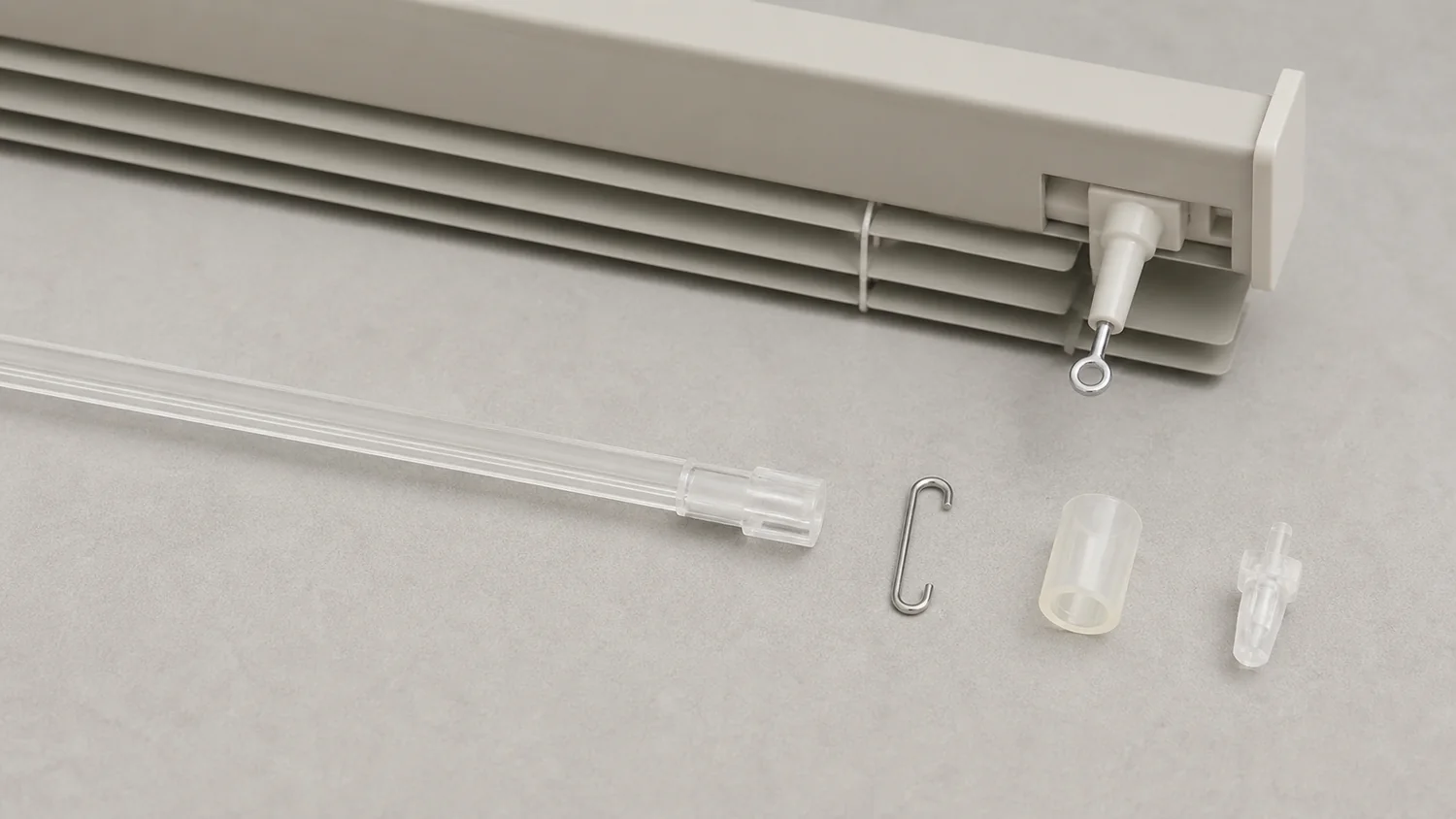
The image separates a generic wand, hook, sleeve, connector and tilter stem so the parts can be named. It is not a universal kit or a compatibility template.
Start with the piece that is still attached
Do not begin by measuring the loose rod. Look at the control point on the installed blind without opening the headrail. What remains there tells a parts supplier which branch to investigate. Use normal operating pressure only; resistance, cracking or a loose headrail is a reason to stop, not a test to repeat more forcefully.
| What you can observe | Evidence to capture | Part route to verify | What is not yet proven |
|---|---|---|---|
| The wand is missing, but an intact eyelet or stem remains | Blind label, complete control side, stem shape and opening, old wand if available | Exact wand plus its documented attachment hardware | That a generic hook or “universal” wand matches the stem |
| The wand body is sound, but its top tip, hook or cap is broken | Both ends of the wand, broken and remaining pieces, attachment close-up | Named tip, hook, sleeve or complete wand for that product | That the whole wand must be replaced or that a loose tip is supported |
| The external stem is cracked, missing or turns abnormally | Headrail label, stem location and the exact response to normal wand motion | Tilt mechanism, control-end assembly or manufacturer service | That a new rod can restore the internal connection |
| The wand turns, but horizontal slats do not tilt | Whether the blind still lifts, whether every slat responds and any visible stem movement | Exact horizontal tilter or larger supported assembly | Which internal gear or linkage failed |
| A vertical blind rotates but will not traverse, or traverses but will not rotate | Exact headrail, wand or chain arrangement, failed motion and carrier response | Named vertical control, carrier or headrail service path | That the visible wand is the failed component |
| The product identity or attachment cannot be established | Whole blind, labels, order record, control side and every remaining piece | Manufacturer or qualified parts identification | Any safe or functional replacement purchase |
This map routes a purchase; it does not diagnose an enclosed mechanism from a photograph. Fix My Blinds separates a fallen wand, broken wand tip, hook or sleeve from a broken stem or tilt mechanism in its horizontal-blind guidance. That commercial repair source has an interest in selling parts, but the separation is useful: external pieces and an internal tilter are different service units.
Make the failed motion name the control
On a horizontal blind, a tilt wand changes the slat angle. It does not raise the entire blind. Blinds.com’s current parts definitions identify the tilt wand by that job, while its glossary treats lift and tilt as separate controls. If the bottom rail will not rise but the slats still rotate, a replacement wand is aimed at the wrong motion.
If the motion is still hard to name, use the blind lift-versus-tilt diagnostic before shopping. That page owns broad motion routing. Here the narrower task starts after “horizontal slat tilt” or another exact motion has been identified.
Cordless adds another naming trap. A cordless horizontal blind may still use a wand for slat tilt even though the bottom rail controls lift. The cordless mechanism guide keeps the user motion tied to the named operating system. Do not buy a wand to correct a bottom-rail, spring or motor response merely because the product is marketed as cordless.
Vertical blinds need their own sentence. Some named systems use one wand for more than one motion; others separate vane rotation from traversal or use chains and cords. State exactly what still works: “The vanes rotate, but they do not travel across the headrail” is more useful than “the rod broke.” If the carriers or vanes are implicated, the vertical-blind vane and track guide preserves that separate service boundary.
Match the attachment before the length and color
A wand can be clear, white or wood-toned and still be mechanically wrong. The top may use a wire hook through an eyelet, a shepherd’s-hook shape, a cap over a stem, a clip, a direct connector or a product-specific control interface. A similar-looking top seen from one angle is not enough; photograph the opening in the stem and the wand’s mating part in the same orientation.
Current retail listings show why compatibility text matters more than the category label. The current Home Depot wands category includes one replacement described for named 2-inch and 2.5-inch Home Decorators Collection faux-wood blinds and a separate clear wand presented for 1-inch vinyl and aluminum blinds. These are not dimensions to combine. They demonstrate that one store category contains candidates with different product-family and slat-size scopes.
Length becomes relevant only after the attachment and control are approved. Record the original wand length if it is available, the installed headrail height, the regular user’s comfortable reach and any sill, furniture or door conflict. Do not lengthen a wand by hanging an unapproved object from it. For a high or inaccessible control, ask whether the exact product has a supported longer wand, control pole, control-side option or another operating system.
Color and material are final fields, not identity fields. A clear acrylic candidate and a painted wood candidate may use different tips even when both are called tilt wands. Match the exact functional part first, then choose only a finish the compatible part record actually offers.
Keep the headrail in the identification record
A loose wand photo strips away the most useful evidence. Add one image of the whole blind, one of the headrail label or order record, one of the control side in context and one straight-on close-up of the remaining attachment. Include the old wand and every loose piece in another frame. A ruler can document size when it is held in the same plane, but size alone does not establish the interface.
Record whether the blind is horizontal or vertical, the slat or vane material, approximate purchase date, control side, product family and the motion that failed. If the label is hidden by a valance or the blind must be removed to inspect it, follow the exact manufacturer instructions. The blind bracket identity guide remains the owner for headrail support and release hardware; a wand search does not authorize prying the rail out of an unknown bracket.
Manufacturer support may identify an exact original part, a current successor, a connector kit, a tilter or a larger assembly. Save that response with the photographs and order. A marketplace title that says “fits most blinds” cannot supersede a product-specific incompatibility or turn an unknown stem into a known one.
Choose the smallest supported service unit
The cheapest visible object is not always the smallest supported repair. Use the evidence chain to choose among these outcomes:
- Wand only: the exact blind and attachment are known, the stem and tilt response are consistent with an external-wand failure, and a current compatible wand is documented.
- Tip, hook, sleeve or connector: the maker or parts source treats the smaller piece as a supported service unit for that exact wand and stem.
- Tilt mechanism or control assembly: the external rod is not the failed unit, and the named product has a documented part or qualified service path.
- Headrail or completed blind: the mechanism is unsupported, the rail is damaged, several control parts are failing or the replacement scope no longer preserves reliable operation.
- Hold: the blind family, remaining interface or compatibility cannot be established without guessing.
Do not convert the parts purchase into an improvised repair. Follow the current instructions for the exact supported unit, and use manufacturer or qualified service when the procedure reaches the enclosed headrail, safety hardware or an unsupported part. If the repair changes the broader choice between manual and powered control, return to the Smart Motorized Blinds Planner instead of attaching automation to an unidentified mechanism.
A complete order record needs only five settled facts: the exact blind family, the failed motion, the piece still attached, the current compatible part or service unit, and the required length and finish. When those facts point to one wand, a blind replacement rod is a precise purchase. Until then, the long plastic piece is only the most visible suspect.