A full circle has no straight lower edge where a conventional headrail can sit quietly. There is no obvious flat pocket for fabric to stack into, either. That is why a covering can be made in a round shape and still fail the one thing its owner expected: revealing the whole window again.
Choose round window blinds by the window states they can create. Decide whether you need the glass fully clear, softly filtered and fully private. Then make the proposal show what remains in the circle, where the covering goes, and how it comes apart for service. A fixed insert, tilt-only blind, removable panel, genuinely movable specialty shade and rectangular outside treatment are not interchangeable answers.

The image shows four conceptual samples: stationary pleated coverage, a circular louvered treatment, a removable insert and a rectangular roller shade overlapping the circle. They are operation classes, not universal products or fit examples.
The flat line changes the problem
First make sure the opening is a full circle. A half-round window has a straight spring line across its base. An arch over a rectangular window has a lower zone that may accept an ordinary headrail. A true circle curves all the way around. An oval can look circular in a photograph while presenting different center dimensions and a different template.
Photograph the window straight on. On a reference drawing, mark the horizontal and vertical centerlines, visible glass, inner edge of the frame, usable reveal, trim, and any flat surface that could carry hardware. These are field facts, not order dimensions. Do not average the circle into one diameter or apply an inside-mount deduction unless the selected supplier’s current process tells you to do so.
Hunter Douglas’s current circle-and-oval guide routes these openings to exact specialist selection rather than a standard category assumption. Graber separately says selected aluminum blinds can be crafted for unusual shapes including circles, but its page cautions that not every configuration is available in every market. Together those pages establish possibility, not a fit or an operating promise for your window.
If your drawing has a flat base, use the arched-window guide instead. Record the reference opening, reveal and obstructions in the Smart Shade Measurement and Compatibility Checker, but keep the full-circle template and finished-size authority with the supplier that will fabricate the treatment.
Give the window three jobs before it gets a product name
“I need privacy” is not one state. The room may need a clear daytime view, glare control during a short sun angle and privacy after dark. Put each state on the same front elevation.
- Clear: mark how much glass and architectural frame must be visible. If a fixed fan, rail, louver or pleat can remain, draw it. If you mean every part of the glass should be exposed, write that plainly.
- Filtered: mark the glare or privacy zone that can accept material in front of it. Decide whether directional louvers, translucent fabric or a permanent film-like layer would solve that moment without promising darkness.
- Private: draw the sightline that must close when indoor lights are on. A decorative shaped treatment is not automatically a nighttime privacy treatment, and a clear center is not useful if the perimeter still exposes the required view.
Now add frequency. A high landing window that changes twice a year may tolerate a removable insert. A bathroom circle that changes every morning and evening probably will not. A tilt-only shutter can alter light and view while always occupying the opening. An outside roller can clear the glass easily, but it covers the circular trim with a rectangle when lowered. The right route is the one whose awkward state occurs least often—not the one with the most attractive category name.
Follow every proposal out of the glass
Ask the seller to draw the treatment in its advertised “open” position. The word open is useful only when the drawing shows what remains and where everything else goes.
| Proposal on the quote | What remains in the circle | Where the covering goes in the clear state | Evidence that closes the claim |
|---|---|---|---|
| Stationary shaped insert | Pleated, cellular, fabric or rigid material remains over the glass | Nowhere; it is a permanent filtered or private state | Finished coverage, material state, attachment and removal-for-service details |
| Circular shutter or shaped blind with adjustable louvers/slats | Frame, rails and louvers/slats remain visible | The louvers or slats change angle; they do not necessarily leave the opening | Exact front and side drawings plus the named louver/slat motion and any panel/removal behavior |
| Removable circular insert | Nothing remains after the owner removes the insert | The insert moves to a real storage location outside the window | Weight, grip/release method, reachable removal path, storage and reinstall orientation |
| Movable specialty-shaped shade | Product-specific rails, frame or hardware may remain | The material must park along the exact path shown by the current product | Exact model, full-open/intermediate/closed drawings or operating record, controls, power and service access |
| Rectangular treatment outside the circle | The circle can be clear when the treatment is raised or drawn away | Fabric stacks or rolls beyond the circular opening | Headrail/roll/stack position, full perimeter overlap when closed and accepted effect on trim and wall |
Current supplier examples show why these rows cannot be collapsed. Norman describes custom specialty shutters made to the opening while preserving a chosen light-control or view objective. A UK circular-blind specialist shows a removable round shutter, a circular Venetian blind whose slats tilt but do not retract, and a rectangular blind behind a round aperture. A Canadian custom-shape seller describes one full-round cellular route as fixed or using a named positioning mechanism. Those are useful mechanical examples, not proof that the same configuration is sold, sized or supported for a particular US order.
Treat “custom,” “motorized” and “made to measure” as adjectives until the operation record is attached. Custom may describe only the outline. Motorized may describe one component without showing that the material clears the circle. A rendering can show fabric neatly filling the opening while hiding the rails, drive and parking space that determine whether it ever leaves.
The least complicated answer may be deliberate permanent coverage. If the circle is only a glare source and the view never matters, a fixed treatment may solve the room with no daily operating burden. If the circle is an architectural focal point that must disappear behind nothing during the day, fixed and tilt-only routes fail no matter how precisely they match the curve.
The circular frame still has to mount and come apart
The visible wood or drywall ring is not automatically a mounting surface. Record the material, flat width, depth, projections and the relationship between trim and glass. Ask who verifies the substrate and fasteners. A specialist template can transfer the outline; it does not prove that the chosen frame, rail, shutter or drive has a sound place to attach.
Keep two sizes on the record: the field reference opening and the supplier-approved fabrication geometry. The measurement checker can preserve center dimensions, reveal and obstructions, but it does not calculate a round product. When the supplier requests a template, site measure, scaled drawing or additional points, that current process owns the order.
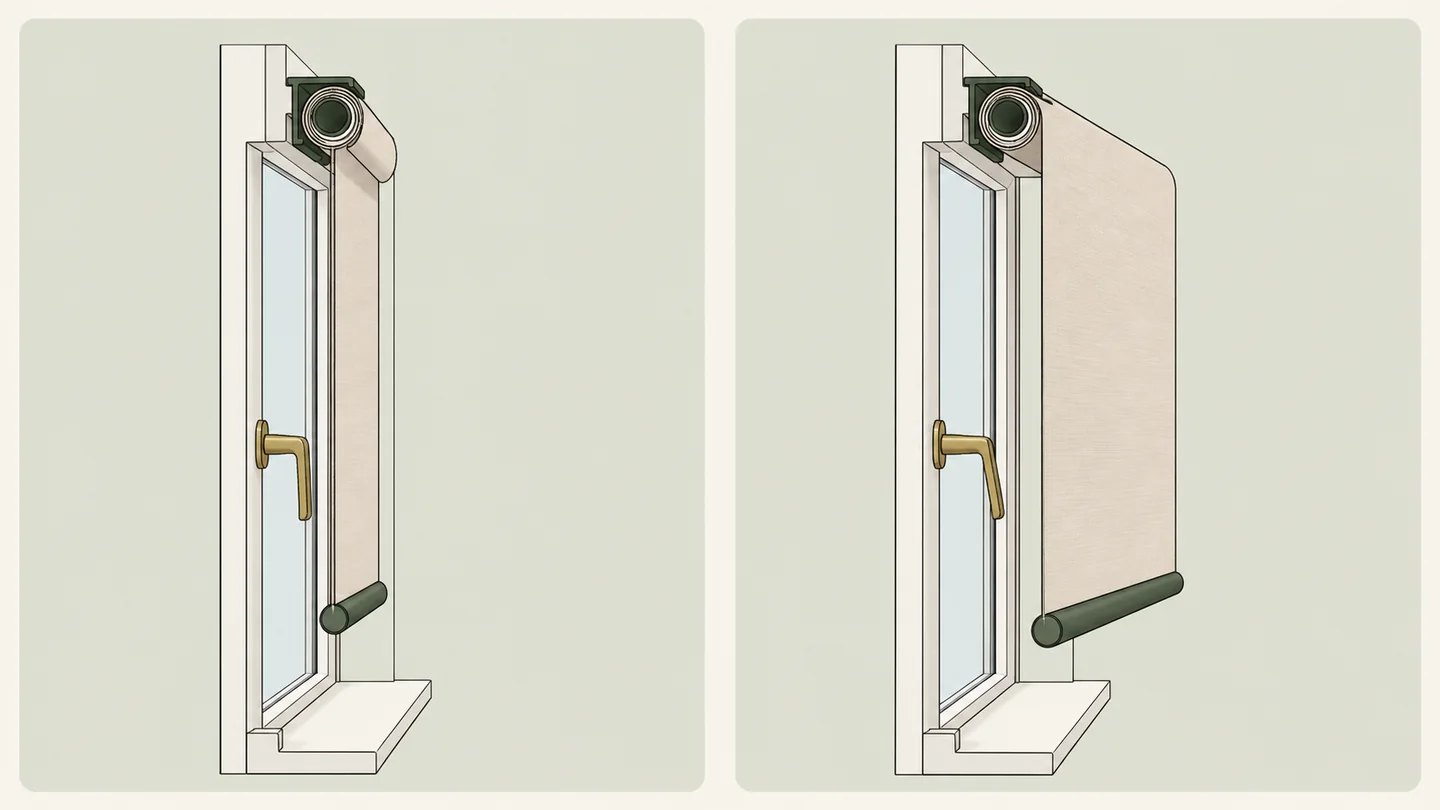
Mount direction changes the visual result. An inside treatment may preserve the outside trim but consume reveal and glass. An outside rectangular treatment can use a familiar moving mechanism while covering the circle’s outline in its closed state. The inside-versus-outside mount guide helps compare clearance and overlap; it does not turn a rectangular measurement into a circular one.
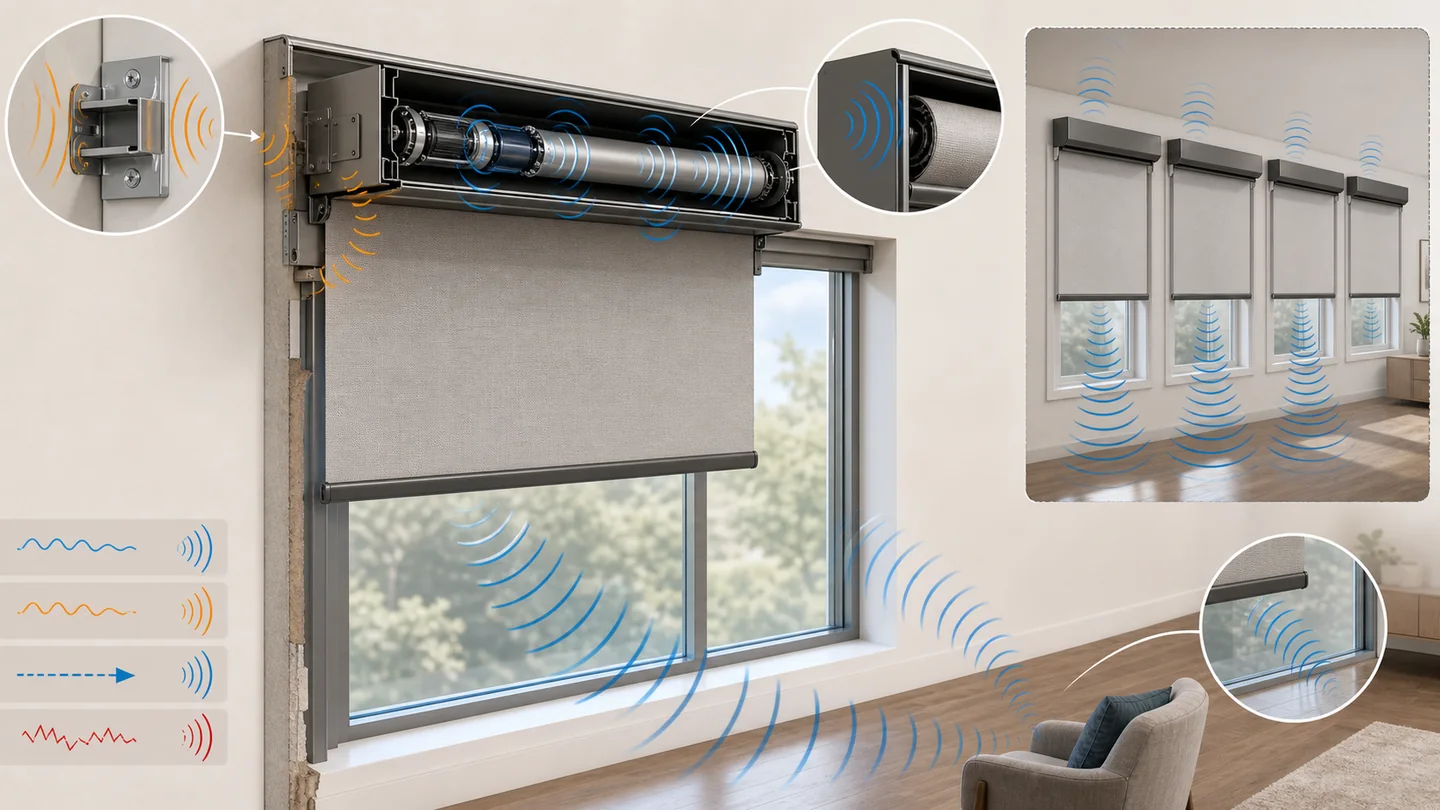
Service deserves its own path around the ring. Show how a fixed insert releases, how a shutter frame or panel opens when glass needs cleaning, how a battery or charging point is reached, and which parts must remain removable after paint, trim or furniture is finished. If the circle sits high or belongs to a larger glazed elevation, carry power, grouping and professional access into the large-opening planning guide rather than accepting “remote controlled” as a maintenance plan.
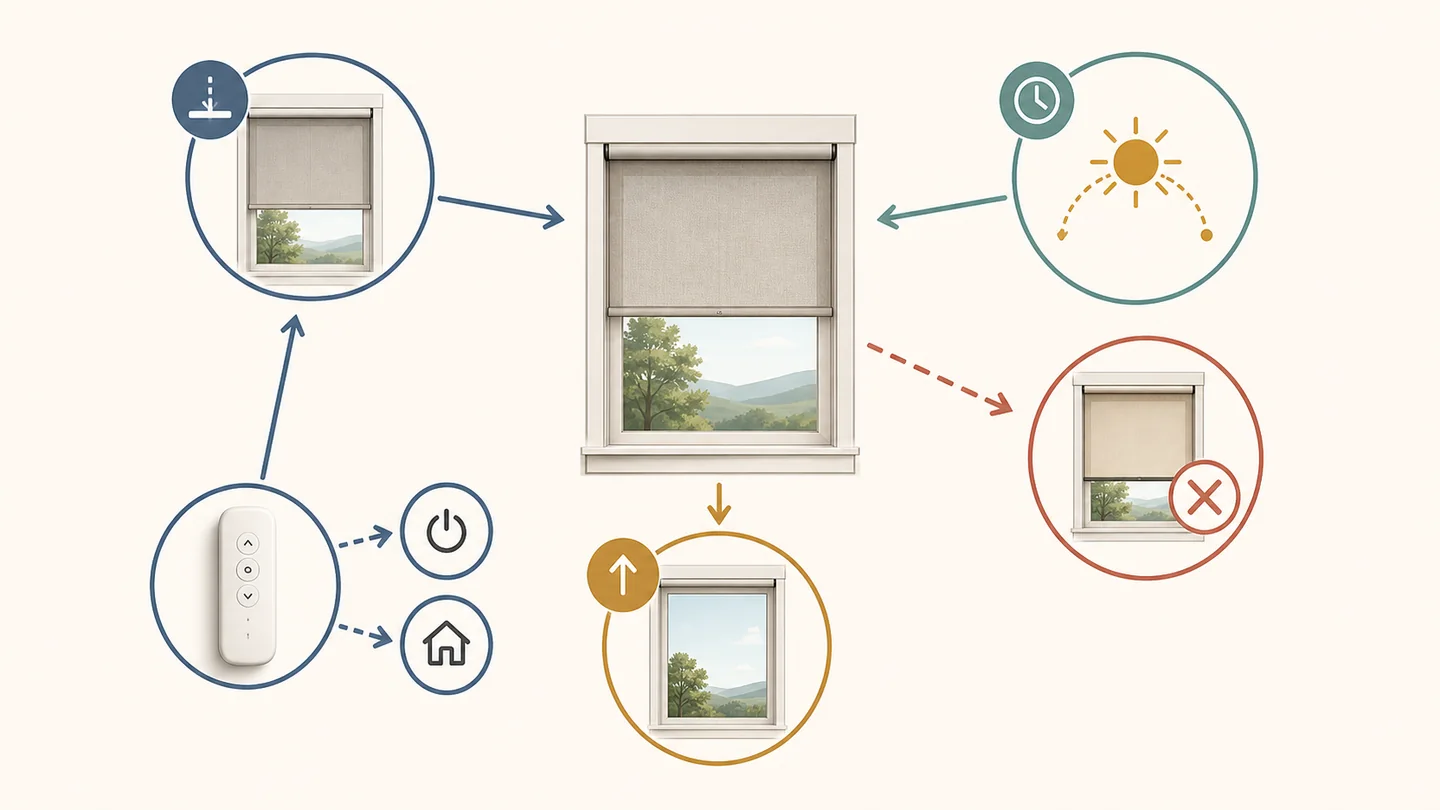
For a claimed movable shaped treatment, ask what happens without the primary control. The answer may be a local button, a documented manual method, service-only recovery or no movement until power returns. None should be guessed from another motor family. The exact current manual and quote must identify the control, power source, reset point, permitted fallback and removal direction.
Send back one circle with nothing left implied
Give the supplier one page for each opening, not a folder of unlabeled photos. Put the window ID beside a straight-on image and require the returned version to show:
- the accepted shape and fabrication authority;
- visible glass, mounting ring, frame or rail and finished perimeter;
- the clear, filtered and private states you requested;
- what stays in the circle and where material parks or is stored;
- the exact control, power and ordinary user action; and
- cleaning, release, reset, removal and future service access.
Read the returned page from the clear state first. If the proposal is fixed, the drawing should admit that the circle never clears. If it tilts, the frame and louvers should remain visible. If it is removable, the removal and storage task should be believable for the real user and height. If it moves, every piece erased from the glass needs a physical destination on the drawing.
Finally, take a pencil eraser to the covering shown in the clear-state elevation. Can you erase it from the glass and still point to the real rail, roll, stack, pocket or storage place that receives it? If the covering vanishes on paper but has nowhere to go, the quote does not include a fully clear round window. Keep the order open until it does.