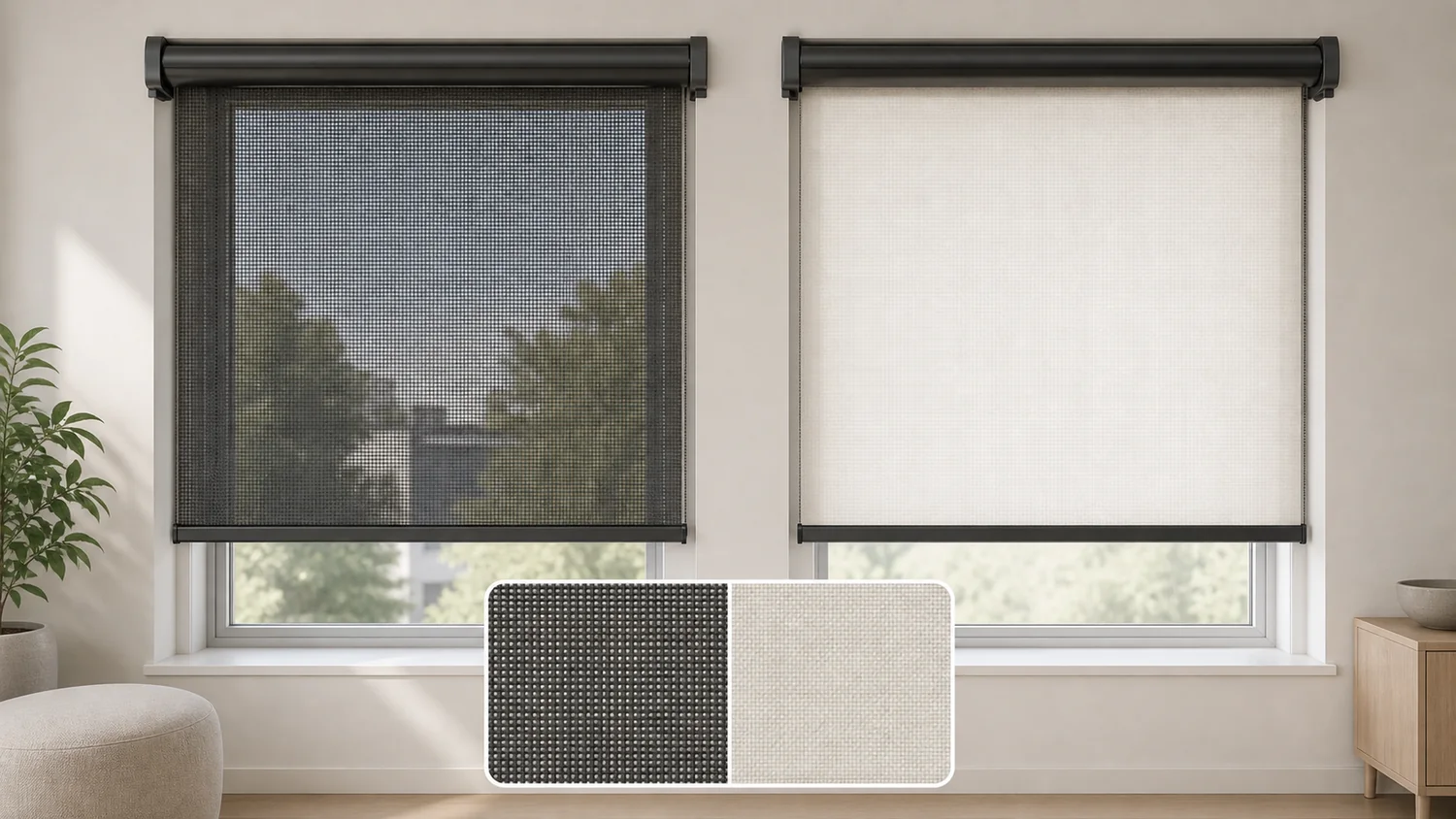
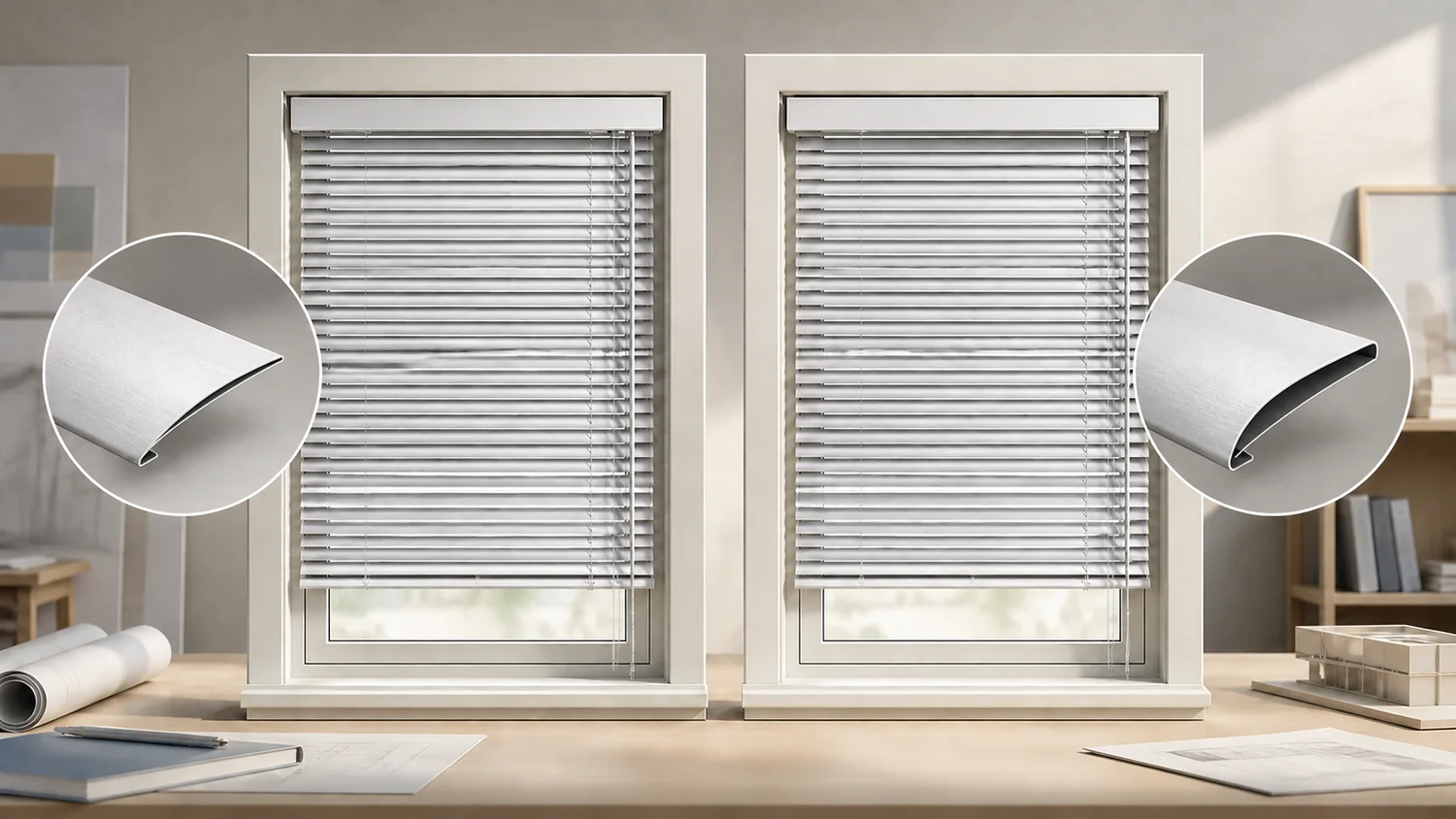
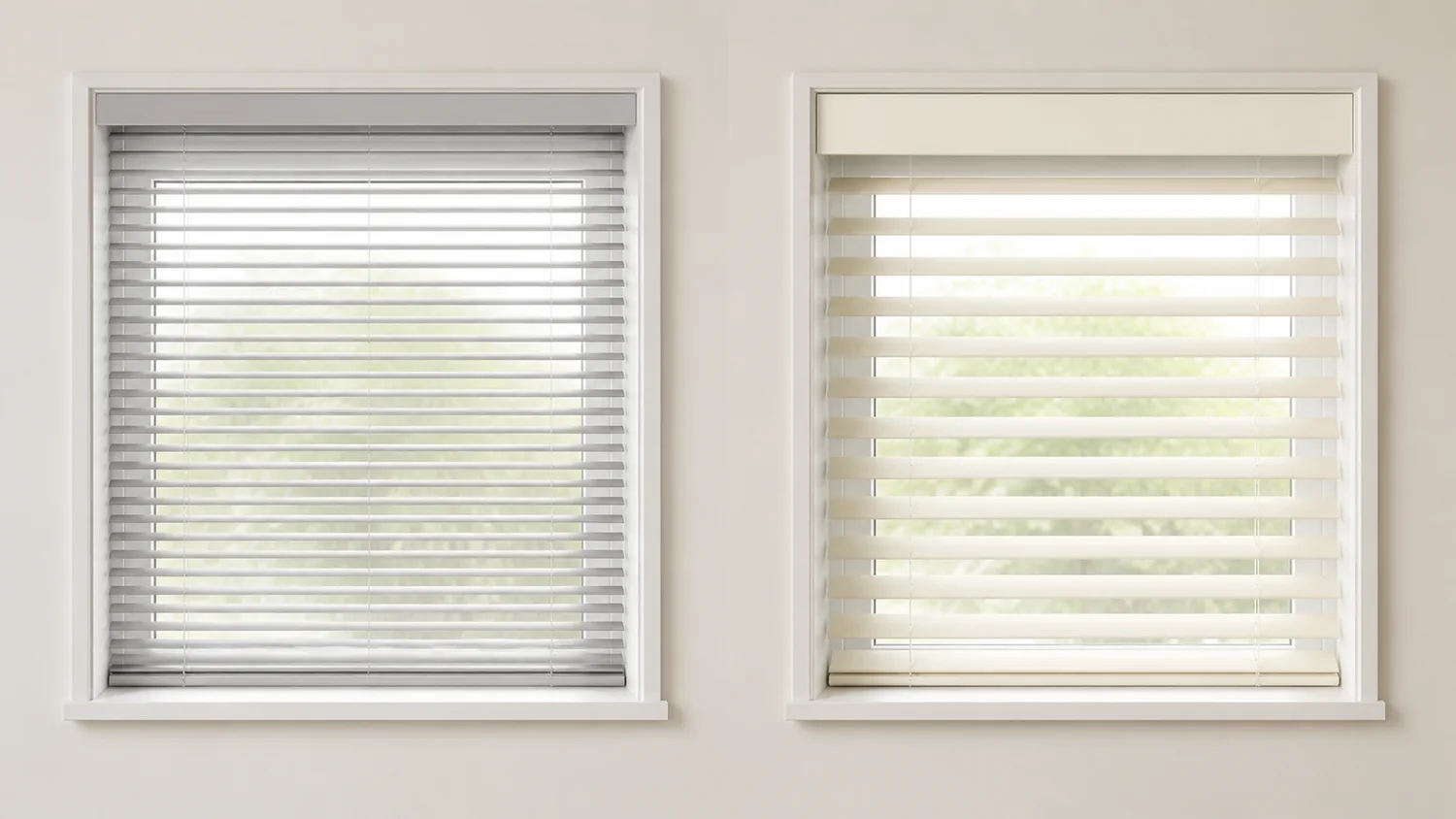
A surface can be easy to wipe and still make a difficult window. Smooth horizontal slats may tolerate a simple method, but every slat has a top, underside and edge. A roller shade offers one broad face, yet an exact fabric may allow only gentle dusting. The word easy is incomplete until the mess and the permitted method are named.
The easiest-to-clean blinds are the exact products whose approved care can remove your dominant mess from every area you can realistically reach. Judge four things together: what lands on the covering, how many faces or folds hold it, what the manufacturer permits for that product and finish, and whether the method is practical after installation.
Match the mess before you name the material
Start at the window, not in a product category. Loose bedroom dust, pet hair, a greasy kitchen film and splash marks are different maintenance jobs. A format that is convenient for one may be awkward or unsuitable for another.
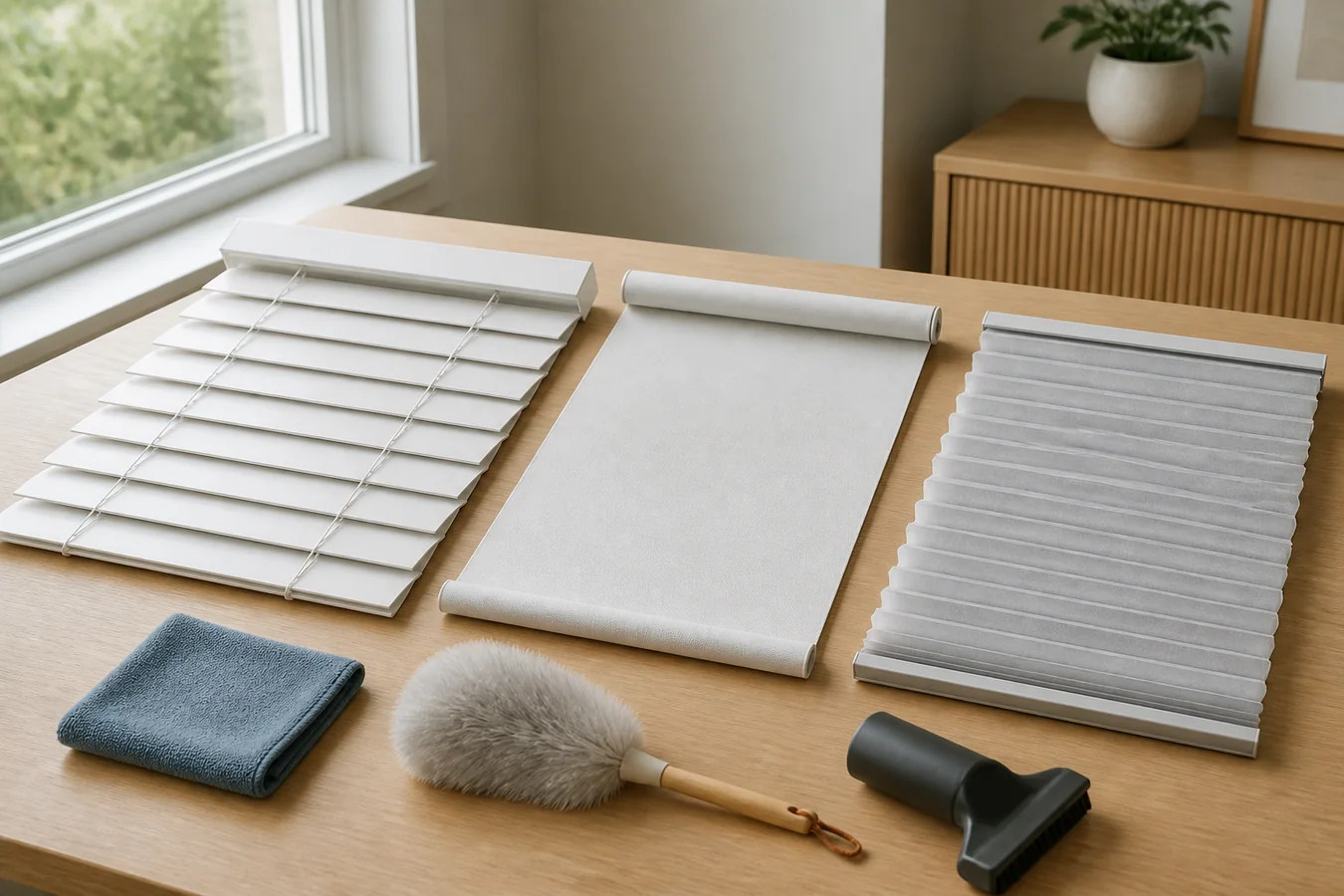
The image shows horizontal slats, a flat roller panel and a cellular sample beside ordinary dry-care tools. It is a geometry comparison, not a cleaning test or ranking. The samples do not establish which method their real manufacturers allow.
| Dominant mess | A lower-burden candidate must prove | Exact evidence to request | Burden a product photo can hide |
|---|---|---|---|
| Loose dry dust | The exposed surfaces can be reached with a permitted duster or low-suction brush method | Product or fabric care page; attachment and suction limits where stated | Slat undersides, pleat edges, ladder tapes, folds and the rear face |
| Pet hair or lint | The texture and seams release the material under an approved dry method | Exact fabric or finish identity and dry-care instructions | Hair caught at seams, inside folds or where the tool cannot pass without bending the covering |
| Fingerprints or occasional splash | The exact finish permits a practical spot or damp method and keeps operating parts protected | Allowed cloth, water or cleaner; blot-versus-wipe rule; headrail and motor exclusions | A rear surface behind a handle, a rail that must stay dry or a mark that cannot be treated locally |
| Cooking film | The maker documents a method for ordinary residue on that exact material and finish | Current care sheet plus any location, moisture and warranty cautions | Porous texture, layered folds, repeated slat faces and an installed position that cannot be wiped safely |
| One visible spot or recurring dampness | The spot method is explicitly permitted, or the moisture source is corrected before fabric care | Product-specific spot-cleaning rule; window or moisture investigation when dampness returns | Cleaner areas, rings, distortion, absorbed odor or a wet window that recreates the problem |
The matrix does not award a winner. It identifies what the winning product must prove. If the needed method is missing from the current instructions, treat cleanability as unresolved rather than borrowing a method from a similar-looking blind.
Count every face, fold and blind spot
Cleaning burden is the whole installed object, not one square inch of sample.
- Horizontal blinds divide the window into repeated slats. Each has two broad faces, edges and overlaps; ladder cords or tapes add narrow areas. Wider, smoother slats may change the motion, but they do not erase the repeated surfaces.
- Vertical blinds replace horizontal slat rows with separate hanging vanes. Each vane still has a front, back and edge, while the carrier and headrail remain separate service areas.
- Roller shades present a large continuous face when lowered. That can simplify access, but the exact textile or screen determines whether dusting, vacuuming or spot treatment is permitted.
- Cellular and pleated shades add pleat edges, and open cells can hold loose debris. Their care belongs to the precise fabric and construction, not to the honeycomb name alone.
- Roman and layered shades create folds, seams and overlapping material. Those details may be the point of the design, but they are also part of the maintenance route.
Now add the window. A covering behind a faucet, above a stair landing or partly hidden by furniture can be hard to maintain even if the sample looks simple. Include the back, bottom rail, valance or cassette, control side and any area that must be lowered, tilted or removed to reach. “One flat panel” is not low maintenance if half of it cannot be approached safely.
A family name cannot grant a cleaning method
Broad category advice fails because permissions vary inside the category. Hunter Douglas’s current home-care guidance presents dusting, gentle vacuuming and cool air as common methods, then lists product- and fabric-specific exceptions. Some products should not be spot cleaned; some require special handling; warm or hot air is not a general shortcut.
Graber’s cleaning matrix makes the same point another way. Dusting, vacuuming, spot cleaning, water immersion, ultrasonic cleaning and special instructions are not checked uniformly across cellular shades, horizontal blinds, roller shades, vertical blinds, wood blinds and faux-wood blinds. A format name does not grant every method in the table.
LEVOLOR’s current general reference likewise directs owners to product charts and notes that certain horizontal shading and cellular fabrics should not be spot cleaned. The useful rule is not “fabric can never get wet” or “hard slats are always wipeable.” It is: identify the exact line, material, color or finish, then read the method and exclusions attached to that identity.
For each candidate, save five fields:
- exact product line, fabric or slat material, and finish;
- allowed routine method and tool;
- allowed spot or deeper-cleaning method, if any;
- prohibited moisture, heat, cleaner, pressure or professional process;
- separate rules for the headrail, motor, tapes, valance and other operating parts.
If you already own a honeycomb product and need a procedure rather than a purchase comparison, use the cellular-shade cleaning guide. It separates face dust, debris inside a cell, an isolated spot and recurring moisture. Those steps should not be copied to a new product until its own care owner agrees.
Rehearse the route with the blind still installed
The permitted method must work where the covering will live. Rehearse the route before placing the order; no dirt or cleaner is required.
- Stand where routine cleaning would begin and confirm that you can reach the top, center, lower edge and control side without climbing on furniture or leaning over a hazard.
- Lower, raise or tilt the proposed format in your mind and note which rear faces, slat overlaps, folds or cell openings remain hidden.
- Trace the tool path around handles, locks, faucets, shelves, screens and trim. A brush or cloth needs room to move without loading the fabric or striking hardware.
- Identify what must stay dry. Headrails, motors, charging points and electronics do not inherit the surface material’s care permission.
- Ask how the covering is removed and reinstalled if a professional method or off-window care is ever required. Record who can do it and whether the product must be re-tensioned or serviced.
A high or over-sink window sometimes makes motorized operation attractive, but motion is not cleaning access. If the physical choice is between a motorized slatted blind and a motorized shade, the smart-blinds-versus-motorized-shades comparison separates those constructions. Add the cleaning route only after the exact format, motor, power and service path are known.
The room changes what “easy” means
In a kitchen, locate the window relative to the sink, cooking area and touched work surfaces. Greasy airborne residue may need a different documented method from loose dust; splash exposure also introduces rail, finish and reach questions. The kitchen-blinds guide keeps cooking safety, ventilation, privacy and control beside the cleaning decision. A wipeable sample does not make an unsafe or unreachable installation acceptable.
In a bathroom, the recurring issue may be condensation rather than food residue. A surface that tolerates an approved wipe still needs suitable hardware, drying conditions and privacy. The bathroom-window-treatment guide treats moisture at the exact window as its own constraint. Cleaning the covering repeatedly does not correct a glass, sill or ventilation condition that keeps it damp.
In a drier bedroom or living room, ordinary loose dust may dominate. A product whose exact guide permits a light dry method can be a better fit than a nominally wipeable option with many hard-to-reach pieces. That does not make every fabric shade easier; it narrows the evidence to the actual soil instead of importing kitchen rules into the whole home.
Maintenance cannot cancel the window’s real job
Low maintenance is one duty, not permission to ignore the others. Smooth slats may be practical to wipe yet introduce more edge gaps or a raised stack you do not want. A flat shade may reduce repeated surfaces yet fail a night-privacy test or require a fabric whose allowed cleaning is too limited for the room.
The broad blinds-versus-shades comparison starts with the light state and privacy state the window must hold. Use it if cleaning has pushed you toward a different physical format. Then return to the exact candidate and verify finished gaps, mount, handles, stack, controls and service access. Do not trade an awkward cleaning burden for a covering that misses the reason the window needs treatment.
Color and texture also affect what you notice, but appearance is not a dirt-repelling claim. View the exact sample in the room’s daylight and evening light. Ask whether the sample has the same coating, backing and finish as the order. A seller’s generic swatch or styled photo cannot prove the cleanability of a different finished configuration.
Put the method on the exact order
A shortlist is ready only when the care method can travel with the exact order. Write one closed maintenance sentence for each finalist. It must name the dominant mess; the exact product, material, color and finish; the permitted and prohibited methods; headrail, motor or professional-care limits; every surface you must reach; and the light, privacy, operation and service duties that remain intact.
If a field is blank, the candidate has not earned an easy-clean label. Ask for the exact document, change the material or format, move the treatment away from the exposure, or price professional care as part of ownership. Do not fill the blank with a method from another brand or product family.
The easiest-to-clean blind is the one whose real mess, visible geometry, permitted care and installed access agree. Once those four pieces close—and the covering still performs its other jobs—you have a low-maintenance configuration rather than a low-maintenance slogan.