A bus brakes outside, you lower the shade, and the sound stays almost as sharp. Buying a thicker product labeled “soundproof” may still miss the problem. A soft shade can absorb some sound that is already inside a room, while traffic noise reaching you through glass, sash or gaps is a transmission problem.
Do not choose soundproof blinds until you separate those two jobs. If the room itself rings or speech lingers, an absorptive covering may help the room side. If a distinct exterior sound remains at the window, inspect the complete window path and require evidence that describes sound transmission—not only an absorption score. No ordinary blind turns a leaky or lightweight window into a sealed acoustic assembly.
Start with the sound, not the shade
Room echo and sound entering from outdoors can exist at the same time, but they do not reward the same purchase. OSHA’s technical noise-control guidance distinguishes absorptive materials, which reduce reflected or reverberant sound, from barriers that interrupt a transmission path. It also notes that absorption does not reduce sound traveling directly from a source.
That distinction changes the first question. Clap once or speak from the normal listening position in a quiet room. A bright, lingering response points toward room-side absorption. A passing truck, conversation or mechanical tone that is strongest near the window points toward the exterior path. This is a practical observation, not an acoustic measurement, and it cannot produce a decibel prediction.
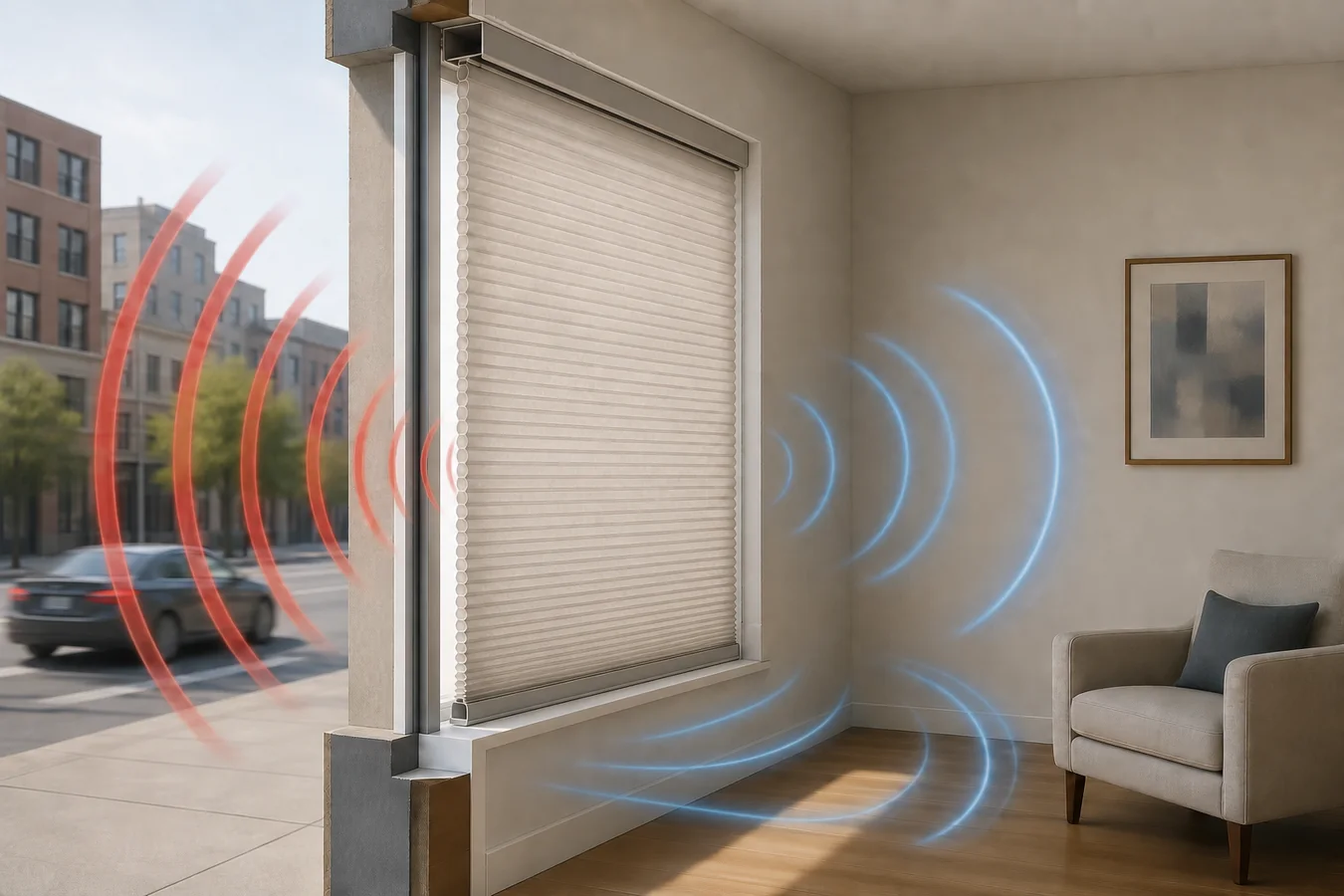
The illustration keeps the paths separate: the lowered cellular shade is a soft interior surface, while the exterior wave still has to cross the whole window assembly. The shade may affect what happens after sound enters; it does not erase the glass, frame, sash or perimeter.
Let one open-and-closed comparison choose the next question
Use one repeatable noise event if possible: the same fan outside, the same road period or the same speaker position in an adjacent space. Listen from the same chair with the existing shade fully raised and then fully lowered. Do not move the listener, change a second treatment or treat a phone app as a laboratory meter. You are looking for a direction, not a score.
| Observation | Likely next question | Evidence to seek | Purchase route |
|---|---|---|---|
| Room sounds lively even without the exterior source | Would another soft, deployed surface reduce reflections where people listen? | Absorption data for the exact covering plus realistic deployed area | Compare a soft shade or an additional room treatment for absorption, not “soundproofing” |
| Closing the shade softens the room but the outside source stays distinct | Is the remaining problem passing through the window assembly? | Window-path inspection and transmission evidence for any proposed assembly | Treat the shade as secondary; investigate glass, sash, frame and perimeter first |
| A rattle, whistle or edge hot spot accompanies the noise | Is there movement or an opening at a serviceable part? | Exact window condition, safe service scope and repair responsibility | Pause the blind upgrade until the window path is understood |
| The fully lowered shade makes a repeatable, useful difference | Does the proposed replacement preserve the construction, coverage and fit that produced it? | Exact product, mount, edge coverage and relevant acoustic test record | Compare completed configurations; do not transfer the observation to a category label |
| The result changes with source or pitch | Is the claim hiding frequency-dependent performance? | Frequency-band data and the tested specimen, not one unqualified number | Hold the acoustic claim until the record matches the troublesome sound |
A subtle difference may be real, expectation or a change in room reflections; this comparison cannot distinguish them. Its value is narrower: it prevents a category page from deciding the noise path for you.
Read acoustic evidence without swapping the metric
An acoustic number is useful only when it answers the job you have. NRC and absorption coefficients describe how a specimen absorbs incident sound in a defined test. Transmission loss, STC, OITC or an installed level difference address different questions about sound crossing an assembly. They are not interchangeable labels for “quieter.”
| Claim element | What it can support | What it cannot support alone | Required record |
|---|---|---|---|
| NRC or absorption coefficient | Room-side absorption for the tested specimen and frequencies | Exterior noise blocked through the complete window | Test method, product construction, deployed state and frequency values |
| Transmission-loss, STC or OITC record | Sound crossing the named tested assembly under the stated method | A different window, mount, size, seal or field installation | Complete specimen, glass/window/shade combination, mounting and rating method |
| Claimed dB or percentage change | Only the exact comparison defined in its test | Your room, source spectrum or installation | Baseline, endpoint, source, frequency range, distance, specimen and procedure |
| “Thick,” “cellular” or “acoustic” | A reason to request evidence | Any numeric or whole-room result | The exact product-level test, if one exists |
A useful manufacturer example shows the boundary. A Hunter Douglas Duette FR document reports octave-band absorption coefficients and an NRC of 0.60 for named product configurations. That is stronger than a bare “noise reducing” label because it identifies a metric and product scope. It is still absorption evidence from a manufacturer document for those configurations—not proof that any cellular shade will cut exterior traffic by a stated number of decibels.
When a seller gives one attractive number, ask for the document behind it. If the document does not identify the exact product, test standard, specimen, mounting and frequency scope, leave the acoustic result unresolved. Missing evidence is not proof of poor performance; it is a reason not to pay an acoustic premium yet.
The window can outrank the blind
Sound follows weak paths. OSHA’s guidance explains why openings and gaps compromise barriers, and NIST’s research on residential walls, doors and windows found that cracks and openings can seriously reduce window sound isolation. The historical test program does not predict a particular home, but it makes leakage a first-order variable rather than a minor detail.
Listen and inspect without dismantling anything. Does the sash rattle when a vehicle passes? Is the sound concentrated at an operable edge, meeting rail or visible gap? Does the window close and latch normally? Is there damage, water entry or failed hardware? A safe, documented adjustment or repair may belong to the window owner or a qualified professional. Do not seal drainage paths, emergency egress or unfamiliar moving parts as an improvised acoustic fix.
A shade mounted in front of the opening can add another layer and change the room side, but its edge gaps remain. If the purchase is being justified as a barrier, request evidence for the complete tested combination, not the fabric center alone. The broader energy-efficient blinds guide addresses thermal fit and perimeter effects; those measurements are useful context, but thermal performance is not acoustic proof.
Soft, hard and layered treatments change different parts of the room
Soft, fully deployed treatments are the sensible shade category to investigate when room absorption is the job. Cellular fabric, lined Roman fabric or a separate drapery layer can present more absorptive area than hard, open slats. Hunter Douglas likewise says no window treatment literally soundproofs a room and describes soft treatments as absorption options while noting the gaps in hard slatted products. Treat that as manufacturer guidance, then ask for exact evidence.
Construction still matters more than the family name. A sheer single layer, a cellular product, a lined Roman shade and a tightly pleated drapery do not expose the same material area or close the same perimeter. The roller, cellular and Roman comparison can narrow the physical format. For a direct roller-versus-cellular purchase, use the same-window comparison to keep roll, stack, edges, care and controls attached to the exact order.
Layering may add room absorption and coverage, but it also adds depth, visual weight, cleaning, controls and service paths. It does not turn two untested products into a tested sound barrier. Admit the second layer only if it has a defined job—such as room absorption, nighttime privacy or darkness—and the mount can support it.
Keep the shade’s other jobs in the decision
A covering that slightly softens a room can still be the wrong purchase if it destroys the view, misses nighttime privacy, blocks a handle or becomes impractical to operate. Return to the room-by-room shade planner and keep the window’s hardest requirement beside the sound goal.
For an office, speech comfort may matter alongside screen glare, camera exposure and shared control. The office-blinds guide owns those visual and operating scenes; an acoustic label does not override them. In a bedroom, define darkness and night privacy separately. For any motorized option, verify size eligibility, power, local control and service access just as you would without an acoustic claim.
Compare the exact deployed configuration, not a loose swatch. Ask how much of the window the fabric covers when the noise occurs, where the edges sit, whether the tested configuration includes side channels or another layer, and whether the product can remain in that state when the room is used. An impressive lab record for a setup you will not install is not decision evidence.
Spend in the order the noise path earns
The goal is not to make one blind win. It is to put the first dollar on the part of the problem for which you have evidence.
| Dominant evidence | First spend | Condition before buying | What remains unresolved |
|---|---|---|---|
| Room echo is the main complaint | A suitable soft shade or another absorptive room surface | Exact absorption record where claimed, enough deployed area, and acceptable light/privacy | Exterior sound transmission |
| Outside sound clusters at a rattle, crack or operable edge | Window-condition assessment or documented repair path | Owner, safety and repair scope are clear | Performance after the path is corrected |
| Outside sound remains through a closed, apparently sound window | Exact assembly evidence or an acoustic-window assessment | Tested specimen, mount, rating and frequency scope match the decision | Field result until the complete installation is known |
| A current soft shade helps, and its other duties pass | A completed replacement configuration that preserves the useful traits | Construction, coverage, fit and evidence are not inferred from the category | Any performance difference between old and new products |
| The claim has no accessible exact test record | None on the acoustic premium | Obtain the record or judge the product only on its proven non-acoustic duties | The advertised noise benefit |
If the room needs less echo, buy absorption evidence. If the sound enters at the window, buy knowledge of that path before buying a blind. When both are present, give each its own budget and acceptance condition. “Soundproof” is not the result; a matched problem, exact configuration and bounded test record are.