Kitchen blinds rarely become a bad purchase because the color was slightly off. Trouble usually starts when the blind above a sink is chosen by the same rules as the one in a dry breakfast nook. One catches splash, condensation and frequent fingerprints; the other may deal mainly with afternoon glare and a view from the patio.
Treat each window as its own small project. Name the mess it will face, ask for the exact product’s cleaning instructions, and settle cooking safety before comparing style. Then check privacy, fit and operation. If the seller cannot document an allowed cleaning method for the quoted material and finish, that option is not ready for the shortlist.
Give every kitchen window its own job
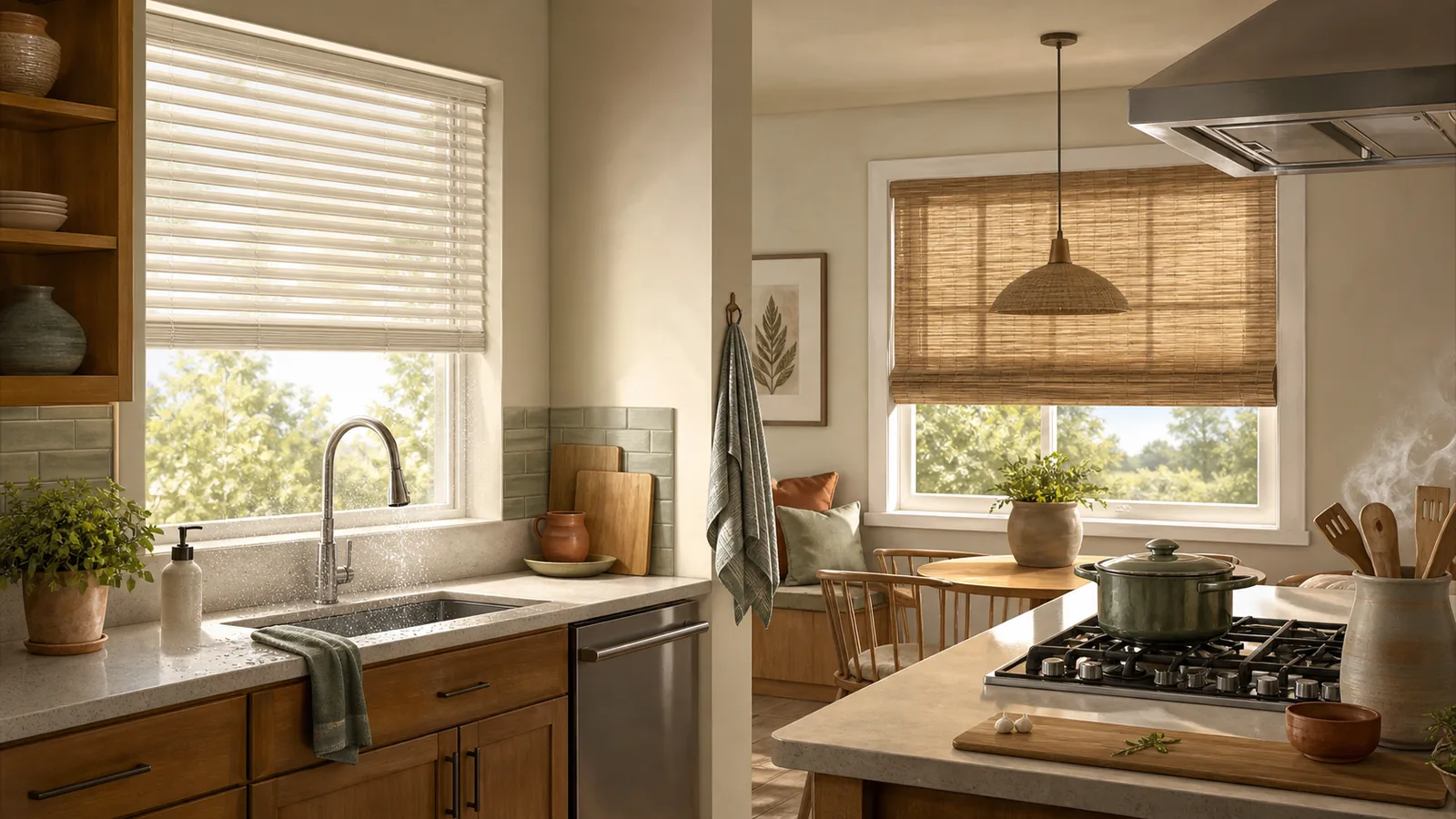
Walk the room while it is being used, not just when it is tidy. A window over the sink may be splashed and may show condensation after dishwashing. A window beside a cooking area can collect airborne residue even when it never receives a direct splatter. A prep counter or back-door window may be touched often. A breakfast-nook window can stay comparatively dry but create difficult glare or nighttime privacy.
- Sink or dishwasher window: tolerate the cleaning method you will actually use and stay operable around the faucet, handles and wet counter.
- Cooking-area window: remain outside the cooking hazard and have a documented way to remove ordinary residue.
- Prep or traffic window: cope with frequent touch and avoid controls that interfere with food preparation or passage.
- Dry nook or patio window: handle the real glare, view and privacy condition without borrowing unnecessary constraints from the sink.
The smart shades room-by-room guide explains how kitchen choices fit the rest of a home plan. Here, the room label is only the starting point; window location makes the final cut.
Use the exposure table before you compare materials
| Window location | Likely issue to inspect | Reject or pause when | Evidence to request |
|---|---|---|---|
| Sink or dishwasher | Splash, condensation, fingerprints and faucet clearance | The finish or operating parts have no stated cleaning method, or the blind blocks safe use of the window | Exact material and finish, approved cleaner and method, drying instructions, rail or motor exclusions |
| Near a cooking area | Airborne residue, heat source, cleaning frequency and safe separation | The treatment could enter the cooking hazard, or the seller substitutes a generic material claim for exact instructions | Product drawing, exact layout review, care sheet and any heat or location restrictions |
| Prep counter or traffic path | Repeated touch, controls, passage and window hardware | Controls cross a work surface, remain accessible to a young child, or service requires dismantling the counter area | Control location, cordless status, removal direction, hardware clearances and service access |
| Dry nook or patio | Glare, view, night privacy and door movement | A daytime image is used as proof of night privacy, or stack and controls obstruct the door or view | Sample in the real light, finished coverage and gaps, stack position, privacy condition and local control |
This is not a material ranking. It is a way to decide what an exact quote must prove. Two products with the same broad label can have different finishes, care restrictions, rails, motors and warranty terms.
The care sheet matters more than an “easy-clean” label
“Wipeable” and “moisture resistant” sound useful, but they do not tell you what can touch the surface, whether a rail may get wet, or how a motorized headrail should be handled. Ask for the current care document tied to the exact product, material and finish on the quote.
- Confirm whether routine dusting, a damp cloth, a named cleaner or another method is allowed.
- Note whether scrubbing, solvents, steam or soaking are prohibited.
- Check whether the slats or fabric and the headrail or operating system have different instructions.
- Record how the treatment should be dried and whether the proposed method affects the finish or warranty.
The variation inside one manufacturer’s published guidance is a useful warning. Hunter Douglas gives different cleaning instructions for different blind products and cautions against steam or high moisture for the real-wood products covered by its guidance; some methods also exclude the headrail or operating system. Those details cannot be carried over to another product simply because it is also called a blind.
For a sink window, picture the weekly cleaning motion. Can the blind be reached without leaning on the faucet? Can the bottom rail be lifted clear of the wet counter? Can the treatment be removed or serviced without disturbing a backsplash or fixed shelf? A credible care method that cannot be performed in the installed position is not an easy-clean solution.
Keep the blind out of the cooking hazard
The U.S. Fire Administration advises keeping combustible items, including curtains, away from the stovetop. It does not provide a universal blind clearance, so a convenient number should not be invented for a kitchen-window article.
If a window sits behind or beside a range, document the appliance, window, trim and proposed treatment on the same drawing. Keep the choice open until the applicable appliance instructions, product restrictions and a qualified professional resolve the layout. A blind that can technically be cleaned is not acceptable if it can move into a heat or flame hazard.
Steam and condensation are separate from fire safety. The EPA recommends using kitchen exhaust to remove moisture outside and responding when moisture collects on windows or other surfaces. Ventilation may reduce the burden, but it does not turn an undocumented finish into a kitchen-safe one.
Solve privacy after you solve the mess
A treatment can pass the cleaning question and still fail the room. Stand at the actual outside observation points in daylight and again after dark with normal kitchen lights on. Decide what must be hidden: a silhouette, a face at the sink, the prep counter, the entire room or simply a direct view from a neighboring path.
Do not treat a daytime product photo as evidence of night privacy. Sheer, solar and light-filtering materials change with the light balance, while slats depend on angle and observer height. If upper daylight matters but the lower sightline needs cover, record that geometry rather than asking for a vague “private” fabric.
Glare deserves its own time and viewpoint too. A west-facing nook may need control only during dinner; the sink window may never have the same problem. That is a reason to split treatments or control groups, not to make the entire kitchen inherit the strictest window’s specification.
Smart controls still need a practical service path
An over-sink or high window can make remote operation useful, but reach alone does not prove that a motor is the better purchase. First record the opening, trim, handles, faucet arc and usable mounting depth with the Smart Shade Measurement and Compatibility Checker. Then compare inside and outside mount against finished coverage and window operation.
For any powered option, ask how it is charged or powered, which local control works without an app, how the shade is removed, and what must be reached for reset or service. Battery runtime and ecosystem support remain exact-model questions. The motorized-shade power guide separates rechargeable, solar-accessory, plug-in and professionally planned hardwired routes without pretending they are interchangeable.
Where young children are present, operation also has a non-negotiable boundary. The U.S. Consumer Product Safety Commission says cordless coverings are the safest option and warns about accessible cords. Do not add an exposed cord because it is easier to reach over the counter.
Put the winning details on the quote
Do not let the final order collapse back into “white kitchen blinds.” Give every window a line of its own.
| Field | What to record | Accepted only when |
|---|---|---|
| Window and location | A unique name plus sink, cooking, prep/traffic or dry-nook exposure | The installer and buyer are referring to the same opening |
| Exact product | Product line, material, finish and operating system | The care document applies to that exact combination |
| Cleaning method | Allowed tools or cleaners, prohibited methods, drying and operating-part exclusions | The method is practical after installation |
| Cooking boundary | Appliance, window and treatment relationship plus responsible confirmation | No treatment can enter an unresolved cooking hazard |
| Privacy and glare | Observer, time, lighting and acceptable result | A sample or documented configuration meets the named condition |
| Fit and coverage | Mount, usable depth, projection, finished gaps, stack and hardware clearance | The window, faucet, counter and passage still work |
| Control and service | Manual or cordless operation, exact power path, local control, charging, removal and reset access | Normal use and service can be completed safely |
| Open question | Missing document, sample, dimension or professional decision | The line remains no-order-yet until it is closed |
Matching every kitchen window is optional. A coherent room can use different constructions or control paths when the exposures are genuinely different. The shortlist is ready when each window has an exact cleaning method, a safe location, a stated privacy condition, workable fit and reachable service—not when every sample happens to come from the same collection.
If one line in the record still depends on “probably,” split that window from the order or keep it open. That small pause is cheaper than forcing a room-wide match that is difficult to clean, awkward to use or impossible to verify.