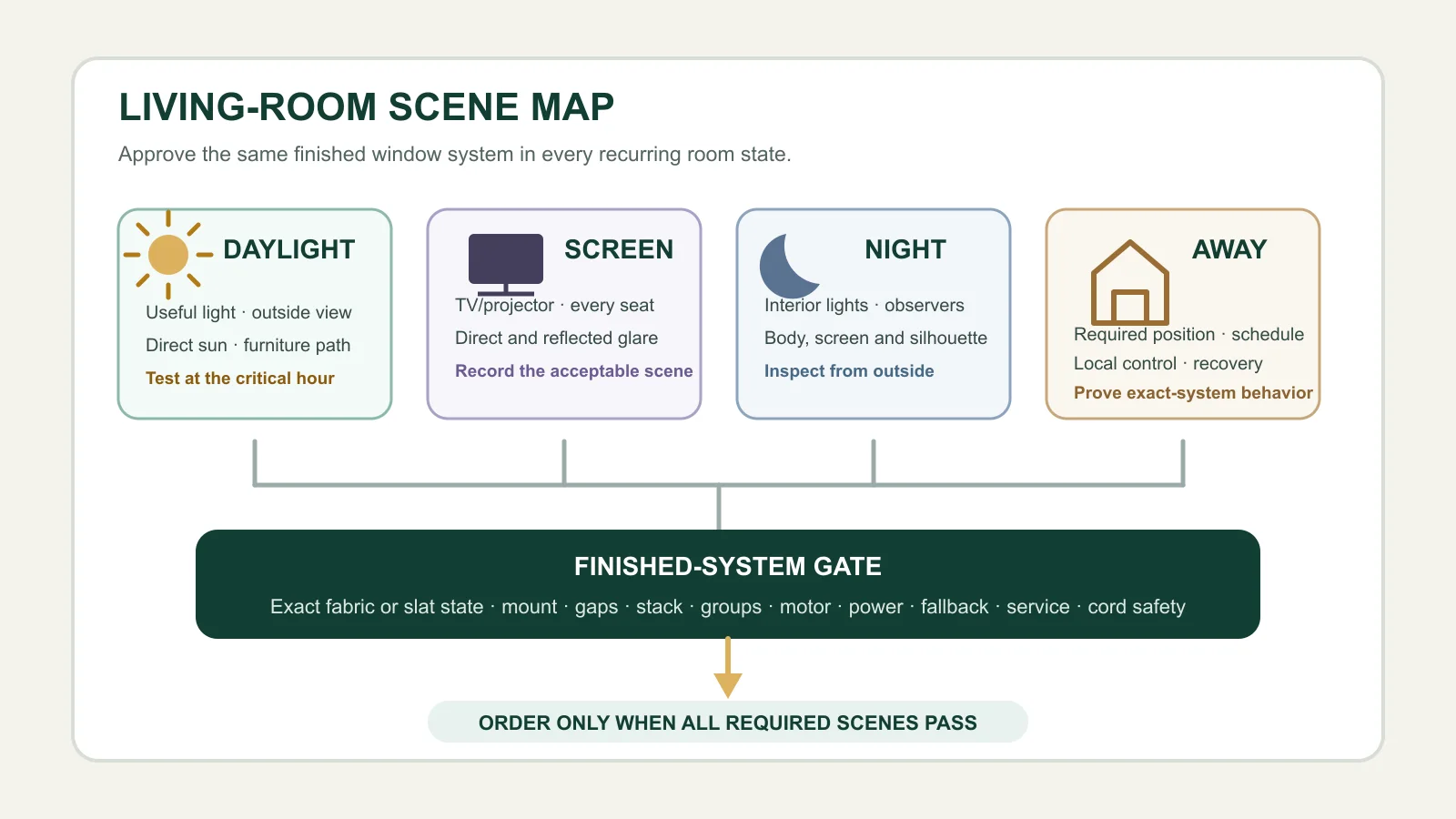
The best living room blinds are the ones that solve the room you actually use. A treatment that looks ideal in daylight can reflect beside the television, expose the seating area after dark, block a valued picture-window view, or make a sliding door awkward. Before comparing materials, draw the windows, seats, screen and exterior sightlines. Then place four scene overlays on that floor plan: daylight, TV or movie, night privacy, and away.
If one covering cannot pass all four overlays, that is useful information. You may need adjustable slats, a solar or light-filtering daytime layer, an opaque second layer, different treatment groups, or a simpler manual path. The plan should reveal that conflict before color, motor brand or styling commits the order.
Put the furniture and sightlines on paper
Sketch the room as viewed from above. Mark each window and glazed door, compass direction if known, television or projector screen, primary seats, walkways, frequently opened sash, and door swing or sliding passage. Outside the walls, mark realistic observers: sidewalk, neighboring window, driveway, porch or shared garden.
Draw arrows for direct sun and for reflected light from pale floors, neighboring glass or water. A second arrow should connect each exterior observer to the seating or activity they could see. This geometry is more valuable than a list of fashionable treatments because it tells you where a covering must redirect light, interrupt a view, clear a passage or preserve a picture-window outlook.
The broader smart-shades room-by-room planner is the pillar for coordinating different spaces. This page goes deeper on the living room, where several people, activities and windows often share one control plan.
Use four overlays, not one wish list
| Overlay | Keep visible | Block or reduce | Record as a pass |
|---|---|---|---|
| Daylight | Useful sky, view and comfortable room brightness | Harsh direct light and unwanted street sightlines | Normal activities work without closing the room unnecessarily |
| TV or movie | Screen detail and safe movement around the room | Direct beam and bright reflected fields at every main seat | The screen remains comfortable during the critical viewing period |
| Night privacy | Interior circulation and any deliberately retained exterior view | Faces, activities and silhouettes from named outside positions | The household’s stated detail threshold is met with normal lamps on |
| Away | Nothing that conflicts with the security preference | Direct views of occupancy, valuables or room layout | A reachable local action or verified schedule puts every group in its chosen state |
Keep the overlays separate long enough to find contradictions. “Bright all day” may conflict with “no street view after dusk.” “Preserve the picture window” may conflict with “hide the screen reflection at 4 p.m.” A single adjective such as private, light-filtering or smart cannot resolve those competing conditions.
The daylight sheet protects more than brightness
On the daylight overlay, mark where people read, talk, play or walk and which portions of the view matter. A large picture window may be valuable precisely because it connects the room to the outside. Hunter Douglas’ current picture-window guide identifies view, privacy, afternoon glare and stack as distinct considerations. That is the right frame: do not solve one by silently sacrificing the others.
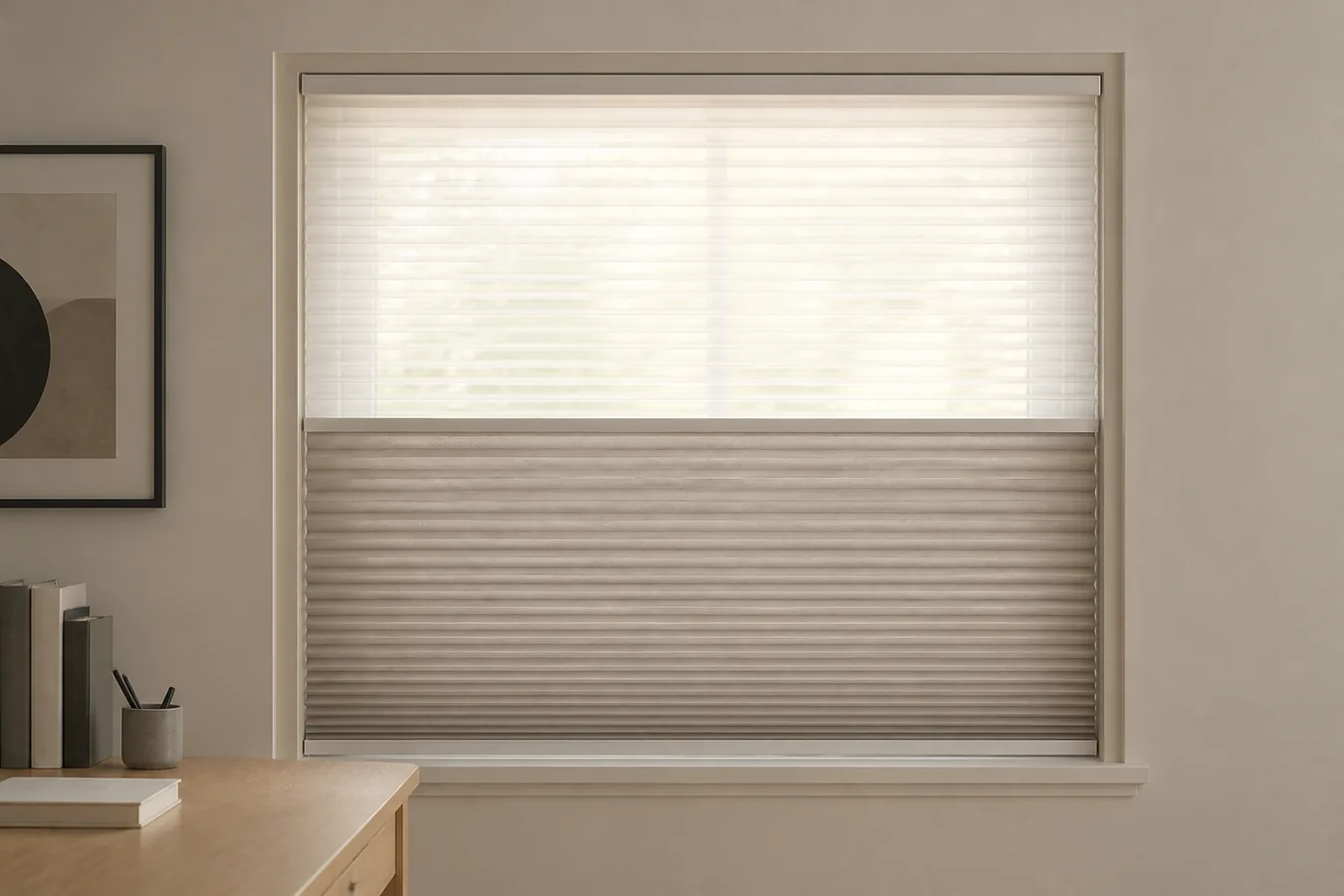
Try zones rather than assuming every window must move together. A high or sunny pane may need diffusion while a shaded pane remains open. Directional slats can interrupt a low sightline; a top-down/bottom-up configuration can cover the observer line while retaining upper daylight. The top-down bottom-up shade planner is useful when the privacy horizon, not total glass coverage, defines the problem.
The screen sheet begins at the viewer’s eyes
Sit in every primary seat during the hour when the screen problem occurs. Mark whether the disturbance is a direct sun beam, a window reflected on the display, a bright fabric beside it, or ambient light washing out the image. These failures do not always share a solution.
Lower or angle a sample through several positions and record the smallest intervention that works. A denser light-filtering material may reduce a direct view yet remain a bright reflection. A solar screen can preserve some daytime outlook while managing sun, but openness, color, night privacy and finished gaps remain exact-product questions. Use the motorized solar-shade glare and view trial when that route becomes the leading candidate.
A movie setting does not automatically require blackout. Define the desired screen contrast and room atmosphere, then test the actual display and seats. If darkness is a hard requirement, include edge light, inter-panel gaps and door glazing in the acceptance—not only the center fabric.
The night sheet is drawn from outside inward
After dark, turn on the lamps normally used in the living room and visit each exterior observation point on the plan. Note whether an observer can see a glow, silhouette, clothing, face, activity or valuable object. Move near and away from the covering. A fabric that looks private from the sofa may reveal more when a person stands close to it.
Do not infer night privacy from a daytime product photo or from a label such as sheer, solar or light filtering. Directional slats and partial-height coverage also depend on observer height and angle. If the night overlay demands greater coverage than the daytime layer can provide, layering is not an aesthetic extra; it is the architecture that separates two incompatible jobs.
The away sheet needs a dependable action
Decide what “away” means for this household. It might close every street-facing group, leave selected upper daylight, conceal a television, or avoid a visibly identical daily schedule. The covering does not create security by itself; the overlay simply ensures the chosen privacy state can be reached without walking window to window.
If automation is proposed, identify the exact trigger and what happens when the gateway, cloud service or internet is unavailable. A dedicated remote or wall control may be more important than an elaborate integration. The away state should remain reachable locally and should not depend on an unverified assumption about every motorized product.
Let all four sheets vote on the covering path
- Directional slats or shutters suit rooms where changing the sightline is more valuable than uniformly covering the glass.
- Solar or light-filtering shades can lead when daytime glare or diffusion matters and the exact sample passes the relevant view and privacy scenes.
- Room-darkening material belongs where the TV/movie overlay or night privacy requires a substantially dimmer state.
- Layered day/night coverage is coherent when no single material preserves desired daylight while meeting the night threshold.
- Manual cordless operation is often enough when shades are reachable, infrequently changed and do not need coordinated timing.
- Motorized groups and scenes earn their place when several openings must reach different repeatable states as activities change.
Graber’s current living-room guide connects selection with window location, room use, light/privacy, safety and layering. Use those categories as prompts, not as proof that an unnamed material will pass your overlays.
Large panes and doors can redraw the plan
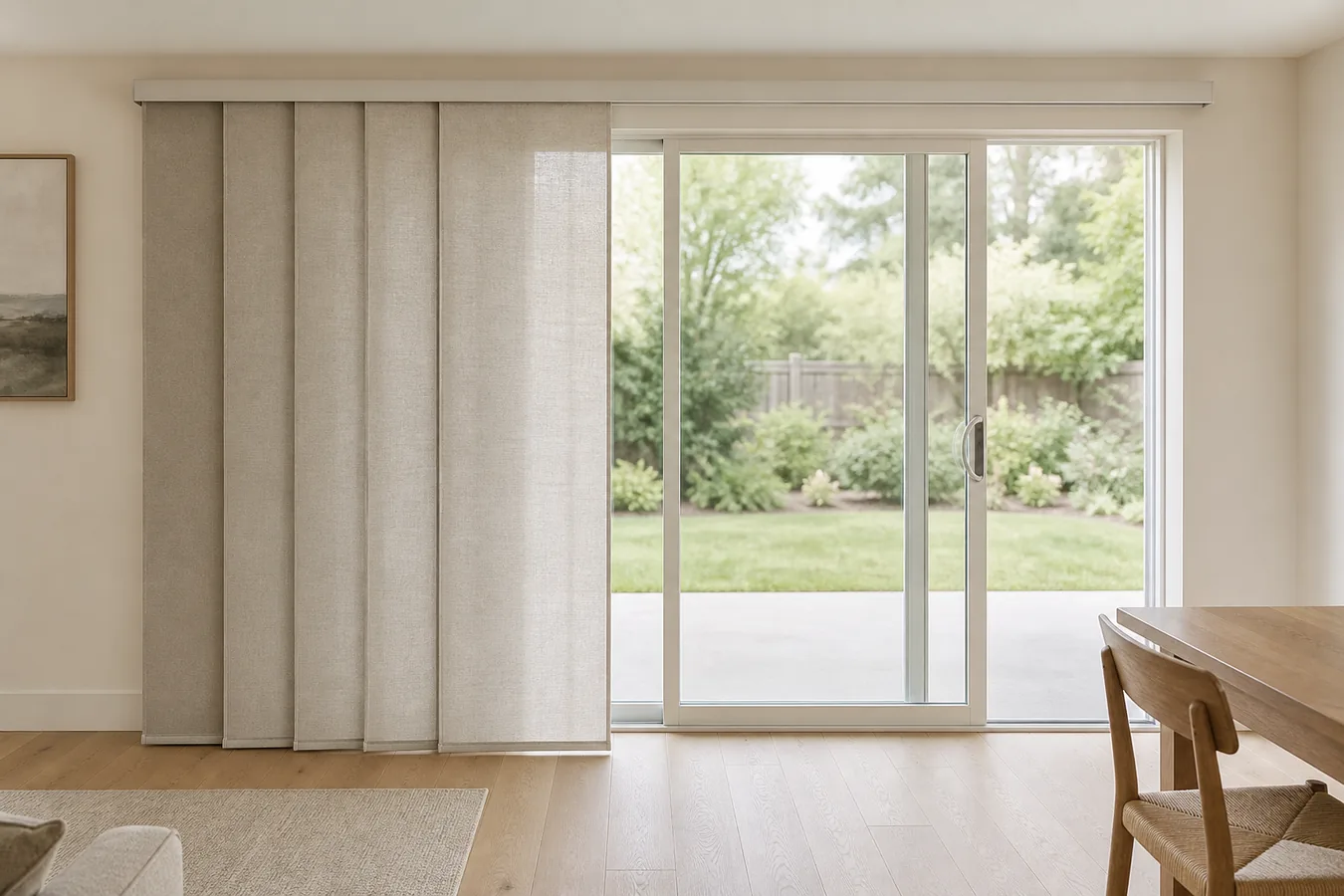
A picture window may require multiple shades because of fabric, tube or motor limits. A sliding door may need a side stack or independent passage panel. Splits create vertical gaps; stacks can block a valued view; grouped motors can stop at visibly different positions. Put these consequences on the floor plan before approving the architecture.
The large-opening shade planning guide covers passage, splits, stack, power and service in detail. In the living room, carry its result back to every overlay: does the door still open during daylight, does a center split reflect beside the television, and does the night scene cover the traffic path?
The border of the treatment is part of every scene
Use the Smart Shade Measurement and Compatibility Checker to record opening dimensions, usable depth, trim, handles, locks, cranks, screens and obstructions. Then use the inside-versus-outside mount guide to compare recess, overlap and projection.
Ask for the actual fabric or slat coverage, side and inter-panel gaps, headrail/cassette projection, raised stack, bottom position and removal direction. Sketch those values rather than only the nominal opening. A narrow uncovered strip can recreate the television glare line or expose the sofa at night; a deep cassette can block a tilt-in sash; a low stack can reduce the very view that justified the picture window.
Layering should have two named jobs
A layered system is justified when each layer owns a different overlay. For example, a solar or light-filtering layer may handle the daylight and screen sheets, while an opaque layer handles night privacy and movie darkness. If both layers perform the same vague task, the extra depth, hardware, controls and service may not be worthwhile.
Verify both layers alone, both raised, both closed and every transition. Check that one bottom rail does not trap the other, that gaps do not align badly, and that the window or door still operates. If thermal performance is part of the purchase, use exact product ratings and applicable conditions. The U.S. Department of Energy’s cellular-shade research summary is useful evidence that fit and operating state matter, but its study results are not a promise for an arbitrary product or home.
Automation is valuable when scenes really change
Name the positions by outcome—daylight conversation, west-screen glare, evening privacy, movie and away—rather than by unexplained percentages. Decide which windows belong in each group and which must remain independent for door access or an occupant’s preference.
Current named systems demonstrate that scenes and schedules can exist. Hunter Douglas documents preset/custom scenes, schedules, remotes and gateway-based functions for compatible PowerView products. Lutron documents app, Pico remote and scene/group paths for named Serena/Caséta configurations, including local remote behavior under described conditions. Verify the exact quoted combination rather than transferring either behavior to another motor.
At a representative group, call each scene from several starting positions. Check whether gaps, alignment and the useful glare angle remain acceptable. Disable the app or internet path and prove that a local control can still reach the privacy state. Then rehearse charging, battery replacement, reset and shade removal from a safe position.
Add safety to the completed elevation
Living rooms often put window coverings near sofas, play areas and climbing furniture. Inspect the delivered operating system and all accessible loops or inner cords rather than assuming a motor label completes the safety review. The U.S. Consumer Product Safety Commission advises that cordless coverings are the safest choice where young children are present.
Also preserve required door operation and clear travel paths. Structural anchoring, electrical work and egress requirements belong to the product instructions and qualified professionals where applicable; the scene plan should expose those dependencies, not pretend to approve them.
Finish with one demanding group
Select the group with the harshest screen reflection, most sensitive exterior view, largest opening or busiest door. Confirm the delivered fabric/slat identity and hardware. Measure actual coverage and stack. Then run daylight, TV/movie, night and away exactly as drawn, including the external observations and local-control failure case.
Record which overlay passed, which compromise was accepted and which openings are genuinely similar enough to copy. Do not scale while the exact material is missing, a night threshold rests on daytime appearance, a screen reflection was never observed at its critical hour, door passage or stack is unresolved, or the only path to privacy depends on an unverified app.
A strong living-room plan turns ordinary activities into predictable shade positions: comfortable daylight, a clear screen, real night privacy, and a dependable away state. The system is ready when people can reach those states even if the app or internet is unavailable.